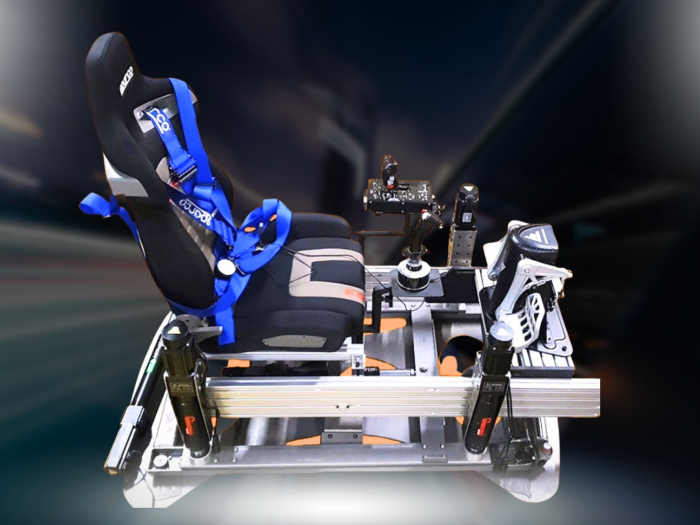

The difference between a fast lap and a podium finish isn't found in your monitor's refresh rate; it's found in the precise moment your inner ear registers a loss of traction. You've likely felt the frustration of a static rig where your eyes see a slide that your body fails to feel until you're already in the gravel trap. It's a common hurdle for drivers who find that immersion-breaking lag or a lack of physical feedback ruins their competitive edge. Deciding on a 6 DOF vs 3DOF simulator is the most critical hardware choice you'll face when building a professional-grade cockpit in 2026.
This article clarifies the technical and sensory differences between these systems to help you determine which motion platform will best transform your home sim racing experience. We'll break down how specific axes like heave and surge affect your driving feel, whilst providing the confidence you need to choose a platform that fits your space and improves your lap time consistency. By bridging the gap between digital telemetry and physical sensation, you'll finally understand how to select the ultimate foundation for your virtual racing career.
Key Takeaways
- Decode the physics of motion by distinguishing between rotational movements and the vital translational forces of heave, surge, and sway.
- Compare the 6 DOF vs 3DOF simulator to determine if full six-axis movement is the necessary next step for your specific racing discipline.
- Understand how twin traction loss technology translates digital telemetry into the physical sensations required to maintain perfect car control.
- Explore how ultra-low profile engineering solves the common space and stability challenges associated with high-end motion rigs.
- Learn how to synchronise your motion platform with VR hardware to eliminate sensory mismatch and achieve professional-grade immersion.
Understanding Degrees of Freedom: The Foundation of Sim Racing Realism
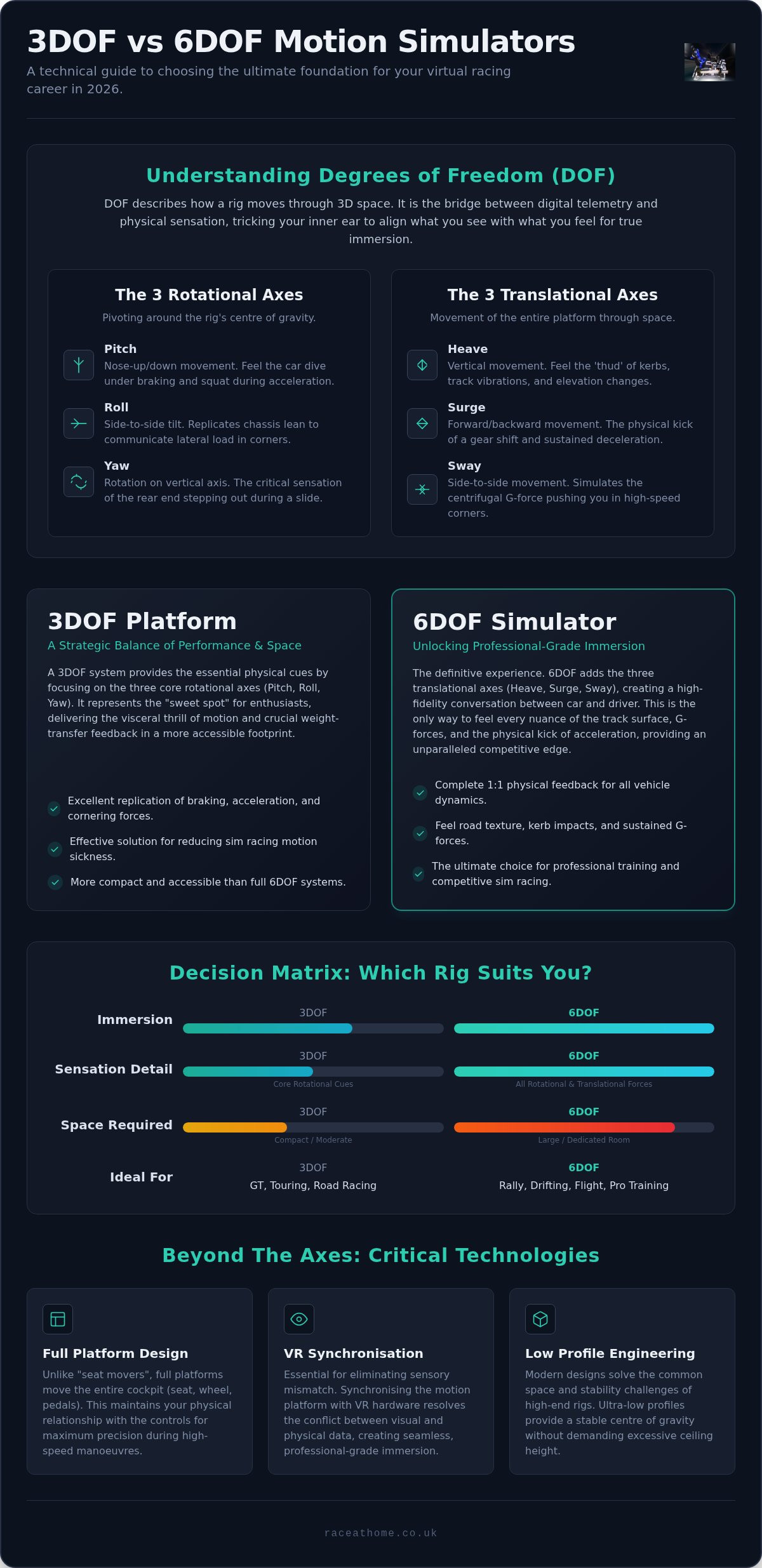
Degrees of Freedom are the fundamental building blocks of virtual realism. In mechanical engineering, Six degrees of freedom (6DOF) describes the specific ways a rigid body can move through three-dimensional space. When you're comparing a 6 DOF vs 3DOF simulator, you aren't just counting motors. You're deciding how many layers of physical information your brain receives whilst you're on the limit. It's the difference between a rough approximation of speed and a nuanced, high-fidelity conversation between the car and your senses.
The process relies on telemetry translation. Your sim software generates a constant stream of physics data, measuring everything from suspension travel to tyre slip. High-end actuators then convert this digital noise into tactile feedback. This physical output tricks your inner ear, aligning what you see on screen with what your body feels in the cockpit. Without this synchronisation, the brain quickly identifies the experience as fake, leading to the immersion-breaking lag often found in lower-end setups.
The Three Rotational Axes
Rotational movements are the most common in the sim racing world. They describe how the chassis pivots around its centre of gravity:
- Pitch: This is the nose-up and nose-down movement. It's essential for feeling the car "dive" under heavy braking or "squat" during aggressive acceleration.
- Roll: Side-to-side tilt. This replicates the chassis leaning into a corner, giving you immediate feedback on how much lateral load you're carrying.
- Yaw: The rotation of the car around its vertical axis. If your rear tyres lose grip, yaw is the sensation that tells you the back end is stepping out before your eyes even see the slide.
The Three Translational Axes
Translational axes represent the platform actually moving through space, rather than just tilting. These are the missing links that often define the choice between a 6 DOF vs 3DOF simulator:
- Heave: Vertical displacement. This isn't just for jumps; it's for the micro-vibrations of the track surface, the "thud" of a kerb, and the compression felt in a dip.
- Surge: Longitudinal movement. It provides the physical "kick" of a gear shift and the sustained pressure of deceleration that keeps you braced against your harness.
- Sway: Lateral movement. Unlike roll, which is a tilt, sway is the entire platform shifting sideways. It simulates the centrifugal force that pushes you towards the outside of a high-speed bend, providing a more authentic sense of "G-force."
The 3DOF Motion Platform: A Strategic Balance of Performance and Space
Choosing between a 6 DOF vs 3DOF simulator often begins with a pragmatic assessment of floor space and budget. A 3DOF platform typically focuses on the core rotational movements of pitch and roll, supplemented by a third axis, usually heave for vertical road texture or yaw for rear-end rotation. For many enthusiasts, this represents the "sweet spot" where the visceral thrill of motion meets a more accessible entry point. It provides the essential physical cues that tell your body what the car is doing without requiring the footprint of a full-scale professional rig.
The architecture of these rigs generally falls into two categories: seat movers and full platforms. Seat movers are compact and cost-effective, but they can create a sensory disconnect because the steering wheel and pedals remain stationary whilst your body moves. Full platforms, like the LowSlider 3DoF motion platform, move the entire cockpit. This ensures your physical relationship with the controls remains constant, which is vital for maintaining precision during high-speed manoeuvres. If you're building your first serious rig, the full platform approach offers a much higher ceiling for skill development.
What 3DOF Does Well
A well-engineered 3DOF system excels at replicating the fundamental weight transfer of a race car. As you brake into a hairpin, the pitch axis provides that essential forward dive, whilst roll simulates the chassis leaning into the apex. This level of feedback is often the most effective motion sickness sim racing solution. By providing physical cues that match the visual data from your monitors or VR headset, it resolves the sensory conflict that leads to nausea. It's a superb choice for flight simulation or casual GT3 racing where the extreme nuances of tyre slip are less critical than general immersion.
The Competitive Disadvantage of 3DOF
Whilst 3DOF is a transformative upgrade over a static rig, it leaves a physiological gap in your driving data. The primary limitation is the lack of translational sway and surge. In a real car, cornering forces don't just tilt you; they push your entire body laterally. Without these sensations, your brain has to work harder to interpret the car's behaviour. Academic research on motion simulation fidelity confirms that as the degrees of freedom increase, the cognitive load on the driver decreases. When weighing up a 6 DOF vs 3DOF simulator, you must consider if you can afford to miss the sharp "kick" of a surge force during a rapid downshift or the subtle sway of centrifugal force. If you're looking to eliminate these gaps, exploring the Race@Home range can help you decide if a more advanced platform is the key to your next tenth of a second.
The 6 DOF Motion Simulator: Unlocking Professional-Grade Immersion
If a 3DOF system introduces you to the world of motion, a 6 DOF platform allows you to inhabit it entirely. Transitioning to a full six-axis setup isn't merely an incremental upgrade; it's a fundamental shift in how your body processes digital physics. By providing simultaneous movement across every possible plane, these rigs eliminate the "washout" effect common in lesser systems. Washout occurs when an actuator reaches its physical limit and must return to centre, often creating a jarring sensation that reminds you you're in a room rather than on a track. In a 6 DOF vs 3DOF simulator comparison, the superior headroom of a six-axis platform ensures that motion cues remain fluid and uninterrupted, even during sustained high-G manoeuvres.
This level of fidelity has established 6 DOF as the definitive gold standard for professional sim racing simulators. It creates a seamless sensory loop where every twitch of the steering wheel results in an immediate, accurate physical response. You stop reacting to what you see on the screen and start pre-empting the car's behaviour based on the pressure in your seat and the vibrations in your feet.
The Power of Translational Feedback
The true magic of 6 DOF lies in translational movement: surge, sway, and heave. Surge provides the longitudinal force that pins you to your seat during a launch or throws you forward during heavy braking. Sway represents lateral displacement; it's the sensation of the entire chassis shifting sideways as you navigate a high-speed chicane. Whilst a 3DOF rig might use a vibration motor to simulate road surface, a 6 DOF platform uses actual heave to replicate the vertical travel of the suspension. You'll feel the difference between a minor ripple in the tarmac and the aggressive compression of a kerb at the Apex of Eau Rouge. These "strafing" and "surging" movements create a genuine sense of velocity that rotational tilt alone cannot achieve.
Why Traction Loss Changes Everything
The most critical advantage for competitive drivers is the integration of twin traction loss motion platforms. In a 6 DOF environment, the simulator can slide laterally to mimic the exact moment your rear tyres lose grip. This physical cue is instantaneous. It reaches your brain milliseconds before the visual data on your monitor changes, allowing you to catch a slide with instinctive muscle memory rather than conscious correction. Feeling the rear end break loose isn't just about the thrill; it's about consistency. When you can physically sense the limit of adhesion, you can push the car harder, lap after lap, without fear of an unrecoverable spin.
Decision Matrix: Which Motion Rig Suits Your Racing Style?
Selecting the right platform requires an honest look at your primary racing discipline and long-term ambitions. Whilst an entry-level 3DOF rig offers a significant jump from static racing, the 6 DOF vs 3DOF simulator debate usually ends with a "buy once, cry once" philosophy for those chasing professional-grade realism. It's a serious investment. It pays off in lap times and long-term satisfaction. Your choice should reflect not just where you race today, but where you intend to be in two years' time.
Choosing for Discipline
Space and Infrastructure Logistics
Many drivers hesitate to upgrade due to the perceived physical footprint. We should debunk the myth that a 6 DOF rig requires a dedicated garage or industrial power supply. Modern engineering has streamlined these systems significantly. Our LowSlider range maintains an ultra-low profile that fits comfortably within most home offices whilst using premium PT Actuators to ensure noise levels remain surprisingly quiet. You won't need to reinforce your floors or install three-phase power; most high-end systems now run off standard household sockets.
If you're planning a Pimax VR motion simulator setup, the 6 DOF platform becomes even more vital. VR demands perfect alignment between your visual field and your vestibular system to prevent nausea. A 3DOF system can sometimes leave a "sensory gap" that leads to discomfort during high-speed cornering. Before you commit, check your existing sim rig motion platform compatibility to ensure your chassis can handle the torque and rapid direction changes of a full six-axis system. Ready to bridge the gap between digital data and physical sensation? Build your ultimate cockpit today by exploring the Race@Home motion platform range.
Beyond the Axes: Why the LowSlider Design Redefines Motion Simulators
Traditionally, deciding on a 6 DOF vs 3DOF simulator meant choosing between a compact home rig and a massive, industrial-looking cage. The Race@Home LowSlider philosophy shatters this compromise. By delivering full six-axis movement within a compact motion simulator platform, we've brought commercial-grade physics into the home environment without the need for a dedicated warehouse or a specialised engineering team. It's a no-compromise approach to realism that fits your lifestyle as well as it fits your lap times.
Our design prioritises an ultra-low profile for several critical engineering reasons. A lower centre of gravity significantly increases platform stability, ensuring that the high-torque forces generated by the actuators are translated directly to the driver's body rather than being lost to chassis flex. This design also makes entry and exit as effortless as stepping into a real GT3 car. Each platform is hand-built in the UK, reflecting a level of craftsmanship and dedication to engineering authority that mass-produced alternatives amongst the market simply cannot match.
Engineering for the Home Environment
The LowSlider manages to deliver professional-grade forces whilst remaining remarkably quiet. This is achieved through the use of premium PT Actuators, which provide silent, precise, and high-frequency feedback. You'll feel the most minute road textures and tyre vibrations without disturbing the rest of your household. Because the system is designed with a minimal footprint, it fits comfortably into standard rooms where other 6 DOF rigs would be physically impossible to install. We also provide extensive customisation options for sim racing accessories, ensuring your setup is perfectly tailored to your competitive needs.
The Race@Home Ownership Experience
We believe that the world's most complex sim racing hardware shouldn't require a degree in mechanical engineering to assemble. That's why we ship our platforms worldwide in four easy-to-manage pieces. Our "One-Hour Assembly" promise is a core part of the ownership experience. You won't spend days deciphering manuals or hunting for obscure tools. Instead, you'll be on the starting grid within sixty minutes of opening the crates. If you require assistance, our UK-based expert support team provides direct guidance for both physical setup and software integration. Ready to transform your racing? Explore the LowSlider 6 DOF Motion Platform and experience the ultimate evolution of the hobby.
Elevate Your Sim Racing to the Professional Standard
The choice between a 6 DOF vs 3DOF simulator ultimately defines the ceiling of your virtual driving career. Whilst a 3DOF setup offers a visceral leap from static rigs, only a full 6 DOF platform provides the translational data and twin traction loss required to truly master the limit of adhesion. It isn't just about the thrill; it's about developing the instinctive muscle memory that separates the top split from the rest of the pack. By bridging the gap between digital telemetry and physical sensation, you eliminate the cognitive load that slows your reactions.
Our proprietary LowSlider design ensures that this professional-grade immersion fits seamlessly into your home environment. Each rig is hand-built to order in the UK, featuring an ultra-low profile that prioritises stability and precision. It's why our hardware is trusted by professional drivers worldwide who refuse to compromise on their training fidelity. Whether you're navigating a high-speed chicane or catching snap oversteer on a rally stage, the right motion platform ensures your body and brain are in perfect synchronisation.
Invest in Professional Realism: View the LowSlider 6 DOF Platform
Your journey toward total immersion starts with the right foundation. We look forward to seeing you on the podium.
Frequently Asked Questions
What is the main difference between 3DOF and 6 DOF sim racing?
The primary difference lies in the translational axes: surge, sway, and heave. Whilst a 3DOF rig typically handles rotational movements like pitch and roll, a 6 DOF vs 3DOF simulator comparison reveals that only the six-axis platform provides the "strafing" and "shunting" movements. These are essential for feeling centrifugal forces and longitudinal acceleration, providing a complete spatial representation of the car's behaviour.
Do I need a 6 DOF simulator for iRacing or Assetto Corsa?
Whilst iRacing and Assetto Corsa function perfectly on 3DOF rigs, a 6 DOF platform is required to extract the full depth of their physics engines. The added sway and surge data allow you to feel the limit of the tyres more accurately. This is particularly beneficial in competitive racing where identifying the exact moment of traction loss is the difference between a save and a spin.
Can a 6 DOF motion platform fit in a standard-sized room?
Absolutely. The proprietary LowSlider design is engineered specifically to provide a full 6 DOF experience within a standard room's footprint. By utilising an ultra-low profile, these rigs avoid the bulky overhead structures seen in older commercial simulators. You won't need to sacrifice your home office or spare bedroom to achieve professional-grade immersion without compromising on floor space.
Is a 6 DOF simulator harder to set up than a 3DOF rig?
Modern engineering has simplified the process significantly. Our platforms ship in four pre-assembled sections, allowing for a one-hour assembly time. Whilst a 6 DOF system involves more actuators than a 3DOF rig, the software integration is equally straightforward. Most popular sim titles are "plug-and-play" with our UK-based support team available to guide you through the initial telemetry calibration.
Does 6 DOF motion really improve your lap times?
Motion platforms improve lap times by increasing your consistency and reducing reaction times. By feeling the car's weight transfer and rear-end slip through your body, you can make micro-corrections milliseconds before your eyes register the movement on screen. This sensory advantage leads to fewer mistakes and a more confident approach to aggressive cornering during long endurance stints.
How much power does a 6 DOF motion platform consume?
Modern high-performance systems are surprisingly efficient. Most home rigs, including those using premium PT Actuators, run comfortably off standard household wall sockets without the need for dedicated circuits or industrial power. Power draw fluctuates based on the intensity of the motion, but it's comparable to running a high-end gaming PC and remains manageable for daily home use.
Can I upgrade a 3DOF system to a 6 DOF later?
Upgrading depends entirely on the chassis architecture you start with. Some modular systems allow you to add actuators over time, but for the highest level of stability, a dedicated 6 DOF vs 3DOF simulator design is often preferable. Starting with a 6 DOF-ready frame ensures that the geometry is optimised for the specific stresses of six-axis movement from the outset.
Is motion sickness worse on 6 DOF or 3DOF simulators?
Motion sickness is generally less prevalent on 6 DOF systems. Nausea in sim racing is usually caused by a sensory mismatch where your eyes see movement that your body doesn't feel. Because a 6 DOF platform provides more accurate physical cues that match the visual data, it helps the brain synchronise the experience more effectively, leading to a much more comfortable session.


