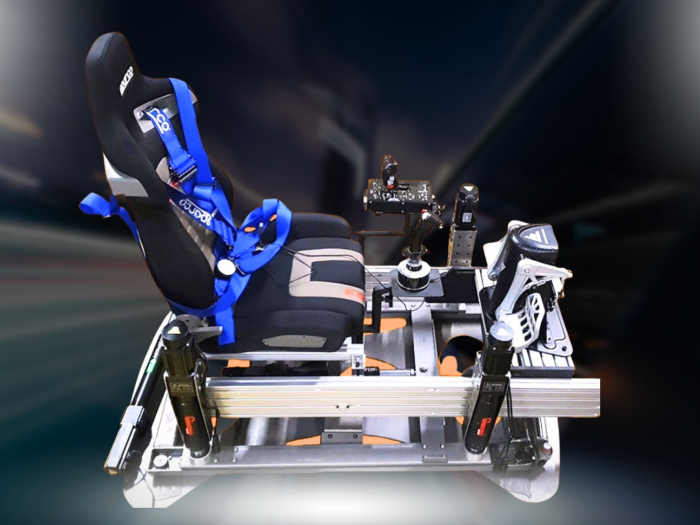

A racing simulator is no longer a luxury for the off-season; it is a critical engineering requirement for the modern paddock. Choosing the right motion simulator for racing team operations can be the difference between a podium finish and a wasted weekend of expensive track testing. You already know that every hour spent on track costs a fortune in tyres, fuel, and logistics, whilst the frustration of a simulator that feels like a toy often makes virtual testing feel like a compromise. If the steering rack doesn't communicate the scrub of the front tyres or the seat doesn't telegraph the loss of rear traction, your drivers aren't building muscle memory; they're just playing a game.
This guide explores how high-end 6 DOF motion platforms transform team performance by translating raw telemetry into precise sensory feedback that actually matches the car's behaviour. We will examine the mechanics of twin-traction-loss technology, the importance of reliable data correlation, and how to fit a professional-grade rig into the limited space of a race trailer or workshop. By the end, you'll understand how to bridge the gap between digital data and physical sensation to reduce lap times and maximise every minute of your testing programme.
Key Takeaways
- Learn how to transition from basic virtual practice to a professional driver development programme that significantly reduces the overhead of physical track days.
- Understand why a 6 DOF motion simulator for racing team use must include Twin-Traction-Loss to accurately communicate the limit of tyre adhesion.
- Discover how the ultra-low profile LowSlider design allows for professional-grade motion in workshops or trailers with restricted ceiling heights.
- Explore the synergy between wide field-of-view Pimax VR headsets and real-time telemetry to sharpen driver depth perception and reaction times.
- Recognise the benefits of bespoke, hand-built UK engineering over off-the-shelf solutions for maintaining long-term reliability and precise data correlation.
The Role of Motion Simulators in Modern Racing Team Strategy
The 2026 racing landscape has undergone a fundamental shift. What was once dismissed as a high-end gaming peripheral has evolved into a mandatory engineering tool. For a professional outfit, a motion simulator for racing team use is now a precision instrument, designed to bridge the gap between digital telemetry and physical reality. Whilst static rigs provide visual and auditory cues, they fail to replicate the visceral sensations of weight transfer and tyre slip that a driver relies on to find the final tenth of a second. Relying on visuals alone leaves a driver blind to the subtle chassis movements that precede a spin or a lock-up.
A sophisticated Motion simulator provides the 6 degrees of freedom (DOF) necessary to replicate the pitch, roll, and yaw of a chassis under load. This isn't just about immersion; it's about accuracy. If a driver cannot feel the rear end stepping out through their hips, they cannot react with the subconscious speed required at the limit of adhesion. Bespoke engineering, such as the UK-built LowSlider platforms, ensures that these movements are translated without the latency or mechanical "noise" often found in entry-level hardware. In high-stakes competitive environments, these tactile details are what allow a team to refine their strategy before the car even leaves the workshop.
Maximising Driver Coaching Workflows
Coaches often struggle to explain the subtle nuances of weight transfer through video analysis alone. With a high-fidelity motion simulator for racing team training, a coach can observe a driver's physical inputs and reactions in real-time. If a driver is over-driving the front tyres or failing to settle the car after a kerb strike, the motion platform makes these errors tangible. By integrating telemetry software like MoTeC or Assetto Corsa Competizione, teams can overlay sim data directly against track data. This creates a closed-loop feedback system where every virtual lap informs real-world setup changes, ensuring the driver arrives at the circuit already "in the zone".
Just as precision in data analysis is vital for racing success, other technical sectors require similar levels of hardware reliability; you can discover Dextro Imaging Solutions to see how high-performance workstations facilitate critical diagnostic imaging.
The ROI of High-Fidelity Simulation
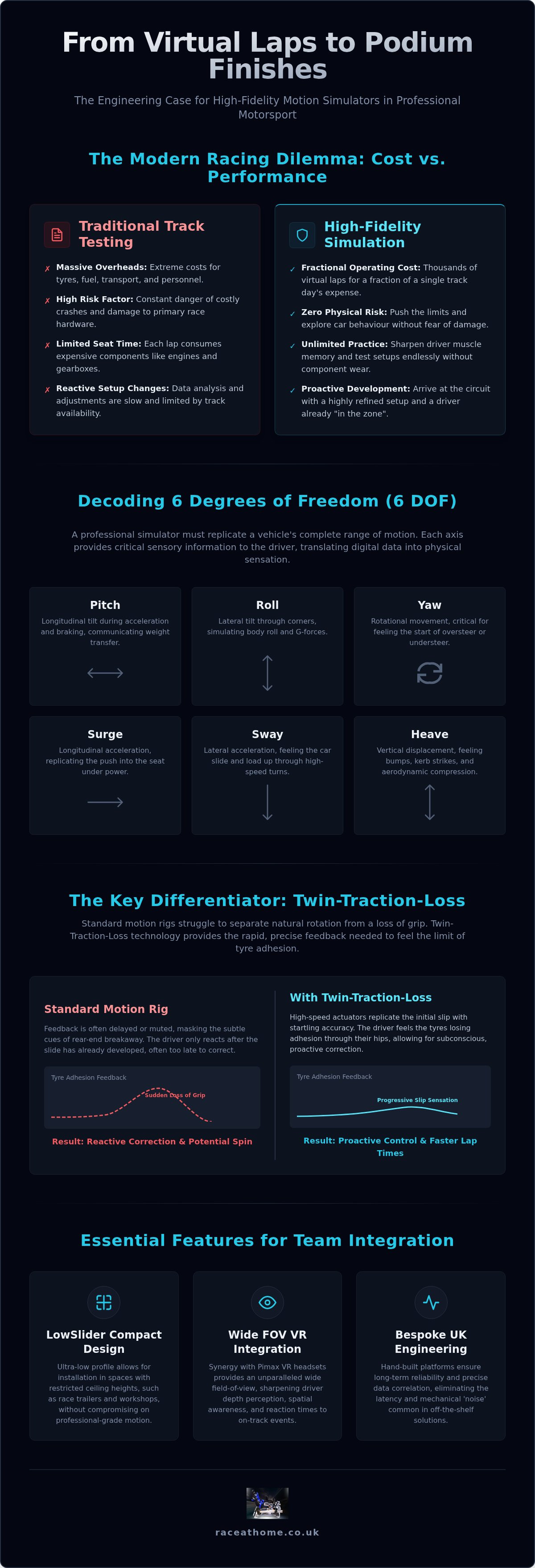
The financial argument for simulation is undeniable. A single track day involves massive outlays for tyres, brake pads, fuel, and transport, not to mention the inherent risk of a heavy crash. In contrast, a motion rig allows for thousands of laps at a fraction of the operating cost. It preserves the lifespan of primary race engines and gearboxes whilst keeping the driver's muscle memory sharp during the off-season. High-fidelity motion simulation delivers a superior performance-per-pound advantage by converting every hour of virtual seat time into measurable lap-time gains on the physical circuit.
Decoding 6 Degrees of Freedom: Why Teams Require Twin-Traction-Loss
For an engineer, the phrase "6 Degrees of Freedom" (6 DOF) isn't marketing fluff; it's a mathematical description of a body's movement in three-dimensional space. A professional motion simulator for racing team use must account for heave (vertical displacement), pitch (longitudinal tilt during braking or acceleration), roll (lateral tilt through corners), yaw (rotation), surge (longitudinal acceleration), and sway (lateral acceleration). Without all six, the simulation is incomplete. If your rig lacks surge, your driver won't feel the weight shift forward under heavy braking. If it lacks sway, they won't feel the lateral load building through a high-speed sweeper. These physical cues are the primary language of racing.
The true challenge for any motion simulator for racing team setup is replicating the "feel" of the car at the limit of adhesion. This is where Twin-Traction-Loss becomes essential. Standard motion rigs often struggle to differentiate between a car that is rotating naturally and one that is sliding. By utilising high-speed actuators, the LowSlider 6 DOF platform provides the rapid response times required to catch a slide before it becomes a spin. It replicates rear-end break-away with startling accuracy, allowing drivers to develop the subconscious corrections needed for wet-weather racing or qualifying laps on the ragged edge.
Surge and Sway: Replicating G-Force Sensations
Surge and sway are the primary drivers of physical realism in a cockpit. Surge replicates the push into the seat during acceleration and the pull against the harness during braking. Sway simulates the lateral forces that pin a driver against the side bolsters. When these movements are delivered with zero latency via PT Actuator technology, it significantly reduces the driver's cognitive load. Instead of mentally calculating the braking point based on visual markers alone, the driver feels the deceleration through their body. Research into Data Synchronisation and VR suggests that this haptic alignment is critical for preventing simulator sickness and improving reaction times amongst professional athletes.
Traction Loss vs. Twin-Traction-Loss
Whilst many rigs offer "traction loss" (simple rear-end yaw), professional teams require the independent front and rear slip simulation provided by Twin-Traction-Loss. This allows engineers to test aero-balance and mechanical grip setup changes with far greater precision. If you change the wing angle or soften the rear springs, the driver can feel exactly how that affects the break-away behaviour of the car. For a deeper technical dive into these specs, see our guide on Twin Traction Loss: The Secret to Realistic Sim Racing.
Investing in a bespoke motion platform ensures your drivers are training with the most accurate tactile data available, turning every virtual session into a genuine performance advantage.
Case Study: Maximising Paddock and Workshop Space with Low-Profile Rigs
Space in a race trailer or a busy workshop is always at a premium. Traditional hydraulic towers often require high ceilings and massive floor areas, making them impossible to integrate into a standard paddock setup. This is where the LowSlider design changes the game for a motion simulator for racing team. It provides full 6 DOF movement whilst keeping the centre of gravity low and the footprint compact. You don't need a dedicated aircraft hangar to house your simulation department; you just need a well-engineered platform that respects the reality of racing logistics.
The logistics of the "Four-Piece" assembly are designed for speed. The platform arrives in easy-to-handle sections that allow a team to move from an initial crate to a fully operational cockpit in under 60 minutes. This efficiency is critical for teams operating at international circuits where every minute of preparation time is accounted for. Scientific analysis in The Role of Motion Simulators in Modern Racing Team Strategy highlights that professional drivers extract performance through consistent, high-fidelity sensory input. Achieving this without the bulk of a full-car replica allows teams to maintain a professional, high-tech aesthetic even within restricted spaces.
The LowSlider Footprint Advantage
When comparing square footage, the LowSlider requires significantly less room than traditional hydraulic tower systems. Because the actuators are integrated into the base rather than mounted on external pillars, the rig occupies the same footprint as most static professional cockpits. This compact nature makes it easy to integrate into existing workshops alongside the physical race cars. For teams that travel, the ability to pack a high-end motion simulator for racing team into a standard flight case is a massive logistical win that reduces transport overheads and simplifies setup in temporary paddock structures.
Durability and Maintenance in Professional Use
Professional racing environments are notoriously harsh on equipment. Bespoke UK manufacturing ensures that every frame is built to withstand the constant vibrations and high-torque forces of a 6 DOF system. We utilise PT Actuator technology because it offers the reliability required for high-usage environments, ensuring that your drivers aren't sitting idle due to hardware failure. The modular design also simplifies team maintenance. If a component needs attention, the self-serviceable nature of the rig means your own mechanics can handle the majority of adjustments without waiting for an external engineer, keeping your training programme on track.
Data Synchronisation and VR: Optimising Driver Coaching
The effectiveness of a motion simulator for racing team coaching relies on the perfect synchronisation of visual and physical data. When a driver enters a corner, their brain expects a specific set of physical sensations to match what their eyes see. In static simulators, this disconnect often leads to motion sickness as the inner ear detects a lack of movement whilst the eyes perceive high-speed motion. A 6 DOF platform eliminates this conflict by aligning the vestibular system with the virtual environment. This physical alignment allows drivers to train for hours without fatigue, ensuring that virtual seat time translates directly to better performance on the physical circuit.
By integrating motion with virtual reality, you create a training environment where the driver can judge distances and speeds with millimetre precision. This isn't just about making the experience "feel" real; it's about providing the brain with the data it needs to make split-second decisions. If the motion is out of sync by even a few milliseconds, the training value is lost. Professional systems prioritise low-latency signal processing to ensure that every bump on the track surface is felt at the exact moment it's seen.
Visual Fidelity with Pimax VR
Professional drivers don't just look at the road; they hunt for the apex. Pimax VR headsets have become the industry standard for elite teams because they offer the ultra-high resolution and wide field-of-view (FOV) necessary for natural situational awareness. In a standard headset with a narrow FOV, a driver has to move their entire head to check their mirrors or spot a rival on their quarter. With Pimax, they can use their peripheral vision just as they would in a real GT3 or formula car. This increased visual range reduces eye strain during long-duration endurance training sessions and allows for much higher precision during corner entry and side-by-side racing.
Telemetry and Motion Mapping
To get the most out of a motion simulator for racing team operations, the motion profile must be bespoke to the car's chassis characteristics. You can't use the same heave and pitch settings for a softly-sprung GT car as you would for a high-downforce prototype. Modern software allows teams to export sim data directly into professional analysis tools like MoTeC. This enables coaches to see exactly how the driver is reacting to track surface changes, such as kerbs, bumps, and elevation shifts. For more detailed advice on integrating these systems into your team's daily operations, see our Commercial Motion Simulator: 2026 Driver Training Guide.
By mapping the haptic feedback to match real-world telemetry, you create a training environment where every vibration tells a story about the car's balance. Ready to upgrade your team's training capabilities? Explore our range of Pimax VR headsets and motion accessories to complete your professional setup.
Investing in Bespoke Engineering: The Race@Home Advantage
Mass-market bundles often fail because they prioritise profit margins over the surgical precision required by professional engineers. A motion simulator for racing team use is a long-term investment in driver performance, not a temporary distraction. Off-the-shelf solutions frequently suffer from flex in the chassis or latency in the electronics; both of which degrade the quality of the sim-to-reality translation. By choosing a bespoke approach, you ensure that every component is selected to meet the specific demands of high-stakes competition. It's about building a precision instrument that behaves exactly like the car on the circuit.
Hand-Built Precision from the UK
Every LowSlider platform is hand-built to order in our UK workshop. This allows us to maintain rigorous quality control standards for every weld and actuator mount. We partner with PT Actuator to provide commercial-grade movement that doesn't fade during back-to-back testing sessions. This direct-to-manufacturer relationship means you get expert support from the people who actually designed the hardware. Whether you need custom mounting for high-torque direct-drive bases or specific team branding, our engineering team can accommodate the unique requirements of your organisation.
Global logistics are a core part of our service. We understand that racing is a worldwide endeavour. Our platforms are professionally crated and shipped in modular sections to ensure they arrive in perfect condition, whether they're heading to a workshop in Silverstone or a facility in Abu Dhabi. This modularity also makes the system future-proof. As new sim racing accessories or VR technologies emerge, your rig can be easily upgraded without needing a complete chassis replacement. You aren't just buying a rig; you're investing in a platform that evolves with your team.
Getting Started with Your Team's Simulator
The procurement process is straightforward and consultative. We begin by discussing your specific goals, from reducing track-day costs to refining aero-balance setups. Once the specification is finalised, your bespoke 6 DOF platform is built and dispatched. Because the LowSlider arrives in its signature four-piece assembly, your team can have the high-end motion simulator for racing team operational in under an hour. It's time to stop compromising on your virtual testing and start building real-world results through superior haptic engineering.
Enquire about a bespoke motion simulator for your racing team
Revolutionising Your Team's Testing Programme
The transition from visual-only simulation to a high-fidelity motion simulator for racing team operations is no longer optional for those chasing the podium. By integrating 6 DOF movement and proprietary Twin-Traction-Loss technology, you provide your drivers with the tactile reality they need to master the limit of adhesion. This isn't just about immersion; it's about reliable data correlation that translates directly to reduced lap times and preserved mechanical components. Every virtual session becomes a genuine engineering exercise that prepares the driver for the physical demands of the circuit.
Our LowSlider platforms are hand-built in the UK and trusted by professional drivers globally for their uncompromising precision and ultra-low profile. Whether you're optimising space in a race trailer or a dedicated workshop, this modular system ensures your organisation stays ahead of the curve in a rapidly evolving digital landscape. It's time to bridge the final gap between telemetry and sensory feedback with a rig that matches your competitive ambitions.
Upgrade your team's performance with a bespoke LowSlider 6 DOF platform and start turning virtual laps into real-world victories. The future of driver development is physical, precise, and ready for your next session.
Frequently Asked Questions
Why is a 6 DOF motion simulator better than a 3DOF for professional teams?
A 6 DOF motion simulator for racing team use is superior because it provides the full range of physical sensations required for accurate driver training. Whilst a 3DOF platform covers pitch, roll, and heave, it misses the critical surge and sway forces that define heavy braking and high-speed cornering. By adding these dimensions alongside yaw, drivers can feel the car's weight transfer and the exact moment the rear tyres lose grip.
Can the LowSlider platform be integrated with our existing telemetry software?
Yes, our platforms are designed to integrate seamlessly with the telemetry software your team already uses. The system correlates data from industry-standard tools like MoTeC, iRacing, and Assetto Corsa Competizione to ensure physical feedback matches the virtual car's behaviour. This allows your engineers to verify that setup changes are being accurately telegraphed to the driver through the haptic actuators.
How difficult is it to assemble a motion simulator for a racing team?
Assembling our professional rigs is a straightforward process that typically takes under 60 minutes. We ship the platform in four pre-assembled modular sections to simplify the logistics of a paddock or workshop setup. This design ensures that your team can move from unboxing to active driver coaching without the need for specialised engineering tools or lengthy downtime.
Does the motion platform help reduce simulator sickness for drivers?
A high-fidelity motion platform significantly reduces simulator sickness by aligning the driver's inner ear with what they see on screen. Simulator sickness is usually the result of a sensory disconnect where the brain perceives motion through the eyes but feels nothing in the vestibular system. By providing immediate, low-latency physical feedback, the rig eliminates this conflict and allows for longer, more productive training sessions.
What are the space requirements for a professional 6 DOF motion rig?
The LowSlider design is specifically engineered for facilities where space is at a premium, such as race trailers or compact workshops. Unlike traditional hydraulic towers that require significant ceiling height and floor area, this rig occupies a footprint similar to a standard static cockpit. Its ultra-low profile allows it to fit under restricted heights whilst still providing a full 6 DOF experience.
Is worldwide shipping available for commercial-grade motion platforms?
We provide worldwide shipping for every motion simulator for racing team order, utilising professional-grade crating to ensure safe delivery. Our logistics network handles global transport to ensure that teams based anywhere from the UK to the Middle East can access bespoke haptic technology. Each unit is packed to withstand the rigours of international transit and arrives ready for rapid assembly.
Can we use Pimax VR headsets with the LowSlider 6 DOF platform?
Pimax VR headsets are fully compatible and highly recommended for use with our 6 DOF platforms. The wide field-of-view and high resolution of Pimax hardware allow drivers to use their peripheral vision naturally, which is essential for spotting apexes and managing side-by-side racing. This combination of visual and physical fidelity creates the most accurate training environment available in 2026.
What kind of maintenance does a professional motion simulator require?
Maintenance requirements are minimal because we utilise industrial-grade PT Actuators designed for high-usage environments. Professional teams should perform occasional checks on mounting bolts and cable connections to ensure everything remains tight under the high-torque forces of the motion system. The modular design means that if any component does require attention, it can be serviced or replaced without dismantling the entire rig.


