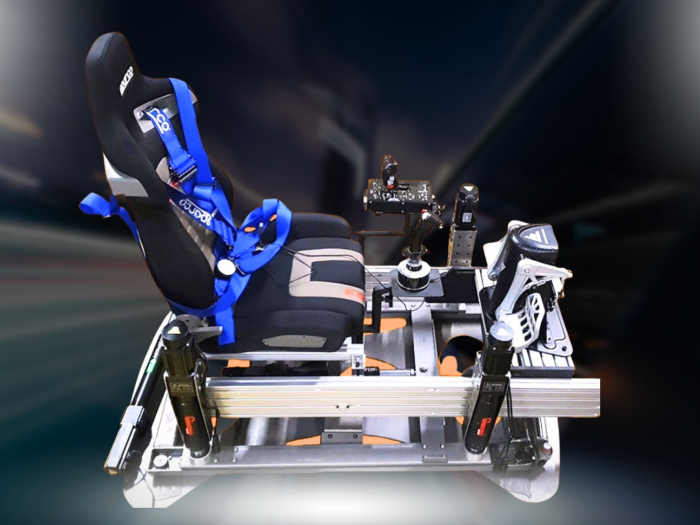

If your eyes see the apex but your body feels absolutely nothing, are you truly racing or are you simply managing a digital display? You've likely experienced that split-second delay where the rear end steps out and you don't realise it until you're already spinning towards a tyre wall. It's the most common frustration in high-end simulation. You have the direct-drive wheel and the load-cell pedals, yet you're still missing the "seat of the pants" feedback that defines real-world car control. This disconnect leads many enthusiasts to wonder if a sim racing motion rig is worth it in 2026 or if it's merely an expensive luxury.
We agree that a rig should be a tool for performance, not just a source of vibration. In this professional guide, you'll discover how the latest motion platforms translate raw telemetry into actionable driver intuition, allowing you to sense traction loss before it becomes a disaster. We'll examine how British engineering has finally addressed the historic pains of rig size and assembly complexity. By the end of this article, you'll know exactly how to achieve total immersion with a compact, reliable setup that fits your home environment whilst delivering professional-grade realism.
Key Takeaways
- Understand how high-fidelity motion platforms translate digital telemetry into physical "seat of the pants" sensations to help you catch slides before they happen.
- Evaluate the specific criteria that make a sim racing motion rig worth it for competitive enthusiasts, focusing on the return on investment for driver intuition.
- Decode the complexity of Degrees of Freedom (DOF) to choose a system that provides the precise pitch, roll, and traction loss feedback you require.
- Discover how ultra-low profile British engineering has solved the traditional barriers of space and complexity with rigs that assemble in under an hour.
- Learn why pairing motion with VR creates a superior sensory experience that can actually reduce nausea whilst providing total immersion.
Beyond the Gimmick: Does a Motion Rig Actually Improve Your Racing?
Many sceptics dismiss motion as a flashy addition for those with too much floor space. This is a profound mistake. A professional motion setup isn't about the spectacle; it's about the physical translation of digital telemetry into actionable sensory feedback. Whilst "seat movers" provide a basic level of vibration or tilt, a Full motion racing simulator moves the entire cockpit, mimicking the exact G-forces and weight shifts of a real vehicle. This distinction is vital when deciding if a sim racing motion rig worth it for your personal development.
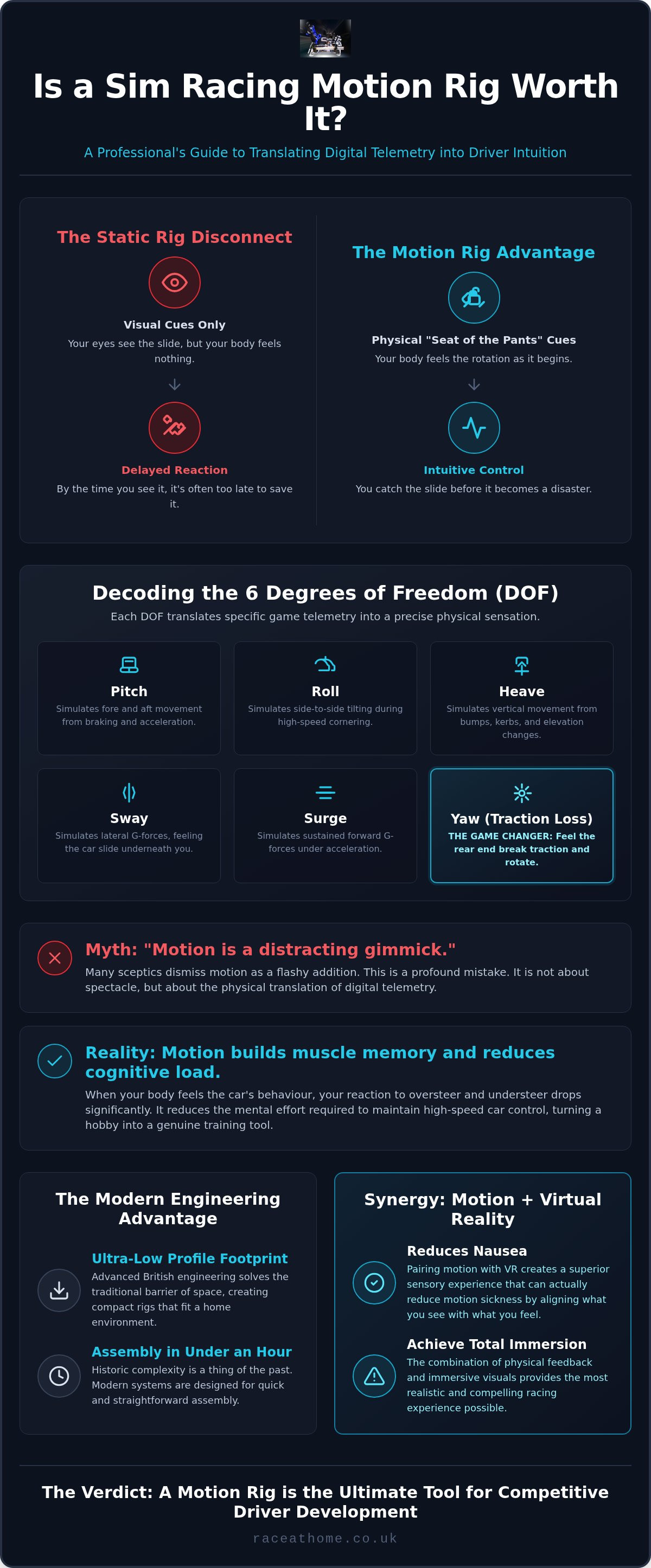
There's a persistent myth that motion makes you slower because it's "distracting". In reality, the opposite is true. When your inner ear and torso feel the car rotate before your eyes process the movement on screen, your reaction time to oversteer drops significantly. You aren't just reacting to a visual cue; you're feeling the "seat of the pants" sensation that professional drivers rely on to dance a car on the limit of adhesion. By the time you see a slide on a static monitor, it's often too late to save it. With motion, you catch the slide whilst it's still a suggestion from the rear tyres.
The Science of Telemetry and Physical Cues
Modern actuators are incredibly sophisticated, interpreting game data at high frequencies to simulate precise weight transfer during heavy braking or high-speed cornering. This low-latency feedback is the cornerstone of professional driver development, as it allows the brain to map physical sensations to specific car behaviours. If the front end washes out, you feel the lightness in the chassis immediately. By providing physical context to visual data, motion rigs significantly reduce the cognitive load required to maintain high-speed car control. This emphasis on the mind-body connection is a principle shared by elite training facilities such as The Athlete's Playground, which focus on honing the physical precision required for peak performance in any high-stakes environment.
Immersion vs. Competitive Advantage
The "fun factor" of motion is undeniable, but the technical benefits for muscle memory are where the real value lies. High-fidelity 6 DOF platforms provide the specific cues needed for advanced techniques like heel-and-toe shifting and trail braking, where the pitch of the car tells you exactly how much grip is left on the nose. This hardware works in perfect synergy with other sim racing accessories, specifically load-cell pedals. When you feel the nose dive under braking, your muscle memory naturally calibrates the pressure needed to avoid a lock-up. It's this holistic feedback loop that transforms a hobbyist setup into a genuine training tool, making a sim racing motion rig worth it for anyone serious about finding those final tenths of a second.
The 2026 Buyer’s Framework: Deciding Between 3DoF and 6 DOF
Choosing the right level of movement is a balance between your racing ambitions and your budget. In the world of simulation, we measure movement through "Degrees of Freedom" (DOF). Each degree represents a specific axis of motion that interprets game telemetry into a physical sensation. Research into the Training Effectiveness of Visual and Motion Simulation has long demonstrated that adding these physical dimensions significantly reduces the time it takes for a pilot or driver to reach peak proficiency. For the modern enthusiast, deciding if a sim racing motion rig worth it often comes down to how many of these axes you truly need to feel the car's limit.
The six core movements available in high-end rigs are Pitch, Roll, Heave, Yaw, Surge, and Sway. Pitch and Roll simulate the basic tilt of the car during braking and cornering, whilst Heave captures the vertical jolts of hitting a kerb or a dip in the tarmac. However, for those competing in GT3 or drifting disciplines, the addition of Yaw (Traction Loss) is the most critical factor. It provides the sideways rotation that tells your hips the rear tyres have broken traction. Without this specific feedback, you're essentially guessing the car's rotation until you see it on screen.
3DoF: The Entry Point to Realism
A 3DoF system typically covers Pitch, Roll, and Heave. This configuration is a massive leap over a static rig, providing the essential weight transfer cues that help you manage brake pressure and corner entry speed. It is an ideal choice for casual enthusiasts or those primarily racing F1 cars, where the suspension is stiff and the vertical "Heave" of the track is a dominant sensation. If you're looking for a technical deep-dive into these differences, our LowSlider 6 DOF vs 3DoF guide breaks down the engineering behind each setup.
6 DOF: The Gold Standard for Total Immersion
For the driver who demands zero compromise, 6 DOF is the only logical conclusion. By adding Surge (longitudinal G-forces), Sway (lateral G-forces), and Yaw, you create a complete sensory envelope. Professional drivers prefer this setup because it eliminates "cue conflict", a phenomenon where your brain expects a sensation that the hardware fails to provide. Our twin-traction loss systems are specifically engineered to provide this level of detail, ensuring that every slide and weight shift feels authentic. If your goal is professional-grade training, you'll find a sim racing motion rig worth it when it features these full six degrees of movement. You can explore the full technical specifications of these systems at raceathome.co.uk to see how they integrate into a bespoke setup.
Overcoming the "Big Rig" Barrier: Space, Noise, and Assembly Realities
A common deterrent for many enthusiasts is the assumption that a high-end motion rig requires a dedicated aircraft hangar. You might find yourself questioning if a sim racing motion rig worth it if the hardware forces you to sacrifice an entire room. In 2026, this "Big Rig" barrier has been dismantled by smarter engineering. Modern setups no longer rely on massive, sprawling frames. Instead, they utilise ultra-low profile designs that integrate seamlessly into home offices or spare bedrooms without dominating the environment. This evolution means you can enjoy professional-grade feedback without turning your living space into a construction site.
Noise is another historical concern that's been addressed through industrial-grade innovation. Older systems often relied on loud, clunky mechanical parts that could be heard through walls. Today, industrial actuators provide near-silent operation whilst delivering intense physical feedback. This shift from "toy" to "tool" is backed by extensive research into Simulator Training and Skill Transfer, which highlights how high-fidelity environments are essential for serious skill acquisition. When the hardware is this refined, the immersion becomes transparent, allowing you to focus entirely on the apex rather than the machinery beneath you.
The LowSlider Solution for Home Users
The Race@Home LowSlider design is specifically engineered for the space-conscious racer. By prioritising a compact footprint, we've created a platform that offers full 6 DOF realism without the bulk. The system arrives in four manageable pieces, allowing for a rapid assembly process that typically takes under an hour. This low centre of gravity doesn't just save space; it significantly improves stability and reduces floor vibrations. It's a neighbour-friendly solution that doesn't compromise on the visceral intensity of a GT3 start.
Logistics and Worldwide Support
Reliability is paramount when investing in hardware of this calibre. By partnering with PT Actuator, we ensure our rigs provide industrial-grade durability that stands up to hours of daily use in a home environment. For those worried about the technical hurdle, building a professional motion rig is now a straightforward task thanks to modular components and pre-configured software. Even whilst shipping worldwide from our UK base, we provide bespoke support to ensure your transition to motion is seamless. If you want a reliable, compact setup that delivers on its promises, you'll find a sim racing motion rig worth it when it's built with this level of craftsmanship.
Maximising Your Investment: Synergy Between Motion and VR
Visuals alone can only take you so far. To achieve the ultimate level of immersion, you must pair high-resolution optics with physical feedback. In 2026, the combination of a Pimax VR headset and a 6 DOF platform is the gold standard for anyone asking if a sim racing motion rig worth it. Whilst some fear that adding movement to a VR experience will induce nausea, the reality is exactly the opposite. By synchronising what your eyes see with what your inner ear feels, you eliminate the sensory disconnect that often leads to motion sickness. When you consider the reduction in simulation fatigue, the argument that a sim racing motion rig worth it becomes even more compelling for endurance racers who need to stay sharp for hours.
A critical component of this synergy is "motion compensation" software. This technology ensures that your virtual horizon remains stable even as your physical cockpit pitches and rolls beneath you. Without it, your virtual head would move relative to the car every time the actuators fired, breaking the illusion and causing instant discomfort. By locking your virtual position to the rig's telemetry, the software allows you to feel every bump and kerb whilst your view remains perfectly aligned with the track ahead.
The Pimax and LowSlider Integration
A wide Field of View (FOV) is essential when your cockpit is physically rotating and pitching. Pimax VR Headsets provide that vital peripheral vision, allowing you to glance at your mirrors or check for a car alongside whilst the rig is in motion. Because the LowSlider is engineered for extreme stability, it prevents the micro-jitters that can sometimes disrupt headset tracking in lesser rigs. To get the most out of this hardware, our Pimax VR motion simulator setup guide offers specific optimisation tips for 2026 software.
Eliminating Cue Conflict
Cue conflict occurs when your brain receives conflicting signals; your eyes see a sharp turn, but your body remains static. This discrepancy is the primary cause of simulation fatigue and that lingering feeling of "sim sickness" after a session. A 6 DOF rig provides the exact vestibular input the brain expects, aligning the physical sensation of G-forces with the visual data from the headset. This synergy allows for longer, more comfortable racing sessions that feel significantly more natural than a static setup. If you are ready to experience this level of total immersion, you can explore our range of high-performance motion platforms and VR headsets to build your ultimate professional-grade simulator.
The Verdict: Is a Motion Rig Worth It for You?
The final decision on whether a sim racing motion rig worth it boils down to the intersection of your ambition and your environment. If you view sim racing as a light-hearted hobby to pass a rainy Sunday, a well-built static rig remains a sensible choice. However, if you are chasing the final tenths of a second or preparing for real-world track days, the physical feedback of a motion platform is no longer optional. It is the only way to develop the subconscious muscle memory required to catch a snap of oversteer or judge the threshold of a braking zone with absolute precision. You aren't just buying a piece of hardware; you're investing in the ability to drive with intuition rather than guesswork.
Industrial-grade actuators are an investment in longevity. Whilst you might upgrade your steering wheel or graphics card every two seasons, a high-quality motion platform is designed to provide consistent, reliable service for a decade. This makes the long-term cost of ownership significantly more attractive than it appears at first glance. When you factor in the reduced simulation fatigue and the accelerated learning curve, the value proposition becomes clear. Bespoke British engineering ensures that every pound spent translates into a more accurate, more durable, and more immersive experience.
When to Pull the Trigger
You'll know you've outgrown your static aluminium profile rig when you find yourself frustrated by the lack of "feel" in high-speed corners. If you're relying solely on visual cues to understand what the rear tyres are doing, you've reached the limit of what static hardware can offer. Bespoke motion platforms also hold their value remarkably well on the secondary market due to their industrial durability and the high demand for premium simulation gear. For a deeper look at the logistics of acquiring such a system, consult our professional guide to buying motion simulators in the UK.
Why Race@Home is the Logical Conclusion
The LowSlider platform represents the pinnacle of no-compromise British engineering. We've specifically designed this system to solve the three biggest hurdles for home users: space, complexity, and realism. By offering a full 6 DOF experience in a compact, ultra-low profile footprint, we've made it possible to house a professional-grade simulator in a standard home environment. This isn't just another peripheral; it's a hand-built, bespoke tool designed to translate digital data into the visceral reality of racecraft. Choosing a Race@Home platform means you're investing in a solution that will grow with your skills, providing the sensory detail you need to excel at the highest levels of competition. Ultimately, a sim racing motion rig worth it when it removes the barriers between you and the car, allowing your brain to focus entirely on the pursuit of the perfect lap.
Transform Your Racecraft with Professional Motion
You've seen how a full-motion platform bridges the gap between digital data and physical intuition. From mastering the nuances of 6 DOF to overcoming the traditional barriers of space and noise, it's clear that home simulation has entered a new era. By synchronising visual cues with vestibular feedback, you aren't just increasing immersion; you're fundamentally improving your ability to control a car at the absolute limit. This synergy is what separates a gaming setup from a genuine training tool.
You'll ultimately decide if a sim racing motion rig worth it based on your own racing ambitions. If you demand the same "seat of the pants" feel used by professional drivers to catch slides and master weight transfer, the investment is undeniable. Our rigs are hand-built in the UK and feature a proprietary ultra-low profile design that fits your home without compromise. With worldwide shipping in four easy-to-assemble pieces, professional-grade realism is now within reach. It's time to stop guessing and start feeling the track.
Explore the LowSlider 6 DOF Motion Platform today and feel the difference that precision engineering makes to every lap. Your journey to the podium starts with the right feedback.
Frequently Asked Questions
Does a sim racing motion rig actually make you faster?
A motion platform can absolutely make you faster by shortening the time between a car's movement and your corrective input. Instead of waiting for visual confirmation of oversteer on a screen, your body feels the rotation instantly through the chassis. This tactile feedback allows you to catch slides before they develop into spins, leading to more consistent lap times and fewer errors during high-pressure qualifying sessions.
How much space do I need for a full 6 DOF motion platform?
Modern engineering has significantly reduced the footprint required for high-end simulation. Whilst older systems were sprawling, our proprietary LowSlider design is compact enough to fit comfortably in a standard home office or spare bedroom. If you have space for a traditional aluminium profile rig, you likely have enough room for a professional 6 DOF setup, provided you have a small amount of clearance for the platform's range of motion.
Will a motion rig cause motion sickness if I use VR?
Physical movement actually helps prevent motion sickness in VR by eliminating the "cue conflict" that confuses your brain. When your inner ear feels the G-forces that your eyes see in the headset, the sensory disconnect is removed. This alignment of visual and physical data makes for a much more comfortable experience, allowing you to endure long stints without the nausea often associated with static VR racing.
Is a 3DoF platform enough for a realistic experience, or do I need 6 DOF?
A 3DoF platform provides essential weight transfer cues like pitch and roll, which is a massive leap over a static setup. However, many enthusiasts find a sim racing motion rig worth it specifically for the addition of Yaw or Traction Loss found in 6 DOF systems. For competitive GT or drift racing, the ability to feel the rear end break traction is vital for professional-level car control.
How difficult is it to assemble a motion simulator at home?
Assembly is no longer the complex, weekend-long project it once was. The LowSlider system is delivered in four pre-configured pieces that are designed for rapid home setup. Most users can have their platform fully operational in under an hour. This modular approach removes the technical headache, allowing you to focus on the driving experience rather than wrestling with complicated mechanical assembly or wiring looms.
Can I use my existing sim racing pedals and wheel with a motion rig?
You can certainly integrate your current high-end peripherals with a professional motion rig. Our platforms are designed to be compatible with industry-standard direct-drive wheels and load-cell pedals. Because the motion platform moves the entire cockpit as one unit, your relative position to your controls remains constant, ensuring that your muscle memory for braking and steering isn't disrupted whilst the actuators are active.
Are motion simulators loud enough to disturb neighbours or family?
Modern industrial actuators operate with a surprising level of silence, making them suitable for home use. Whilst older, gear-driven systems were noisy, the latest technology prioritises smooth, quiet movement. The primary sound is usually a low hum or the mechanical "thump" of hitting a kerb. Our ultra-low profile design also helps manage floor vibrations, making it a neighbour-friendly choice for those living in flats or shared houses.
What sim racing software supports 6 DOF motion platforms in 2026?
Almost every major simulation title in 2026 provides the high-fidelity telemetry data needed to drive a 6 DOF platform. This includes industry staples such as iRacing, Assetto Corsa Competizione, and the latest rally simulations. Deciding if a sim racing motion rig worth it is often easier when you realise your favourite software already supports the complex physics data required for pitch, roll, heave, yaw, surge, and sway.


