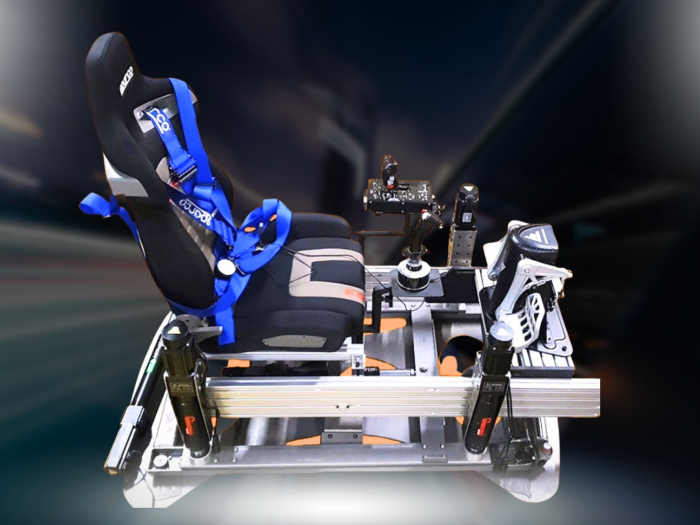

A professional sim racing simulator is no longer about collecting expensive parts; it's about engineering a seamless sensory loop between software telemetry and physical feedback. You likely already know the frustration of staring at a maze of aluminium profiles and wondering if your chosen wheelbase will actually support sim rig motion platform compatibility later on. The fear of outgrowing entry-level gear or cluttering your home with a massive, incompatible rig is a common hurdle for even the most dedicated enthusiasts.
In this guide, we'll show you how to build a world-class setup from the ground up, moving from basic peripherals to high-end immersion without wasting a single bolt. We'll break down a future-proof hardware list for 2026, explain how motion systems like the LowSlider 6 DOF transform your driving, and prove that a professional-grade simulator can comfortably fit within a standard room footprint.
Key Takeaways
- Learn why a rigid, motion-ready cockpit is the essential structural foundation for maintaining ergonomics and technical consistency.
- Understand the specific requirements for sim rig motion platform compatibility to ensure your hardware accurately translates digital telemetry into precise physical feedback.
- Discover why prioritising load cell or hydraulic pedals over steering torque is the secret to mastering professional-grade braking modulation.
- Evaluate the trade-offs between the spatial presence of VR headsets and the wide field of view offered by triple monitor configurations.
- Gain practical insights into modular assembly and cable management to transform a complex hardware list into a polished, high-performance simulator.
The Foundation: Choosing a Motion-Ready Sim Racing Cockpit
Your cockpit is the structural heartbeat of your entire simulator. It's easy to get distracted by high-torque wheelbases or vibrant displays, but if your frame flexes under load, you're effectively filtering out the very telemetry you've paid to feel. Professional sim racing in 2026 demands a platform that can handle the violent, high-frequency vibrations and sustained G-forces of a full motion racing simulator. Choosing the wrong frame now creates a technical debt that's difficult to repay later. You must prioritise a chassis designed with sim rig motion platform compatibility as a primary engineering requirement, not an afterthought.
Industrial-grade aluminium extrusion, specifically 120mm x 40mm profiles, has become the industry standard for its modularity and strength. However, bespoke steel engineering is often required when you're looking to minimise the overall footprint without sacrificing rigidity. A compact rig isn't just about saving floor space; it's about reducing the mass that your actuators have to move. This directly translates into sharper, more responsive feedback, as the motion system doesn't have to fight the inertia of an overbuilt, heavy frame.
Maximising your available floor space also opens up possibilities for a multi-use room; for instance, you might explore Ball pits from SoftplayToys4kids to establish a safe play zone for children within the same area as your simulator.
In addition to the rig's structure, the flooring of your sim room must be durable enough to withstand concentrated weight and vibrations; you may wish to explore Vinyl Flooring from Home Expo Asia to create a high-performance environment that is both resilient and easy to maintain.
Static vs. Motion-Ready Rigs
A static rig is built to support weight, but a motion-ready platform is built to resist force. When you add actuators, every joint in your frame becomes a potential point of failure or unwanted noise. If your rig isn't stiff enough, the motion energy dissipates through the frame instead of your body. Starting with a LowSlider 3DoF motion platform provides an immediate entry into this immersive world. It offers a low-profile solution that integrates seamlessly with existing setups whilst maintaining the structural integrity needed for high-frequency heave and pitch movements.
Ergonomics and Seating Position
Consistency is the foundation of speed. Whether you prefer a reclined Formula position or the more upright GT stance, your rig must maintain that geometry under heavy braking. If your seat flexes when you apply 80kg of pressure to a load-cell pedal, your muscle memory will suffer. You should look for rigs that offer the following features:
- Reinforced Pedal Plates: Essential for preventing flex during emergency braking.
- Rigid Seat Mounts: To ensure every vibration from the motion platform is felt by the driver.
- Infinite Adjustability: Allows you to fine-tune the distance between your eyes and the screen for perfect FOV.
This level of adjustment is vital for growing enthusiasts or households with multiple drivers. It ensures that your ergonomic centre remains perfectly aligned with your eye level and arm reach, regardless of the hardware you choose to mount on the frame. For those in the region seeking similar levels of customisation and comfort in their daily lives, 電動輪椅 香港 solutions from Fivestep provide engineered support for rehabilitation and mobility.
Physical resilience is just as important as the rig's geometry when handling sustained forces; Arete Gyms offers small group personal training Aldgate East to help sim racers build the core strength and stability needed for peak performance.
To complement these ergonomic adjustments and avoid repetitive strain, you can check out Functional Movement Physio for professional advice on staying fit for the track.
While perfecting your ergonomics is crucial for comfort, supporting your physical recovery after long sessions is equally important; you can explore Numans Luni 400 for innovative wellness solutions designed to help you stay at your peak.
Precision Control: Selecting Direct Drive Wheels and Pedals
If the cockpit is the skeleton of your simulator, the steering and pedals are the nervous system. In 2026, the transition from entry-level gear to professional-grade hardware is defined by the move to Direct Drive (DD) technology. Unlike older belt-driven systems that muffle fine details, a DD wheelbase mounts the steering wheel directly onto the motor shaft. This creates a raw, unfiltered connection to the car's front tyres. Maintaining sim rig motion platform compatibility across your entire peripheral suite is the only way to avoid telemetry lag, where your eyes, hands, and inner ear receive conflicting signals. When your motion platform tilts into a corner, your wheel must simultaneously communicate the weight transfer through your palms.
Direct Drive Wheelbases
Torque is the headline figure for DD systems, usually measured in Newton-metres (Nm). Whilst a 5Nm wheelbase offers a taste of realism, professional setups typically utilise motors capable of 12Nm to 25Nm. This isn't just about making the steering harder to turn; it's about dynamic range. High torque allows the system to replicate subtle vibrations, such as the hum of a rumble strip or the sudden lightness of understeer, without clipping the signal. A robust quick-release system is equally vital, allowing you to swap between a GT-style rim and a Formula wheel in seconds. To truly optimise your cockpit, consider enhancing your edge with premium sim racing accessories that bridge the gap between digital data and physical sensation.
Pedal Sets and Muscle Memory
Your lap times are won or lost under braking. Standard pedals use potentiometers to measure how far the pedal has moved, which is a poor way to build muscle memory. Professional drivers rely on pressure, not distance. Load cell pedals measure the actual force you apply, allowing you to "feel" the threshold of the ABS just like in a real GT3 car. For the ultimate in realism, hydraulic pedal sets use actual fluid pressure to mimic the rock-hard resistance of a race car's braking system. This level of fidelity is why advanced simulation technology is now a cornerstone of safety and performance research at institutions like the National Advanced Driving Simulator.
Achieving the perfect heel-and-toe downshift or left-foot braking technique requires a pedal face that is adjustable for height, angle, and spacing. When these controls are mounted to a rigid frame, they become an extension of your body. Whilst you assemble your peripheral list, ensure your choices align with a high-fidelity LowSlider motion platform to guarantee that every millisecond of telemetry is translated into a tangible, real-world sensation.
Visual Immersion: Triple Monitors vs. Virtual Reality (VR)
Visual immersion is the final bridge between a digital simulation and a visceral reality. Whilst your pedals and wheel handle the tactile inputs, your eyes dictate your brain's perception of speed and spatial orientation. This choice significantly impacts your sim rig motion platform compatibility, as the way you perceive movement through your eyes must align perfectly with the physical forces acting on your body. If there is a disconnect between what you see and what you feel, the illusion of racing shatters instantly.
In 2026, the debate between screens and headsets has shifted from a question of "which is better" to "which suits your environment". Triple monitors offer a massive, stable field of view that is easy on the eyes during four-hour endurance stints. Conversely, Virtual Reality provides a level of depth perception and "presence" that makes you feel like you are actually sitting inside a carbon-fibre tub. Both options have distinct requirements for space, computing power, and structural mounting that you must consider before committing to a build.
Maintaining physical stamina for long sessions is key to performance; using high-performance training apparel from REP Store can help sim racers stay comfortable and focused during intense endurance events.
Beyond apparel, many competitive drivers integrate boxing into their fitness routines to enhance reaction times and shoulder endurance; you can source professional-grade boxing gloves australia from The Fight Club to support your off-track conditioning.
The Triple Monitor Setup
Triple screens remain the gold standard for many professional drivers due to their reliability and peripheral coverage. To achieve a seamless 180-degree view, you typically need three 32-inch or 27-inch displays angled precisely to wrap around your periphery. Calculating the correct angle is a matter of mathematics; your eyes should be the centre point of the arc. However, monitor stand stability is paramount. You should always use a standalone monitor mount rather than attaching screens directly to the rig frame. If the displays are physically connected to a high-performance motion platform, the resulting vibrations can cause distracting screen wobble or even internal hardware fatigue over time. Maintaining a rock-solid visual horizon is essential for precision driving.
The VR Revolution with Pimax
Virtual Reality has evolved from a niche alternative into a professional necessity for those seeking total immersion. High-end Pimax VR Headsets have redefined the category by offering up to a 200-degree field of view. This eliminates the "scuba mask" effect of older hardware, allowing you to use your natural peripheral vision to spot rivals alongside you. VR provides genuine spatial awareness; you can look deep into the apex of a corner to judge your turn-in point with centimetre-perfect accuracy.
One of the most significant advantages of combining VR with a LowSlider motion platform is the reduction in motion sickness. When your inner ear feels the physical heave and roll of the car whilst your eyes see the corresponding horizon shift, the sensory conflict that causes nausea is largely resolved. This synchronisation of digital telemetry and physical feedback allows for longer, more intense sessions. It transforms the experience from watching a race to actually living it. High refresh rates are non-negotiable here; you need a PC capable of maintaining at least 90 FPS to ensure the motion remains fluid and the immersion stays intact. For those looking to build or upgrade their setup, Budget Gamer UAE offers high-performance gaming PC systems specifically designed to handle such demanding graphical loads.

The Ultimate Evolution: Sim Rig Motion Platform Compatibility
Static simulators, regardless of how high-end their peripherals are, often suffer from a "floaty" sensation where the car feels disconnected from the road. You see the kerb on your screen and hear the tyre scrub through your headset, but your body remains stationary. This sensory gap is where sim rig motion platform compatibility becomes the defining factor of a professional build. By integrating a motion system, you ground the digital experience in physical reality, allowing your vestibular system to process the same G-forces and weight transfers you'd encounter on a real circuit.
True immersion is dictated by Degrees of Freedom (DOF). Whilst a basic setup might focus on Pitch (nose up/down) and Roll (side to side), a professional-grade LowSlider 6 DOF motion simulator expands this to include Heave (vertical movement), Sway (lateral G-forces), Surge (acceleration and braking forces), and Yaw (traction loss). These six axes work in concert to eliminate the guesswork from your driving. Instead of waiting to see a slide develop on screen, you feel the chassis rotate beneath you, allowing for instantaneous corrections that are impossible on a static rig.
6 DOF vs. 3DOF: Understanding the Difference
A 3DOF platform is an excellent entry point into motion, capturing the essential body movements of the car as it navigates undulations and corners. It's particularly effective for GT racing where chassis roll is a primary feedback source. However, for disciplines like Rally or high-downforce Formula racing, 6 DOF is the gold standard. The addition of surge and sway allows you to feel the violent "thump" of a gear change and the sustained lateral load of a high-speed sweeper. Choosing the right platform depends on your discipline, but ensuring your frame has the sim rig motion platform compatibility to upgrade from 3 to 6 degrees of freedom is a vital bit of future-proofing.
The Engineering of Traction Loss
Traction loss is frequently described as the "secret sauce" of sim racing. It is the specific movement that simulates the rear tyres breaking traction, causing the back of the car to step out. Without this feedback, you're forced to rely on visual cues, which are often too late to save a spin. The Race@Home system takes this further with twin traction loss, simulating both front-end understeer and rear-end oversteer. This level of technical sophistication requires a significant commitment to quality. If you're planning your budget, you can find a detailed breakdown in our investment guide for motion simulator costs.
Engineering a rig that accurately translates telemetry into these complex movements requires precision-built hardware. If you're ready to move beyond the limitations of a static setup and experience the visceral reality of 6 DOF movement, explore our range of LowSlider motion platforms and start your ultimate build today.
Assembly and Calibration: Finalising Your Build
The final stage of your build is where the engineering meets the road. Many enthusiasts fear that a high-end simulator requires a degree in mechanical engineering and a full weekend of assembly. That isn't the case in 2026. Professional simulation is now about smart integration rather than complex fabrication. Transitioning from a collection of boxes to a functioning cockpit is a methodical process that rewards patience, particularly when ensuring your cable runs and software profiles are optimised for performance.
For enthusiasts who have developed high-level technical proficiency through such engineering projects and wish to formalise their expertise for the Australian market, Right Pathway offers expert assistance in converting practical experience into nationally recognised qualifications.
Cable management is a critical safety consideration for any motion setup. Because the rig moves across multiple axes, your cables must have enough slack to accommodate full travel without tension. Organising your looms with braided sleeving or flexible cable tracks ensures that your power and data lines stay clear of the moving parts. This maintains a clean aesthetic whilst preventing technical failures or port damage during a high-intensity session. A tidy rig is a reliable rig.
For those looking to elevate the aesthetics of their home studio even further with bespoke creative accents or unique custom-made gifts, you can learn more about 2d6 Designs.
The One-Hour Assembly Strategy
Race@Home platforms are hand-built in the UK and designed for a four-piece modular assembly. Unlike traditional flat-pack rigs that arrive as a daunting pile of aluminium profiles and hundreds of bolts, this modular approach allows you to move from unboxing to your first shakedown run in under an hour. You won't need a professional workshop or a complex array of specialised tools. Basic hex keys and a standard wrench are typically all that's required to secure the frame. This simplicity ensures that the structural integrity of the rig is maintained without the risk of assembly errors that could lead to frame flex or noise.
Calibration and Telemetry Tuning
Software is the brain of your simulator. Leading applications like SimHub (version 9.11.21, released in July 2026) and SimCommander allow you to bridge the gap between digital telemetry and physical sensation. This is where sim rig motion platform compatibility is truly tested. You'll need to map your wheel and pedals for 1:1 input accuracy, ensuring that your physical actions result in immediate on-screen movement. Once the inputs are locked in, the focus shifts to the motion profiles.
Fine-tuning is a personal journey. You might prefer a violent surge during gear changes to mimic a sequential gearbox, or a softer heave setting for a GT3 car on a bumpy circuit. Adjusting these motion profiles to match different car types and tyre compounds is how you extract the maximum performance from your hardware. Don't overlook the importance of regular firmware updates. These updates ensure long-term rig reliability and maintain compatibility with the latest racing titles, keeping your investment at the cutting edge of the hobby.
Just as sim racing enthusiasts rely on technical data to refine their performance, those dedicated to other specialised hobbies often seek out expert-led communities; for instance, to explore the welfare and appreciation of elite equines, you can read more about the educational resource library hosted by We LOVE Arabian Horses.
To further enhance the cockpit atmosphere, some enthusiasts integrate high-grade vehicle audio systems; expertise from firms like Safe & Sound Mobile can be invaluable when selecting speakers that deliver robust performance in high-vibration environments.
Engineering Your Ultimate Driving Experience
Building a professional simulator in 2026 is an exercise in precision engineering. It starts with a rigid frame and concludes with the seamless integration of motion telemetry. You now understand how a direct drive wheelbase and high-pressure pedals provide the tactile data needed for consistency whilst Pimax VR or triple monitors define your spatial awareness. Ensuring sim rig motion platform compatibility is the final, most critical step in bridging the gap between a digital game and a visceral, real-world sensation. To complete your dedicated racing environment, you can discover Frankly Flooring for a range of durable and high-quality surfaces.
For those in the capital planning to relocate their new setup, VP Smart Removals offers professional expertise in moving high-value equipment and furniture securely.
Race@Home is ready to help you cross that finish line. Our LowSlider platforms are hand-built in the UK and shipped worldwide in modular pieces for a painless, one-hour assembly. They're fully compatible with all major PC sim racing titles, which means you can focus on your lap times rather than troubleshooting your software settings. Don't settle for a static experience when you can feel every kerb and weight transfer.
Design your bespoke motion rig with the LowSlider Series today. It's time to stop playing and start driving.
Frequently Asked Questions
How much space do I need for a full motion sim racing rig?
A standard room footprint is usually sufficient for a LowSlider setup. You'll need approximately 1.5 metres by 0.8 metres for the rig itself, but it's vital to allow a 30cm clearance zone around the perimeter to accommodate the physical travel of the actuators. Because the LowSlider has an ultra-low profile design, you won't need to worry about ceiling height constraints that often affect taller, more traditional actuator systems; such versatility is a key consideration for those living in luxury developments by Pimlico Homes in the North East.
This compact nature makes it an ideal choice for those in urban apartments or luxury student housing; for instance, students in the North West can visit Unipad to explore high-end Lancaster accommodation and city guides that help balance a professional sim racing hobby with a vibrant university lifestyle.
For professionals who require premium, flexible living arrangements while travelling for work or international events, MOT Rentals offers strategic corporate and temporary rental solutions in key urban hubs like Buenos Aires and Mendoza.
When you are not behind the wheel of your simulator, taking a break at a classic British holiday destination can be a great way to unwind; Happy Place Caravans provides a detailed resort map for those planning a trip to Butlins Skegness.
Can I add motion to my existing static sim racing rig?
You can add motion to most aluminium profile cockpits, provided the frame is rigid enough to handle the mechanical stress. This is a primary factor in sim rig motion platform compatibility. Our LowSlider platforms are designed to sit directly beneath your existing chassis, transforming a static rig into a dynamic simulator without requiring you to buy an entirely new frame or seat assembly.
What is the difference between 3DOF and 6 DOF in sim racing?
The difference lies in the complexity and number of the movements. A 3DOF system replicates pitch, roll, and heave, which covers the basic body lean and undulations of the track. A 6 DOF platform adds surge, sway, and yaw. This allows you to feel acceleration, lateral G-forces, and traction loss, providing the most complete sensory translation of digital telemetry available in a home environment.
Is VR better than triple monitors for professional sim racing?
Neither is objectively superior, as the choice depends on your personal priorities. VR headsets like the Pimax range offer unparalleled depth perception and spatial awareness, allowing you to look naturally into a corner's apex. Triple monitors are often preferred for long-distance endurance racing because they're less fatiguing on the eyes and don't require the same level of high-end PC hardware to maintain stable frame rates.
How long does it take to assemble a Race@Home motion platform?
You can assemble a Race@Home platform in under an hour. We ship our systems in four pre-built modular pieces that bolt together with standard tools. Unlike DIY kits that can take a full weekend to calibrate and wire, our modular design is engineered for enthusiasts who want to spend their time driving rather than troubleshooting complex mechanical assemblies.
Do I need a high-end PC to run a motion simulator and VR?
A high-performance PC is essential, particularly if you're using high-resolution VR headsets. Whilst the motion software itself is relatively lightweight, the racing simulation must maintain a high, stable refresh rate (ideally 90 FPS or higher) to keep the motion feedback synchronised with the visuals. Any lag in the system can break immersion and lead to motion sickness.
What is traction loss and why is it important for sim racing?
Traction loss is the lateral yaw movement that simulates the rear tyres breaking grip. It's a critical feedback source because it allows you to feel the car sliding before you can see it on the screen. By sensing the rear end step out through your body, you can make instantaneous steering corrections, which is the key to finding the absolute limit of grip on every lap.
Does a motion platform actually make you faster on track?
A motion platform doesn't automatically decrease your lap times, but it significantly improves your consistency. By providing physical cues for weight transfer and tyre slip, the rig helps you understand the car's behaviour more intuitively. You'll likely find that you make fewer mistakes during long stints, as you're no longer relying solely on visual information to judge the car's balance.


