What if the difference between a podium finish and a mid-pack struggle isn't your driving line, but the tactile information your feet are receiving through the cockpit floor? You've likely felt that jarring disconnect when your eyes see a snap of oversteer on the screen, yet your body remains motionless. It's a common frustration amongst enthusiasts who find their performance plateauing because of immersion-breaking cable clutter or a lack of genuine feedback from the car. Choosing the right sim racing accessories is the only way to resolve this sensory gap and reclaim your competitive edge.
We'll show you how to transform your setup from a standard rig into a professional-grade simulator that mirrors the visceral intensity of the track. You'll discover how load cell pedals and high-fidelity VR headsets provide more precise control over your braking and shifting whilst eliminating the discomfort of long endurance races. This guide explores the specialised hardware required to achieve total sensory immersion through haptics and motion; ensuring your home cockpit looks as professional as it performs. We are moving beyond simple peripherals and into the realm of high-performance engineering.
Key Takeaways
- Understand how sensory fidelity bridges the gap between software data and physical feedback to improve your competitive consistency.
- Learn why investing in high-fidelity sim racing accessories, such as load-cell pedals, is the single most impactful upgrade for achieving professional-level lap times.
- Discover the necessity of vibration-proof mounting for peripherals when they are integrated with high-performance 6 DOF motion platforms.
- Explore the synergy between Pimax VR headsets and motion hardware to achieve total spatial awareness whilst eliminating motion sickness.
- Gain insight into the bespoke Race@Home philosophy, where curated hardware partnerships ensure your simulator operates as a cohesive, professional-grade machine.
Beyond the Wheel: Why Sim Racing Accessories Define the Experience
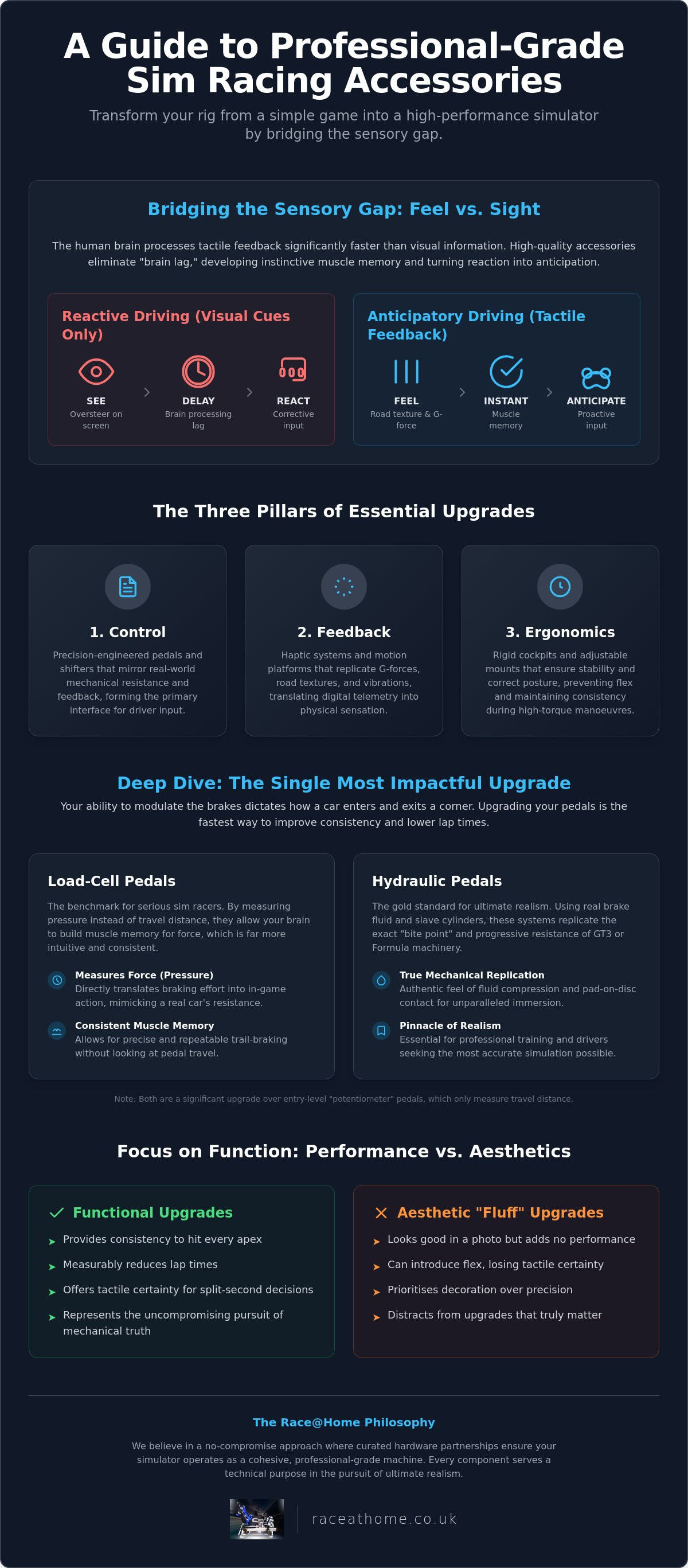
A standard steering wheel is just the beginning. To truly understand What is Sim Racing, you must look at the peripherals that sit beyond the rim. Professional-grade sim racing accessories are the specialised hardware components that translate digital telemetry into physical sensation. They are the difference between playing a game and operating a high-performance machine. Whilst a basic setup relies on visual cues, a professional simulator engages the entire body to provide a more comprehensive data set to the driver. We categorise these essential upgrades into three primary pillars:
- Control: Precision-engineered pedals and shifters that mirror real-world mechanical resistance.
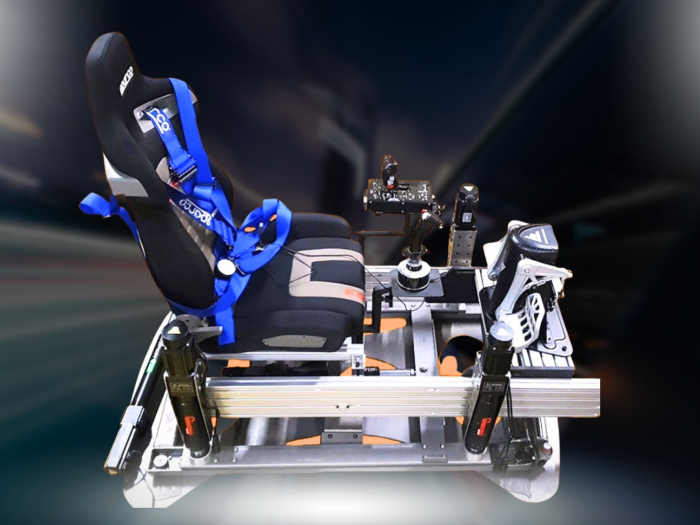
- Feedback: Haptic systems and motion platforms, such as the LowSlider, that replicate G-forces and road textures.
- Ergonomic: Rigid cockpits and adjustable mounts that ensure stability during high-torque manoeuvres.
The transition from a gaming hobby to a serious simulation happens when you stop reacting to what you see and start anticipating what you feel. This shift requires a no-compromise approach to hardware selection, ensuring every component serves a technical purpose.
The Psychology of Immersion
The human brain processes tactile feedback significantly faster than visual information. When you rely solely on a monitor, there is a measurable "brain lag" between seeing the rear of the car step out and reacting to it. High-quality feedback accessories eliminate this delay by providing immediate haptic signals through your hands, feet, and seat. This develops instinctive muscle memory for braking points and weight transfer. In the context of 2026 telemetry standards, sensory fidelity is defined as the high-frequency accuracy with which digital physics data is converted into tangible, vibration-based feedback that the driver can interpret without conscious thought.
Performance vs. Aesthetics
It's easy to be distracted by RGB lighting or carbon-fibre trim, but professional drivers prioritise functional upgrades that actually reduce lap times. A "fluff" upgrade looks good in a photo; a functional upgrade provides the consistency needed to hit every apex. When you invest in performance-led sim racing accessories, you are buying precision rather than just decoration. Rigid mounting is vital here. If your button box or display flexes when you use it, you lose the tactile certainty required for split-second decisions. Realism isn't about visual flair; it's about the uncompromising pursuit of mechanical truth and the sensory bridge between the software and the driver. For those who appreciate this level of precision in every aspect of their lifestyle, you can learn more about Replicahause - Super Clone Replica Watches to see how high-end engineering is mirrored in the world of luxury horology.
High-Performance Control: Pedals and Shifters
If you want to shave seconds off your lap times, stop looking at your steering wheel and start looking at your feet. Your pedals are responsible for the most critical aspect of racing: weight transfer. Whilst steering determines your direction, your ability to modulate the brakes dictates how the car enters and exits a corner. Professional sim racing accessories in the control category are designed to move away from the "potentiometer" sensors found in entry-level gear, which only measure how far a pedal is pushed. Instead, they focus on pressure-based feedback that mirrors the physics of a real-world braking system.
Load-Cell vs. Hydraulic Pedals
The single biggest lap-time improver in any simulator is a load-cell brake pedal. These sensors measure the force applied rather than the distance travelled. This is vital because the human brain is far better at developing muscle memory for pressure than for limb position. For those seeking the absolute pinnacle of realism, hydraulic pedal sets are the gold standard. These systems use actual brake fluid, slave cylinders, and braided lines to replicate the exact "bite point" and resistance found in GT3 or Formula machinery. A comparative analysis of brake pedal sensors demonstrates how these different technologies impact a driver's ability to modulate pressure with precision. You should always adjust your pedal stiffness to match your specific discipline; a rock-hard, short-throw pedal is essential for F1, whereas a more progressive, softer feel is better suited to classic touring cars.
Shifters and Handbrakes
Mechanical realism extends to how you engage the gearbox. High-end sequential shifters offer a heavy, tactile "clunk" that provides immediate sensory confirmation of a gear change. This prevents the missed shifts that often plague endurance stints. If you prefer classic racing, a high-quality H-pattern shifter with adjustable gates is essential for that authentic, manual connection to the car. Integrating these peripherals onto a compact, high-performance rig like the LowSlider 3DoF motion platform requires absolute mounting rigidity. If your shifter mount flexes during a rapid downshift, you lose the tactile certainty required for competitive consistency.
For rally and drift enthusiasts, a dedicated handbrake is a non-negotiable accessory. It allows for precise car rotation by locking the rear wheels, a technique that simply cannot be replicated with a button on a wheel rim. These enthusiast-grade sim racing accessories require a "no-compromise" mounting solution to handle the high-torque forces involved. When your controls are rock-solid, your brain can focus entirely on the telemetry data rather than compensating for hardware flex.
Motion-Optimised Accessories for the LowSlider Era
Integrating a motion platform into your cockpit isn't just about the actuators; it's about how every other peripheral reacts to the movement. When you transition to a LowSlider 6 DOF Twin-Traction-Loss Motion Platform, your sim racing accessories are suddenly subjected to forces they were never designed to handle in a static rig. Pitch, roll, and heave create significant mechanical stress. Without the right mounting strategy, your high-end button boxes and telemetry displays will become points of failure rather than tools for performance. Consistency requires a setup that remains stable whilst the world around you is shifting.
Rigidity and Vibration Management
Standard plastic mounts often fail under the sustained G-forces of a 6 DOF rig. They flex, they sag, and eventually, they snap. For a motion-heavy setup, you must utilise aluminium or steel bespoke brackets. These rigid solutions ensure that your peripherals stay exactly where you need them, even during violent weight transfers or off-track excursions. Reducing "rattle" is equally vital. Any loose component creates unwanted noise that masks the visceral, high-frequency feedback coming from your PT Actuator system. By securing your equipment with industrial-grade mounts, you keep your focus on the road texture and tyre slip rather than a vibrating dashboard.
Tactile transducers, often called bass shakers, serve as an excellent complement to full-motion systems. Whilst the actuators handle the large-scale body movements, transducers provide the micro-details like engine RPM and kerb strikes. This dual-layered approach creates a more comprehensive sensory map, but it also increases the need for vibration-proof mounting across the entire frame. If your cockpit isn't rigid, these high-frequency vibrations will simply dissipate into the metalwork instead of reaching your seat.
Cable Management for 6 Degrees of Freedom
Managing electronics on a rig that moves in every direction is a serious engineering challenge. You can't simply zip-tie cables to the frame and expect them to survive. You need to design a "service loop" at every pivot point to prevent cable snags or port damage during extreme pitch and roll. These loops provide enough slack for the platform's full range of motion without allowing the wires to get caught in the mechanical linkages. Specialised braided sleeving is another essential accessory, offering a layer of abrasion resistance against the metal edges of the cockpit.
When configuring your space, you must ensure the LowSlider 6 DOF platform has sufficient clearance to accommodate the maximum travel of the actuators without tensioning the connectors or hitting nearby walls. This proactive approach to organisation prevents the immersion-breaking "disconnection" mid-race. A professional setup isn't just about the speed of the actuators; it's about the reliability of the entire ecosystem whilst in motion.
The Digital Cockpit: VR and Telemetry Displays
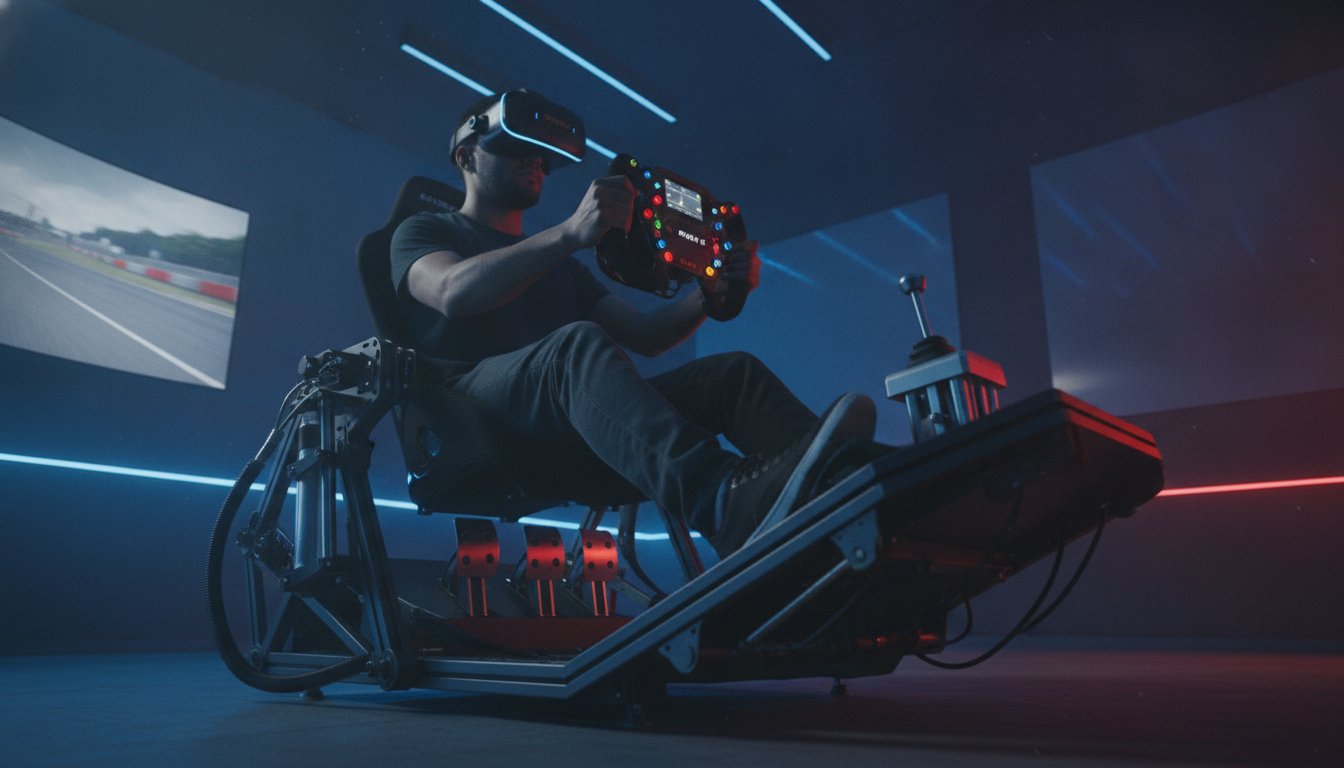
Whilst motion platforms provide the physical data, the visual interface defines your spatial awareness. Virtual Reality (VR) has evolved from a niche alternative into the definitive choice for competitive drivers seeking total immersion. It provides a level of depth perception that triple-monitor setups struggle to match. By placing you inside the car, VR allows you to judge distances to the apex and other drivers with natural intuition. This is where high-fidelity sim racing accessories transition from mere hardware into sensory extensions of the driver.
VR Integration: The Pimax Advantage
A wide Field of View (FOV) is the secret to consistent lap times. Pimax VR headsets offer an expansive FOV that allows you to see your mirrors and the car alongside you without significant head movement. This spatial clarity is vital for hitting every apex with precision. High refresh rates are equally important in this environment. If your visuals lag behind the movement of your LowSlider 6 DOF motion platform, your brain receives conflicting signals, which is the primary cause of motion sickness. The synergy between Pimax hardware and precision actuators ensures that what you see matches what you feel, creating a seamless, sickness-free experience. For long endurance stints, always prioritise the ergonomics of your headset; adjusting the strap tension and using breathable face foams will prevent fatigue during three-hour sessions.
Tactile Controls for VR Users
Operating a cockpit whilst wearing a headset presents a unique challenge because you cannot see your hands. This makes the selection of button boxes and stream decks a matter of tactile ergonomics rather than just aesthetics. You should choose sim racing accessories with distinct physical markers, such as raised edges, varying button textures, or recessed toggles. This design allows for "blind" operation, letting you adjust brake bias or fuel maps without ever lifting your visor. Voice-command software also functions as a powerful secondary accessory, allowing for hands-free pit requests and strategy changes whilst your hands remain on the wheel.
For those who prefer a traditional triple-screen setup, DASH displays and external shift lights remain essential immersion tools. These peripherals keep critical telemetry like tyre temperatures and oil pressure in your peripheral vision. Just as with shifters, mounting these displays requires absolute rigidity to ensure they don't rattle or flex when the motion platform is active. Whether you are a VR enthusiast or a screen purist, your digital cockpit must be organised to deliver data without distraction.
If you are ready to eliminate the barrier between the digital and physical worlds, explore our range of Pimax VR Headsets to complete your professional-grade simulator.
Bespoke Upgrades: The Race@Home Philosophy
Bespoke simulators require a level of curation that mass-produced rigs simply cannot accommodate. At Race@Home, we view sim racing accessories as integral components of a unified engineering project rather than mere add-ons. A hand-built simulator is only as strong as its weakest mounting point. This is why we prioritise hardware that meets a "no-compromise" standard, ensuring every pedal press and gear shift is translated with absolute fidelity. By partnering with specialists like PT Actuator and Sim Racing Professional, we provide an ecosystem where digital data becomes visceral reality.
The LowSlider Ecosystem
The proprietary design of the LowSlider platform provides an ultra-low profile, creating a compact footprint that doesn't sacrifice expansion capability. Unlike generic frames that struggle with professional-grade peripherals, our ecosystem includes custom mounting solutions specifically engineered for Pimax VR headsets and high-torque pedal sets. This rigidity is essential. It ensures that the forces generated by a 6 DOF system don't compromise the precision of your inputs. Even with the addition of complex haptics or telemetry displays, our rigs maintain a "one-hour assembly" philosophy. We ship globally in four easy-to-assemble pieces, allowing you to spend more time on the track and less time in the workshop.
Expert Consulting and Global Support
The future of the hobby is moving toward even greater sensory detail and mechanical complexity. As we move through 2026, we are seeing the launch of next-generation hardware like the Fanatec Podium Pedals and the Heusinkveld DisplayDash, both arriving in July 2026. Integrating these cutting-edge sim racing accessories requires more than just a toolkit; it requires the guidance of an engineering specialist. Our UK-based team provides personalised advice to a global customer base, helping you decide between a 3DOF or 6 DOF setup based on your specific performance goals.
Elevating your setup requires a specialist touch to ensure total hardware synchronisation. If you are ready to elevate your experience beyond the standard, enquire about a bespoke accessory package for your LowSlider rig today. Our expertise ensures that your simulator is not just a collection of parts, but a precision instrument designed for the ultimate competitive edge.
Dominate the Track with Professional-Grade Realism
Transforming a home rig into a world-class simulator requires a fundamental shift in focus from visual flair to tactile precision. You now understand how high-fidelity pedals and specialised shifters provide the mechanical consistency needed for world-class racing; whilst VR and motion technology bridge the final gap in sensory immersion. By selecting the right sim racing accessories, you eliminate the sensory lag that holds most drivers back from their full potential. Consistency is born from hardware that responds as predictably as a real-world race car.
Upgrade your setup with professional sim racing accessories and feel the visceral difference that true engineering makes. Your journey to the top of the podium begins with the right foundation.
Frequently Asked Questions
What are the most essential sim racing accessories for a beginner?
Beginners should prioritise a load-cell brake pedal and a direct-drive wheelbase as their first major investments. These components provide the most significant improvement in consistency and car control. Whilst cheaper gear-driven wheels are available, investing in high-quality sim racing accessories early prevents the need for costly upgrades as your skills progress.
Do I need special accessories for a 6 DOF motion platform?
Yes, accessories mounted on a 6 DOF platform must be secured with vibration-proof aluminium or steel brackets to handle the G-forces. Standard plastic mounts often fail or flex under the intense movement of a LowSlider rig. You also need specialised cable management solutions to ensure wires don't snag during extreme pitch and roll manoeuvres.
Can I use any sim racing pedals with a Race@Home rig?
You can use most professional-grade pedals with a Race@Home rig, as our mounting plates are designed for maximum compatibility. We specifically recommend load-cell or hydraulic sets from our partners to ensure the rig's rigidity is fully utilised. If you use entry-level plastic pedals, you may find they lack the structural integrity required for a high-performance motion environment.
Is VR a better accessory than triple monitors for immersion?
VR headsets like the Pimax series offer superior depth perception and spatial awareness, allowing you to judge apexes more naturally than on a flat screen. It is a more compact solution that eliminates the need for large monitor stands. However, triple monitors remain a popular choice for drivers who prefer a wider peripheral view whilst remaining connected to their physical cockpit environment.
How do I manage cables on a motion simulator that moves in all directions?
Cable management on a motion rig requires the use of service loops and specialised braided sleeving. Service loops provide the necessary slack for the platform to reach its maximum travel without tensioning the connectors. Organising your electronics this way prevents immersion-breaking disconnections and protects your hardware from mechanical wear during high-speed traction loss simulations.
Are sim racing gloves and shoes necessary for home setups?
Gloves and shoes are highly beneficial for protecting your equipment and maintaining consistent pedal pressure. Gloves prevent skin oils from damaging Alcantara steering wheel rims and provide better grip during long endurance stints. Sim racing shoes offer a thin, consistent sole that allows for better modulation of high-pressure hydraulic or load-cell braking systems.
What is a button box and do I need one for VR racing?
A button box is an external control panel used to map car functions like brake bias, fuel maps, and pit requests. They are incredibly useful for VR racing, provided they feature distinct tactile markers like raised buttons or toggle switches. This physical feedback allows you to operate the controls by touch whilst your vision is occupied by the headset.
How much should I expect to spend on high-end sim racing accessories?
The cost of a competitive sim racing setup typically ranges from $3,000 to $5,000 for mid-range equipment as of March 2026. High-end sim racing accessories are an investment in long-term engineering quality and sensory realism. Professional-grade components are designed to withstand the rigours of 6 DOF motion and deliver the precision required for elite-level competition.


