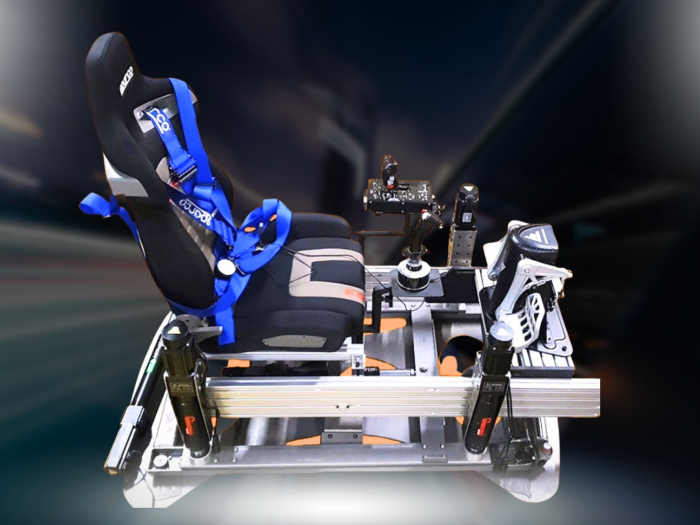

First let's get this out there. Forget the money. If you can't afford a 6DoF LowSlider Mini (Starting price £8,600 ex tax) why bother reading on. I would argue that the biggest cost is the loss of joy if you compromise but could have afforded to invest in a better product.
The most expensive mistake in sim racing isn't buying the wrong wheelbase; it's paying for 'vibration' when you actually wanted 'motion'. Many enthusiasts enter the market only to realise that a few hundred pounds merely buys a rumble motor, whilst true, physics-based immersion requires a far more sophisticated level of engineering. If you're asking how much does a motion simulator cost in 2026, you've likely encountered a bewildering range of figures that span from the price of a modest holiday to the cost of a luxury supercar. Once again, £8,600 before shipping and taxes gets you a 6DoF system with 75mm heave, 200 twin TL and 150 Surge. Less than the price of a track day fail.
We understand that the transition from a static rig to a dynamic platform is a significant commitment. It's natural to feel concerned about whether a specific setup will fit your spare room or if the technical complexity will outweigh the enjoyment. This guide provides a definitive breakdown of the current investment landscape, from accessible seat movers to elite, professional-grade systems that can exceed £100,000 in the turnkey market. You'll gain a clear understanding of the price tiers, the specific components that drive costs, and the knowledge required to select a platform that delivers authentic, high-fidelity feedback without compromise.
Key Takeaways
- Distinguish between basic haptic vibration and true physics-based motion to ensure your investment delivers genuine immersion rather than simple road rumble.
- Discover exactly how much does a motion simulator cost by comparing the investment required for entry-level seat movers against professional, turnkey 6 DOF systems.
- Learn why industrial-grade actuators are the critical component for reducing latency and providing the precise telemetry needed for professional muscle memory training.
- Compare the long-term value of hand-built, high-rigidity UK platforms against the hidden costs and technical hurdles often found in mass-market kits.
- Identify the essential peripheral requirements, including the specific computing power and visual hardware needed to synchronise high-speed motion data effectively.
Understanding the Tiers of Motion Simulator Investment
The 2026 sim racing landscape is defined by a massive spectrum of hardware. At one end, you have haptic cushions that offer subtle vibrations; at the other, you have professional-grade 6 DOF platforms that replicate every nuance of a GT3 car's suspension. When evaluating how much does a motion simulator cost, you must first decide which tier of immersion your training requires. It's a question of technical fidelity versus budget, where the most expensive platforms aren't just moving more; they're moving more accurately. In this market, you truly get what you pay for in terms of latency and data translation.
Seat Movers vs Full Cockpit Motion
Seat movers represent the entry point for many novices. These devices pivot only the seat, leaving your wheel and pedals static. Whilst this provides a visceral sense of acceleration, it creates a physical disconnect. As the seat tilts back under acceleration, your reach to the steering wheel changes. Full cockpit motion, such as that found in our LowSlider 3DoF motion platform, moves the entire rig as one unit. This preserves your ergonomic relationship with the controls, ensuring that your muscle memory remains consistent even during violent weight transfers. This consistency is why serious enthusiasts often bypass seat movers entirely, opting for a solution that maintains the physical integrity of the driving position.
Degrees of Freedom (DOF) and Price Scaling
The complexity of a motion simulator or motion platform is measured in Degrees of Freedom (DOF). Each additional axis adds a new layer of data translation, and consequently, a jump in engineering requirements. Common configurations include:
- 2-Axis: Basic pitch and roll, simulating tilting forward, backward, and side-to-side.
- 3DoF: Adds 'heave', allowing you to feel vertical bumps, kerb strikes, and suspension travel.
- 6 DOF: The gold standard. It includes surge, sway, heave, roll, pitch, and yaw.
The transition to a 6 DOF system, like the LowSlider 6 DOF Twin-Traction-Loss Motion Platform, represents a significant engineering shift. It isn't just about adding more motors; it's about the ability to simulate lateral slide and traction loss. For drivers serious about shaving tenths off their lap times, this level of feedback is essential. It tells your brain exactly when the rear tyres are beginning to let go. When considering how much does a motion simulator cost, remember that you are investing in the speed and accuracy of that data translation. A high-fidelity 6 DOF platform provides the sensory detail needed to react instinctively, rather than waiting for visual cues on a screen. Finding your 'sweet spot' involves balancing the number of actuators against the quality of the telemetry they provide.
The Engineering Behind the Price: Actuators and Telemetry
The heart of any high-fidelity rig is the actuator. Whilst it is easy to assume all motors perform similarly, the engineering gap between consumer-grade units and industrial-grade hardware is vast. When calculating how much does a motion simulator cost, you aren't just paying for the metal and magnets; you're investing in the speed and durability of the movement. Research into the costs of providing motion in simulators highlights that the price scales sharply with the required level of fidelity. Industrial-grade PT Actuators, which we use in our builds, are designed to handle thousands of hours of high-torque stress without the thermal throttling or mechanical degradation common in cheaper alternatives.
Software integration is another invisible driver of value. Entry-level systems often rely on 'canned' effects, which are pre-programmed vibrations triggered by certain game events. These feel more like a vibrating controller than a car. Professional-grade platforms use raw telemetry data to calculate the exact physical response required in real-time. This low-latency translation ensures that if your car hits a ripple strip, you feel the specific frequency and impact of that kerb instantly. This level of precision is why high-end enthusiast rigs command a premium, as they require sophisticated controllers to process data at lightning speeds.
Actuator Speed and Precision
Latency is the enemy of immersion. If the motion lags even a few milliseconds behind the visual input, the result is often motion sickness rather than excitement. High-speed industrial actuators eliminate this disconnect by providing near-instantaneous feedback. Cheaper motors often lack the torque required to move a full cockpit with the necessary acceleration, leading to a 'mushy' sensation. In commercial environments or dedicated home setups, these budget motors frequently fail under the constant load. Investing in precision hardware ensures your rig remains responsive and reliable for years of daily use.
The Hidden Value of Twin Traction Loss
Traction loss is often described as the 'secret sauce' of sim racing. It simulates the rear of the car breaking loose, a sensation that is typically missing from basic pitch and roll setups. Adding this functionality requires a complex sliding mechanism and additional actuators, which naturally increases the build cost. However, the performance benefit is undeniable. By feeling the oversteer through your hips before you see it on the screen, you can catch slides earlier and drive closer to the limit. Our LowSlider 6 DOF Twin-Traction-Loss Motion Platform is engineered specifically to provide this lateral feedback, giving you the competitive edge that static rigs simply cannot replicate.
Bespoke Hand-Built Platforms vs Mass-Market Rigs
A common debate amongst sim racers is whether to embark on a DIY build or invest in a professionally engineered platform. Whilst the initial price tag of a self-sourced actuator kit might look attractive, the hidden costs often spiral. These include the price of custom fabrication, the time spent troubleshooting software conflicts, and the risk of using unverified engineering designs that may flex under high-G loads. When you calculate how much does a motion simulator cost, you must factor in the value of your own time and the longevity of the hardware. A bespoke, hand-built platform eliminates the 'trial and error' phase, providing a refined experience from day one.
UK-based engineering offers a level of rigour that mass-produced aluminium kits often lack. In a 6 DOF environment, every bolt and weld is a potential point of failure or unwanted vibration. Mass-market rigs frequently rely on generic brackets that can struggle with the violent, high-frequency movements of professional-grade actuators. By contrast, a hand-built platform is designed as a singular, cohesive unit. This superior rigidity ensures that 100% of the actuator's energy is translated into motion rather than being lost to chassis flex. This craftsmanship doesn't just improve the feel; it significantly extends the lifespan of the equipment compared to entry-level consumer units.
The LowSlider Design Advantage
Traditional motion platforms often require you to climb into a towering structure, creating a 'tank-like' presence that dominates a room. Our proprietary LowSlider design solves this by maintaining an ultra-low profile. This engineering choice isn't just about aesthetics; it keeps the centre of gravity low and reduces the physical footprint. If you have limited space, this compact design allows for a full 6 DOF experience without the need for a dedicated industrial-scale room. It bridges the gap between high-end performance and domestic practicality, ensuring that the rig fits into your lifestyle as easily as it fits into your home.
Shipping and Assembly Logistics
Logistics are a frequently overlooked factor in how much does a motion simulator cost. In 2026, shipping heavy, pre-assembled motion rigs across the globe can incur astronomical fees. We've engineered our platforms into a modular, four-piece design to mitigate these costs. This allows for efficient worldwide shipping whilst ensuring the structural integrity remains uncompromised. Because the system is pre-configured and hand-tested in the UK before dispatch, assembly typically takes under an hour. This ease of setup removes the need for expensive professional installation fees, allowing you to focus your investment on the hardware itself rather than the logistics of getting it through your front door.

Beyond the Rig: Essential Peripheral and Infrastructure Costs
A high-performance motion platform is the backbone of your setup, but it doesn't exist in a vacuum. When asking how much does a motion simulator cost, you must account for the secondary hardware that translates digital speed into physical force. Your PC acts as the brain of the operation. Processing low-latency motion telemetry requires a robust CPU capable of handling high-frequency data streams whilst simultaneously running the simulation software. If your processor bottlenecks, the motion feedback will stutter, breaking the immersion you've invested so heavily to achieve.
Peripheral matching is equally critical for long-term reliability. If you're using a 6 DOF system, your pedals and wheelbase must be rigid enough to withstand the forces exerted by the actuators. Flimsy mounting or entry-level plastic components will flex or even fail under the constant stress of pitch, roll, and traction loss. You need enthusiast-grade hardware that can withstand the vibrations of a kerb strike without degrading. This holistic approach ensures that your investment provides a consistent, professional-grade experience for years to come.
VR and Motion: The Ultimate Immersion Pair
For many, the ultimate evolution of the hobby is the pairing of motion with high-end VR headsets, such as those from Pimax. VR eliminates the need for massive triple-monitor stands. This significantly reduces the physical space requirements and the costs associated with complex display mounting. However, this shift places even greater demand on your GPU to maintain high frame rates. Integrating the right sim racing accessories, from tactile transducers to specialised mounting hardware, ensures that every sensory input is perfectly synchronised with the movement of the platform.
Power and Maintenance Requirements
Infrastructure is a practical consideration that often goes overlooked during the initial planning phase. High-torque actuators can draw significant current during peak manoeuvres. Ensuring your circuit can handle the load is vital for consistent performance. You should also consider the flooring; whilst our LowSlider design is compact, it still requires a solid, level surface to operate effectively. Long-term maintenance for industrial-grade systems is minimal. It typically involves periodic checks of cable management and verifying the integrity of emergency stop systems. These safety features are essential components of any high-fidelity build.
Explore our range of high-performance motion hardware to see how these components integrate into a professional-grade ecosystem.
Investing in Realism: Is a Motion Rig Worth the Cost?
The ultimate question isn't just how much does a motion simulator cost, but rather what value it returns to your driving performance. For professional racers, the ROI is measured in shaved lap times and reduced track-day expenses. Motion allows for the development of genuine muscle memory; it lets you practice weight transfer and limit-handling in a safe, repeatable environment. If you're serious about competition, the 'buy once, cry once' philosophy holds true. Investing in a high-fidelity 6 DOF motion simulator ensures you won't be looking for an upgrade in twelve months. These platforms also retain remarkable resale value amongst the enthusiast community, making them a sound long-term asset rather than a disposable consumer gadget.
Matching your budget to your ambitions requires a realistic look at the 2026 market. Whilst elite turnkey systems can reach figures like £100,000, most serious racers find their sweet spot between £30,000 and £60,000 for a complete, balanced build. This range typically secures industrial-grade actuators and a rigid chassis that won't flex under load. Your final verdict should depend on your goals. If you want to feel the car's behaviour through your hips and react instinctively to oversteer, then a full-motion platform is an essential evolution of your hobby.
Commercial vs Home Use Justification
Sim centres and corporate venues require industrial-grade durability to justify their initial capital outlay. In these environments, hardware must run for eight to ten hours a day without thermal throttling or mechanical failure. Home users are increasingly adopting this same 'prosumer' hardware, moving away from mass-produced consumer kits toward hand-built UK rigs. There's a profound psychological satisfaction in knowing your equipment isn't the bottleneck. When you're chasing those final hundredths of a second, having a no-compromise platform allows you to focus entirely on your technique rather than fighting the limitations of your hardware.
Choosing Race@Home for Your 2026 Build
Choosing a UK-based specialist provides a level of support and engineering clarity that generic global retailers cannot match. Our LowSlider design represents the 2026 shift toward ultra-low profile integration. It proves that professional performance doesn't require a bulky, industrial aesthetic that dominates your home. We've balanced the high-speed response of premium actuators with a footprint that respects your living space. If you're ready to define your own path to immersion, the next step is a direct consultation. We'll help you understand exactly how much does a motion simulator cost for your specific requirements, ensuring your investment delivers the visceral, high-fidelity experience you've been searching for. For clients travelling to the UK for a personal consultation, booking a professional transfer with VRUM provides a seamless transport solution that complements the premium nature of a bespoke simulator build.
Master the Physics of Performance
The transition from a static rig to a dynamic cockpit represents the ultimate evolution for any dedicated sim racer. You now recognise that the true answer to how much does a motion simulator cost depends on the fidelity of the actuators and the speed of the telemetry translation. Opting for industrial-grade components and a rigid, hand-built chassis ensures that your investment translates into genuine muscle memory rather than mere vibration.
At Race@Home, we pride ourselves on engineering the most immersive platforms in the industry. Our hardware is hand-built in the UK and utilised by professional racing teams to maintain their competitive edge. We provide worldwide shipping with a modular design that ensures assembly in under an hour, making professional-grade motion accessible for your home environment. It's time to stop reacting to visual cues and start feeling every nuance of the track.
Customise your bespoke LowSlider 6 DOF platform today and take your place amongst the elite. The finish line is closer than you think.
Frequently Asked Questions
How much does a basic 2 DOF motion platform cost in 2026?
Entry-level 2 DOF platforms typically start around £2,000 for basic seat-moving units. These systems focus on pitch and roll, providing a fundamental sense of acceleration and braking. Whilst they are a budget-friendly starting point, they lack the vertical heave and lateral traction loss that define a professional-grade experience. Many users find these systems serve as a gateway before upgrading to more sophisticated multi-axis hardware.
Is a 6 DOF motion simulator significantly more expensive than 3DoF?
Yes, a 6 DOF system requires a larger investment due to the increased number of actuators and complex mechanical engineering involved. Whilst a 3DoF platform provides heave, pitch, and roll, the 6 DOF configuration adds surge, sway, and yaw. This extra hardware requires more robust power management and sophisticated telemetry processing to synchronise all six axes of movement with millisecond precision.
Do I need a special PC to run a motion simulator?
You need a high-performance PC with a modern multicore processor to handle the additional telemetry load without latency. Processing real-time physics data for the actuators whilst simultaneously running the simulation software is demanding. If your CPU bottlenecks, you'll experience a disconnect between the visuals and the motion. We recommend a dedicated gaming PC with a high-tier graphics card, especially when running VR.
Can I add motion to my existing static sim racing rig?
You can often add motion to an existing rig if it is built from a rigid aluminium extrusion profile. Flimsy or plastic chassis aren't suitable because they will flex and degrade under the high-torque forces of industrial actuators. If your current rig is structurally sound, a platform can be integrated beneath it. This allows you to upgrade your immersion without discarding your existing seat and peripherals.
How much space do I need for a full motion simulator?
Our LowSlider design is engineered to fit into a standard room, requiring approximately the same footprint as a traditional static rig. Whilst older industrial platforms needed significant clearance, modern ultra-low profile systems are highly compact. You should allow roughly half a metre of clear space around the rig's perimeter to ensure safe operation during high-amplitude movements and violent weight transfers.
What are the hidden costs of buying a motion simulator?
The primary hidden costs involve high-torque peripherals, robust flooring, and potential shipping fees. When calculating how much does a motion simulator cost, you must also factor in the 'time cost' of software configuration and assembly. Choosing a pre-tested, UK-built system can mitigate these costs by providing pre-configured motion profiles and modular designs that eliminate the need for expensive professional installation services.
Is a motion simulator worth it for casual sim racing?
It's worth the investment if your primary goal is visceral immersion and sensory realism. For casual racers who only play occasionally, the cost might be difficult to justify. However, for those who want to feel every kerb strike and suspension nuance, it transforms the hobby from a game into a high-performance experience. It provides a level of physical feedback that simply cannot be replicated by static hardware.
How much does it cost to ship a motion platform internationally?
International shipping fees depend on the destination and the weight of the hardware, but modular designs help keep these costs manageable. By shipping our platforms in four easy-to-assemble pieces, we avoid the excessive surcharges associated with oversized, pre-built crates. This modularity ensures that enthusiasts across the globe can access premium UK engineering whilst keeping the overall how much does a motion simulator cost within a reasonable range.


