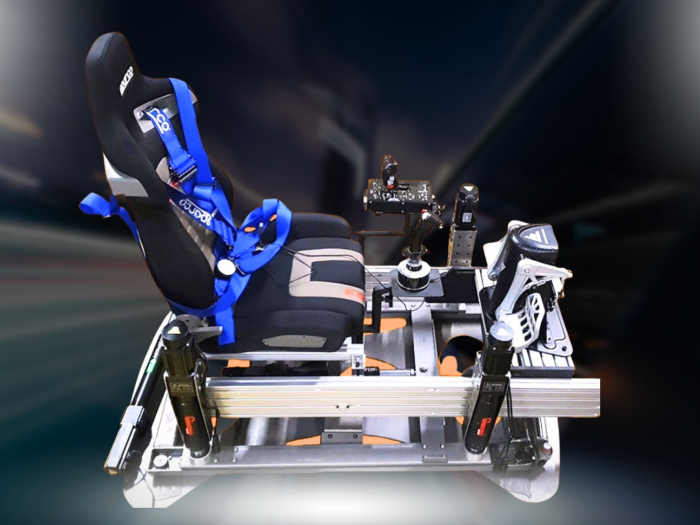

If you cannot feel the back end of your car stepping out through your hips, you aren't truly driving; you're simply managing a digital image. Most enthusiasts agree that the biggest hurdle in sim racing is the sensory disconnect between what your eyes see on screen and what your body feels in the seat. This mismatch often leads to the dreaded floaty sensation or motion sickness that ruins the experience. Integrating a professional-grade 6 DOF motion simulator into your rig changes everything by translating raw telemetry into physical reality.
You deserve a setup that provides the same visceral feedback found in elite training centres, without needing a dedicated warehouse to house it. We promise to show you how 6 Degrees of Freedom transforms your laps from a game into a high-performance driving session, offering the traction loss cues and heave sensations necessary to shave tenths off your personal bests. We will explore the technical precision of modern motion platforms, how they solve the problem of limited space, and why a bespoke UK-engineered solution is the ultimate evolution for your home office or spare room.
Key Takeaways
- Learn how the six axes of motion replicate the exact physical forces of a GT or Formula car, from the snap of oversteer to the compression of high-speed corners.
- Understand the role of high-fidelity actuators and telemetry software in translating digital data into tangible, real-world sensations.
- Identify the critical differences between 3DOF and a full 6 DOF motion simulator to determine which level of immersion aligns with your competitive goals.
- Discover how low-profile engineering allows for a professional-grade motion platform to fit comfortably within a standard home office or spare room.
- Explore the advantages of choosing a hand-built, British-engineered rig that prioritises craftsmanship and easy assembly over mass-produced alternatives.
What is a 6 DOF Motion Simulator? Defining the Ultimate Immersion
A 6 DOF motion simulator represents the absolute pinnacle of home-based immersion. It doesn't simply vibrate or tilt; it moves your entire racing rig through three-dimensional space with surgical precision. To truly understand What is a Motion Simulator in the context of 6 Degrees of Freedom, you must look at the hexapod architecture. This sophisticated setup allows for movement across three rotational axes and three linear axes. It's the same high-fidelity technology used by professional GT teams and commercial pilots to replicate the physics of high-performance vehicles with total accuracy; for instance, you can discover 2FLY Airborne to see how this technology underpins professional flight training. If you want to bridge the gap between a game and a visceral reality, this is the hardware that makes it happen.
The psychological benefit of this technology is just as vital as the visceral thrill. When your eyes see a sharp left-hand bend on screen but your body feels no lateral force, your brain triggers a "mismatch" response. This sensory conflict is the primary cause of the nausea and disorientation known as motion sickness. By providing immediate, accurate physical cues that match your visual inputs, a 6 DOF system eliminates this "brain-lag". You aren't just watching a race. Your vestibular system is fully convinced you're sitting in the cockpit, allowing you to focus entirely on your racing line rather than fighting your own equilibrium.
The Anatomy of Motion: Pitch, Roll, and Yaw
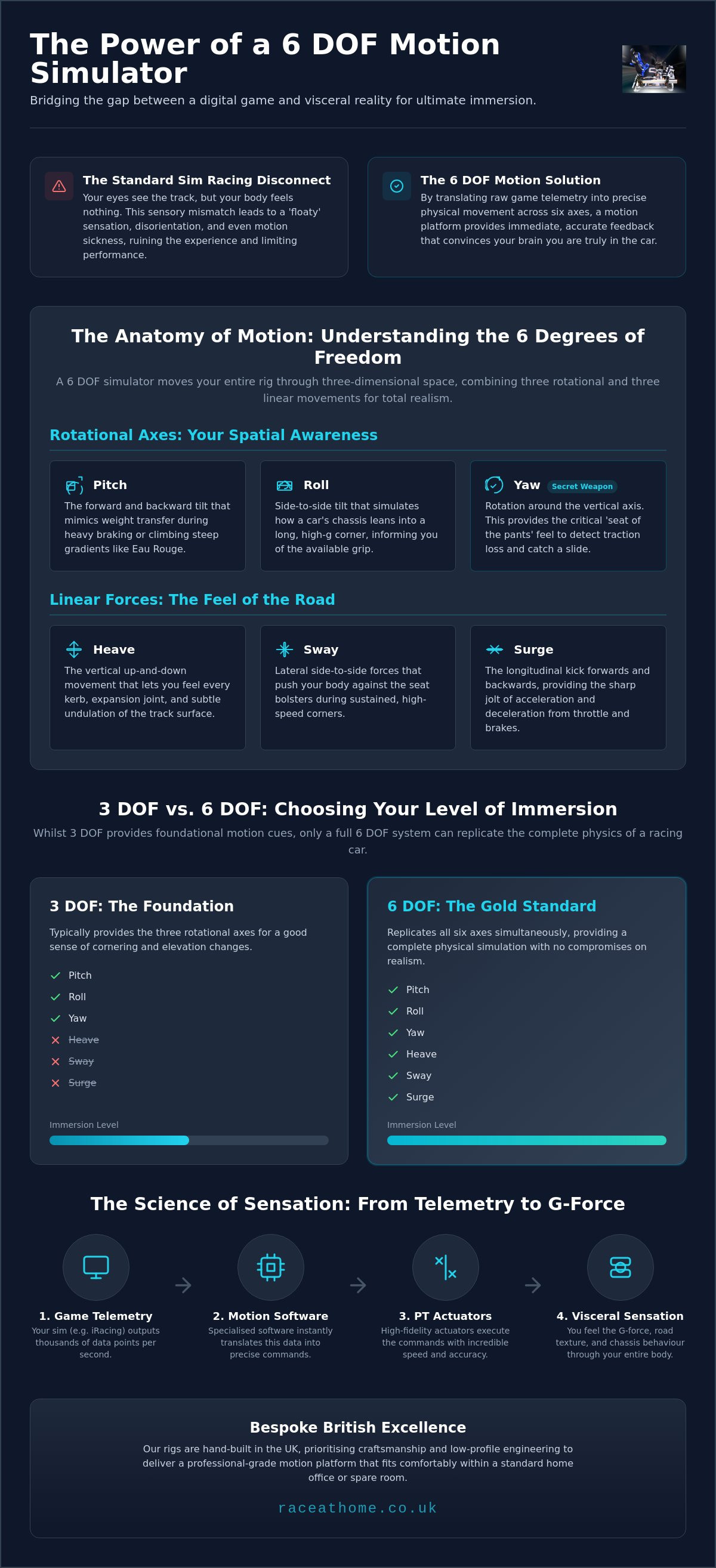
These rotational movements form the foundation of your spatial awareness on the track. Pitch allows your rig to tilt forward or backward, perfectly mimicking the weight transfer during heavy braking or whilst climbing the steep gradients of a circuit like Spa-Francorchamps. Roll handles the side-to-side tilt, simulating how a car leans into a long, high-speed corner. Most importantly, Yaw replicates the rotation around the vertical axis. In a competitive racing context, this is your secret weapon. It provides that essential "seat of the pants" feel that tells you exactly when your rear tyres have lost grip, giving you the split-second feedback needed to catch a slide before it ends your race.
The Linear Forces: Heave, Sway, and Surge
Whilst rotation is essential, linear forces provide the visceral textures of the track surface. Heave is the vertical movement. It lets you feel every kerb, every expansion joint, and the subtle undulations of the tarmac through your spine. Sway represents the lateral g-forces that push your body against the bolsters of your racing seat during sustained high-speed sweeps. Finally, Surge provides the longitudinal "kick". When you bury the throttle or bang through the gears of a sequential gearbox, surge provides that sharp jolt of acceleration and deceleration. It’s this intricate combination of all six axes that makes a 6 DOF motion simulator the undisputed gold standard for enthusiasts who refuse to compromise on realism.
The Science of Sensation: How Telemetry Becomes G-Force
The magic of a 6 DOF motion simulator lies in the invisible stream of data flowing from your PC to your seat. When you fire up a title like iRacing or Assetto Corsa, the game engine calculates thousands of variables every second, including suspension travel, tyre slip, and longitudinal G-forces. This raw telemetry is extracted by specialised motion software and translated into physical commands. Precision is everything. If the physical movement lags behind the visual cue by even a few milliseconds, the immersion shatters and the experience becomes disorienting. High-fidelity systems ensure this translation is instantaneous, turning digital numbers into visceral, bone-shaking reality.
Modern Driving Simulator Research confirms that the closer the physical feedback matches the visual telemetry, the more effectively a driver can find the limit of grip. This synchronicity is what allows professional sim racers to react to a snap of oversteer through muscle memory rather than waiting for the visual confirmation on screen. If you're looking to elevate your performance, exploring a bespoke motion platform provides the technical foundation needed to bridge that gap between software and sensation.
PT Actuators and Precision Engineering
Response time is the enemy of latency, which is why PT Actuator systems are the industry benchmark for high-end rigs. These actuators don't just move; they react with incredible velocity and frequency to mimic the high-pitched vibrations of a vibrating engine or the sharp jolt of a rumble strip. The "travel" of an actuator determines the range of motion, whilst its "velocity" determines how quickly it can reach that position. By partnering with these engineering leaders, Race@Home ensures that every movement is crisp, reliable, and capable of sustained professional use without the mechanical fade found in lesser systems.
Twin-Traction-Loss: The Secret to Finding the Limit
Standard motion platforms often struggle to communicate what the rear tyres are doing. Our Twin-Traction-Loss mechanism solves this by providing dedicated axes for the back of the car, allowing for true physical displacement rather than mere vibration. When the rear end steps out, the entire platform pivots to replicate that lateral slide. It’s a transformative sensation that allows you to catch slides that would otherwise result in a spin. Traction loss is the bridge between driving by sight and driving by feel. This specific feedback loop allows you to push harder into corners, knowing exactly how much grip you have left before the tyres give up.
6 DOF vs 3DOF: Choosing the Right Motion Level
The first thing you notice when transitioning from a 3DoF heave actuator system to a 6 Dof kit with linear travel is how smooth the driving experience has become. People don't tend to understand how the software adapts to eliminate the exaggerated pitches and rolls and convert the rocking horse motion in to sideways and back and forth motion along a flat plane. Suddenly, you are driving an actual car rather than a 2D render. Motion is much more subtle and targeted. When people complain that motion does not make you faster on the track, it's because the only feeling they get is rise, fall and lean. Only after you have tried a properly tuned 6DoF system will you appreciate the massive shortcomings of a 3DoF heave system and how much you have been missing.
Deciding between a 3DOF and a full 6 DOF motion simulator is often the most significant choice a sim racer will make. Whilst both systems provide a transformative escape from the limitations of a static rig, they serve different purposes. A 3DOF setup is an excellent entry point for those wanting to feel the car's basic attitude. It manages the essential movements that help you understand the track's topography. However, for drivers who demand professional-grade precision, the leap to six degrees of freedom is about more than just "more movement"; it's about complete sensory immersion.
When is 3DOF Enough?
A 3DOF platform is ideal if you're working within a tighter budget or a more constrained space. It focuses on the primary rotational and vertical axes:
- Pitch: Feeling the nose dive under heavy braking.
- Roll: Sensing the car lean through a long corner.
- Heave: Communicating the bumps and kerbs of the road surface.
Whilst this provides a massive boost to immersion, it leaves out the linear forces that tell you what the chassis is doing under acceleration and lateral load. Even worse, it converts sideways motion in to tilts and dives as if you were on a motorcycle and not a car. It's a great starting point, and many enthusiasts find that a 3DOF system satisfies their needs for years before the desire for total realism takes over. Once you have experienced the difference, you will never want to return to this basic setup.
The Professional Choice: Why 6 DOF Wins
For those involved in competitive leagues or professional driver coaching, a 6 DOF motion simulator is the non-negotiable standard. By adding sway, surge, and yaw, the platform provides a 360-degree sensory input that 3DOF simply cannot match. You aren't just feeling the car tilt; you're feeling the lateral G-forces pushing you into the seat bolsters during a high-speed sweep at Silverstone. You're also feeling the sharp jolt of the surge axis during a flat-out upshift.
This level of feedback is crucial for building real-world muscle memory. When you can feel the yaw axis reacting to a loss of rear-end grip, your brain processes that information faster than your eyes can see it on a monitor. This split-second advantage often means the difference between a podium finish and a retirement. Beyond the performance gains, a full 6 DOF rig serves as the ultimate centrepiece for any dedicated sim room, projecting an image of engineering excellence and a no-compromise approach to the hobby. If you plan to eventually reach the top tier of simulation, starting with a platform that can be upgraded or choosing a full 6 DOF system from the outset is the smartest way to future-proof your investment.
The Home Setup Challenge: Space, Footprint, and Assembly
Noise and vibration are the other silent killers of the home racing dream. If your rig shakes the entire house every time you hit a kerb, your racing sessions will be short-lived. We solve this by utilising high-density acoustic dampening and precision-engineered actuators that focus energy on the driver rather than the floorboards. Managing the electrical load is equally straightforward. These systems are designed to operate from a standard domestic power outlet, so you won't need to hire an electrician before you can turn a wheel in anger.
Low-Profile Design: The LowSlider Philosophy
Stability is the cornerstone of precision. A lower centre of gravity doesn't just make the rig easier to fit under a standard ceiling; it improves the mechanical response. By keeping the mass closer to the floor, we reduce unwanted oscillations and ensure that every millimetre of actuator travel is translated into pure sensation. This bespoke British approach allows a full 6 DOF motion simulator to occupy roughly the same space as a static aluminium profile rig. It’s the difference between an eyesore and a piece of high-performance engineering that complements your favourite room.
From Box to Podium: One-Hour Assembly
Logistics shouldn't be a barrier to entry. We've simplified the process through a "Four Pieces" shipping model that makes global delivery and setup effortless. You don't need a degree in mechanical engineering to get started. Most users are ready to hit the track within sixty minutes of opening the crates. The process is methodical and intuitive. You simply connect the main frame segments, mount the pre-calibrated actuators, and plug in the controller box. If you're ready to see how a professional setup fits into your life, explore our range of compact motion platforms today.
The Race@Home LowSlider 6 DOF: Bespoke British Excellence
The sim racing market is saturated with generic, mass-produced rigs that often feel like a compromise. Choosing a 6 DOF motion simulator from Race@Home means moving away from one-size-fits-all solutions and embracing a platform engineered specifically for your competitive goals. Whilst competitors often offer kits that arrive as a daunting pile of hundreds of loose components, our approach focuses on delivering a refined, hand-finished product. This isn't just about movement; it's about the soul of the machine. Every LowSlider is a testament to British engineering, designed to provide a seamless bridge between digital telemetry and physical sensation.
Our commitment to excellence extends beyond the hardware itself. We understand that a professional-grade rig is a significant investment in your hobby. That's why we provide worldwide support to ensure your system performs at its peak, no matter where your home circuit is located. From initial configuration to long-term maintenance, you're backed by the same experts who hand-built your platform. This bespoke relationship ensures that your rig evolves alongside your driving skills, maintaining its position as the ultimate evolution of your home setup.
Hand-Built to Order
Your journey begins with a consultation, not just a checkout button. Because every driver has a different favourite discipline, we tailor the setup to match your specific needs. If you're a Formula enthusiast, the response curves are optimised for high-downforce precision. If you prefer GT endurance, the system is tuned for the subtle weight transfers of a heavy chassis. Being hand-built in the UK allows for a level of quality control that mass production simply cannot replicate. We don't just ship boxes; we deliver a bespoke piece of performance hardware that has been tested and refined before it ever leaves our workshop.
The Complete Sensory Package
A world-class motion platform is the heart of your rig, but the ecosystem around it completes the illusion. To achieve total immersion, we recommend pairing the LowSlider with Pimax VR headsets. This combination ensures that the visual horizon moves in perfect harmony with the physical tilt of your seat, effectively eliminating the sensory lag that breaks the "presence" of the simulation. When you integrate high-end pedals and a direct-drive wheel, the transformation is complete. You're no longer playing a game; you're operating a professional training tool. If you're ready to stop compromising and start driving, it's time to take the final step in your sim racing evolution.
Enquire about your bespoke LowSlider 6 DOF build today
Elevate Your Racing Beyond the Screen
Transitioning from a static rig to a 6 DOF motion simulator is the single most significant upgrade you can make to your simulation career. By bridging the gap between digital telemetry and physical sensation, you gain the split-second feedback necessary to master oversteer and perfect your lines. You've seen how modern engineering has solved the traditional hurdles of space and complexity. The dream of a professional-grade cockpit in a standard home office is now a reality.
With our proprietary ultra-low profile LowSlider design, you don't have to compromise on your living space to achieve world-class realism. Every rig is hand-built in the UK and arrives at your door in four easy-to-assemble pieces, allowing you to go from unboxing to the podium in just one hour. We ship worldwide to ensure every enthusiast has access to the ultimate evolution of the hobby.
Build Your Dream 6 DOF Motion Rig with Race@Home
Your fastest lap times are waiting to be discovered; it's time to feel the track like never before.
Frequently Asked Questions
Do I need a special floor to support a 6 DOF motion simulator?
You don't need a specially reinforced industrial floor, but a solid, level surface like concrete or a sturdy wooden floor is ideal. Because the LowSlider distributes weight across a proprietary wide footprint, it is safe for most modern domestic buildings. We recommend using high-density rubber matting to protect your flooring and further dampen any vibration during intense racing sessions. This ensures the rig remains stable whilst protecting the integrity of your home's interior.
Will a 6 DOF motion platform work with all racing games?
Most leading sim racing titles are fully compatible through industry-standard software like SimTools or SimRacingStudio. This includes popular sims such as iRacing, Assetto Corsa Competizione, and Dirt Rally 2.0. If a game outputs telemetry data, a 6 DOF motion simulator can translate that into physical movement. The depth of the experience depends on the specific game's telemetry output, but most modern titles provide rich data for all six axes.
How much space do I actually need for a LowSlider 6 DOF rig?
You need surprisingly little space, as the LowSlider is designed with a small physical footprint that matches most high-end static aluminium rigs. A dedicated area of approximately 2 metres by 1.5 metres is usually sufficient for the rig and its full range of motion. We suggest leaving a small "safety zone" around the platform to ensure the moving parts don't strike walls or furniture during high-travel manoeuvres. This compact design makes it the perfect fit for a standard spare room.
Does a motion simulator help with sim sickness or make it worse?
A high-fidelity 6 DOF motion simulator typically reduces sim sickness by aligning your body's physical sensations with the visual cues on screen. Motion sickness is often caused by the brain receiving conflicting signals; your eyes see movement whilst your inner ear feels none. By providing accurate G-force cues that match what you see in your headset or on your monitors, the simulator resolves this conflict, allowing for longer, more comfortable racing sessions.
What kind of PC specs are required to run a 6 DOF motion system?
You don't need a secondary PC, but your current system should be powerful enough to handle the sim and the motion software simultaneously. A modern multi-core processor and at least 16GB of RAM are recommended to ensure low-latency data processing. The motion software itself has a small CPU overhead, but maintaining a high, stable frame rate in your racing title is essential for smooth motion synchronisation and a lag-free experience.
Can I upgrade a 3DOF LowSlider to a 6 DOF system later?
Yes, the LowSlider system is designed with a modular philosophy that allows you to start with a 3DOF platform and upgrade when you're ready. You can add the additional actuators and the Twin-Traction-Loss mechanism as your budget or competitive needs evolve. This future-proof approach ensures your initial investment remains protected whilst providing a clear, logical path to the ultimate 6 DOF experience without having to replace your entire rig.
How loud is a 6 DOF motion simulator during a race?
Modern PT Actuators are remarkably quiet, producing a mechanical hum that is often drowned out by your game audio or the cooling fans on your PC. Whilst the actuators themselves are stealthy, the rig can transmit vibrations through the floor during heavy kerb strikes. Using the included dampening feet and placing the rig on a rug or acoustic matting ensures you can race late into the night without disturbing housemates or neighbours.
Is the LowSlider 6 DOF compatible with VR headsets like Pimax?
The LowSlider 6 DOF is fully compatible with VR headsets, including the high-resolution Pimax range. In fact, using VR alongside a motion platform provides the most immersive experience possible. The motion software includes "motion cancellation" features to ensure your view in the virtual cockpit remains stable. This means your head position in the game doesn't bounce around unnaturally even as the physical rig tilts and surges beneath you.


