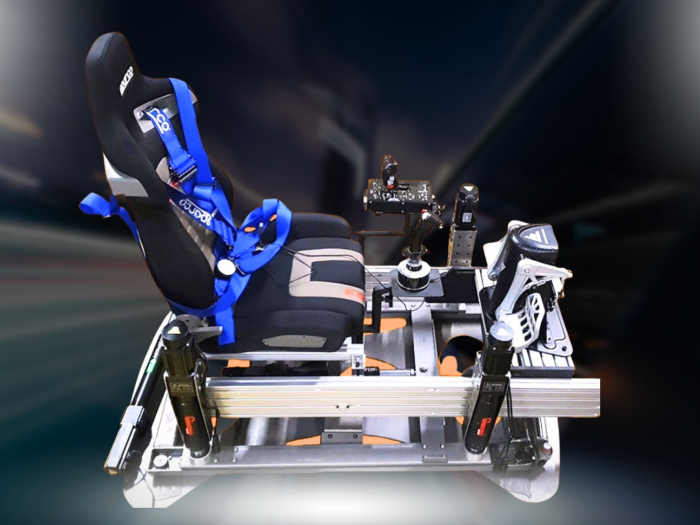

Could a few millimetres of mechanical travel be the difference between a podium finish and a costly trip into the tyre wall? You likely recognise that static simulators, whilst useful for learning track layouts, often fail to communicate the vital weight transfer required to master true car control. If your current setup leaves you feeling disconnected or, worse, battling the "cue conflict" that leads to motion sickness, then you haven't yet experienced a professional motion simulator for driver training.
We'll show you how professional-grade hardware transforms your preparation from simple visual cues into a high-fidelity tool for building real-world racecraft. This guide explores the evolution of 6 DOF technology, focusing on how the bespoke LowSlider platform delivers precision feedback within a compact footprint suitable for a home office or small studio. You'll learn to develop instinctive muscle memory for oversteer and understeer, significantly reducing the cost of your driver development programme while maintaining a no-compromise approach to engineering realism. We will examine the technical specifications required to eliminate latency and ensure every bit of digital telemetry translates into a tangible, visceral sensation.
Key Takeaways
- Understand why high-frequency response is essential for building the vestibular system's muscle memory and real-world intuition.
- Learn why a professional motion simulator for driver training must include 6 Degrees of Freedom and Twin Traction Loss to accurately replicate vehicle behaviour.
- Discover the performance benefits of full-motion platforms that move the entire cockpit, ensuring your controls remain perfectly aligned during intense weight transfers.
- Explore how modular engineering and a compact footprint allow you to integrate a high-fidelity training tool into a standard home office or studio.
- Recognise how bespoke, UK-built hardware provides the structural rigidity and low centre of gravity required for precise telemetry feedback.
The Role of a Commercial Motion Simulator in Professional Driver Training
Commercial-grade hardware is defined by one thing: frequency response. Whilst entry-level consumer rigs often rely on slow, sweeping movements that feel more like a fairground ride than a race car, a professional motion simulator prioritises high-velocity micro-movements. These actuators must react in milliseconds to translate digital telemetry into physical reality. If the hardware cannot keep pace with the software, the result is a disconnect that breaks immersion and prevents the development of genuine racecraft. For the serious driver, a motion simulator for driver training isn't a luxury; it's a precision instrument designed to bridge the gap between a screen and the tarmac.
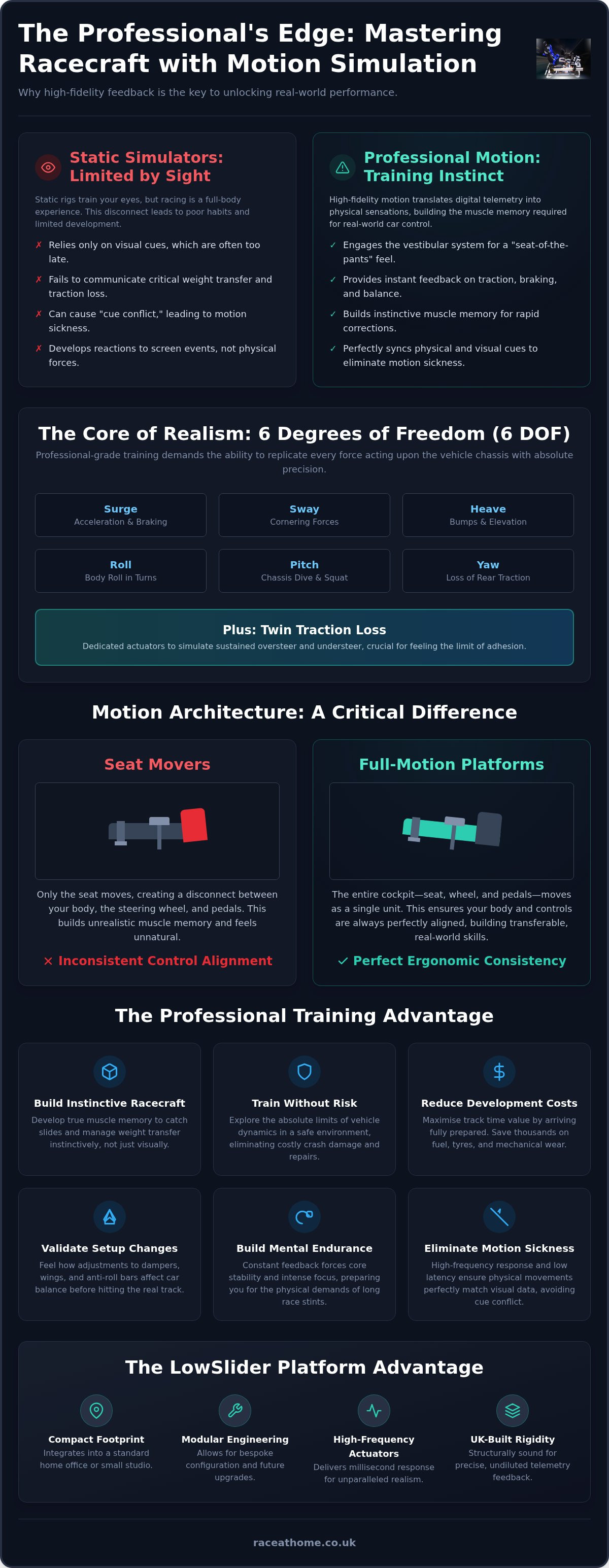
Static simulators are fundamentally limited because they only train your eyes. In a real vehicle, your inner ear and vestibular system detect a loss of traction long before your vision registers the slide. By the time you see the car rotating on a static screen, it's often too late to catch it. A high-fidelity motion rig corrects this by providing the "seat-of-the-pants" feel required to catch oversteer instinctively. This builds the specific muscle memory needed for high-performance driving, allowing you to react to the car's behaviour through physical sensation rather than visual lag.
The financial argument for professional motion is equally compelling. Consider the spiralling costs of a single track day: fuel, fresh tyres, brake pads, and transport logistics. A bespoke motion platform allows for thousands of laps of repeatable, high-intensity practice without the mechanical wear or the risk of a heavy shunt. It's a one-time investment in hardware that pays for itself by maximising the value of every actual minute you spend on a real circuit.
Bridging the Gap Between Virtual and Real-World Physics
Professional motion cues alert you to the limit of adhesion instantly. When the rear tyres begin to scrub or the front end pushes wide, the actuators communicate that vibration directly to your chassis. You'll feel every kerb, every expansion joint, and every subtle change in elevation with startling clarity. Low-latency feedback is the secret to avoiding the dreaded "cue conflict" that causes motion sickness. By ensuring the physical movement perfectly matches the visual data, the brain accepts the simulation as reality, allowing for hours of focused training without fatigue.
Developing Racecraft Without the Risk
A motion rig provides a safe environment to explore the absolute limits of a vehicle's envelope. You can practice aggressive late-braking manoeuvres or deliberate oversteer correction repeatedly until the movement becomes second nature. It's also an invaluable tool for building mental endurance. Handling a car at its limit is physically demanding; the constant feedback from a 6 DOF system forces you to maintain core stability and focus through long stints. This allows you to validate setup changes, such as damper stiffness or wing angles, by feeling how they alter the car's balance before you ever turn a wheel on a physical track. For drivers who combine their sim training with real-world karting, using professional equipment from Lazy Kart ensures that their physical gear is as optimised for performance as their digital setup.
Technical Fidelity: Why 6 Degrees of Freedom and Twin Traction Loss are Mandatory
High-performance driving is a game of sensory data. To build a truly effective motion simulator for driver training, the hardware must reproduce every physical force acting upon the chassis with absolute precision. Whilst basic simulators might offer three degrees of freedom (3DoF), professional-grade development requires 6 Degrees of Freedom (6 DOF). This ensures that every nuance of the car's behaviour is communicated to the driver's body. Even the most sophisticated research driving simulator used in federal safety testing relies on these complex motion profiles to ensure data validity. Without this level of fidelity, you are simply playing a game; with it, you are conducting a professional test session.
The integration of PT Actuator technology within our platforms allows for the translation of digital telemetry into high-frequency vibrations and sustained G-force sensations. These actuators don't just move; they communicate. They replicate the harshness of a kerb strike, the subtle vibration of an engine at the redline, and the violent weight shift of a sudden lane change. If you're looking to refine your competitive edge, exploring a bespoke motion platform can provide the fidelity required for professional-grade training.
The Science of Traction Loss Feedback
The most significant hurdle for any driver is mastering the limit of adhesion. Traditional motion systems often use a single "yaw" axis to simulate the car rotating, but this is insufficient for professional training. The LowSlider 6 DOF Twin-Traction-Loss Motion Platform utilises two independent axes to simulate traction loss at both the front and rear axles. This allows you to feel the "snap" of oversteer as the rear tyres break traction, or the distinct, numbing sensation of understeer as the front end scrubs wide. Detecting this front-end wash-out is critical for refining your corner entry speed and steering inputs, a level of detail that basic yaw rotation simply cannot provide.
Degrees of Freedom and Driver Behaviour
- Heave and Surge: These axes replicate vertical movement and longitudinal forces. You'll feel the nose dive under heavy braking and the rear squat during hard acceleration, teaching you to manage the contact patch of the tyres.
- Roll and Pitch: These movements inform the driver about cornering loads and elevation changes. Understanding how the car's weight leans into a corner allows you to adjust your line and throttle application with greater accuracy.
In the context of professional telemetry integration, 6 DOF refers to the simultaneous reproduction of heave, surge, sway, pitch, roll, and yaw to create a cohesive, lag-free physical representation of the vehicle's state. By mastering these forces in a controlled environment, you develop an intuitive understanding of vehicle dynamics that translates directly to the real-world circuit.
Comparing Motion Architectures: Seat Movers vs Full-Motion Platforms
Choosing the right architecture is often the most debated aspect of commissioning a motion simulator for driver training. On one side, you have seat movers, which articulate only the driver’s chair whilst the rest of the rig remains stationary. On the other, you have full-motion platforms that move the entire cockpit, including the wheel, pedals, and seat. Whilst seat movers are often marketed as a cost-effective way to simulate G-forces through pressure points, they introduce a fundamental flaw for professional development: the changing distance between your body and your controls.
When your seat tilts back under acceleration but your pedals stay fixed, your leg extension increases. This creates a disconnect that never occurs in a real race car. For a professional race driver training simulator, maintaining consistent ergonomics is non-negotiable. A six-degrees-of-freedom motion-base system that moves the entire chassis is the only way to ensure the physical relationship between your hands, feet, and the vehicle remains constant. This architectural choice is what prevents "cue conflict", the jarring sensation where your eyes see one thing but your body feels an anatomically impossible movement. By moving the entire unit, the brain accepts the motion as a singular, cohesive event.
Why Full-Motion is the Gold Standard for Coaching
Professional coaching requires a platform that eliminates false cues. If a simulator teaches you to adjust your grip or pedal pressure because the seat is moving independently of the steering column, you are developing bad habits that will hinder you on the track. Full-motion platforms ensure that every heave, surge, and roll is felt by the whole unit. This consistency allows you to focus entirely on the telemetry and your inputs. It is also why VR integration, such as with Pimax headsets, works so effectively with full-motion; the entire environment moves in unison, grounding you in the virtual cockpit without the nausea associated with static-wheel setups.
Space vs Performance: The LowSlider Compromise
Historically, achieving this level of fidelity required a massive footprint. Traditional hexapod rigs often demand dedicated rooms with high ceilings and reinforced floors. The LowSlider engineering philosophy challenges this by delivering full 6 DOF and twin traction loss in an ultra-low profile format. By keeping the centre of gravity low and the footprint compact, we have removed the barriers to professional-grade motion. In 2026, "compact" no longer signals a compromise in quality. It represents a refined, bespoke approach to engineering that fits a high-fidelity training tool into a small studio or home office without sacrificing a single degree of mechanical precision.
Implementation Logistics: Footprint, Assembly, and VR Integration
The logistical complexity of installing a high-fidelity 6 DOF rig has historically been a significant barrier for private drivers. Traditional hexapod systems often arrive as a monolithic crate of industrial components, requiring specialised teams and several days to commission. We've dismantled this barrier through a modular engineering approach. By shipping the platform in four manageable, pre-configured pieces, we can offer a "One-Hour Assembly" promise. This allows you to transition from unboxing to your first out-lap in a fraction of the time required by mass-market alternatives.
Space management is equally critical when integrating a motion simulator for driver training into a residential or small studio environment. Whilst industrial-grade simulators typically demand a dedicated workshop, the LowSlider is designed with a compact footprint that respects the constraints of a home office. This efficiency doesn't just save space; it simplifies the process of grounding and powering the unit, ensuring that professional-grade feedback is accessible without the need for structural room modifications.
Maximising Immersion with VR and Motion
For drivers working within a compact studio, VR headsets like the Pimax Crystal are the ideal partner for a motion platform. VR eliminates the need for massive triple-monitor stands, further reducing the overall footprint of your setup. The key to this integration is precise motion cancellation. This software-level synchronisation ensures that your virtual head position remains perfectly aligned with the cockpit, even as the actuators produce violent heave and surge forces. This technical synergy creates a professional sim racing simulator experience that feels indistinguishable from reality, providing a 1:1 visual and physical relationship with the track.
Ease of Ownership and Maintenance
Investing in a hand-built UK product ensures long-term reliability and straightforward maintenance. Every component of our platforms is chosen for its industrial durability, designed to withstand the high-frequency vibrations of daily training sessions. Our hardware communicates naturally with software platforms like Sim Racing Professional, allowing for instant telemetry tuning and profile customisation. This modular philosophy extends to future-proofing; as new actuators or control boards emerge, the rig's design allows for upgrades rather than replacement. If you're ready to bring this level of engineering into your own space, you can explore our full range of motion platforms and VR accessories to find the perfect configuration for your training goals.
The LowSlider Advantage: Professional Training Realism in a Compact Format
The LowSlider engineering philosophy is built on the pursuit of mechanical purity. By prioritising an ultra-low profile, we've eliminated the pendulum effect often found in taller, less stable systems. This low centre of gravity ensures that every actuator force is directed into your body rather than being lost to chassis flex or platform sway. When you invest in a motion simulator for driver training, you are buying the accuracy of that feedback. Hand-built in the UK, each LowSlider platform represents a level of craftsmanship that mass-market, factory-line alternatives cannot replicate. It is a bespoke tool for those who demand engineering excellence over consumer-grade compromises.
Our signature 6 DOF Twin-Traction-Loss configuration stands as the definitive tool for serious driver development. It bridges the gap between digital data and physical intuition by isolating the slip angles of both the front and rear axles. This allows you to feel the car's balance with surgical precision, providing the necessary cues to adjust your driving style in real-time. This level of detail is why the LowSlider is the logical choice for a 6 DOF motion simulator upgrade. It doesn't just add movement; it adds meaning to your telemetry, transforming every session into a genuine test of your racecraft.
Bespoke Engineering for the Serious Enthusiast
We understand that every driver has a unique focus, whether it's mastering the nuances of GT3 weight transfer or the high-frequency vibrations of a single-seater. Our platforms are designed to be tailored to your specific training goals. This customisation extends to the integration of high-end sim racing accessories, ensuring that your steering torque and pedal resistance perfectly complement the motion profile. Because we design and build our rigs in the UK, our clients enjoy direct support from the engineering team that actually turned the wrenches on their platform. This relationship ensures your hardware is always optimised for the latest software updates and racing series.
Next Steps: Taking Your Training to the Next Level
Transitioning to a high-fidelity motion simulator for driver training is a significant step in any competitive career. If you're ready to move beyond the limitations of static rigs, the process begins with a consultation to define your specific requirements. We'll help you prepare your facility or home studio for delivery, ensuring you have the correct power requirements and floor space for the LowSlider's compact footprint. Don't settle for a setup that merely entertains; invest in a tool that develops your skills. You can request a bespoke quote today and begin the journey of transforming your virtual laps into real-world performance.
Elevate Your Racecraft with Professional Motion
The evolution of driver development in 2026 demands more than just visual cues; it requires a physical connection to the car's telemetry. By moving beyond static setups and embracing a high-fidelity motion simulator for driver training, you're investing in the instinctive muscle memory that defines professional racecraft. We've explored how 6 Degrees of Freedom and Twin Traction Loss provide the specific feedback necessary to master the limit of adhesion, whilst full-motion architecture ensures your ergonomics remain perfect through every high-G corner.
The proprietary LowSlider design proves that you don't need a warehouse-sized facility to achieve world-class realism. Every platform is hand-built in the UK with engineering precision and is available with worldwide shipping to ensure your training programme is never restricted by geography. It's time to bridge the gap between software and the circuit. Explore the LowSlider 6 DOF and start your professional training journey today. Your path to the podium begins with the right feedback.
Frequently Asked Questions
Is a motion simulator actually helpful for learning real-world tracks?
Yes, a motion simulator for driver training is exceptionally effective for learning track layouts and elevation changes. Whilst a static rig teaches you where the corners are, motion teaches you how the car's weight shifts through them. This physical feedback allows you to identify compression points and off-camber sections, ensuring your real-world out-lap is significantly more productive and safer from the first turn.
How much space do I need for a 6 DOF motion simulator for driver training?
You need surprisingly little space for a modern 6 DOF system like the LowSlider. Unlike traditional industrial rigs that require a dedicated room with high ceilings, our compact design fits within a footprint similar to a standard triple-monitor setup. Most drivers find that a small studio or home office provides ample room for the platform's range of travel and safe operation without structural modifications.
Does a motion platform help reduce motion sickness in VR?
Yes, a motion platform is one of the most effective ways to reduce VR-induced nausea. Motion sickness often stems from "cue conflict", where your eyes see movement that your inner ear doesn't feel. By providing physical feedback that matches the visual telemetry, the motion platform synchronises your senses and allows for much longer, more intense training sessions without the physical discomfort associated with static VR use.
Can I use a commercial motion simulator with standard sim racing games like iRacing?
Absolutely, our commercial platforms are fully compatible with leading titles like iRacing, Assetto Corsa Competizione, and rFactor 2. The hardware utilises professional-grade telemetry software to extract data directly from the game engine. This ensures that every bump on the digital track is translated into a precise physical movement through the actuators, making it a versatile tool for both competitive sim racing and real-world preparation.
How difficult is it to assemble the LowSlider motion platform?
Assembly is straightforward and specifically designed for the end-user. The LowSlider arrives in four pre-configured, manageable pieces that bolt together simply. We offer a one-hour assembly promise, meaning you won't need a team of technicians or specialised industrial tools to get your rig operational. It's a professional solution engineered for simple home or studio integration without the typical headaches of high-end hardware.
What is the difference between 3DoF and 6 DOF for driver training?
The primary difference lies in the complexity of the weight transfer and vehicle behaviour. A 3DoF system typically handles pitch, roll, and heave, which covers basic car movement. However, a 6 DOF motion simulator for driver training adds surge, sway, and yaw. This full range is mandatory for professional training because it replicates the lateral sliding and longitudinal forces that are vital for mastering car control at the limit.
Do I need special electrical wiring for a professional motion rig?
No, you typically don't require specialised industrial wiring for our motion platforms. The actuators are engineered for high efficiency and generally run off standard UK household power sockets. We recommend a dedicated circuit if you're running multiple high-draw components like powerful PCs and direct drive wheels simultaneously, but the motion system itself is remarkably energy-efficient and designed for standard residential or office environments.
Are these simulators compatible with direct drive wheels and load-cell pedals?
Yes, our platforms are designed specifically to handle the extreme forces generated by direct drive wheels and high-pressure load-cell pedals. The structural rigidity of the LowSlider chassis ensures that none of the feedback from your peripherals is lost to frame flex. This creates a cohesive ecosystem where your steering, braking, and motion feedback all work together with absolute precision to replicate the feel of a real race car.


