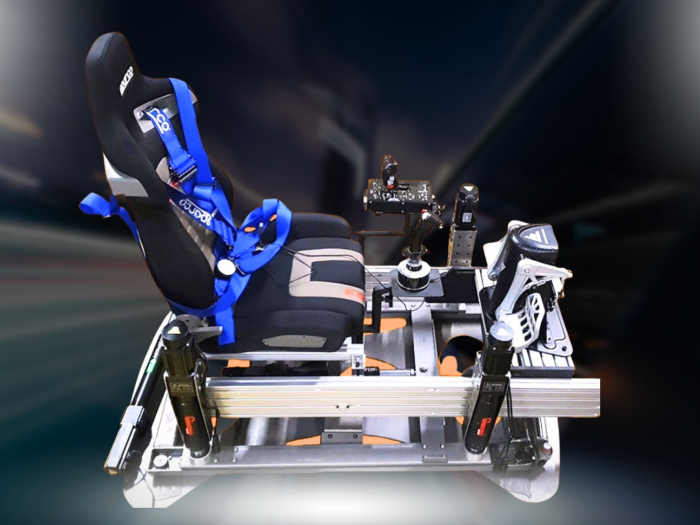

What if you could experience the raw, visceral G-forces of a professional 6 DOF rig without spending your entire weekend lost in a labyrinth of aluminium extrusion and T-nuts? Most sim racers assume that high-fidelity motion realism requires a dedicated warehouse and a PhD in mechanical engineering just to get started. You've likely felt the frustration of bulky platforms that dominate your floor space or the nagging fear that a slight misalignment during a complex home build will lead to mechanical binding. It's a common hurdle that keeps many enthusiasts stuck on static rigs whilst dreaming of more immersion.
The good news is that clever engineering has changed the landscape for 2026. Understanding the low profile motion simulator benefits is the key to unlocking a professional-grade experience that fits seamlessly into a spare bedroom or home office. If you choose a modular, hand-built design, then you can bypass the traditional headaches of assembly without compromising on sensory feedback. This guide explores how you can achieve a track-ready, pre-calibrated 6 DOF setup in under an hour, ensuring your focus remains on hitting the apex rather than tightening bolts.
Key Takeaways
- Discover how modular engineering allows you to assemble a professional 6 DOF motion platform in under 60 minutes using only four pre-aligned components.
- Learn about the low profile motion simulator benefits that ensure your rig remains stable and compact enough for a standard home office or bedroom.
- Understand why a lower centre of gravity and hand-built UK craftsmanship deliver superior rigidity and more accurate sensory feedback than mass-market kits.
- See how factory-tested modules remove the technical hurdles of mechanical binding and complex calibration, getting you onto the track faster.
- Explore the logistics of modular rigs that provide a no-compromise gateway to professional-level immersion without the need for specialist installation teams.
The Evolution of Sim Racing Rig Assembly in 2026
The era of the "weekend build" is officially over. In 2026, professional-grade sim racing no longer requires a literal toolbox and three days of your life to achieve immersion. We've seen a decisive shift away from raw aluminium extrusion kits toward factory-tested modular systems. This evolution is driven by advanced actuator technology that now integrates motion and telemetry data more efficiently than ever before. One of the primary low profile motion simulator benefits in this new landscape is the simplified architecture. By reducing the number of individual parts, engineers have actually increased mechanical precision. Fewer joints mean fewer points of failure and a more direct translation of digital physics into physical sensation.
Modern enthusiasts demand a "Ready to Race" experience. They want the visceral thrill of a motion simulator without the industrial-scale assembly project. This demand has birthed a new generation of hardware where the complex engineering happens at the factory in the UK, not on your living room floor. If you choose a system designed with a modular philosophy, then you're investing in a rig that prioritises your time on the track over your time with a hex key.
The Problem with Traditional T-Slot Extrusion Rigs
If you've ever stared at a pile of two hundred T-nuts and a thirty-page manual, you know the specific frustration of traditional rigs. The "hundred-bolt" headache isn't just about time; it's about accuracy. Standard nuts and brackets are notoriously difficult to align perfectly at home. Consider these common pitfalls:
- Alignment Errors: Just one millimetre of error during home assembly can lead to mechanical binding. This creates friction that wears down your actuators and ruins the smoothness of the feedback.
- Structural Creep: Over time, the vibration from high-torque direct drive wheels can cause hundreds of individual fasteners to loosen, leading to unwanted flex.
- Calibration Hurdles: Complex DIY builds often require professional software calibration after the physical build is finished to compensate for assembly variances.
The Modular Revolution: Speed Without Compromise
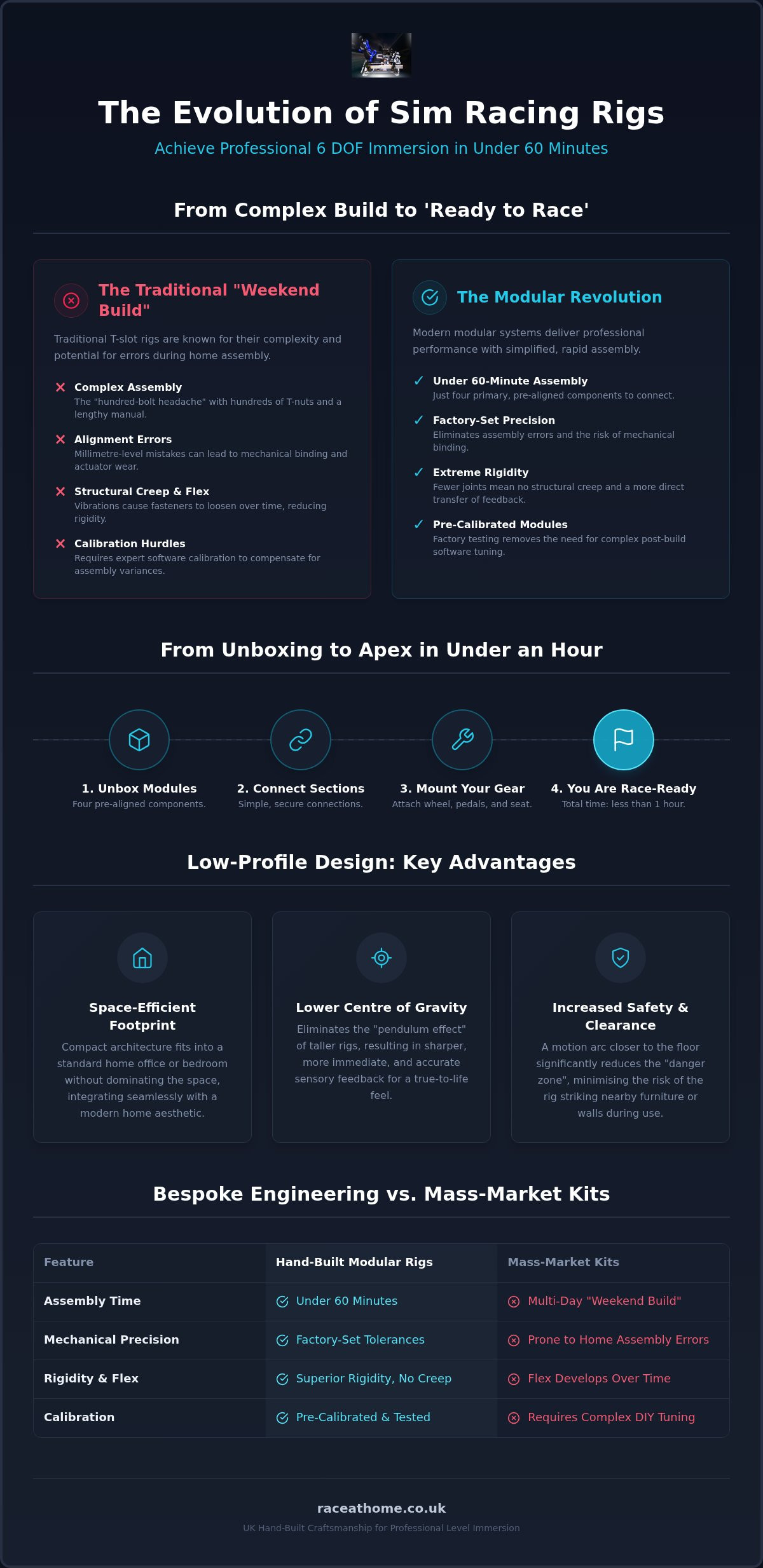
Modular design is the sophisticated answer to these assembly woes. By shipping a rig in four primary pre-aligned components, manufacturers ensure the structural integrity remains uncompromised. This approach maintains the extreme rigidity required for professional 6 DOF systems whilst ensuring a verified assembly time of under 60 minutes. You get the benefit of factory-set tolerances that simply cannot be replicated with a bag of loose bolts. This "Four-Piece" strategy means you can move from unboxing to the starting grid in record time, confident that your low profile motion simulator benefits from the same precision engineering used in professional motorsport trainers. It’s about achieving elite realism through clever design rather than sheer complexity.
Key Benefits of Low Profile Motion Simulators for Modern Homes
Traditional motion systems often resemble industrial scaffolding, requiring a dedicated room with high ceilings just to accommodate the vertical travel of the actuators. One of the standout low profile motion simulator benefits is the ability to house a professional 6 DOF setup within a standard room footprint. Because the architecture is compact, you don't need to sacrifice your home office or spare bedroom to achieve elite-level immersion. These designs look like professional-grade racing equipment rather than a DIY experiment, making them far easier to integrate into a modern home aesthetic.
Safety and clearance are equally important in a domestic setting. A taller rig creates a larger "danger zone" around the equipment, as the arc of motion covers a wider area. By keeping the platform closer to the floor, you significantly reduce the risk of the rig striking nearby furniture or walls during high-intensity racing. It’s a practical evolution that prioritises your living space whilst maintaining the rigour of professional simulation.
Physics and Performance: The Low Centre of Gravity
A lower rig isn't just about saving space; it's about the physics of the drive. When the centre of gravity is closer to the floor, you effectively eliminate the "pendulum effect" that plagues taller, top-heavy rigs. This leads to sharper, more immediate feedback during high-speed cornering and sudden weight transfers. If you're interested in how simulator fidelity impacts driver performance, you can look at human factors research which highlights the importance of realistic physical cues in training environments. The LowSlider design specifically addresses these challenges by keeping the entire platform height to a minimum, ensuring that traction loss and yaw feel more direct and less dampened by frame sway.
Ergonomics and Accessibility
Ease of ingress is a massive practical win for the home user. You should be able to step into your rig, not scale it like a piece of gym equipment. This lower entry point simplifies the seating position for long-distance endurance racing and ensures your cockpit height aligns naturally with standard desk or monitor setups. For VR enthusiasts, a low-profile rig is particularly beneficial. It reduces the disconnect between your physical height in the room and the virtual cockpit height in the software, which significantly lowers the risk of motion sickness or disorientation during intense sessions. If you're ready to upgrade your home setup, you can explore our range of motion platforms to see how these engineering choices translate into performance.
The Anatomy of a Modular Motion Platform: Rigidity Meets Convenience
Engineering for the domestic environment requires a calculated approach to physics and logistics. The "Four-Piece" strategy utilised by Race@Home represents a significant departure from the "bag of bolts" mentality that defines mass-market kits. Instead of forcing you to build a complex frame from scratch, the platform arrives as four primary, pre-aligned modules. This architecture is the foundation of the low profile motion simulator benefits, as it allows for a verified assembly time of under 60 minutes without sacrificing the industrial strength required for professional-grade simulation. You're effectively unboxing a rig that has already been fully built and tested as a complete unit in a UK facility before being modularised for transit.
Materials play a decisive role in this balance. Whilst some competitors opt for thin-walled tubing to reduce shipping costs, these structures often lack the torsional rigidity needed for 6 DOF realism. We utilise heavy-duty steel for the primary frame components. This choice ensures that the rig remains a "zero-flex" environment, even when paired with high-torque direct drive wheel bases that can exceed 25Nm of force. By using pre-wired electronics, we also eliminate the "cable nest" that typically plagues home builds. If you can connect a handful of primary structural bolts and plug in a few pre-labelled connectors, then you have the technical skills required to get onto the track.
Structural Integrity in Easy-Assembly Designs
The secret to a successful modular rig lies in knowing where to weld and where to bolt. Permanent strength is essential in the motion housing to prevent the frame from "creeping" over time under the intense vibration of the actuators. The integration of PT Actuator technology within this modular framework allows for lightning-fast response times and incredible mechanical precision. Because the core components are factory-aligned, you don't have to worry about the millimetre-level errors that lead to mechanical binding in DIY extrusion kits. It’s professional-grade engineering delivered in a format that respects your time.
Software Integration: The Digital Side of Easy Setup
A rig is only as good as its telemetry translation. To ensure the hardware delivers on its promise of realism, every platform comes with pre-calibrated telemetry profiles. This removes the "software struggle" that often follows a physical build. Whether you're chasing lap times in iRacing, masterminding a drift in Assetto Corsa, or navigating a flight path in MSFS, the motion feedback is tuned to feel natural from the first corner. This plug-and-play philosophy extends to VR as well. Integrating Pimax VR headsets is a seamless process, providing immediate, high-resolution immersion that works in perfect harmony with the physical cues of the platform. You aren't just buying hardware; you're investing in a curated ecosystem where the digital and physical worlds are already in sync.
Step-by-Step: Assembling Your Pro-Grade Rig in Under One Hour
Forget the six-hour marathons often associated with DIY motion kits. When your rig arrives, you’ll find exactly four primary modular components ready for integration. This streamlined approach is a direct result of the low profile motion simulator benefits inherent in our engineering philosophy. By handling the complex alignment at our UK facility, we’ve reduced the home assembly process to a series of straightforward structural connections. You won't need a specialist engineering degree; you just need about 45 to 60 minutes and a basic set of tools.
The assembly begins with unboxing and organising these four modules. Because every rig is hand-built and tested as a complete unit before shipping, every bolt hole and connector is guaranteed to align. This removes the guesswork and the potential for mechanical binding that often occurs when building from raw extrusion. You are simply re-joining a system that has already proven its performance on our factory floor.
Phase 1: The Foundation and Motion Base
Phase 2: Peripheral Mounting and Final Tuning
Once the core frame is secure, you can seat the cockpit and secure the pedal plate assembly. The modular design allows for quick-release adjustments, making it easy to dial in the perfect reach for different driver heights. Now is the time to attach your favourite steering wheel and other sim racing accessories. Because we’ve pre-routed the primary internal wiring, your final cable management will be clean and professional. Avoid the usual "cable nest" by following the pre-labelled routing paths for a finish that looks as good as it performs.
The "First Power-On" sequence is the most rewarding part of the process. Connect the control box to your PC and initiate the motion check. The system will perform a self-diagnostic sweep, confirming that all six degrees of freedom are responding to the telemetry data. If you’re ready to stop building and start racing, you can order your modular LowSlider platform today and be on the track by next weekend.
The LowSlider Advantage: Why Bespoke Engineering Beats Mass-Market Kits
Selecting your ultimate simulator is a defining moment for any enthusiast. Whilst mass-market kits are often treated as generic consumer electronics, the LowSlider 6 DOF Twin-Traction-Loss Motion Platform is treated as a piece of precision motorsport equipment. The difference lies in our "Ready to Race" promise. Every rig is hand-built and rigorously tested in our UK facility before it ever reaches your door. This ensures that the mechanical tolerances are perfect and the sensory feedback is exactly as the engineers intended, providing a level of out-of-the-box reliability that mass-produced alternatives simply cannot match.
The Race@Home approach eliminates the need for a dedicated team of engineers to manage your unboxing. Because the system is modularised only after it has passed its final performance check, you receive a rig that is guaranteed to work. You also gain direct access to professional support from the specialists who actually designed and built your hardware. If you have a technical query or need to fine-tune your telemetry, you're speaking to an expert, not a generic call centre agent. To fully appreciate the true investment value of a professional rig, you must look at the longevity and support that comes with bespoke UK craftsmanship.
Hand-Built Quality vs. Factory Mass Production
Mass production often requires compromises in material thickness and fastener quality to facilitate automated assembly. We take the opposite path. By hand-finishing every structural joint, we ensure that the tactile feedback you feel through the chassis is crisp and unfiltered. One of the primary low profile motion simulator benefits of this bespoke approach is the integration of our proprietary twin-traction-loss technology. This isn't a generic add-on; it's a fundamental part of the modular design that allows for realistic oversteer and understeer sensations without the bulk of traditional frames. These rigs are engineered to survive the rigours of both high-intensity home use and demanding commercial environments, ensuring your investment remains at the cutting edge for years to come.
Join the Future of Sim Racing
When you decide to order a bespoke LowSlider 6 DOF or LowSlider 3DoF motion platform, you're entering a collaborative process. We keep you informed throughout the build, ensuring every component meets our stringent rigidity standards before it's carefully modularised for worldwide shipping. You don't have to choose between professional realism and home-friendly logistics anymore. If you're ready to experience the most immersive feedback in the industry, Explore the LowSlider range and start your professional build today. The starting grid is waiting, and with a rig that's built to perform, you'll be ready to dominate it in under an hour.
Step into the Future of Professional Home Simulation
Achieving elite-level immersion no longer requires a compromise between professional realism and the practicalities of home life. By embracing a modular architecture, you can sidestep the technical frustrations of traditional T-slot builds whilst securing a rig that delivers uncompromising 6 DOF feedback. The low profile motion simulator benefits extend far beyond mere aesthetics; they provide a foundation of superior stability and a lower centre of gravity that translates digital telemetry into sharp, visceral physical sensations. You're investing in a system where the heavy engineering is already complete, allowing you to focus on the drive rather than the assembly.
Every rig we produce is hand-built in the UK to order and ships in just four pre-aligned pieces. This proprietary design ensures a verified sub-60 minute assembly time, getting you from unboxing to the starting grid faster than any other professional motion system on the market. If you're ready to transform your sim racing experience with a setup that prioritises both performance and convenience, then it's time to take the next step. Build Your Bespoke LowSlider Motion Platform Today and experience the apex of home simulation. We'll see you on the track.
Frequently Asked Questions
How long does it actually take to assemble a Race@Home motion rig?
It typically takes under 60 minutes to move from unboxing to the starting grid. Because the LowSlider arrives in four primary pre-aligned modules, you aren't building a frame from scratch. You are simply re-joining factory-tested components that have already been verified for mechanical precision in our UK facility. This streamlined process eliminates the typical weekend-long assembly projects associated with traditional DIY motion kits.
Do I need special tools or engineering skills to build the LowSlider?
No specialist engineering skills or heavy industrial tools are required for the build. You can complete the assembly using a basic set of hex keys and spanners. Since the electronics are pre-wired and the actuators are pre-installed, you won't need to tackle complex wiring diagrams or soldering. If you can tighten a structural bolt, you have all the technical expertise necessary to get your rig track-ready.
Can one person assemble the 6 DOF platform alone?
Yes, a single person can comfortably assemble the 6 DOF platform. Whilst the heavy-duty steel components provide professional rigidity, the modular design ensures that each of the four pieces is manageable for a solo home user. The pre-aligned bolt holes ensure that the components slide together without the need for a second set of hands to hold heavy beams in place during the fastening process.
Is a low-profile rig as sturdy as a tall aluminium extrusion frame?
A low-profile rig is actually sturdier than many tall frames because it significantly reduces the pendulum effect and frame sway. One of the primary low profile motion simulator benefits is the lower centre of gravity, which minimises the leverage forces acting on the joints. By using hand-finished UK steel rather than thin-walled aluminium, we ensure a zero-flex environment that handles high-torque direct drive bases with ease.
Does the rig come with all the necessary motion software and cables?
Every system ships as a complete, plug-and-play solution including all necessary power cables, data leads, and pre-calibrated software profiles. You won't have to spend hours hunting for telemetry settings or troubleshooting driver compatibility. The rig arrives with pre-set configurations for major titles like iRacing and Assetto Corsa, ensuring that the physical motion and digital data are perfectly synchronised from your very first session.
What are the space requirements for a 6 DOF motion simulator?
The 6 DOF platform is designed to fit within a standard room footprint of approximately 1.5m by 2.0m. Because the actuators are integrated into the low-profile base rather than extending vertically, you don't need high ceilings or a massive clearance zone. This spatial efficiency makes it possible to enjoy professional-grade realism in a typical home office or spare bedroom without relocating your existing furniture.
How does the worldwide shipping work for such large components?
We utilise a modular shipping strategy that allows these professional-grade systems to be delivered worldwide without the need for specialist freight handling. By breaking the rig down into four pre-assembled modules, we can package the system securely for international transit. This approach ensures your hardware arrives in pristine condition, factory-tested and ready for a swift assembly, regardless of where your home circuit is located.
Can I upgrade from a 3DoF to a 6 DOF platform later?
The modular nature of our engineering allows for a straightforward upgrade path from a 3DoF to a full 6 DOF platform. If you choose to start with a 3DoF setup, you can later integrate the additional actuators and twin-traction-loss modules to achieve the full range of motion. This flexibility ensures that your rig can evolve alongside your sim racing ambitions without requiring a complete chassis replacement.


