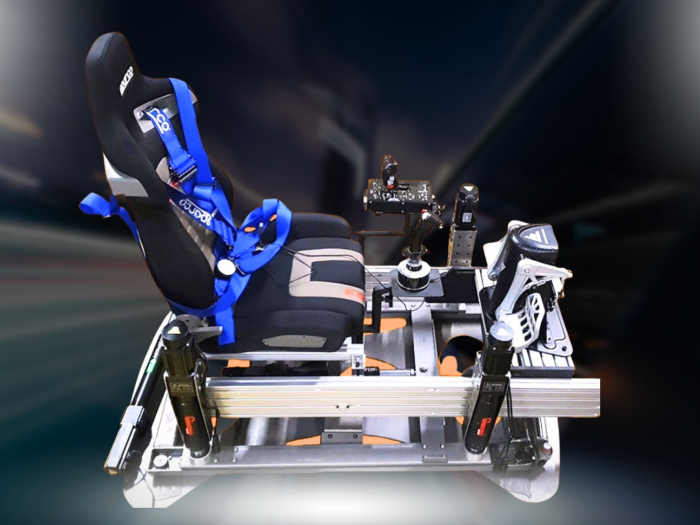

If you are relying on a static rig to prepare for a competitive race weekend, you aren't truly training; you're simply memorising a map. To build a professional race driver training simulator environment, you need more than just visual cues. Digital precision is useless if your body cannot feel the weight transfer through a high-speed apex or the subtle loss of traction under heavy braking. You likely recognise the frustration of nailing a virtual lap time only to find that the lack of physical feedback makes it difficult to translate those digital gains to the actual tarmac, or worse, leads to the disorientation of motion sickness in poorly optimised setups.
This guide demonstrates how to bridge that gap by utilising advanced motion technology to build genuine proprioceptive muscle memory. You'll discover how to transform your setup into a high-fidelity environment that replicates the visceral intensity of the cockpit. We will explore the technical nuances of UK-engineered 6 DOF motion platforms, such as the LowSlider, and examine how data-driven coaching can sharpen your racecraft whilst significantly reducing your real-world testing costs.
Key Takeaways
- Learn why physical sensory feedback is the foundation of a professional race driver training simulator, moving beyond simple visual immersion to build true proprioceptive memory.
- Understand how 6 DOF motion platforms communicate critical vehicle behaviours, such as understeer and oversteer, before your eyes even register the change on screen.
- Discover the essential hardware components for a coaching-grade rig, including the proprietary LowSlider platform and high-fidelity Pimax VR headsets.
- Master the methodology of a professional training session by implementing baseline testing and advanced telemetry data acquisition to track your progress.
- Explore how the compact, UK-engineered design of the LowSlider 6 DOF allows you to maintain a professional-standard training environment within a home-based footprint.
Defining the Professional Race Driver Training Simulator
A professional race driver training simulator is far more than a high-end gaming peripheral; it's a precision engineering instrument designed for measurable performance gains. Whilst entry-level setups focus on visual immersion, a professional-grade environment prioritises the translation of digital telemetry into physical sensations. If your rig doesn't communicate the exact moment your rear tyres lose grip, you're guessing, not training. The goal isn't just to play a game, but to build a reliable feedback loop between the car's physics and your own central nervous system.
Authentic vehicle behaviour relies on a full motion racing simulator that uses real-time data to drive actuators. This ensures that every bump, kerb strike, and weight shift is felt exactly as the software calculates it. Without a stable, high-torque platform, these forces are lost in chassis flex. Consistency is the hallmark of professional training. If the hardware cannot reproduce the same sensation lap after lap, you cannot develop the reliable muscle memory required to find those final tenths on a qualifying run.
The Core Pillars of Simulation Fidelity
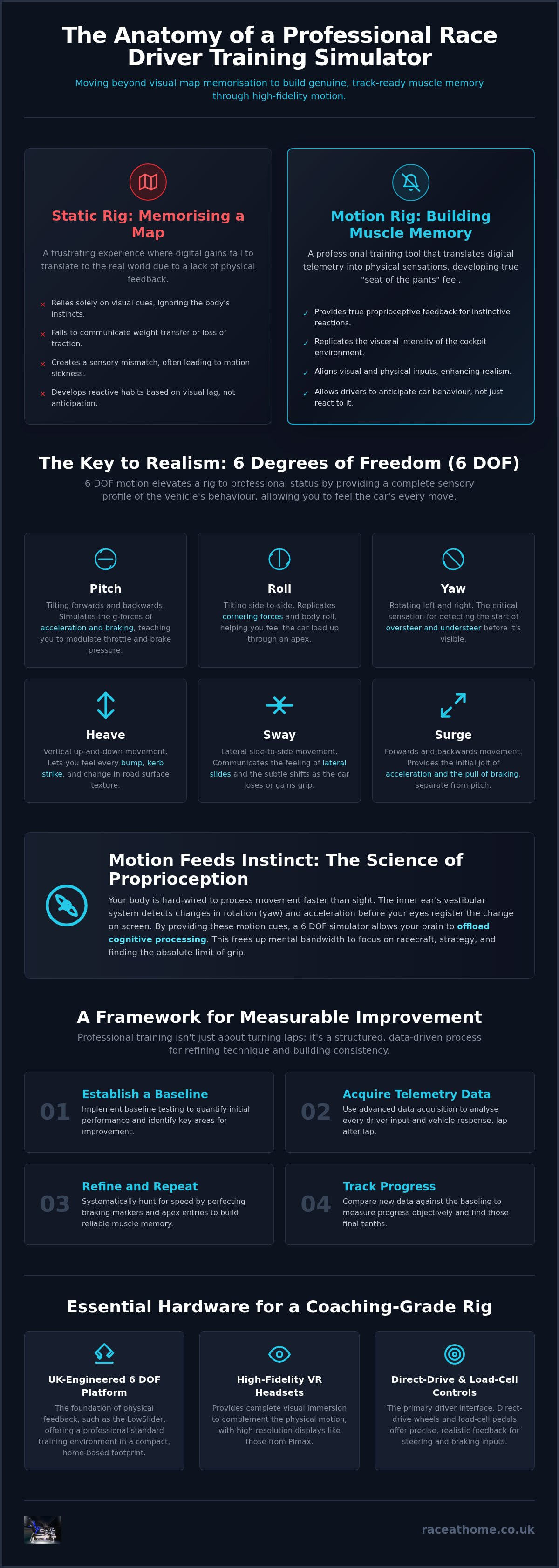
True fidelity begins with 1:1 physics modelling. Software like iRacing provides the mathematical foundation, but the hardware must be capable of expressing it. High-end load-cell pedals and direct-drive steering wheels are foundational because they provide the primary resistance points for the driver. However, the introduction of 6 Degrees of Freedom (6 DOF) is what elevates a rig to professional status. By simulating pitch, roll, yaw, heave, sway, and surge, a platform like the LowSlider 6 DOF provides a complete sensory profile. This allows you to anticipate car behaviour rather than reacting to visual lag.
Bridging the Gap: From Virtual to Tarmac
Professional drivers use simulators to do more than just learn a track layout. They use them to hunt for speed by refining braking markers and perfecting apex entries. This process relies on cognitive offloading. When the simulator provides realistic physical cues, your brain doesn't have to work as hard to interpret what the car is doing. This frees up mental bandwidth for strategic decision-making and refining technique. In this context, fidelity is defined as the accuracy of data translation. It's the measure of how closely the digital output matches the physical input required to control a real-world vehicle.
Why Motion Realism is Non-Negotiable for Driver Development
Visuals provide the map, but motion provides the truth. In a professional race driver training simulator, the primary objective is to shorten the gap between digital simulation and physical reality. Human biology is hard-wired to process movement faster than sight. When a car begins to rotate into an oversteer moment, your inner ear detects the change in yaw before your eyes register the pixel shift on a screen. If your rig is static, you're constantly reacting to late information, which prevents the development of the reflexive, "seat of the pants" instincts required at the limit of grip.
This physiological connection is known as proprioception. It's the body's ability to sense its own position and movement in space. Research conducted by organisations like the Driving Safety Research Institute highlights how high-fidelity motion is essential for valid driver behaviour studies. Without these physical cues, the brain must work significantly harder to "guess" the car's state, leading to cognitive fatigue. By integrating a 6 DOF platform, you allow your brain to offload this processing to your natural balance centres, enabling you to focus entirely on racecraft and technical precision.
The Science of Proprioceptive Feedback
Your vestibular system, located within the inner ear, is a sophisticated motion sensor. It detects linear acceleration and rotational movements with incredible sensitivity. Static rigs create a sensory mismatch; your eyes see 200mph, but your body feels total stillness. This conflict is the primary cause of simulator sickness. A well-calibrated motion setup aligns these inputs, reducing disorientation whilst building accurate muscle memory. For a deeper dive into the mechanics of these systems, explore The Ultimate Guide to 6 DOF Motion Simulators.
Mastering the Limit with Twin-Traction-Loss
In GT racing or professional drifting, the ability to feel rear-end slip is the difference between a podium and a DNF. Traditional motion platforms often struggle to separate chassis roll from tyre slip. The LowSlider 6 DOF addresses this through Twin-Traction-Loss technology. This specific configuration allows the platform to simulate independent front and rear lateral movement. If the rear tyres begin to wash out, you feel the platform physically slide beneath you. This immediate feedback teaches you to catch slides earlier and more consistently, effectively refining your car control through tangible sensory data rather than visual guesswork.
Essential Components for a Professional Sim Coaching Setup
Constructing a professional race driver training simulator requires a curated ecosystem where every component justifies its presence through data accuracy and physical reliability. It isn't merely about assembling the most expensive peripherals; it's about ensuring each part communicates effectively with the driver. A professional coaching setup must provide a consistent, repeatable environment that allows you to isolate variables in your driving technique. If your hardware fluctuates in its feedback, your training becomes guesswork rather than a scientific pursuit of speed.
The foundation of this ecosystem is the interface between the software's physics engine and your physical senses. Whilst many enthusiasts focus on aesthetics, a professional driver prioritises the fidelity of the control inputs. This means selecting high-torque direct-drive wheelbases and, crucially, high-fidelity pedals. Software like iRacing and Assetto Corsa Competizione lead the coaching industry because their telemetry output is granular enough to drive professional-grade hardware with 1:1 precision, allowing coaches to analyse your brake pressure and steering traces with absolute clarity.
Selecting the Right Motion Platform
The motion platform is the central nervous system of your rig. Mass-produced, consumer-grade frames often lack the structural rigidity required to handle the violent, high-frequency vibrations of professional actuators. Choosing a hand-built platform, such as the LowSlider 6 DOF, ensures that the motion is transferred directly to the driver rather than being absorbed by a flexing chassis. This UK-engineered design offers a compact footprint, making it ideal for dedicated home training rooms where space is at a premium but performance cannot be compromised. For advice on selecting the right pedals to pair with such a rigid frame, consult our Sim Racing Accessories Guide.
Immersive Visuals and VR Integration
Visual fidelity is about more than just high frame rates; it's about spatial awareness. Whilst triple-screen setups offer a wide field of view, high-fidelity Pimax VR headsets provide an unparalleled sense of depth perception. This allows you to judge the distance to an apex or a braking marker with the same stereoscopic vision you'd use on a real circuit. To maximise this advantage, it's vital to align your VR "world scale" with your physical seat position. When your virtual hands and the physical rim match perfectly, the immersion transition is seamless, allowing you to clip apexes with millimetre precision whilst maintaining total situational awareness of the cars amongst you on the grid.
How to Organise a Professional Training Session
Owning the hardware is only half the battle. To extract genuine value from a professional race driver training simulator, you must approach every session with the discipline of a factory racing team. Just as a factory relies on integrated systems for efficiency, the garment industry uses Tracker to handle production scheduling and machine integration. This begins with baseline testing. You must establish your raw pace without electronic assists, ensuring that your lap times are a direct product of your technique rather than the software's safety nets. Once a baseline is set, data acquisition becomes your primary tool. Setting up telemetry software like MoTeC allows you to move beyond "feeling" fast and start proving it through objective, granular data.
Targeted drills are the most effective way to bridge the gap to the leaders on the grid. Instead of endlessly lapping a circuit, focus on specific sectors or techniques, such as perfecting your trail-braking consistency or your throttle application at a particular apex. By isolating these movements, you build the refined muscle memory that we discussed in previous sections. Finally, the process concludes with a review and iteration phase. By comparing your sim telemetry against real-world data logs from a VBOX or AiM system, you can identify precisely where the digital environment is helping or hindering your real-track progress. Extracting peak performance from a professional race driver training simulator requires this constant loop of action and analysis.
Telemetry and Data Analysis for Drivers
Reading a "squish" chart is a fundamental skill for any serious driver. These visualisations show the overlap between your braking and throttle application, highlighting moments of coasting or inefficient transitions that cost hundreds of a second. Comparing your line against a professional "ghost" lap provides immediate visual feedback on your positioning and corner speed. For a deeper look at how these analytical tools are shaping the future of the sport, see our report on The Evolution of the Professional Sim Racing Simulator.
Remote Coaching and Connectivity
Connectivity has transformed home-based training into a collaborative experience. You can now share high-fidelity telemetry files with a professional coach in real-time, regardless of your location. Tools like Discord enable live screen-sharing, allowing a coach to watch your inputs whilst you're in the motion seat. One highly effective technique is the "blind" session, where a coach remotely alters car variables like brake bias or aero balance without your knowledge. This forces you to rely on the physical feedback of your rig to adapt your driving style on the fly, just as you would during a changing race stint.
To begin building your own data-driven training environment, explore our professional motion platforms.
Elevating Performance with Race@Home LowSlider Technology
Race@Home provides the technical bridge between digital telemetry and the physical realities of the circuit. By focusing on the proprietary LowSlider design, we've developed a professional race driver training simulator that prioritises mechanical honesty over aesthetic fluff. Every rig is hand-built to order in the UK, ensuring that the structural integrity of the chassis can withstand the high-frequency demands of professional-grade actuators. This isn't a mass-produced product; it's a bespoke engineering project designed for the driver who views their simulator as a critical development tool rather than a luxury toy.
Choosing the right partner for your training environment means looking beyond the hardware specs and evaluating the long-term reliability of the system. Our hand-built approach ensures that every bolt and weld is inspected for rigidity, preventing the parasitic vibrations that plague lighter, mass-market frames. When you're training at the limit, you need to know that every sensation is a direct translation of the car's behaviour, not a rattle in the rig. This commitment to craftsmanship makes Race@Home the preferred choice for drivers who demand no-compromise realism in their pursuit of competitive excellence.
The LowSlider 6 DOF Advantage
Realism in a motion rig is often compromised by the physical height of the platform. A high centre of gravity introduces artificial pendulum effects that don't exist in a real race car, muddling the sensory data your brain receives. The LowSlider 6 DOF Twin-Traction-Loss Motion Platform solves this through an ultra-low profile design that keeps the driver as close to the floor as possible. This configuration, paired with lightning-fast PT Actuators, ensures that every heave, pitch, and roll command is executed with zero perceptible lag. To understand how to integrate this technology into your specific home environment, consult The Ultimate Sim Racing Setup Guide.
Seamless Support and Worldwide Reach
One of the primary barriers to entry for a professional race driver training simulator has traditionally been the complexity of the installation. Whilst competitors often require on-site engineers and days of calibration, the Race@Home model is built for efficiency. We ship our platforms worldwide in four pre-assembled pieces. This allows for a one-hour assembly process that gets you into the cockpit without the stress of a complex logistics project. Whether you're adding Pimax VR Headsets for total immersion or fine-tuning your inputs with our curated sim racing accessories, our team provides the technical authority to keep your training on track.
Explore our range of professional motion platforms today and take the first step toward a more precise, data-driven racing career.
Master the Tarmac from Your Cockpit
The transition from a digital enthusiast to a podium contender requires more than just seat time; it requires a sensory environment that refuses to compromise on physics. By integrating 6 DOF motion and Twin-Traction-Loss technology, you move beyond visual guesswork and start training your vestibular system to react to the subtle nuances of vehicle behaviour. We've explored how high-fidelity hardware and rigorous telemetry analysis transform a standard rig into a genuine professional race driver training simulator, allowing you to build the instinctive muscle memory needed for the real-world track.
Investing in your racecraft shouldn't be a logistical burden. Every Race@Home platform is hand-built in the UK and engineered for worldwide shipping in four easy-to-assemble pieces, ensuring you can begin your professional training within an hour of delivery. Our proprietary LowSlider technology provides the ultra-low centre of gravity required for authentic feedback, keeping you grounded whilst you hunt for those final tenths. If you're ready to bridge the gap between virtual data and tangible results, the path forward is clear.
Build Your Professional Training Rig with Race@Home
Your next lap record is waiting; make sure you have the tools to claim it.
Frequently Asked Questions
How does a motion simulator help with real-world driver training?
It bridges the gap between visual information and physical sensation by stimulating your vestibular system. This allows you to develop reflexes for car rotation and weight transfer that static rigs simply cannot replicate. By experiencing realistic G-forces, you build the specific muscle memory required to catch slides and manage weight distribution on a real circuit.
What is the best software for professional driver coaching in 2026?
iRacing and Assetto Corsa Competizione remain the industry standards for a professional race driver training simulator setup. These platforms provide high-fidelity physics engines and granular telemetry output. This data is essential for coaches to analyse driver inputs and vehicle behaviour with the precision required for competitive development.
Can I use a 6 DOF motion platform for remote coaching sessions?
Yes, 6 DOF platforms are ideal for remote coaching when paired with live telemetry streaming. A coach can monitor your inputs and the car’s state in real-time via software like Discord or dedicated data portals. This connectivity allows for immediate feedback on your physical handling of the car’s movement during a live session.
How much space does a professional 6 DOF simulator require?
A professional 6 DOF setup typically requires a dedicated area of approximately 2.5 metres by 2 metres. Whilst traditional rigs are often bulky, the professional race driver training simulator built on a LowSlider design is specifically engineered for a compact footprint. This allows you to house a full-motion environment within a standard spare room without sacrificing performance.
Does a motion platform help reduce simulator sickness?
Yes, a well-calibrated motion platform significantly reduces simulator sickness by resolving the sensory mismatch between your eyes and your inner ear. When your body feels the acceleration and cornering forces that your eyes see on screen, the brain processes the environment more naturally. This alignment prevents the disorientation often experienced in static setups.
How long does it take to assemble a Race@Home LowSlider rig?
Assembly typically takes approximately one hour. Because the rig is shipped in four major pre-assembled components, the setup process is straightforward and requires no specialist engineering knowledge. This approach ensures you can transition from delivery to driver training with minimal downtime or technical frustration.
Is VR or a triple-monitor setup better for professional training?
Both have distinct advantages depending on your training goals. High-fidelity VR headsets, such as those from Pimax, offer superior depth perception and spatial awareness for clipping apexes. Triple-monitor setups provide better peripheral vision and are often preferred for long-duration endurance training where heat and comfort are primary considerations.
What telemetry software is recommended for professional sim racing?
MoTeC i2 is widely considered the gold standard for professional sim racing data analysis. It allows you to compare your virtual laps against real-world data logs with incredible detail. Other professional-grade options include VBOX and AiM, which are frequently used by racing teams to synchronise simulator sessions with actual track testing data.


