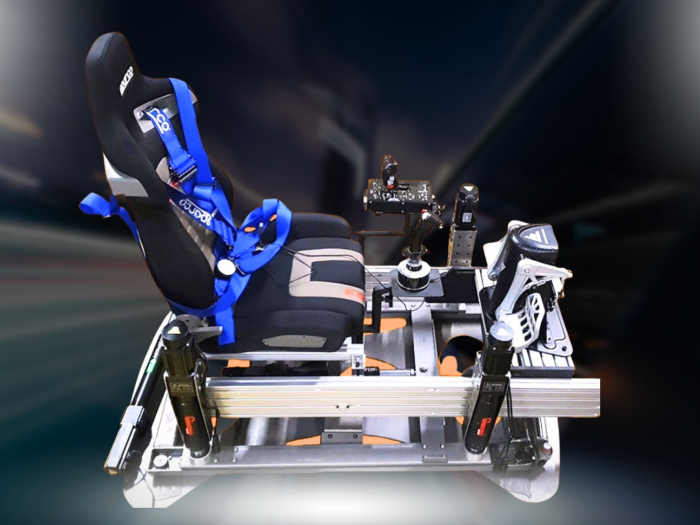

Most drivers assume a motion platform should throw you violently around the room, but excessive travel actually destroys lap times. True kinetic realism isn't about fairground rides; it's about translating tyre telemetry into instantaneous balance instincts. If you are contemplating upgrading from static rig to motion, you are likely wondering how to bridge the gap without suffering chassis flex, latency headaches, or an unwieldy rig that dominates your living space.
You have spent countless hours dialling in direct-drive feedback, brake pressures, and racing lines; the last thing you want is a noisy, flexing setup that induces nausea instead of shaving off tenths. In this guide, you will master every technical, structural, and ergonomic factor needed to convert your static cockpit into an authentic motion platform. We will evaluate whether your existing chassis can withstand dynamic actuator loads, compare the telemetry translation of 3DoF and 6 DOF architectures, and map out a seamless route to genuine tactile immersion from day one.
Key Takeaways
- Learn how vestibular onset cueing replaces purely visual reaction times with instantaneous physical sensations, transforming how you detect tyre slip and weight transfer.
- Audit your existing aluminium cockpit for torsional flex and weight distribution to ensure dynamic actuator energy is felt rather than absorbed by the chassis.
- Compare the distinct mechanical physics of seat movers, 3DoF platforms, and comprehensive 6 DOF architectures featuring independent twin traction loss.
- Discover why upgrading from static rig to motion requires isolated display mounting or active VR motion compensation to eliminate visual disorientation and hardware strain.
- Uncover how pre-calibrated modular engineering and an ultra-low centre of gravity solve domestic living space, noise, and complex calibration hurdles.
Why Upgrading from Static Rig to Motion Transforms Sim Racing
Static rigs isolate your sense of car control to your palms and your eyes. When tyre grip breaks at the rear axle, your steering wheel lightens and the pixels on your screen yaw. By the time your visual cortex identifies that slide, the car's yaw angle is already past its optimum recovery window. Kinetic feedback bridges this sensory deficit. It acts as high-frequency vestibular communication, converting direct physics telemetry into the exact physical displacements your body anticipates.
A widespread misconception across online sim racing forums is that dynamic cockpits simply bounce drivers around like theme-park rides. Rudimentary setups might produce disorienting theatre, but precision platforms utilise vestibular onset cueing. When you brake, accelerate, or trail into an apex, actuators supply rapid, brief acceleration cues before smoothly washing out back to centre below the threshold of human perception. This mechanical precision is what makes upgrading from static rig to motion a competitive advantage rather than an immersion novelty.
The Limits of Visual and Force Feedback Cues
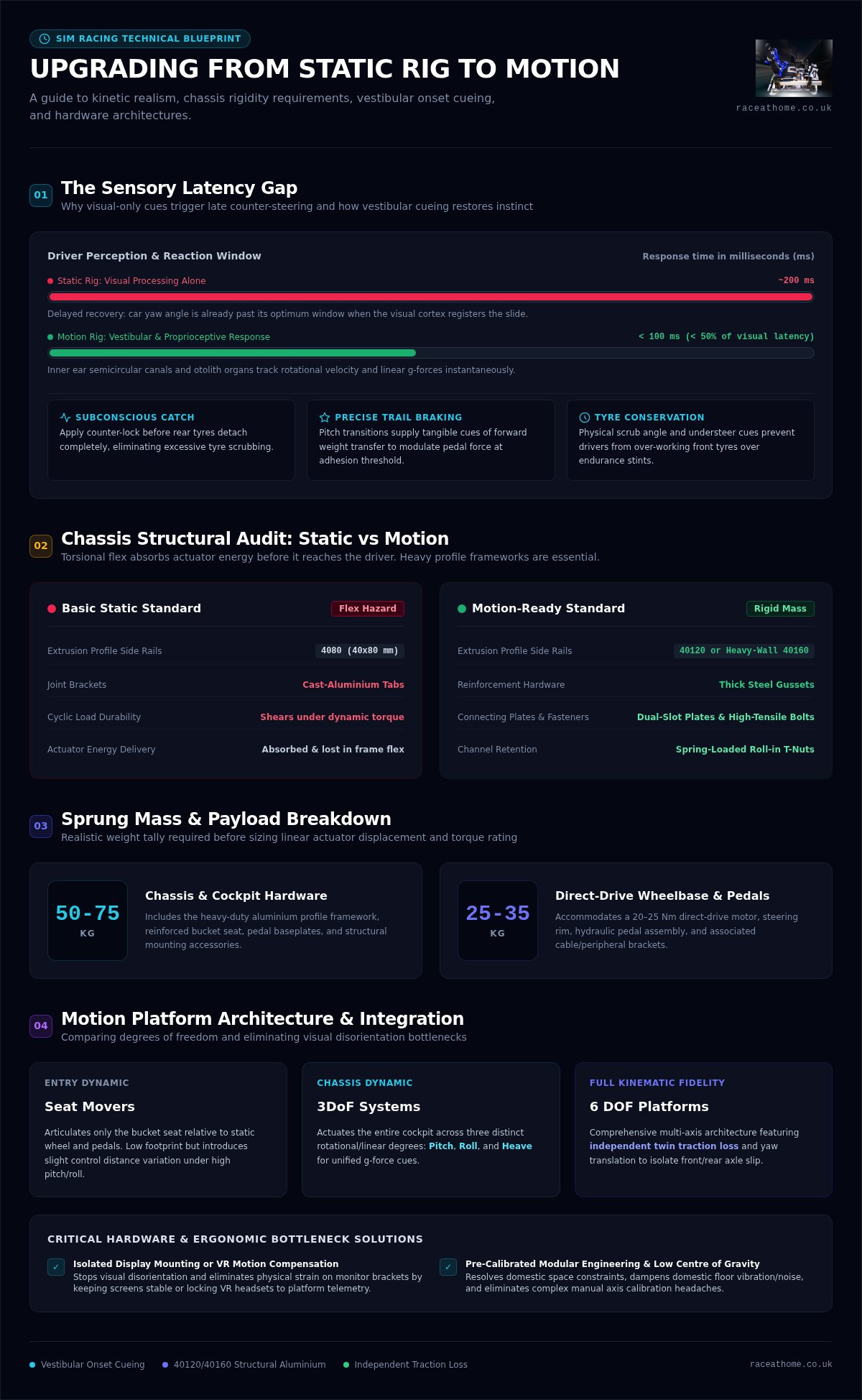
Direct-drive wheelbases are formidable tools, yet relying purely on motor torque forces your brain into constant guesswork. Visual processing takes roughly 200 milliseconds to detect a breaking car, whereas human proprioception and vestibular organs react in less than half that time. On a static chassis, sudden oversteer leaves you waiting for wheel resistance to soften or the horizon to rotate. This sensory delay triggers late counter-steering, erratic throttle snaps, and mental fatigue across long endurance stints.
Vestibular Acceleration and Muscle Memory Development
Your inner ear contains semicircular canals and otolith organs that track rotational velocity and linear g-forces instantaneously. Exploring the established degrees of freedom in motion simulation reveals how isolating pitch, roll, and heave directly targets these biological receptors. Instead of calculating a slide through sight alone, your inner ear registers vehicle rotation within milliseconds of weight transfer occurring.
This rapid physical transmission shifts your driving from conscious calculation to muscle memory:
- Subconscious catch reflexes: You apply counter-lock before the rear tyres completely detach from the asphalt, preventing excessive tyre scrubbing.
- Precise trail braking: Pitch transitions deliver tangible cues of forward weight transfer, enabling you to modulate pedal pressure right at the tyre's adhesion threshold.
- Sustained tyre conservation: Sensing understeer and scrub angle physically stops you from over-driving the front tyres during long stints.
Ultimately, upgrading from static rig to motion changes how you process vehicle limits, transforming cold telemetry data into pure driving instinct.
Assessing Your Current Setup: Is Your Static Rig Motion-Ready?
Subjecting a static cockpit to dynamic linear actuation exposes structural weaknesses instantly. Many sim racers assume that any basic aluminium profile framework can accept linear actuators without modification. That assumption often leads to twisted extrusions, stripped t-nuts, and ruined telemetry. If your chassis flexes under the violent torque of heave impacts, that flex absorbs the kinetic energy before it reaches your body. Upgrading from static rig to motion requires a systematic structural audit before you introduce dynamic forces.
Chassis Rigidity and Extrusion Profile Requirements
Your base framework needs significant structural mass to resist torsional bending. While standard 4080 (40x80 mm) extrusion suffices for static duties, an actuator-driven rig ideally demands 40120 or heavy-wall 40160 aluminium profile side rails. Lightweight corner brackets with cast-aluminium tabs will shear under prolonged cyclic loading. Replace them with thick steel gussets, dual-slot connection plates, and high-tensile bolts secured with spring-loaded roll-in t-nuts.
Payload Capacity, Weight Distribution, and Inverted Pedals
Calculate your total sprung mass realistically. A standard setup quickly escalates beyond what lighter consumer systems can manage:
- Chassis and hardware: An aluminium frame, heavy-duty bucket seat, and mounting accessories average 50 to 75 kg.
- Direct-drive system and controls: A 20-25 Nm wheelbase, steering rim, and hydraulic pedal assembly add another 25 to 35 kg.
- The driver: Budget 70 to 110 kg for yourself, including racing gear and peripheral loads.
This places total operating mass between 200 kg and 350 kg. Crucially, your front-to-rear weight bias must balance across the actuators. Placing heavy inverted pedal assemblies on an unsupported crossbar causes front-end sag. Under emergency braking, extreme pedal forces combined with downward actuator heave will twist the pedal deck if it lacks dedicated triangulation struts.
Cable Management, Strain Relief, and Electromagnetic Shielding
A static rig's cable loom remains stationary, but a dynamic cockpit pulls, stretches, and rubs wiring thousands of times per session. Secure all umbilical lines inside flexible, nylon drag chains mounted alongside dedicated service loops. Industrial servo drives also generate significant electromagnetic interference (EMI). Without proper shielding, high-frequency motor pulses cause direct-drive disconnects and pedal signal dropouts. Run an independent earth wire connecting each extruded section back to your primary power ground to eliminate static build-up.
Research into vestibular stimulation during motion simulation confirms that our biological sensors detect subtle latency anomalies immediately. When mechanical flex or EMI disrupts signal transmission, the brain rejects the sensory input. If you prefer to bypass the headaches of reinforcing a flexible frame, exploring an engineered platform from Race@Home provides a purpose-built foundation designed specifically around rigid, lag-free linear actuation.
Motion Platform Architectures: Comparing Seat Movers, 3DoF, and 6 DOF
Selecting the mechanical architecture is the single most critical crossroad when upgrading from static rig to motion. The sim racing market is flooded with conflicting claims, often categorising rudimentary pivot chairs alongside full chassis displacement systems. In reality, how your platform moves in physical space governs whether incoming telemetry translates into authentic vehicular balance or artificial disorientation.
Seat Movers vs. Full Cockpit Movement
Seat movers pivot only the bucket seat while your steering wheel and pedal deck remain bolted to the floor. While tempting as a budget entry point, this design introduces severe biomechanical flaws. When the seat tilts under braking or acceleration, your spinal position shifts relative to your controls. Your arms stretch, your leg extension changes, and your muscle memory on a load-cell brake pedal is instantly compromised. Genuine motorsport involves the entire cockpit moving as a unified rigid cell, preserving your critical ergonomic geometry under load.
The 3DoF Baseline: Pitch, Roll, and Heave
A true 3DoF setup places four vertical linear actuators at the chassis corners. This configuration accurately replicates:
- Pitch: Forward and aft tilt during heavy threshold braking and aggressive throttle applications.
- Roll: Lateral lean through mid-corner weight transfer.
- Heave: Pure vertical displacement across kerb strikes, elevation drops, and tarmac textures.
With high-speed actuators sampling telemetry updates at several hundred hertz, 3DoF delivers exquisite road feedback. However, missing rotational yaw means you cannot feel the chassis pivoting around its central axis during sudden drifts. To understand how these components integrate within an overall build, consult our guide on the ultimate sim racing setup guide.
The 6 DOF Advantage: Complete Vehicular Kinematics
Stepping up to 6 DOF delivers the holy grail of vehicular dynamics by unlocking surge, sway, heave, roll, pitch, and rotational yaw. Modern driving simulator motion cueing algorithms process these translational axes simultaneously, eliminating sensory dead zones during rapid transitions.
The defining performance distinction lies in true twin-traction-loss engineering. Traditional single-pivot yaw only swings the rear of the cockpit, simulating oversteer. An engineered twin-layer platform decouples the front and rear axles on low-friction bearing assemblies. When the front tyres scrub across rubber-marbled asphalt on corner entry, you feel front understeer slip instantly through your feet. When the rear diff breaks traction on power, the back end swings with independent linear authority. For a complete mechanical breakdown of these advanced kinematic degrees, read the ultimate guide to 6 DOF motion simulators.
Upgrading from static rig to motion via a unified chassis mover preserves input accuracy, ensuring your body reacts to car behaviour rather than fluctuating cockpit ergonomics.
Displays, Peripherals, and Software: Solving the Upgrade Bottlenecks
Bolting linear actuators to your frame solves only half the dynamic equation. When upgrading from static rig to motion, visual tracking, telemetry tuning, and secondary peripheral mounting must harmonise perfectly. Overlooking these peripheral components introduces sensory discord, eye strain, and physical collisions that degrade the entire racing experience.
Visual Strategy: Freestanding Triples vs Rig-Mounted vs VR
Bolting triple 32-inch or 42-inch displays directly to a moving chassis introduces severe mechanical failure points. Violent actuator oscillations shake delicate display circuit boards, shear standard VESA hardware, and introduce visual motion blur. Freestanding floor stands eliminate this mass penalty. When using freestanding monitors, position the display bezels just clear of your wheelbase at maximum heave and pitch travel, setting strict software boundaries to prevent contact.
Virtual reality provides the ultimate spatial immersion, but moving physically inside a virtual environment creates a unique problem. Without compensation, your rig's movement causes your in-game head to lurch through the virtual windscreen. Running OpenXR Motion Compensation (OXRMC) runtime resolves this by reading an IMU sensor or tracking tracker puck bolted to the chassis. The software subtracts the platform's physical displacement in real time before rendering frames. For an end-to-end hardware walk-through, read the ultimate Pimax VR motion simulator set-up guide.
Telemetry Pipelines and Motion Profile Tuning
Raw physics feeds from simulators are erratic. If you pipe unfiltered game telemetry directly into industrial servos, the resulting harshness will trigger severe motion sickness. Using dedicated telemetry routing such as SimHub or FlyPT Mover lets you construct custom motion profiles. Set progressive smoothing filters on vertical heave to emulate tyre compliance and damper travel. Dial in conservative washout filters that return the platform to level below your vestibular perception threshold. Tailor these curves per vehicle class: high-downforce single-seaters demand rapid, tight frequency cues, whilst GT3 machinery requires softer, progressive roll angles.
Accessory Rigidity: Shifters, Handbrakes, and Wind Simulators
Dynamic movement magnifies physical leverage on peripheral mounts. Heavy sequential shifters and load-cell handbrakes need dual-slot bracket supports; otherwise, violent multi-axis shifts will twist auxiliary extrusion uprights. Integrating speed-proportional wind simulators provides continuous directional airflow. This sensory layer reinforces your vestibular cues, combats screen fogging, and reduces driver fatigue during two-hour stints. Review our recommended cockpit additions in our sim racing accessories guide.
If you want to sidestep hardware bottlenecks and mismatched profiles when upgrading from static rig to motion, explore Race@Home's engineered motion platforms to secure a cohesive, race-proven foundation from the start.
The Seamless Upgrade Path: Selecting, Installing, and Calibrating Your System
Adding motion to your cockpit shouldn't turn your home into an industrial workshop. The journey often stalls because sim racers get caught between complex piles of loose DIY parts and the fear of endless mechanical troubleshooting. Upgrading from static rig to motion should enhance your track time, not trap you in calibration limbo for months on end.
Component Kits vs. Engineered Modular Platforms
Piecing together open-source linear actuator kits sounds appealing until you confront raw motor drivers, unshielded wiring looms, and bespoke CNC bracket fabrication. Sourcing disparate hardware leaves you debugging firmware conflicts and electrical faults alone. Conversely, purpose-engineered platforms integrate matched industrial PT Actuators and pre-tested motion control electronics straight out of the crate. Evaluating the balance between effort and reward is vital, as explored in our guide on is a sim racing motion rig worth it.
Footprint Optimisation and Domestic Living Integration
Seating elevation represents a massive hurdle for home cockpits. Conventional motion platforms stack bulky pivot plates beneath your rig, hoisting the bucket seat to impractical, top-heavy heights. This pendulum effect induces unnatural swaying, multiplies strain on floor mounts, and looks out of place in a home office. Ultra-low profile engineering solves this by recessing the kinematic linkages and actuator mounts. Maintaining an ultra-low centre of gravity preserves dynamic stability, reduces mechanical leverage, and ensures acoustic resonance remains whisper-quiet in domestic living spaces.
Fast Setup and Final Commissioning
You don't need a professional technician on-site to achieve a professional-grade result. Modern platforms arrive pre-calibrated in four modular sections that bolt together smoothly in under 60 minutes using standard workshop hand tools:
- Sectional mating: Interlock the four pre-aligned structural modules and secure the joint plates with high-tensile fasteners.
- Dry-run verification: Execute an unweighted software sweep across heave, pitch, and roll axes to confirm full travel clearances and test your emergency shut-off protocols.
- Chassis docking: Bolt your aluminium profile cockpit directly atop the motion base, verifying that your fore-and-aft weight balance sits squarely over the primary actuator contact points.
Choosing precision-crafted, UK-built systems like Race@Home motion platforms bypasses the frustration of bespoke metalwork, giving you instantaneous, authentic kinetic feedback from your very first flying lap.
Taking the Leap: Translating Telemetry into Pure Instinct
Transitioning beyond static constraints isn't about fairground theatre; it's about authentic vestibular communication. When your chassis provides immediate physical cues for traction loss, brake dive, and weight transfer, you stop guessing at vehicle limits and begin reacting on pure instinct. Maximising the return on your setup simply requires a rigid chassis foundation, isolated visual tracking, and finely tuned telemetry profiles.
Crucially, upgrading from static rig to motion shouldn't demand months of custom fabrication or an unwieldy setup that dominates your living space. Hand-built in the UK, the LowSlider architecture delivers proprietary ultra-low profile engineering with an ultra-low centre of gravity, seamlessly integrating industrial PT Actuator hardware. Shipped worldwide in four modular sections that assemble in under an hour, it eliminates the traditional headaches of complex DIY builds.
Step beyond the limitations of static driving. Upgrade your cockpit with hand-built LowSlider motion platforms and experience authentic, lag-free motorsport dynamics from your very next session.
Frequently Asked Questions
Can I convert my existing aluminium profile static rig into a motion simulator?
Yes, provided your aluminium chassis possesses sufficient structural rigidity. Standard 4080 or heavier 40120 extrusion profiles can mount directly onto a dedicated motion base. However, you must reinforce all corner joins with steel gussets and ensure your pedal deck resists severe braking flex. Upgrading from static rig to motion is often simplest when mounting your existing cockpit atop a pre-calibrated, modular platform that handles dynamic loads without bespoke fabrication.
Will upgrading to a motion platform cure or cause sim racing motion sickness?
When tuned correctly, motion platforms typically reduce motion sickness rather than cause it. Vestibular nausea occurs when your visual inputs report movement while your inner ear senses static immobility. High-fidelity actuators eliminate this sensory conflict by providing immediate physical onset cues that align with on-screen movement. Sickness generally only arises when using unfiltered raw profiles, excessive displacement travel, or uncompensated virtual reality tracking.
How much physical room and ceiling height do I need for a motion rig upgrade?
You need a clear floor perimeter of roughly 2.5 by 1.5 metres and standard residential ceiling clearance. Traditional raised systems require significant overhead room, but ultra-low profile platforms keep your seating position close to floor level. Maintain at least 30 to 50 centimetres of clearance around all edges so the chassis can articulate through maximum surge, sway, and yaw without clipping freestanding monitor stands or domestic walls.
Is a 3DoF motion platform sufficient, or do I need full 6 DOF with traction loss?
A 3DoF platform provides sufficient heave, pitch, and roll for track elevation and braking cues, but full 6 DOF is essential for genuine slip angle dynamics. Missing rotational yaw leaves you blind to lateral breakaway during corner entry and exit. Upgrading from static rig to motion with a 6 DOF system introduces independent twin traction loss, letting you physically feel front-tyre understeer and rear snap oversteer the instant adhesion breaks.
Can I mount my triple monitors directly to the moving motion chassis?
Mounting triple screens directly to an articulating cockpit is strongly discouraged. Continuous actuator heave and vibration shake monitor electronics, loosen VESA plates, and produce rapid visual fatigue. Freestanding monitor floor stands isolate delicate displays completely from kinematic impacts, preserving your hardware and preventing display blur. Alternatively, using a VR headset with active motion compensation eliminates the need for large screen structures altogether.
How noisy are modern sim racing motion actuators during intense racing sessions?
Modern industrial servo actuators operate with minimal acoustic noise, sounding comparable to a quiet domestic cooling fan. Industrial PT Actuator servos run smoothly beneath high workloads, avoiding the harsh mechanical clatter of older screw-driven jacks. The primary consideration is acoustic energy transferring into hollow floorboards. Placing high-density rubber isolation dampeners beneath your platform feet keeps vibration strictly contained within domestic rooms and upstairs flats.
Do motion platforms work seamlessly across all major sim racing titles?
Yes, modern platforms interface smoothly with virtually every leading racing title through telemetry routing software. Middleware like SimHub and FlyPT Mover read raw physics data directly from iRacing, Assetto Corsa Competizione, Automobilista 2, and Le Mans Ultimate. Because the software extracts tyre slip, suspension velocity, and g-forces via standard local telemetry streams, you enjoy authentic, lag-free kinematic translation across your favourite simulators without requiring bespoke patches.


