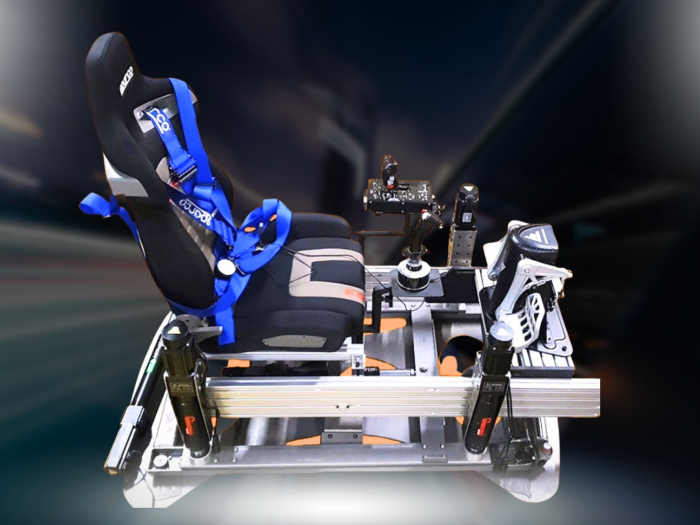

The most immersive racing experience in 2026 isn't found in a massive, ceiling-scraping industrial cage. It lives in the subtle, high-frequency translations that bridge the gap between digital telemetry and your physical senses. If you've spent hours searching for a motion simulator buyer's guide 2026, you likely already know that raw power is useless without surgical precision. You want to feel the rear tyres lose grip through a damp corner at Silverstone, not just get shaken around by a noisy, oversized motor.
We agree that high-end simulation shouldn't mean turning your home into a factory floor or battling complex software for weeks. You deserve professional 6 Degrees of Freedom realism without the industrial bulk or the assembly nightmares typical of international shipping. This article promises to show you how to choose a rig that fits your living space without compromise. We will explore the technical nuances of 6 DOF physics, the benefits of low-profile UK engineering, and how to achieve total immersion through a setup that's as reliable as it is visceral.
Key Takeaways
- Understand why 2026 marks the definitive shift from purely visual immersion to telemetry-driven physical feedback as the primary driver of performance.
- Learn to decode the physics of 3DoF and 6 DOF platforms to determine which motion axes are essential for your personal simulation goals.
- Discover how the LowSlider design provides uncompromised 6 Degrees of Freedom realism whilst maintaining a compact, home-friendly footprint.
- Use this motion simulator buyer's guide 2026 to navigate technical requirements, from power consumption to ensuring seamless VR motion compensation.
- Gain insights into the benefits of hand-built UK quality and how modular designs allow for quick assembly and long-term hardware reliability.
The Evolution of Sim Racing: Why 2026 is the Year of Motion
Sim racing has reached a definitive tipping point. Visual fidelity reached its peak years ago; now, the frontier is purely physical. If you're consulting a motion simulator buyer's guide 2026, you've likely realised that a static rig is a significant bottleneck for performance. Modern titles like iRacing and Assetto Corsa Competizione output high-fidelity telemetry that provides a granular map of the track surface. Motion platforms translate this digital data into a visceral "seat-of-the-pants" feel. This isn't just about fun. It's about consistency. When your body feels the weight transfer during braking, your brain processes the information faster than eyes alone ever could. You stop reacting to what happened and start anticipating what will happen next.
The Death of the Static Rig
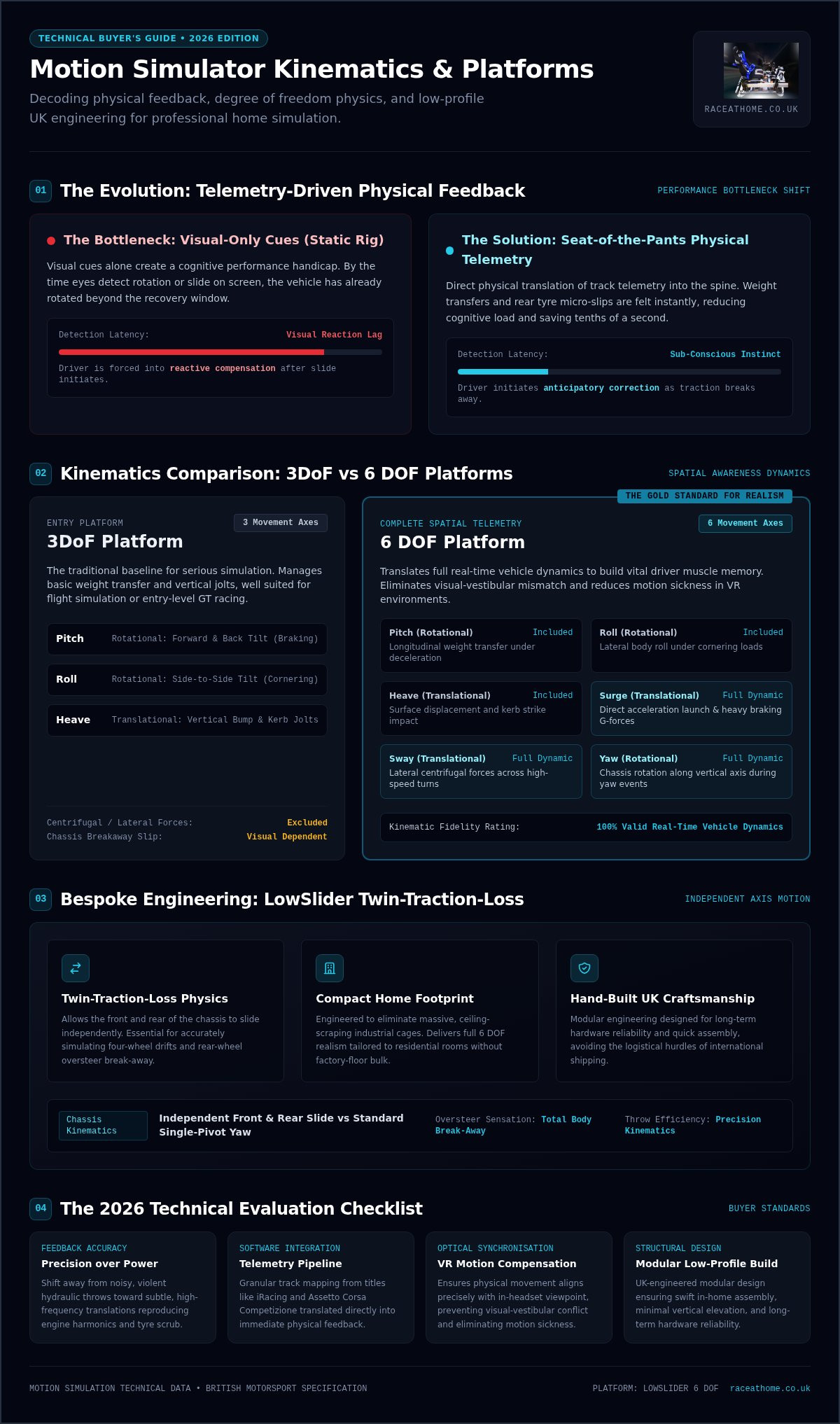
In 2026, relying solely on visual cues is a performance handicap. Your eyes are fantastic at identifying apexes, but they're slow at detecting the micro-slips of a rear tyre. By the time you see the car rotating on screen, the moment to catch the slide has often passed. Physical feedback solves this by reducing your cognitive load. Instead of guessing the grip levels, you feel the degrees of freedom in motion simulation through your spine. This immediate sensation allows for instinctive corrections. If you can feel the traction loss before the visual lag catches up, you'll find those missing tenths of a second. Competitive racers now view motion not as a luxury, but as a mandatory tool for high-level esports.
2026 Motion Trends: Precision over Power
The era of violent, jerky hydraulic systems is over. Today's enthusiasts demand precision over raw power. The trend has shifted toward subtle, high-frequency vibrations that mimic engine harmonics and tyre scrub. We're seeing a massive move toward bespoke hardware that integrates haptic feedback directly into the motion pipeline. This "no-compromise" approach ensures that every millimetre of actuator travel serves a purpose. Whilst mass-market options exist, the high-end community is pivoting toward hand-built, UK-engineered systems. These rigs prioritise a low profile and refined kinematics, proving that professional realism doesn't require a room the size of a garage. It's a sophisticated evolution of the hobby that values the quality of the movement over the quantity of the throw.
Decoding Degrees of Freedom: 3DoF vs 6 DOF Platforms
Understanding kinematics is the first step in any motion simulator buyer's guide 2026. In technical terms, a "Degree of Freedom" (DoF) represents a specific axis of movement. A static rig provides zero; a professional platform provides six. These axes are divided into translational movements (moving straight along an axis) and rotational movements (turning around an axis). To achieve true spatial awareness, your brain needs these physical inputs to match the visual data from your screen or VR headset. Without this synchronisation, the immersion breaks, and the risk of motion sickness increases.
3DoF: The Essential Motion Experience
A 3DoF platform is the traditional entry point for serious enthusiasts. It typically manages Pitch (tilting forward and back), Roll (tilting side to side), and Heave (vertical translation). These movements are vital for simulating weight transfer. When you hit the brakes, the rig pitches forward; when you climb a kerb, the heave axis provides the vertical jolt. This level of feedback is often sufficient for flight simulators or entry-level GT racing where longitudinal and lateral G-forces are less complex. It provides a significant step up from a static setup, helping you feel the car's basic behaviour whilst maintaining a smaller footprint.
6 DOF: The Gold Standard for Realism
For those who refuse to compromise, 6 DOF is the only choice. This configuration adds Surge (acceleration and braking forces), Sway (lateral centrifugal force), and Yaw (rotation around the vertical axis). In 2026, the industry has moved toward the LowSlider 6 DOF Twin-Traction-Loss Motion Platform as the definitive solution for high-end home use. Unlike standard systems, Twin-Traction-Loss allows the front and rear of the chassis to slide independently. This is critical for simulating oversteer and four-wheel drifts. You don't just see the back end step out; you feel the physical break-away through your entire body.
Professional drivers rely on these six axes to build accurate muscle memory. According to driver simulation research, high-fidelity motion is essential for valid real-time vehicle dynamics modelling. When you can feel the lateral sway of a high-speed corner and the surge of a perfect launch, your inputs become more precise. This level of detail is why 6 DOF has become the benchmark for competitive sim racers. If you want to experience this level of precision in your own home, you can explore our bespoke motion solutions designed for professional-grade feedback.
Beyond Actuators: Evaluating Build Quality and Footprint
Rigidity is the unsung hero of any high-end simulation setup. If your frame flexes, it absorbs the kinetic energy intended for your body, effectively deadening the subtle telemetry cues provided by the motors. Whilst many buyers focus on the "throw" or travel distance of an actuator, the underlying chassis defines the clarity of that feedback. A high-performance rig requires a foundation that won't buckle under the sudden torque of high-speed movements. In this motion simulator buyer's guide 2026, we emphasise that the best hardware in the world is wasted on a flimsy frame.
The LowSlider philosophy centres on keeping the driver as close to the ground as possible. This lower centre of gravity isn't just a design choice; it's an engineering necessity for precision. By reducing the height of the platform, we decrease the leverage forces acting against the frame during aggressive surge and sway movements. This results in a faster response time and a more direct translation of data. This approach mirrors the systems found in professional high-fidelity motion-base simulation, where minimising mechanical lag is critical for valid driver training.
The Footprint Challenge: Fitting a Rig into a UK Home
Most 6 DOF platforms are massive, industrial-looking structures that require a dedicated garage or a warehouse-sized room. They often feature tall pivot towers that dominate the environment and ruin home aesthetics. In a typical UK home, space is at a premium. Height is often the "silent killer" of a simulation project, making a rig feel much larger than its floor dimensions suggest. The LowSlider design challenges this by providing a compact footprint that fits into standard living spaces. Before you commit, it's vital to measure your available area carefully. You can find detailed advice on choosing a low profile motion sim rig that balances performance with practicality on our blog.
Hand-Built vs. Mass-Produced
Mass-produced rigs often rely on thinner aluminium profiles or lightweight materials to reduce international shipping costs. These compromises lead to "chassis chatter" and unwanted vibrations that cloud the driving experience. Choosing a hand-built, UK-engineered rig ensures a level of craftsmanship that mass-market brands can't match. Every joint is reinforced, and every component is selected for long-term durability. This bespoke approach also allows for greater customisation, ensuring your rig is built to your specific requirements rather than a generic factory standard. A hand-assembled frame resists flex better over time, maintaining the same crisp feedback on year five as it did on day one.
The Technical Checklist: Compatibility, Assembly, and VR
Technical compatibility is often the most overlooked aspect of a motion simulator buyer's guide 2026. Most high-performance platforms are now designed to integrate seamlessly with standard 8020 aluminium profiles. This means your existing direct-drive wheelbases and high-end pedal sets won't require proprietary mounting solutions. Power requirements have also been optimised. Whilst a 6 DOF rig pulls significant current during peak movements, most modern systems run safely on a standard domestic UK socket. You don't usually need a dedicated circuit unless you're running multiple high-draw peripherals alongside a pro-spec PC.
Assembly and Global Logistics
Many competitors ship their systems as a confusing collection of dozens of small parts. They often expect you to spend a full weekend deciphering manuals and routing complex wiring looms. We've eliminated this barrier with a "four-piece" assembly promise. By shipping the platform in four pre-assembled sections, we significantly reduce the risk of user error. This modular approach allows you to move from the delivery crate to the cockpit in under 60 minutes. If you're looking for a self assembly motion simulator, prioritise brands that offer global shipping support and pre-wired components. This ensures that your hardware arrives safely and functions perfectly from the first power-up.
The VR and Motion Synergy
Virtual Reality has become the definitive standard for motion-based simulation in 2026. High-fidelity Pimax headsets provide an ultra-wide field of view that eliminates the need for massive, heavy triple-monitor stands. This setup saves space and places you directly inside the virtual cabin. However, motion and VR require perfect synchronisation. Without motion compensation software, the headset's internal tracking can conflict with the rig's physical movements, leading to discomfort. Our systems are designed to work in harmony with the latest telemetry programmes to ensure a smooth experience. For a deeper dive into hardware settings, consult The Ultimate Pimax VR Motion Simulator Set-up Guide 2026.
Choosing the right technical foundation is essential for long-term satisfaction. If you're ready to start your journey into professional-grade simulation, you can view our full range of motion platforms to find the perfect fit for your existing equipment.
Investing in Realism: Why a Bespoke LowSlider Rig Wins
Deciding on a high-end setup requires a shift in perspective from buying a peripheral to investing in professional-grade hardware. When you look at the total cost of ownership, entry-level plastic or tubular steel systems often fail the longevity test. They lack the structural integrity to handle the relentless torque and high-frequency vibrations of professional motors. In contrast, a bespoke platform is built for thousands of hours of high-intensity use. This motion simulator buyer's guide 2026 prioritises longevity because the most expensive rig is the one you have to replace after eighteen months of wear.
The choice of actuators is where the battle for realism is won or lost. We utilise PT Actuator hardware, specifically the Scorpion series, because they are the preferred choice for professional-grade reliability and precision. These electric linear servo actuators offer sub-5 millisecond response latency and linear travel speeds of up to 250 mm/s. This technical precision ensures that the sensory feedback is crisp and immediate. There are no dead zones or mushy responses; you receive a direct, no-compromise translation of digital telemetry into physical sensation that mimics a real race car's behaviour.
The ROI of Professional Grade Hardware
High-end rigs retain their value remarkably well compared to mass-produced alternatives. A hand-built aluminium chassis doesn't suffer from the fatigue or chassis chatter that plagues budget frames after heavy use. When you choose to buy motion simulator UK engineered systems, you're also investing in local support and engineering expertise. If a technical question arises, you aren't waiting for parts to cross an ocean; you're dealing with specialists who understand the hardware intimately. Six Degrees of Freedom represents the ultimate spatial evolution of sim racing for 2026, delivering full kinematic feedback across every linear and rotational axis for total immersion.
Your Path to the Podium
Mastering a car at the limit requires more than just fast reflexes; it requires a deep, physical connection to the vehicle dynamics. Moving from a static setup to a full-motion platform transforms your training from a visual exercise into a visceral experience. This transition allows you to develop the same muscle memory used by professional racing drivers on the world's most demanding circuits. The LowSlider is the definitive choice for the 2026 buyer who demands uncompromised 6 DOF performance in a footprint that respects the home environment.
Your journey toward total immersion doesn't have to be a solo effort. We offer bespoke consultations to help you tailor a system to your specific racing goals and space requirements. You can explore the LowSlider 6 DOF motion platform and transform your racing today. It's time to stop playing and start driving.
Secure Your Place on the Professional Grid
Navigating the high-end market requires a clear understanding of how technical specifications translate into lap time improvements. This motion simulator buyer's guide 2026 has shown that true immersion depends on 6 DOF kinematics and a rigid, low-profile chassis. By choosing PT Actuator technology, you ensure every traction loss event is delivered with surgical accuracy. You don't have to choose between industrial-grade performance and a rig that fits your home aesthetics.
We've streamlined the path to professional realism. Our platforms are hand-built in the UK and ship globally in four sections, allowing for assembly in under 60 minutes. Whether you're a veteran racer or a dedicated newcomer, the right hardware bridges the gap between digital data and visceral reality. It's time to feel every nuance of the track surface and react with instinctive precision.
Configure Your Bespoke LowSlider Motion Rig Today and discover what uncompromised engineering does for your performance. See you at the apex.
Frequently Asked Questions
Is a 6 DOF motion simulator worth the investment for a home user in 2026?
6 DOF is definitely worth the investment for any driver seeking the highest level of realism and competitive edge. It offers the full spectrum of spatial kinematics, including surge and sway, which are missing from lower-tier rigs. As noted in our motion simulator buyer's guide 2026, the ability to feel rear-end break-away through twin-traction-loss transforms your driving consistency. This professional-grade feedback helps build the precise muscle memory required for high-level esports.
How much space do I actually need for a LowSlider motion rig?
The LowSlider is engineered specifically to fit into a standard home environment without the need for a dedicated warehouse. Whilst traditional hexapod systems require significant vertical clearance, our ultra-low profile design maintains a compact footprint that sits flush to the floor. It typically occupies a space similar to a standard static aluminium profile rig, making it the ideal choice for sim racers who want 6 DOF performance within a restricted living area.
Can I use my existing sim racing wheel and pedals with a Race@Home platform?
You can absolutely use your existing high-end sim racing peripherals with our platforms. The LowSlider is designed with a universal mounting philosophy that supports all major direct-drive wheelbases and load-cell pedals. In this motion simulator buyer's guide 2026, we highlight that you won't be locked into a proprietary ecosystem. This flexibility allows you to upgrade to a motion base whilst keeping the steering wheel and pedal set you've already mastered.
Does a motion simulator help with sim racing motion sickness?
A high-fidelity motion simulator often reduces motion sickness by resolving the sensory conflict between your eyes and your inner ear. When your brain sees a car turning but your body feels nothing, nausea can occur. By providing immediate physical feedback that matches the visual telemetry, a 6 DOF system creates a cohesive experience. This synchronisation is particularly effective when using VR headsets, as the physical heave and roll reinforce the virtual perspective.
How long does it take to assemble a Race@Home motion simulator?
Assembly is remarkably fast because we ship the platform in four large, pre-assembled sections. You can expect to move from the delivery crate to a fully functional cockpit in under 60 minutes. We've eliminated the frustration of sorting through hundreds of tiny bolts and complex wiring looms. This "four-piece" promise ensures that your setup is technically accurate and ready for the track with minimal downtime or mechanical expertise required.
What is the difference between 3DoF and 6 DOF in terms of driver feel?
The primary difference lies in the complexity of the forces you feel. A 3DoF platform focuses on weight transfer through pitch, roll, and heave, which is excellent for basic immersion. However, 6 DOF adds the critical surge, sway, and yaw axes. This allows you to feel lateral G-forces and traction loss. In 2026, the 6 DOF standard is essential for drivers who want to sense the back end sliding during oversteer.
Do Race@Home simulators support VR headsets like the Pimax Crystal?
We provide full support for high-end VR headsets, including the Pimax Crystal and the wider Pimax range. Our partnership with Pimax ensures that the hardware is optimised for the high-resolution demands of modern flight and racing simulations. When combined with our motion platforms, these headsets offer an uncompromised field of view. This synergy creates a "no-compromise" environment where the physical and digital worlds are perfectly aligned for the driver.
What kind of maintenance does a high-end motion platform require?
High-end motion platforms like the LowSlider require very little maintenance compared to older hydraulic systems. We use high-quality PT Actuator hardware and igus drylin linear guides, which are designed to be clearance-free and maintenance-free. You won't need to deal with messy oil changes or complex mechanical recalibrations. A simple periodic check of the bolt tightness and keeping the rails free of dust is usually all that's needed to ensure years of reliable performance.


