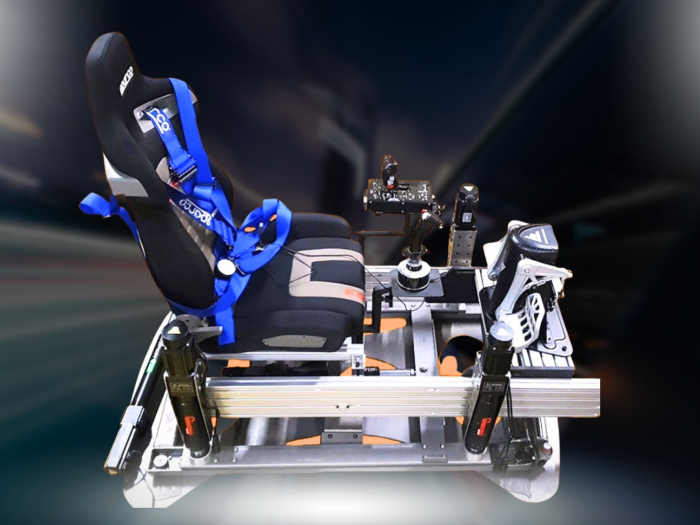

The difference between a simulator that merely moves and one that truly communicates is found in the subtle language of physics. Many enthusiasts mistake raw motion for realism, but without a precise understanding of how telemetry translates into physical force, you're simply vibrating in a high-end chair. This motion simulator heave surge sway explained guide serves as your technical roadmap to the 6 Degrees of Freedom. We understand the hesitation when faced with the complexity of 3DOF versus 6DOF systems, especially when trying to justify the investment in professional-grade hardware. You want to feel the weight transfer under heavy braking and the vertical compression of a kerb at the apex, not just a series of random jolts.
You've likely wondered if additional axes actually improve your lap times or if they're just expensive luxuries. We'll demystify these mechanical movements and demonstrate how the right configuration, such as our LowSlider 6 DOF platform, bridges the gap between digital data and visceral reality. By the end of this article, you'll know exactly which sensations are critical for car control and gain the confidence to invest in a setup that provides genuine racing feedback. We're moving beyond the abstract to show how engineering excellence transforms your home cockpit into a precision tool.
Key Takeaways
- Decode the fundamental mechanics of the 6 Degrees of Freedom to understand how your rig communicates complex vehicle behaviour.
- Our motion simulator heave surge sway explained breakdown identifies the specific linear forces required to simulate heavy braking, acceleration, and complex road textures.
- Distinguish between rotational axes like pitch and roll versus linear movements to justify the investment in a more sophisticated motion platform.
- Learn how high-frequency telemetry translation allows you to feel the limit of adhesion and suspension compression with surgical precision.
- Discover how to achieve professional-grade 6 DOF immersion in a home-friendly footprint without compromising on engineering quality or feedback depth.
What are the 6 Degrees of Freedom (6 DOF) in Sim Racing?
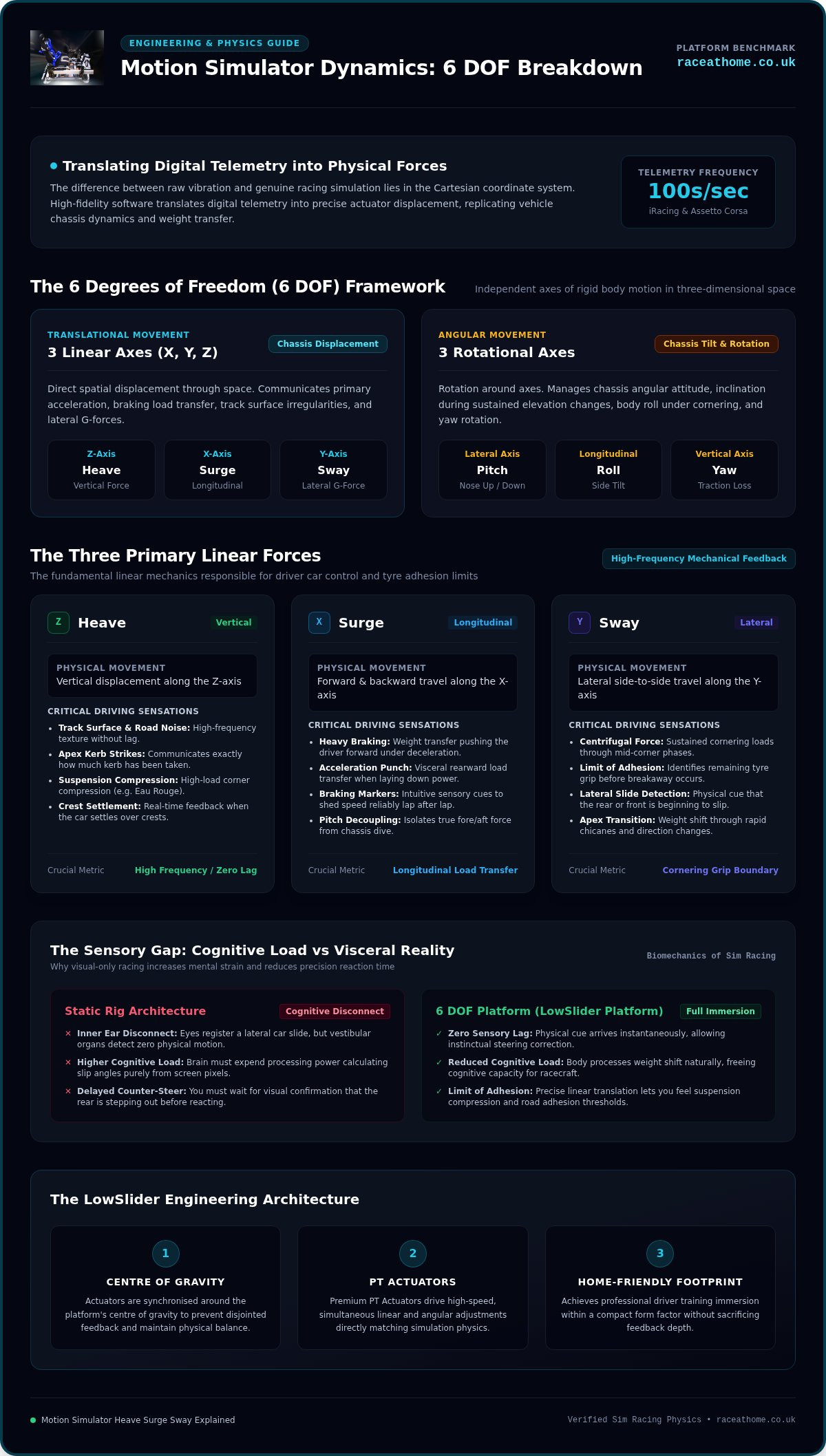
To master sim racing, you need more than just visual cues. You need physics. In engineering terms, six degrees of freedom refers to the specific number of independent ways a rigid body can move within a three-dimensional space. For a racing driver, this isn't just a mathematical concept; it's the difference between feeling like you're in a car and feeling like you're playing a game. These six movements are split into two categories: linear and rotational. Understanding how these forces interact is the first step toward building a professional-grade setup.
Linear motion involves moving along an axis, such as up and down, whilst rotational motion involves turning around those axes. When you combine them, you create a full physical envelope that mimics the behaviour of a high-performance vehicle. This is why 6 DOF is considered the gold standard for professional driver training. It's the only way to replicate the complex forces of a real-world chassis accurately. High-fidelity software like iRacing or Assetto Corsa outputs telemetry data hundreds of times per second. A motion platform takes this raw data and translates it into physical actuator movement. This motion simulator heave surge sway explained breakdown clarifies how those digital numbers become the visceral sensations of a car under load. Physics doesn't lie, and your body knows the difference between a canned vibration and a genuine G-force simulation.
The Mathematical Foundation of Motion
Everything starts with the Cartesian coordinate system. In a sim rig, we map movements onto X, Y, and Z axes to ensure every twitch is captured. The platform's centre of gravity is crucial. If actuators aren't synchronised perfectly around this point, feedback feels disjointed. Our LowSlider systems use premium PT Actuators to ensure these movements happen simultaneously. This motion simulator heave surge sway explained guide highlights why precision engineering is non-negotiable when creating a seamless transition from heavy braking to sharp turn-in.
Why Static Rigs Limit Your Competitive Edge
Driving a static rig creates a sensory gap. Your eyes see the car sliding, but your inner ear feels nothing. This disconnect forces your brain to work harder to process what's happening on screen. Motion reduces this cognitive load by providing intuitive cues your body understands instantly. You don't wait for a visual prompt to know the rear is stepping out; you feel the shift and react. 6 DOF represents the ultimate evolution of sim racing immersion by closing the gap between digital simulation and physical reality.
Heave, Surge, and Sway: Explaining Linear Motion
Linear motion is the bedrock of any high-fidelity racing simulation. Whilst rotational axes handle the tilt of the car, linear movements replicate the actual displacement of the chassis through space. This motion simulator heave surge sway explained guide focuses on the three translational axes: X, Y, and Z. These movements are responsible for the most visceral feedback you receive as a driver. Without them, you're missing the physical cues that signal the car's limit of adhesion. Physics doesn't lie; your body requires these inputs to build an accurate mental map of the track.
Heave: Feeling the Track Surface
Heave represents vertical movement along the Z-axis. It's the force that communicates road texture, kerb strikes, and suspension compression directly to your seat. When you clip an apex, it's heave that tells you exactly how much of the kerb you've taken. High-quality actuators are essential here. They must process "road noise" at high frequencies to prevent lag. If the actuator is too slow, the bump happens on screen before you feel it, breaking the immersion. Precise heave feedback allows you to feel the car settle after a crest or compress through a high-load corner like Eau Rouge.
Surge and Sway: Simulating G-Forces
Surge and sway handle the longitudinal and lateral forces that define performance driving. Surge moves the rig forward and backward along the X-axis. It simulates the heavy weight transfer of braking and the punch of acceleration. Perfecting your braking markers becomes intuitive when you feel the surge force pushing you forward as you shed speed. Sway operates on the Y-axis, mimicking the centrifugal force felt during cornering. It tells you exactly how much lateral grip you have left before the tyres begin to slide. This translation of data relies on the same principles found in NASA research on motion cueing algorithms to ensure physical movements align with vestibular expectations. In complex "S" bends, the synergy between surge and sway creates a seamless transition of weight that a static rig simply cannot replicate. If you want to experience this level of technical fidelity, exploring our LowSlider 6 DOF motion platform is the next logical step for your home setup.
Pitch, Roll, and Yaw: The Rotational Axes
If linear motion provides the impact, rotational motion provides the persistence. Rotational axes allow a rig to tilt, using gravity to simulate the sensation of sustained acceleration. This is a clever trick of the inner ear. Whilst we've looked at motion simulator heave surge sway explained in terms of translational movement, the rotation around these axes is what defines the vehicle's attitude. This interaction is complex. It's why professional flight and racing simulators must adhere to rigorous technical benchmarks, similar to the FAA Part 60 motion system standards, to ensure the physical cues don't conflict with visual data. When your rig tilts back during a long acceleration phase, your body interprets the gravity pulling on your chest as a forward G-force, extending the sensation far beyond the physical travel of an actuator.
Pitch and Roll: Weight Transfer and Cambers
Pitch is the forward and backward tilting of the chassis. It is essential for communicating weight transfer. When you slam on the anchors, the rig pitches forward to simulate nose-dive. Conversely, it tilts back under heavy acceleration to mimic squat. Roll handles the lateral tilt. This is vital for feeling the "set" of the suspension as you enter a high-speed corner. On tracks with significant cambers, such as Zandvoort or the legendary Raidillon at Spa, roll provides the necessary lean to tell your brain the car is loaded and stable. Unlike "seat movers" that only tilt the chair, the LowSlider 6 DOF moves the entire cockpit. This ensures your relationship with the steering wheel and pedals remains consistent whilst the rig tilts, preventing the disjointed feeling common in simpler setups.
Yaw and Traction Loss: The Professional's Secret
Yaw is the rotation around the vertical axis. In a standard setup, yaw helps simulate the car's heading, but in high-end rigs, it's the foundation for traction loss. This is the "holy grail" of feedback for elite drivers. It allows you to sense the rear tyres breaking traction before the visual slide begins on screen. Our LowSlider 6 DOF platform takes this further with a proprietary approach to Twin Traction Loss: The Secret to Realistic Sim Racing. By decoupling the front and rear slip angles, we provide a level of oversteer fidelity that simple 3DOF systems cannot match. You aren't just reacting to a slide; you're managing the limit of adhesion with surgical precision. This motion simulator heave surge sway explained technical deep-dive shows that without yaw, you're essentially driving blind to the behaviour of the car's rear end.
3DOF vs 6 DOF: Choosing the Right Feedback Level
Deciding between 3 and 6 degrees of freedom is the most significant technical choice an enthusiast will make. It determines whether your rig provides a representational experience or a truly visceral one. Having had the motion simulator heave surge sway explained in previous sections, you'll understand that each axis provides a distinct layer of telemetry. A 3DOF system typically manages pitch, roll, and heave. These are the essentials for vertical cues and basic weight transfer. However, without surge, sway, and yaw, the platform cannot replicate the longitudinal and lateral displacement that defines high-performance racing. Moving to 6 DOF completes the physical envelope. It eliminates 'ghost movements' where a system tries to mimic a sensation like braking surge using only pitch tilt, which can feel disjointed and unrealistic.
The 3DOF Experience: Entry-Level Realism
A 3DOF setup is a powerful starting point for those who prioritise road feel and vertical suspension movement. It's often the LowSlider 3DoF: The Perfect Entry into Motion Sim Racing for many drivers. Whilst it excels at communicating kerb strikes and gradients, it has inherent limitations. You won't feel the lateral slide of a car losing grip or the specific forward thrust of acceleration. For many, this is a sufficient upgrade from a static rig, but the 'sensory gap' remains partially open. If you primarily drive on tracks with heavy elevation changes but fewer high-speed lateral transitions, 3DOF offers excellent value for money.
The 6 DOF Advantage: No Compromise
When you step up to 6 DOF, you enter the realm of professional driver development. This is why elite racing teams exclusively use full-motion platforms to train. By adding surge, sway, and yaw, the system aligns your physical sensations perfectly with the visual input from your screen or VR headset. This alignment is critical for eliminating motion sickness. Your inner ear no longer receives conflicting signals when the car slides or brakes. This motion simulator heave surge sway explained deep-dive clarifies why 6 DOF is the only way to achieve total immersion. If you're ready to remove all compromises, our The Ultimate Guide to 6 DOF Motion Simulators provides a deeper dive into the technical specifications required for home-based professional realism. Making the leap to a full 6 DOF platform is an investment in your performance and long-term enjoyment of the hobby.
Ready to experience the ultimate in sim racing fidelity? Explore our range of LowSlider motion platforms and transform your driving today.
The LowSlider Approach: Engineering Precision Motion
Engineering a motion platform that fits within a home environment without sacrificing professional-grade fidelity requires a no-compromise approach to design. Whilst many systems rely on bulky frames and slow actuators, the LowSlider 6 DOF platform is built around the philosophy of ultra-low profile precision. We utilise premium PT Actuators to ensure high-frequency feedback that captures every nuance of the track surface. This motion simulator heave surge sway explained technical overview has demonstrated the "why" of motion; our hardware provides the "how" by translating digital telemetry into 1:1 physical sensations. Hand-built British engineering ensures that every rig we produce outperforms mass-produced alternatives in both durability and response time.
Bespoke Design for Enthusiasts
Stability is the foundation of realism. Our ultra-low profile design keeps your centre of gravity as close to the floor as possible, which is a critical factor in rig stability. By reducing the height of the platform, we eliminate unwanted oscillations and frame flex that can muddy the feedback signals. This design also makes the rig exceptionally compact, allowing for a full 6 DOF experience in a footprint typically reserved for static setups. For those seeking the ultimate bespoke cockpit, we offer extensive customisation options. You can integrate high-end accessories such as Sim Racing Professional pedals or Pimax VR headsets to complete your immersion. If you are planning a new build, our Buy Motion Simulator UK: The 2026 Professional Guide offers a comprehensive roadmap for selecting the right components for a high-end rig.
Global Support and Reliability
We believe that professional-grade hardware should be accessible, not intimidating. Every LowSlider system ships globally in four pre-assembled sections, allowing you to go from delivery to the track in under an hour. This "One-Hour Assembly" promise is made possible by our meticulous hand-built process in the UK. You aren't just buying a box of parts; you're investing in a curated engineering solution. We provide dedicated technical support to ensure your software integration is seamless across all major titles. This motion simulator heave surge sway explained guide has shown that the right axes make the driver, but the right hardware makes the experience. Our commitment to craftsmanship means your rig is built to withstand the rigours of endurance racing whilst providing the surgical precision needed for qualifying laps. Ready to feel every kerb and slide? Explore the LowSlider 6 DOF Motion Platform and secure your gateway to professional realism.
Take the Lead with Precision Engineering
Mastering the physics of the track requires more than just practice; it demands hardware that speaks the language of telemetry. Having had the motion simulator heave surge sway explained, you now understand how these linear forces combine with rotational axes to create a complete physical envelope. You no longer have to guess where the limit of adhesion lies because your rig communicates it directly to your vestibular system. Transitioning from a static setup to a full 6 DOF platform is the ultimate evolution for any serious enthusiast, closing the sensory gap that limits competitive performance.
At Race@Home, we specialise in bringing professional-grade realism to your home cockpit. Our LowSlider platforms are hand-built in the UK with an ultra-low profile design that ensures maximum stability and precision. We ship globally in four pre-assembled sections, keeping our one-hour assembly promise so you can spend less time building and more time racing. If you're ready to stop compromising on your immersion, now is the time to invest in engineering excellence. Build your ultimate 6 DOF motion rig with Race@Home and feel every nuance of the circuit with surgical accuracy. The track is waiting for you.
Frequently Asked Questions
What is heave in a motion simulator?
Heave is the vertical displacement along the Z-axis that replicates the upward and downward forces of a car's chassis. It allows you to feel the texture of the track surface, including rumble strips, apex kerbs, and the compression of the suspension through high-load dips. Without precise heave, the sensation of the road is lost, leaving you with a disconnected experience that relies solely on visual feedback from the screen.
How does surge feel during sim racing?
Surge provides the longitudinal force that mimics the physical impact of acceleration and heavy braking. When you hit the anchors, the rig moves forward, pushing your body against the harness to simulate deceleration. Conversely, a sharp backward movement during gear shifts or standing starts replicates the "punch" of torque. This axis is vital for building muscle memory around braking markers and managing weight transfer effectively during a lap.
Why is sway important for cornering realism?
Sway is the lateral movement along the Y-axis that simulates the centrifugal forces felt during high-speed cornering. As you turn into a bend, the rig moves sideways to replicate the feeling of being pushed towards the outside of the turn. This feedback is essential for sensing the car's lateral grip limits. It provides the intuitive cues needed to hold a line through a sweeping corner without overdriving the tyres.
What is the difference between 3DOF and 6 DOF?
A 3DOF system typically focuses on pitch, roll, and heave, providing the essential vertical and tilt-based cues. A 6 DOF platform, like our LowSlider 6 DOF, adds surge, sway, and yaw to complete the physical envelope. This motion simulator heave surge sway explained guide highlights that 6 DOF eliminates the "ghost movements" found in simpler rigs by providing independent actuators for every possible direction of movement, resulting in total immersion.
Does a motion simulator help with sim sickness?
Yes, a high-fidelity motion platform can significantly reduce sim sickness by aligning your physical vestibular sensations with the visual input from your screen or VR headset. Nausea often occurs when your brain sees movement that your body doesn't feel. By providing accurate 6 DOF feedback, the system synchronises these signals, allowing your brain to process the simulation more naturally and comfortably during long endurance sessions or intense wheel-to-wheel racing.
What is traction loss in a sim rig?
Traction loss is the physical simulation of the rear of the car stepping out, achieved through rotation around the yaw axis. Our LowSlider 6 DOF features Twin-Traction-Loss, which allows you to feel the rear tyres breaking loose before you see the slide on screen. This early warning system is a professional's secret, enabling you to catch oversteer and manage the limit of adhesion with far greater precision than a static rig.
How do actuators translate game telemetry into motion?
Actuators receive raw telemetry data from the racing software, such as G-force, suspension travel, and orientation, at frequencies often exceeding 100Hz. This data is processed through motion cueing algorithms that convert digital values into precise mechanical movements. Premium PT Actuators, used in our hand-built UK rigs, ensure this translation happens with minimal latency. This creates a seamless bridge between the game's physics engine and the physical sensations you feel in your seat.
Is a 6 DOF motion platform worth it for home use?
For enthusiasts seeking the ultimate level of realism and driver development, a 6 DOF platform is a transformative investment. It provides a "no-compromise" experience that replicates the complex forces felt in a real race car. Our LowSlider design is specifically engineered for home use, offering an ultra-low profile and a compact footprint that fits into standard rooms whilst delivering the same technical fidelity used by professional racing teams for training.


