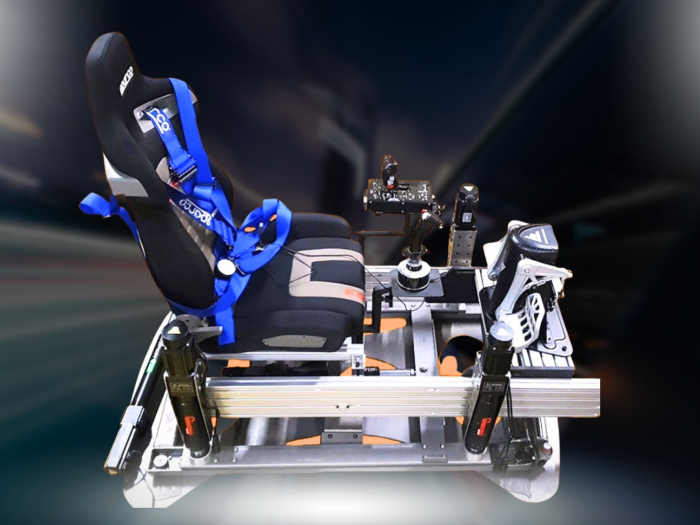

Most sim racers are essentially driving a high-end computer desk, missing the very forces that define the limit of adhesion on a real circuit. You've likely felt that frustrating disconnect when your eyes see the car sliding through a corner, but your body feels absolutely nothing. Static setups simply cannot replicate the physical weight of a car. Even many entry-level motion systems often feel more like a vibrating chair than a true G-force simulation rig, lacking the nuance required to communicate subtle weight transfers. If you're tired of bulky equipment that dominates your spare room without delivering professional-grade feedback, you aren't alone in wanting more from your hardware.
This guide explores how 6 DOF motion technology translates raw racing telemetry into visceral, physical sensations that you can actually use to find lap time. You'll discover how a compact, UK-engineered system can provide the same immersion as a professional motorsport trainer without requiring a dedicated warehouse. We'll break down the technical differences between 6 DOF and more basic systems; whilst explaining how precise actuators turn digital data into the sustained G-forces of a high-speed corner. By the end, you'll understand exactly how to transform your home setup into a precision tool for realistic racing behaviour.
Key Takeaways
- Learn why a genuine G-force simulation rig relies on sustained telemetry-driven motion rather than mere haptic vibration to replicate true cornering forces.
- Understand how 6 Degrees of Freedom, specifically Surge, allow you to feel the physical weight of the car under heavy braking and high-speed acceleration.
- Discover the distinct roles of haptic feedback for road textures and motion platforms for simulating the centrifugal forces that define vehicle behaviour.
- See how the proprietary LowSlider design overcomes the space constraints of home sim racing with an ultra-low profile and simple four-piece assembly.
- Explore the advantages of hand-built UK engineering and why bespoke hardware offers a more precise, professional-grade experience than mass-produced alternatives.
What defines a true G-force simulation rig?
A genuine G-force simulation rig is a high-performance engineering system designed to translate complex in-game physics into tangible physical movement. It isn't merely a seat that shakes or vibrates; it's a sophisticated platform that uses high-torque actuators to replicate the actual inertial forces experienced in a cockpit. Whilst many entry-level setups rely on tactile transducers for engine hum, a professional-grade rig focuses on sustained displacement. This allows your body to feel the weight of the car as it leans into a high-speed apex or dives under heavy braking. Professional drivers rely on these cues because they communicate the limit of grip long before the eyes can register a slide on the screen.
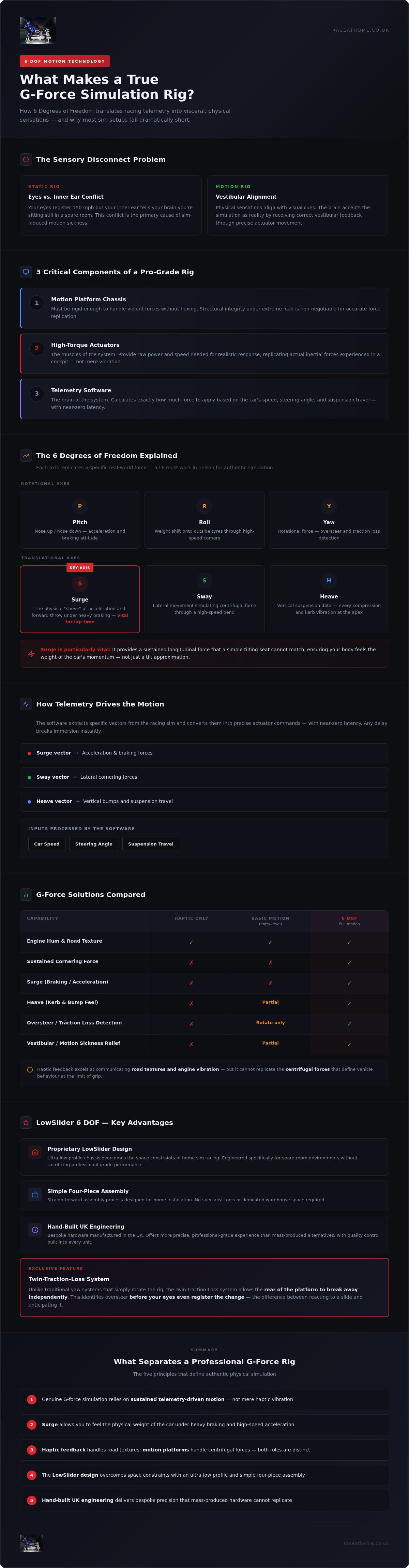
The core of this experience relies on three critical components working in perfect unison. First, the motion platform chassis must be rigid enough to handle violent forces without flexing. Second, the actuators act as the muscles of the system, providing the raw power and speed needed for realistic response. Finally, the telemetry software serves as the brain, utilising complex motion simulator technology to calculate exactly how much force to apply based on the car's speed, steering angle, and suspension travel.
The role of telemetry in force simulation
For a G-force simulation rig to feel authentic, the data must be processed with near-zero latency. Telemetry software extracts specific vectors from the racing sim, such as surge (acceleration and braking), sway (lateral cornering forces), and heave (vertical bumps). If there's even a slight delay between the visual frame and the physical movement, the immersion breaks instantly. High-end systems prioritise bespoke software integration to ensure that every millimetre of actuator travel perfectly matches the digital car's behaviour on track.
Static vs. Motion: The sensory gap
Driving a static rig creates a massive sensory disconnect. Your eyes see you hitting 150mph, but your inner ear tells your brain you're sitting still in a spare room. This conflict is often the primary cause of sim-induced motion sickness. A motion rig solves this by aligning your physical sensations with the visual cues on your monitor or VR headset. By providing the correct vestibular feedback, the brain accepts the simulation as reality. If you're weighing up the costs of such a setup, you can find a comprehensive value analysis in our guide, Is a sim racing motion rig worth it?.
The science of 6 DOF: Replicating real-world physics
To build a world-class G-force simulation rig, you must understand the six fundamental axes of movement. These are Pitch, Roll, Yaw, Surge, Sway, and Heave. Whilst basic rigs might only tilt, a true 6 DOF (Degrees of Freedom) system moves the entire cockpit across three-dimensional space. Surge is particularly vital for replicating the physical "shove" of acceleration and the forward throw of heavy braking. It provides a sustained longitudinal force that a simple tilting seat cannot match, ensuring your body feels the weight of the car's momentum.
Cornering loads are replicated through a sophisticated combination of Sway and Roll. As you turn into a high-speed bend, the rig uses Sway to move you laterally, simulating centrifugal force, whilst Roll adds the sensation of the car’s weight shifting onto the outside tyres. Heave completes the picture by translating vertical suspension data into physical travel. This ensures you feel every compression in the tarmac and every vibration as you clip a kerb at the apex. Without Heave, the track feels flat; with it, the circuit becomes a living, breathing surface.
Twin Traction Loss: The 6 DOF advantage
Traditional yaw systems simply rotate the rig. The LowSlider 6 DOF Twin-Traction-Loss system goes further by allowing the rear of the platform to break away independently. This specific movement identifies oversteer before your eyes even register the change in the horizon. It’s the difference between reacting to a slide and anticipating it, allowing you to catch the car with a level of precision that static setups simply can't provide. If you're ready to step up, you can explore the LowSlider 6 DOF Twin-Traction-Loss Motion Platform to see this engineering in action.
Actuator precision and speed
The quality of this feedback depends entirely on the speed and precision of the actuators. By partnering with PT Actuator, the LowSlider ensures high-frequency response times that eliminate the "robotic" lag found in cheaper systems. Actuator stroke length is carefully balanced with speed. This ensures that transitions between forces are fluid and organic, mimicking the natural weight transfer of a GT3 or Formula car rather than feeling like a series of disjointed jolts. When the hardware can keep pace with the game's physics engine, the result is a seamless translation of digital speed into visceral G-force sensations.
Comparing G-force solutions: Full motion vs. haptic feedback
Choosing the right hardware for a G-force simulation rig often involves deciding between haptic detail and physical motion. Haptic feedback systems, such as tactile transducers and "butt-kickers", are exceptional at replicating high-frequency data. They allow you to feel the grit of the asphalt, the vibration of a high-revving engine, and the sharp "clack" of a gear change. However, haptics alone cannot simulate the sustained centrifugal forces of a long, sweeping corner. They provide the "noise" of racing, but they lack the physical travel required to communicate weight transfer.
Motion platforms represent the other side of the coin, focusing on the large-scale movements that define a car's inertia. Whilst haptics might tell you that you've clipped a kerb, a motion rig tells you that the car's weight has shifted onto the outside tyres. For the serious home enthusiast, a hybrid setup is the gold standard. By combining 6 DOF motion with haptic transducers, you create a complete sensory profile. You feel the visceral shove of G-forces through the actuators whilst simultaneously receiving intricate road texture through the haptics.
Seat-movers vs. Full-motion platforms
Many entry-level motion systems are designed as "seat-movers" that only tilt the chair. This approach can often distort the relationship between your hands, feet, and the controls. If the seat tilts whilst your pedals remain static, your leg extension changes, which can ruin your braking consistency. A professional-grade G-force simulation rig moves the entire cockpit as one unit. This maintains perfect ergonomic consistency, ensuring that your feet stay firmly planted on the pedals and your hands remain correctly positioned on the wheel during high-G manoeuvres. For a more detailed comparison of these systems, see The Ultimate Guide to 6 DOF Motion Simulators.
The VR factor in G-force simulation
Virtual reality is the perfect partner for motion hardware. When you use a high-fidelity headset like a Pimax, your visual field finally aligns with your physical sensations. This synergy significantly reduces motion sickness because your inner ear and eyes are receiving the same data. It's essential to use "motion compensation" software to keep your virtual camera stable whilst the rig moves. Without it, your view would bounce inside the virtual cockpit as the actuators work. You can learn how to dial in these settings in The Ultimate Pimax VR Motion Simulator Set-up Guide.
Engineering the home setup: Space and assembly
Many enthusiasts assume that installing a professional G-force simulation rig requires a dedicated warehouse or a reinforced garage floor. This myth often prevents sim racers from upgrading their immersion. In reality, modern engineering allows for high-performance motion in a compact footprint. The LowSlider design features an ultra-low profile that integrates seamlessly into a home office or spare room without dominating the entire space. It sits lower to the ground than traditional industrial stages; this lowers the centre of gravity and improves stability whilst keeping the aesthetic sleek and professional.
Logistics shouldn't be a barrier to realism. We ship our rigs worldwide in four manageable, pre-assembled pieces. This approach ensures that even international customers can receive a full 6 DOF system without the logistical nightmare of a massive, single-crate delivery. For power, these systems are designed to run on standard home circuits. You won't need to hire an electrician to rewire your house just to feel the heave of a high-speed compression. It's about bringing professional motorsport engineering into a residential environment without the typical compromises.
The one-hour assembly promise
We've eliminated the technical anxiety traditionally associated with high-end motion hardware. Each LowSlider is hand-built in the UK and fully tested before being partially disassembled for shipping. This means you aren't starting from a box of loose bolts and confusing diagrams. Most customers complete the assembly in approximately one hour using basic tools. If you can put together a flat-pack desk, you can build a professional-grade motion platform. This streamlined process allows you to spend less time troubleshooting and more time on track. You can order your LowSlider 6 DOF Twin-Traction-Loss Motion Platform today and experience the simplicity of our UK-engineered setup.
Organising your sim racing centre
When planning your sim racing centre, you must consider the rig's full range of movement. Whilst the footprint is compact, the platform needs a clear perimeter to ensure the actuators can move through their full stroke without hitting walls or furniture. Cable management is equally vital; all leads must have enough slack to accommodate the rig's pitch and roll. If you're installing the system on a second floor, we recommend using vibration-dampening mats. These help isolate the high-frequency haptic data and mechanical noise from the rest of your home, ensuring your high-speed sessions don't disturb the neighbours.
Why the LowSlider 6 DOF is the premier G-force rig
The LowSlider 6 DOF Twin-Traction-Loss Motion Platform represents the ultimate evolution of the sim racing hobby. Whilst mass-produced consumer rigs often rely on plastic components and generic motor controllers, our platform is a no-compromise engineering solution. It bridges the gap between digital telemetry and physical sensation with a level of precision that off-the-shelf products simply cannot match. This G-force simulation rig is designed specifically for those who demand the same visceral feedback found in professional motorsport trainers. It isn't just about movement; it's about the accuracy of that movement and how it informs your driving behaviour at the limit of grip.
The visceral reality of our Twin-Traction-Loss system is what truly sets the LowSlider apart from the competition. It doesn't just vibrate or tilt; it physically displaces the rear of the rig to mimic a genuine loss of traction. This allows you to drive by feel, catching slides through muscle memory rather than waiting for visual cues on a screen. When you combine this with the low-latency response of high-torque actuators, you create a training tool that is as effective as it is exhilarating. It transforms the experience from a visual simulation into a full-body physical event.
Hand-built in the UK
Every LowSlider chassis is hand-built to order in the UK. This bespoke approach allows for a level of quality control that mass production lines simply ignore. By maintaining a proprietary design, we ensure that every weld and actuator mount meets our exacting standards for rigidity. Supporting UK sim racing engineering means you receive a product crafted by specialists who understand the nuances of vehicle physics. It's a commitment to craftsmanship that ensures your rig remains stable and precise, even during the most violent weight transfers on track.
Next steps to professional immersion
Choosing the right configuration depends on your specific performance goals. Whilst the LowSlider 3DoF motion platform offers exceptional heave, pitch, and roll, the 6 DOF system adds the vital twin-traction-loss layer that defines a world-class G-force simulation rig. This modularity allows you to future-proof your setup, knowing your hardware can grow as your skills evolve. Our platforms are also fully compatible with high-end Pimax VR headsets, ensuring your visual and physical cues remain perfectly synced for maximum immersion.
If you're ready to invest in a professional-grade hardware package, consulting with our specialists is the first step. We can help you navigate the technical requirements and logistics to ensure your home sim racing centre is truly elite. For more information on making your first purchase and understanding the high-end market, check out our Buy Motion Simulator UK guide.
Transform your home simulator into a precision racing tool
The journey from a static desk setup to a professional-grade G-force simulation rig is about more than just movement; it's about the accurate translation of data into physical reality. You've seen how 6 DOF technology bridges the sensory gap, allowing you to feel every weight transfer and traction loss before your eyes even register the change. By prioritising low-latency actuators and bespoke UK engineering, you don't just play a game; you experience the visceral physics of a high-performance vehicle. Professional immersion is no longer reserved for industrial training centres.
With our proprietary ultra-low profile design, you can enjoy this elite level of realism without compromising your living space. Every platform is hand-built in the UK and shipped worldwide in four easy pieces to ensure a seamless setup experience. It's time to stop driving with only your eyes and start using your entire body to find those extra tenths on the track. Explore the LowSlider 6 DOF and feel the forces for yourself. We're excited to help you find your new limit on the circuit.
Frequently Asked Questions
Does a G-force simulation rig actually feel like a real car?
A G-force simulation rig provides the physical weight and inertial cues that define real-world driving. Whilst it cannot perfectly replicate the sustained 5G forces of a Formula 1 car, it effectively tricks your brain by aligning your inner ear's vestibular response with the visual speed on screen. This alignment is vital for feeling the limit of grip. You will sense the car's weight shifting during high-speed cornering and the sharp dive of the nose under heavy braking.
What is the difference between 3DoF and 6 DOF for G-force simulation?
The primary difference lies in the complexity of the movement axes. A 3DoF system typically covers pitch, roll, and heave, which are excellent for bumps and basic weight transfer. However, a 6 DOF motion platform adds surge, sway, and yaw. This allows for the simulation of lateral centrifugal forces and the critical twin-traction-loss sensation. It provides a much deeper level of immersion by replicating how a car behaves across all three physical dimensions.
Can I use a motion rig in a small flat or upstairs room?
Yes, the LowSlider is specifically engineered for home environments. Its ultra-low profile design ensures it does not dominate a room, whilst its compact footprint fits most standard sim racing centres. If you are concerned about noise in an upstairs room, we recommend using high-density vibration isolation mats. These help dampen the mechanical sounds and high-frequency haptic data, making the system suitable for flats or shared residential buildings without disturbing the neighbours.
How much power does a 6 DOF motion simulator consume?
Most high-performance systems are designed to run on a standard domestic power supply. You won't need expensive electrical modifications or dedicated industrial circuits to power the actuators. Whilst the power draw varies based on the intensity of your motion settings, the efficiency of modern hardware ensures it remains manageable for home use. It is as simple as plugging the control box into your existing wall sockets and beginning your session.
Do I need special software to run a G-force simulation rig?
You will need telemetry software to bridge the gap between your racing game and the actuators. This software extracts physics data from the sim and translates it into physical movement commands. Our systems are designed to integrate seamlessly with industry-standard telemetry tools, ensuring low-latency feedback and precise control. This software allows you to customise the intensity of specific forces, such as surge or sway, to match your personal preference and vehicle type.
Is it difficult to set up the LowSlider motion platform?
Setting up the LowSlider is remarkably straightforward thanks to our four-piece shipping method. We hand-build and test every rig in the UK before partially disassembling it for delivery. This means you don't have to deal with hundreds of loose components. Most customers can complete the assembly in under an hour using basic household tools. We have focused on reducing technical anxiety so you can transition from unboxing to racing as quickly as possible.
Can I add VR to my G-force simulation setup?
VR is the ideal companion for a high-end motion setup. Using a Pimax VR headset allows your visual field to move in perfect sync with the physical forces of the rig. This synergy creates a powerful sense of presence and significantly reduces the risk of motion sickness. You will need to use motion compensation software to ensure the virtual camera remains stable whilst the platform moves, providing a clear and immersive view of the track.
What maintenance does a motion simulator require?
Maintenance for these professional-grade systems is minimal but essential for long-term performance. You should periodically check that all bolts and mounting hardware remain tight, especially after intense racing sessions. It is also a good idea to keep the actuator shafts clean and free from dust buildup. Unlike a real race car, there are no complex fluid changes or mechanical services required, allowing you to focus entirely on improving your lap times and consistency.


