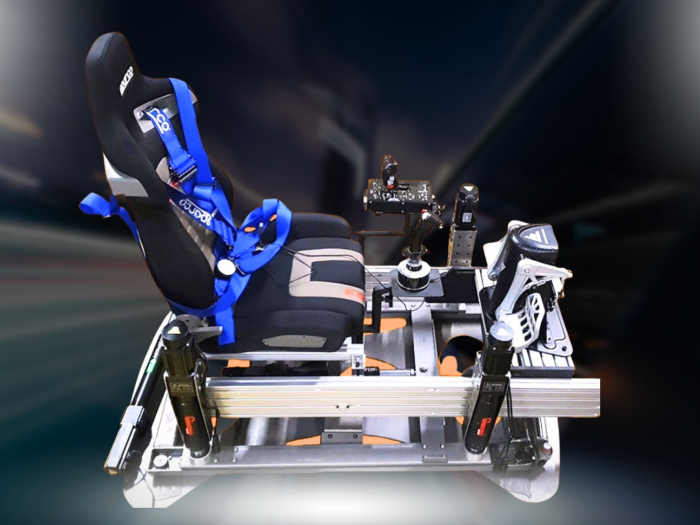

If your eyes are seeing 200mph but your body feels like it's sitting on a kitchen chair, can you really call it racing? You've likely spent hours fine-tuning your force feedback and pedal curves, yet that final layer of immersion remains elusive. It's a common frustration amongst enthusiasts; you want the visceral thrill of the track, but you're held back by concerns over motion sickness, complex software, or a rig that's simply too bulky for a home office.
Integrating a professional-grade motion feedback racing simulator into your setup shouldn't be a compromise. We agree that the best hardware should disappear beneath you, leaving only the pure sensation of weight transfer and tyre slip. This guide will show you how to transform your sim from a game into a high-performance training tool. You'll discover how the latest UK-built engineering, such as the LowSlider 6 DOF, provides authentic traction loss and precision telemetry translation in a compact, low-profile footprint that can be assembled in under an hour. We'll explore the logistics of setup, the importance of low-latency response, and how to choose a system that delivers professional-grade feedback without the footprint of a traditional hydraulic rig.
Key Takeaways
- Understand how professional-grade telemetry translation bridges the gap between digital data and visceral, real-world driving sensations.
- Identify the technical differences between 3DoF and 6 DOF configurations to choose the right level of spatial awareness for your home rig.
- Discover how a motion feedback racing simulator can actually reduce motion sickness in VR by aligning physical cues with visual movement.
- Learn why the bespoke, UK-built LowSlider design offers a superior, compact alternative to bulky mass-market motion platforms.
- Explore how high-fidelity hardware like Pimax VR headsets and PT Actuators work in synergy to create a truly uncompromising training environment.
Understanding Motion Feedback: The Final Frontier of Sim Racing Immersion
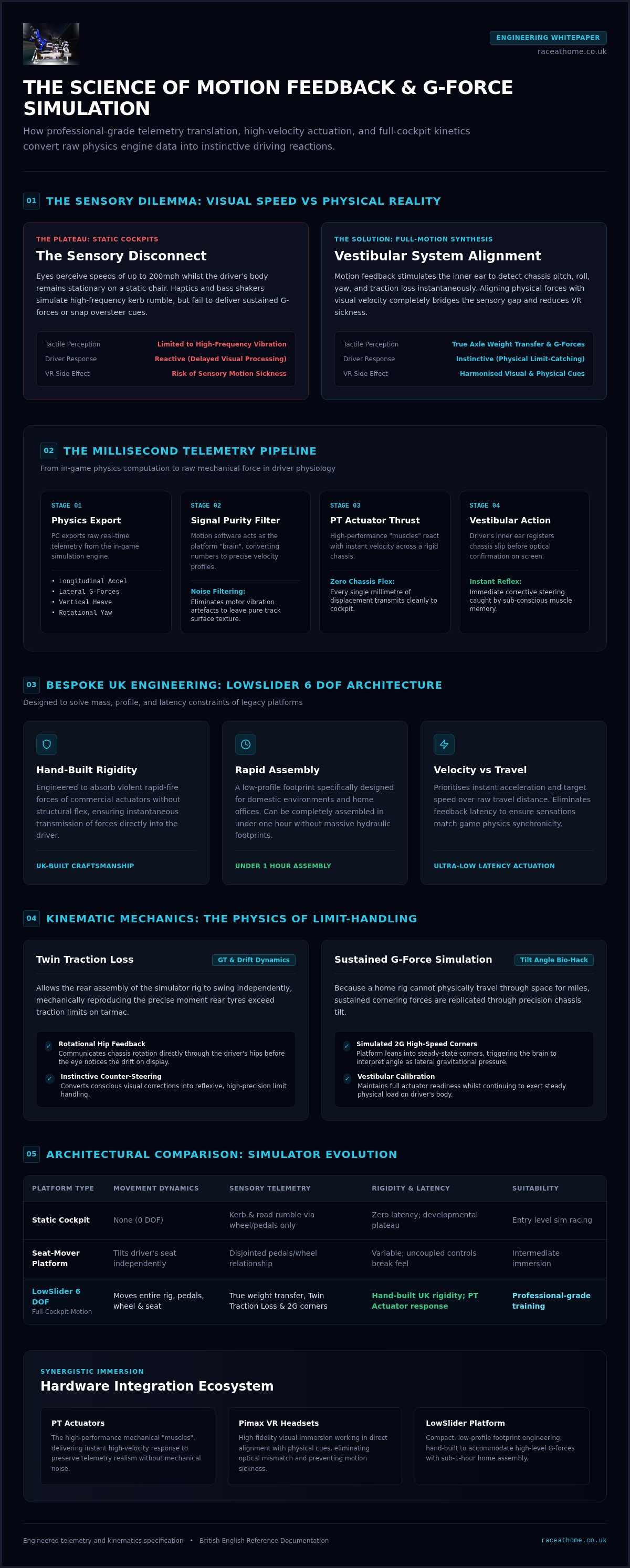
Motion feedback isn't just a luxury; it's the physical manifestation of digital telemetry data. Whilst haptic feedback and bass shakers can simulate the high-frequency rumble of a kerb, they fail to replicate the sustained G-forces of a high-speed corner or the violent snap of oversteer. For professional-level driver training, you need to feel the weight of the car shifting across the axles. This relies on stimulating your vestibular system. When your inner ear detects the exact moment of traction loss, your reaction becomes instinctive rather than reactive. A high-performance motion feedback racing simulator bridges the gap between what you see on screen and what your body expects to feel, effectively eliminating the sensory disconnect that often limits a driver's potential.
The Evolution from Static to Full Motion Rigs
Static rigs often lead to a developmental plateau. You can learn the racing line and the braking markers, but you can't master the subtle "seat-of-the-pants" feel required to find those last few tenths of a second. The industry has shifted from simple seat-movers, which only tilt the driver's chair, to sophisticated full-cockpit platforms that move the entire rig. By 2026, advances in motion simulator technology have drastically reduced latency. Modern actuators now respond with such incredible speed that the physical movement is perfectly synchronised with the in-game physics engine. This evolution ensures that the sensations you feel in the cockpit are identical to the forces acting upon a real-world chassis.
Key Components of a Motion Feedback System
The heart of any premium setup lies in its actuators. We utilise high-specification PT Actuator technology, which functions as the high-performance "muscles" of the rig. These components must be paired with intelligent telemetry software, the "brain" that translates raw game data into precise mechanical movement. However, even the best actuators are wasted on a weak frame. Structural rigidity is non-negotiable for a motion feedback racing simulator. Our hand-built LowSlider 6 DOF platforms are engineered to withstand the intense, rapid-fire forces of professional-grade actuators without flex. This rigidity ensures that every millimetre of movement is transmitted directly to the driver, providing the crystal-clear feedback necessary for high-stakes competition.
The Science of Sensation: How Telemetry Becomes Physical G-Force
The journey from a digital tyre slip to a physical jolt happens in milliseconds. Your PC exports raw telemetry data, including longitudinal acceleration, lateral G-forces, heave, and yaw, which the motion software then processes into precise actuator commands. High-end systems like our LowSlider series prioritise signal purity. By filtering out "mechanical noise" (the unwanted vibrations generated by the motors themselves), the system ensures you only feel the texture of the track. Whilst many novices focus on actuator travel distance, true realism depends on velocity. If an actuator cannot reach its target speed instantly, the feedback arrives late. This latency breaks the immersion of your motion feedback racing simulator, turning a training tool into a mere distraction.
Translating Traction Loss and Rear-End Sway
For GT racers and drifters, "Twin Traction Loss" represents the pinnacle of feedback. It allows the rear of the rig to swing independently, mimicking the exact moment the rear tyres lose their grip on the tarmac. Our LowSlider 6 DOF is engineered to communicate this slip through the chassis before your eyes even register the movement on screen. Traction loss is the critical feedback loop for limit-handling. By feeling the car's rotation through your hips, you can catch a slide with instinctive counter-steering. If you're looking to refine your technique, exploring the capabilities of a bespoke motion platform is the next logical step in your driver development.
G-Force Simulation and Sustained Pressure
Simulating a sustained 2G corner in a spare room requires a clever physiological trick. Since a rig cannot move through miles of physical space, it uses sustained tilt to simulate G-force. As you enter a corner, the platform leans; your brain interprets this lean as lateral pressure against your body. To keep the actuators ready for the next movement, "washout filters" slowly return the rig to a level position at speeds below your perception threshold. This balance is delicate. Too much intensity leads to rapid driver fatigue, whilst too little makes the experience feel numb. We calibrate our systems to deliver professional-grade realism that remains comfortable for long-distance endurance sessions. This precision ensures your motion feedback racing simulator provides the data you need without overwhelming your senses.
3DoF vs 6 DOF: Navigating Degrees of Freedom for Your Home Rig
Choosing the right configuration for your motion feedback racing simulator depends on your specific performance goals and available space. A 3DoF system provides the essential trio of Pitch, Roll, and Heave. These movements allow you to feel the car's attitude as it crests a hill or dives under heavy braking. However, whilst a 3DoF rig is a transformative upgrade from a static setup, it lacks the lateral and longitudinal forces that define a professional driving experience. This is where 6 DOF systems become the gold standard. By adding Surge, Sway, and Yaw, a 6 DOF platform creates a complete spatial envelope. You aren't just tilting; you're moving through a three-dimensional environment where every weight shift is accounted for. Historically, these systems required a dedicated room, but our proprietary LowSlider design has engineered the 6 DOF experience into a remarkably compact, low-profile footprint.
When is 3DoF Sufficient for Your Setup?
A 3DoF rig is often the ideal choice for flight simulation enthusiasts or entry-level sim racers. In flight, the primary sensations involve changes in altitude and attitude, making pitch and roll the dominant forces. For racing, it offers a high cost-to-performance ratio for those who want the thrill of track topography without the complexity of a full spatial rig. It's a significant leap in immersion. Whilst some users wonder about upgrade paths, it's often more efficient to invest in the platform that matches your ultimate goal from the start. If your focus is purely on local track bumps and elevation, 3DoF delivers a refined, engaging experience.
The 6 DOF Advantage: Why Six is the Professional Standard
Professional drivers demand 6 DOF because it replicates the nuanced forces of a real chassis. Surge is the hidden hero here; it provides the longitudinal force felt during aggressive gear shifts and heavy braking. Without Surge, you lose the physical sensation of being thrown forward into your belts. Similarly, Sway informs your brain about lateral grip through high-speed sweeps, allowing you to sense the limit of adhesion before the tyres give up. For a deeper technical dive, you can explore The Ultimate Guide to 6 DOF Motion Simulators. This level of total spatial awareness transforms a motion feedback racing simulator from a piece of gaming hardware into a true high-performance training tool.
Maximising Immersion: Combining Motion Feedback with VR and Premium Hardware
Immersion reaches its peak when you pair a high-fidelity motion feedback racing simulator with a premium VR headset. A common hurdle for many enthusiasts is motion sickness. This discomfort usually occurs when your eyes perceive high-speed motion whilst your body remains static. By introducing a 6 DOF platform, you align the visual data with physical cues. This allows your brain to process the experience naturally, effectively curing the sensory mismatch. Pimax VR headsets are particularly effective in this environment. Their expansive Field of View (FOV) provides the peripheral vision necessary to gauge speed and distance with professional accuracy. To maintain this illusion, a low-profile rig is essential. High-mounted platforms often move the driver too far from the optimal tracking volume, whereas the LowSlider design ensures you remain perfectly positioned for your VR tracking sensors.
Optimising Pimax VR for High-Speed Motion
Achieving a seamless experience requires more than just high resolution. You must implement motion cancellation. This software-level integration ensures the digital cockpit remains stable relative to your head, even as the rig pitches and rolls beneath you. Without it, your virtual view would bounce with every track bump, destroying the sense of realism. For a detailed technical walkthrough on synchronising these systems, see The Ultimate Pimax VR Motion Simulator Set-up Guide 2026. This synergy between hardware and software is what transforms a sim into a genuine training environment.
Bespoke Accessories and Cockpit Ergonomics
A motion rig is only as good as the peripherals attached to it. High-intensity actuators generate significant forces; if your pedal plate or wheel mount flexes, you lose the precision required for limit-handling. Direct-drive wheels and high-pressure SRP pedals are mandatory for this level of simulation. The hand-built LowSlider chassis provides the necessary rigidity to handle these loads without rattle or distortion. By focusing on a "centre of gravity" seating position, we ensure the feedback is delivered directly through your core. This ergonomic focus maximises the impact of every surge and sway. If you're ready to build an uncompromising setup, explore our range of sim racing accessories and motion platforms today. This level of hardware integration ensures that every bit of telemetry data results in a tangible, useful sensation.
Choosing Your Motion Platform: Why Bespoke Engineering Outpaces Mass-Market Solutions
Mass-market solutions often prioritise shipping volume over engineering integrity. This leads to high-mounted platforms that feel disconnected from the floor and prone to unwanted sway. In contrast, a bespoke motion feedback racing simulator like the LowSlider series focuses on an ultra-low profile architecture. By keeping the driver closer to the ground, we lower the centre of gravity and improve the mechanical advantage of the actuators. Every rig is hand-built to order in the UK, ensuring that the craftsmanship meets the rigorous demands of professional telemetry. This isn't just about build quality; it's about the precision of the physical sensation. We've solved the global shipping puzzle without sacrificing rigidity by utilising a proprietary four-piece design. This modular approach allows for worldwide delivery whilst maintaining the structural strength of a professional-grade chassis.
Assembly and Setup: From Box to Track in Sixty Minutes
The engineering behind our four-piece modular design ensures that every component aligns perfectly. We've simplified the logistics so that DIY assembly doesn't have to mean technical frustration. You can realistically move from unboxing to your first hot lap in under one hour. This ease of setup is a core part of our philosophy. We believe that your time should be spent on the track, not struggling with complex hardware configurations. Beyond the initial build, you'll find ongoing support through the Race@Home community, ensuring your rig remains optimised as simulation software evolves throughout 2026 and beyond.
The Investment in Realism
A hand-built rig is a long-term investment in your performance. Mass-market alternatives might offer a lower entry price, but they often lack the longevity, rigidity, and software compatibility required for a professional-level training tool. Evaluating the long-term value means looking at the precision of the actuators and the robustness of the frame. If you're serious about your driver development, our Buy Motion Simulator UK: The 2026 Professional Guide offers a deeper look into selecting high-end hardware. Choosing a platform designed for the ultimate evolution of the hobby ensures you won't outgrow your equipment. Ready to feel every kerb and weight shift with uncompromising clarity? Explore the LowSlider 6 DOF Motion Platform and discover how bespoke engineering transforms your sim racing reality.
The Future of Your Driver Development
Professional sim racing has evolved beyond simple visual feedback. You now understand how precise telemetry translation and the total spatial awareness of a 6 DOF system transform your sessions into genuine high-performance training. By aligning your physical sensations with digital data, you've unlocked the ability to catch slides instinctively and refine your technique with uncompromising accuracy. Investing in a bespoke motion feedback racing simulator is the definitive way to bridge the gap between a home hobby and a professional-grade experience.
Our LowSlider platforms are hand-built in the UK to ensure every component meets our rigorous engineering standards. The proprietary ultra-low profile design offers maximum stability for VR users, whilst our modular four-piece assembly means you can be track-ready in under sixty minutes regardless of where you are in the world. It's time to move beyond the limitations of static rigs and feel every weight shift as the engineers intended. Build Your Bespoke LowSlider 6 DOF Motion Rig and take your place on the starting grid with the ultimate competitive advantage. Your pursuit of perfect realism starts today.
Frequently Asked Questions
How does a motion feedback racing simulator reduce motion sickness?
A motion feedback racing simulator reduces nausea by aligning visual cues with physical sensations to resolve sensory mismatch. When using VR, your eyes see high-speed movement whilst your body remains static; this often leads to discomfort. By providing the G-forces your brain expects, the rig effectively cures this disconnect. This physical feedback allows your vestibular system to synchronise with the digital world, making long sessions far more comfortable for enthusiasts.
What is the difference between 3DoF and 6 DOF motion platforms?
The primary difference lies in the number of axes of movement available to the driver. A 3DoF rig offers Pitch, Roll, and Heave, which covers basic elevation and tilt for track topography. A 6 DOF system adds Surge, Sway, and Yaw, providing a full spatial envelope. This allows you to feel longitudinal forces during braking and lateral grip through corners. Professional drivers prefer 6 DOF for its ability to replicate total vehicle physics.
Can I use a motion simulator in a small room or flat?
Yes, provided you choose a rig designed with a compact footprint and low-profile architecture. Traditional hydraulic systems are often too bulky for home use, but our proprietary LowSlider design prioritises a space-saving layout. This engineering approach minimises the physical space required without compromising on the range of motion. It's specifically designed for home users who need a professional-grade experience within the constraints of a standard spare room or office.
Is the LowSlider motion platform compatible with all sim racing games?
Our platforms are compatible with almost every major sim racing title that outputs telemetry data. This includes popular simulations such as iRacing and Assetto Corsa Competizione. The telemetry software acts as the brain, translating in-game physics into actuator movement. Because we use industry-standard technology, your motion feedback racing simulator provides high-fidelity feedback across a broad spectrum of racing disciplines and ensures compatibility with future software updates as they are released.
How long does it take to assemble a Race@Home motion rig?
You can fully assemble a Race@Home rig in under one hour. We ship our systems worldwide in a four-piece modular design that simplifies the logistics of a high-end setup. Every component is hand-built in the UK and engineered to align perfectly, ensuring that DIY assembly is a straightforward process. This modular approach means you spend less time with a spanner in your hand and more time on the track experiencing visceral feedback.
Do I need special electrical wiring for a 6 DOF motion simulator?
No, our motion platforms are designed to run on standard domestic power outlets. Whilst professional-grade actuators are powerful, they are highly efficient and don't require industrial-grade electrical installations. You'll simply need a few spare sockets to power the actuators and the control box. We recommend using a high-quality surge protector to safeguard your investment, but no complex rewiring of your home or flat is necessary for operation.
What is traction loss and why is it important for sim racing?
Traction loss is the physical sensation of the rear tyres losing grip and the car rotating around its vertical axis. In a 6 DOF rig, this is simulated through the Yaw axis, often referred to as Twin Traction Loss. It's vital because it allows you to feel oversteer through your hips before your eyes see it on screen. This early warning is the key to catching slides and finding the limit of adhesion.
Can I use my existing sim racing pedals and wheel with a motion rig?
Yes, our LowSlider platforms are designed to be highly compatible with premium third-party peripherals. You can easily mount your existing direct-drive wheels and high-pressure load cell pedals. We often recommend hardware from partners like Sim Racing Professional to ensure your accessories match the rigidity of the chassis. The structural strength of our hand-built frames ensures that your high-end pedals won't flex or rattle under intense motion loads during high-speed sessions.


