
Most sim racers believe they are truly driving, but until you feel the chassis heave under heavy braking or the subtle shimmy of a rear tyre losing grip, you are merely managing a sophisticated digital interface. You have likely spent hours perfecting your wheel settings, yet you still find yourself guessing at the limit of adhesion. It is a common frustration to feel disconnected from the car's actual behaviour; a disconnect that often leads to inconsistent lap times or the disorienting motion sickness often associated with static VR setups.
If you are wondering what does a motion simulator feel like, the answer lies in the precise translation of telemetry into visceral, physical feedback. This article explores how professional-grade motion platforms bridge the gap between software and reality. We will examine the specific sensations of pitch, roll, and traction loss, whilst demystifying the technical jargon surrounding 3DOF and 6 DOF systems. You will discover how the compact, UK-engineered LowSlider advantage provides the essential sensory data your brain needs to drive by instinct. By the end, you will understand exactly how high-fidelity motion transforms your rig from a hobbyist setup into a precision training tool.
Key Takeaways
- Understand why professional motion is defined by physical displacement and telemetry translation rather than simple haptic vibrations.
- Discover exactly what does a motion simulator feel like by breaking down the six degrees of freedom, from the surge of heavy braking to the sway of high-speed cornering.
- Learn how shifting from visual reactions to vestibular instincts allows you to find the limit of adhesion and consistently reduce your lap times.
- Identify the "gimmick trap" by comparing the sensations of unnatural seat-movers against the authentic realism of full-motion chassis systems.
- Explore how the LowSlider's ultra-low profile and UK-engineered PT Actuators provide a professional-grade experience within a compact home footprint.
Beyond the Screen: Understanding the Visceral Sensation of Motion
Driving at the limit is a conversation between the car and your nervous system. In a static simulator, that conversation is one-sided. Your eyes see the track rushing past, but your body remains motionless, creating a sensory conflict that the brain struggles to reconcile. To truly understand what does a motion simulator feel like, you must look past the visual spectacle and focus on the physics of weight transfer. It isn't just about movement. It's about the physical translation of digital telemetry into a language your body instinctively understands.
Many novices confuse haptic vibration with true motion. Whilst a vibration motor can simulate the hum of an engine or the grit of a kerb, it cannot replicate the violent displacement of a chassis under load. Motion simulation provides the "displacement" missing from static rigs, moving your entire centre of gravity to mimic the forces of a real race car. Without this, your brain lacks the vestibular cues necessary to judge speed and grip accurately, often leading to the "disconnect" felt in high-speed corners where the car seems to rotate independently of your inputs.
The Sensory Bridge: Telemetry to Actuators
The magic happens behind the scenes through high-speed data extraction. Software interfaces with titles like iRacing or Assetto Corsa to pull real-time telemetry, including suspension travel, tyre slip, and G-force vectors. This data is processed instantly and sent to high-performance actuators, such as the professional-grade PT Actuators used in our builds. These mechanical muscles must react with near-zero latency; if the physical movement lags behind the visual frame, the illusion shatters. When the system is tuned correctly, the actuators mimic the precise compression of a spring or the sharp jolt of a gear change, ensuring the physical sensation is perfectly synced with the digital world.
Immersion vs. Information
There is a critical distinction between "arcade" movement and professional-grade feedback. Gimmicky systems often over-exaggerate movements to provide a "fun" ride, but this actually obscures the data you need to drive faster. A high-fidelity system focuses on providing "seat of the pants" information, allowing you to feel the exact moment the rear tyres begin to slide before your eyes even register the slide on screen. Motion fidelity is the accuracy of physical response to digital input. By prioritising precision over theatricality, a motion rig becomes more than a toy; it becomes a vital tool for finding the limit of adhesion with absolute consistency.
Decoding the Physics: What 6 DOF Actually Feels Like
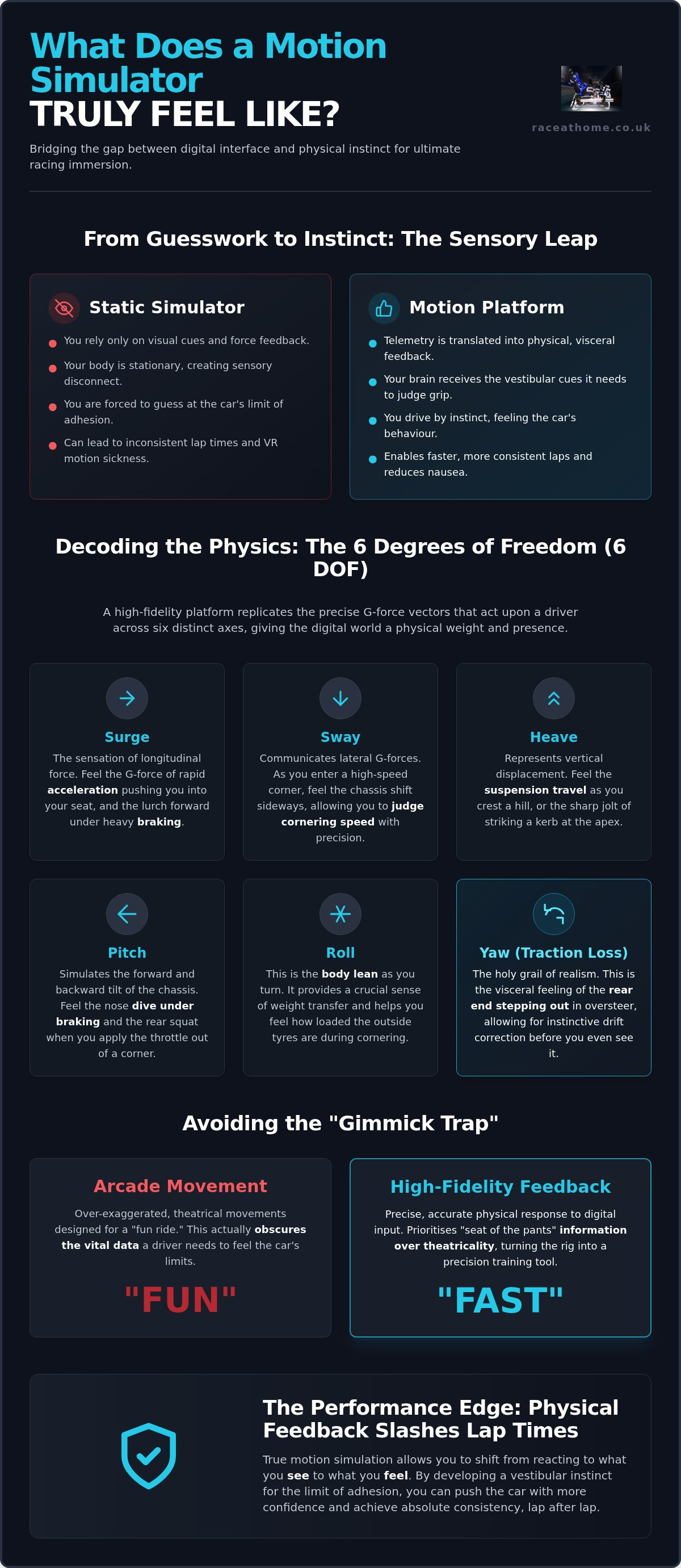
To truly grasp what does a motion simulator feel like, you must look at the physics of the 6 Degrees of Freedom (6 DOF). In a high-end rig, the platform manipulates space across six distinct axes: Pitch, Roll, Yaw, Heave, Sway, and Surge. This isn't just about moving; it's about replicating the specific G-force vectors that act upon a driver in a real cockpit. When these forces work in harmony, the digital world gains a physical weight that static rigs simply cannot replicate.
Surge is the sensation of longitudinal force. When you bury the throttle, the platform moves to simulate the G-forces of rapid acceleration. Under heavy braking, it lurches forward, forcing you against your harness just as you would experience at the end of a long straight. Heave represents vertical displacement. It's what allows you to feel the suspension travel as you crest a rise or the sharp, percussive jolt of striking a kerb at the apex. Sway, meanwhile, communicates lateral G-forces. As you turn into a high-speed sweep, the platform moves sideways to simulate the car's desire to push outward, providing the physical cues needed to judge your cornering speed with precision.
Traction Loss: The Holy Grail of Realism
Yaw, or traction loss, is the most transformative element for competitive sim racers. Whilst a standard rig might signal a slide through the steering wheel's force feedback, twin traction loss motion platforms communicate this directly through your hips. It is the visceral sensation of the rear end stepping out during oversteer. This physical cue allows for instinctive drift correction; you react to the slide before your eyes even register the visual change on screen. Feeling the car's rotation through your body rather than just your hands is what separates a gaming setup from a professional training tool.
Pitch and Roll: Navigating Elevation and Camber
Pitch and roll are essential for replicating the geography of the track. Pitch handles the nose-down attitude under braking and the nose-up attitude during a steep climb, whilst roll communicates the banking of circuits like Monza or Daytona. You feel the weight transfer across the chassis as you transition through a complex S-bend, allowing you to manage the car's balance with far greater confidence. If you want to experience this level of technical fidelity in your own home, exploring our LowSlider motion platforms is the next logical step in your sim racing journey.
Motion Realism vs. Arcade Movement: Avoiding the Gimmick Trap
When investigating what does a motion simulator feel like, many enthusiasts fall into the "Seat Mover" trap. These entry-level systems move only the chair whilst the wheel and pedals remain static. This creates a disjointed sensation where your body moves but your hands and feet stay behind, effectively telling your brain the car is breaking in half. A professional-grade experience requires a full-motion rig where the entire cockpit moves as a single, rigid unit. This ensures that your relationship with the controls remains constant, preserving the ergonomics of the driving position even during violent weight transfers.
The difference between a gimmick and a training tool often comes down to "Cue Conflict." This occurs when your eyes see movement that your inner ear doesn't feel, or when the physical movement is delayed. This mismatch is the primary cause of motion sickness in static VR setups. Professional rigs solve this by providing immediate, low-latency vestibular cues that align perfectly with the visual data. By giving your brain the missing physical information, a high-fidelity platform actually reduces nausea, allowing for longer, more focused sessions without the "seasick" feeling associated with inferior systems.
The Problem with Exaggerated Movement
A common misconception is that more travel equals more realism. In reality, a race car's suspension rarely moves more than a few inches. Gimmicky arcade systems often over-tilt the platform to create a sense of drama, but this creates "noise" that masks the useful telemetry. Professional software filters these signals, prioritising the high-frequency data you need to drive. You want to feel the subtle sensation of "bottoming out" through a high-speed compression or the sharp jolt of a flat-spot on a tyre. These precise, limited movements provide far more information than a rig that simply throws you around the room.
VR Integration and Visual Alignment
Immersion reaches its peak when you align physical motion with high-end virtual reality. For the ultimate sensory wrap-around, a Pimax VR motion simulator setup provides the wide field of view and high resolution needed to eliminate the "screen door" effect. When your vision is completely occupied by the digital cockpit and your body feels every heave and sway, the brain stops questioning the environment. This total alignment ensures your eyes and inner ear agree on every apex and elevation change, turning a digital simulation into a convincing physical reality.
The Performance Edge: How Physical Feedback Slashes Lap Times
A common misconception in the sim racing community is that motion is merely an immersion gimmick. Some players even claim it makes them slower. However, when you understand what does a motion simulator feel like in a professional context, you realise it is actually a high-bandwidth data stream. By engaging your vestibular system, you move from a state of visual reaction to one of instinctive driving. Your eyes are no longer the sole source of information; your inner ear and body provide the cues needed to find the limit of adhesion with surgical precision.
This physical feedback significantly reduces your mental load. In a static rig, your brain works overtime to interpret visual cues or force feedback signals through the wheel to guess what the car is doing. With motion, that information is delivered naturally. You don't have to think about weight transfer; you feel it. This allows you to maintain focus during long race stints, as your subconscious handles the micro-corrections required to keep the car on the track. Muscle memory develops faster when the physical sensations match the digital inputs, leading to a more consistent performance across every lap.
Correcting Slides Before They Happen
The primary advantage of high-fidelity motion is the speed of response. Visual information takes significantly longer for the brain to process than vestibular signals. When the rear of the car begins to rotate, you feel the yaw through your hips before your eyes register the change on the screen. This split-second advantage allows for immediate, instinctive corrections that prevent spins and save race stints. Professional drivers use motion to "feel" the car's balance through the corners, allowing them to push closer to the absolute limit without crossing it. This transition from "reacting to a slide" to "managing the balance" is where the real lap time gains are found.
Consistency in the Braking Zone
Braking is often the hardest skill to master in simulation. Whilst sim racing accessories like load-cell pedals are essential, they are even more effective when paired with surge feedback. The physical sensation of the nose diving and the longitudinal G-forces of deceleration allow you to gauge your braking pressure by feel rather than by staring at a speedometer or a braking marker. This is particularly vital in endurance racing, where fatigue can lead to missed markers. If you are ready to stop guessing and start feeling the track, you can upgrade your rig with a LowSlider motion platform to unlock your true competitive potential.
The LowSlider Experience: Precision Engineering for Your Living Space
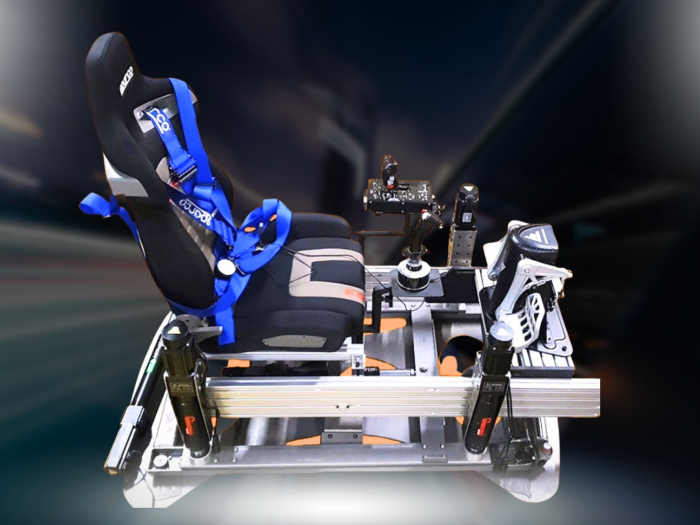
A significant barrier for many enthusiasts is the belief that high-end motion requires an industrial-sized room. Traditional 6 DOF rigs often feature massive, sprawling frames that dominate a space. The LowSlider philosophy challenges this by packing professional-grade telemetry translation into an ultra-low profile, compact footprint. When you ask what does a motion simulator feel like in a home environment, the answer shouldn't be "cramped" or "overwhelming." It should be a seamless integration of world-class engineering into your living space, providing the same visceral feedback used by professional teams whilst maintaining a manageable footprint.
We take pride in our hand-built British engineering. Unlike mass-produced alternatives that rely on generic components, every LowSlider is constructed to order in the UK with a focus on structural rigidity and long-term reliability. This bespoke approach allows us to bridge the gap between commercial-grade training tools and home setups. We've also eliminated the headache of complex installations. Each platform ships globally in four easy-to-assemble pieces, allowing you to move from the shipping crate to your first flying lap in under one hour. It's a no-compromise solution designed for those who value both performance and practicality.
Bespoke Craftsmanship vs. Off-the-Shelf
The foundation of our platforms lies in the use of professional-grade PT Actuators, known amongst industry experts for their precision and durability. A hand-built frame ensures these actuators can deliver their full range of force without the flex or vibration common in lighter, off-the-shelf rigs. This level of build quality is essential for maintaining sim rig motion platform compatibility across a wide range of racing seats and peripherals. By investing in a bespoke frame, you're ensuring that the subtle nuances of the track surface aren't lost to mechanical inefficiency.
Global Reach, Local Support
Whilst we are rooted in UK craftsmanship, our reach is truly global. We've optimised our logistics to ensure that a full-motion platform can be delivered safely and efficiently to your door, regardless of your location. Our team provides the guidance needed to ensure your home setup meets the power and space requirements for a professional rig, making the transition to motion as smooth as possible. Discover why the LowSlider 6 DOF is the definitive answer to the question of realism and take your sim racing career to its ultimate evolution.
Transform Your Simulator into a Precision Training Tool
Transitioning from a static rig to a motion platform is the single most significant upgrade a sim racer can make. You have explored how 6 DOF systems translate complex telemetry into the visceral sensations of traction loss, pitch, and heave. By understanding what does a motion simulator feel like, you will realise that it is not about the drama of movement, but the precision of the data delivered to your body. This sensory alignment slashes lap times and eliminates the disconnect often found in traditional setups.
Our proprietary LowSlider design offers an ultra-low profile and compact footprint, ensuring that professional-grade realism fits perfectly into your home. Each platform is hand-built with British engineering excellence and shipped globally in four easy-to-assemble pieces. You don't need a massive commercial space to experience the pinnacle of sim racing fidelity.
Experience the LowSlider 6 DOF: Hand-Built in the UK and redefine your driving experience today. The limit of adhesion is no longer a guess; it is a sensation you can master.
Frequently Asked Questions
Does a motion simulator feel like a real car?
A high-end motion simulator effectively replicates the weight transfer and G-forces of a real vehicle. By translating digital telemetry into physical displacement, the platform communicates the car's behaviour through your vestibular system. Whilst it cannot perfectly replicate sustained G-forces due to physical space limits, the immediate sensations of braking dive, acceleration surge, and suspension travel create a convincing visceral reality that static rigs simply cannot match.
Will a motion rig make me feel sick?
High-fidelity motion platforms actually reduce motion sickness by eliminating cue conflict. This occurs when your eyes see movement that your inner ear doesn't feel. By providing immediate physical cues that align with your visual data, professional rigs help your brain process the simulation more naturally. If you have ever wondered what does a motion simulator feel like in terms of comfort, it is often more stable than a static VR setup.
Is 6 DOF better than 3DOF for realism?
A 6 DOF system is significantly more realistic because it includes three additional axes of movement: heave, sway, and surge. Most importantly, a 6 DOF platform like the LowSlider includes dedicated yaw for traction loss. This allows you to feel the rear end of the car stepping out, which is a critical sensation for finding the limit of adhesion. Whilst 3DOF provides essential pitch and roll, 6 DOF offers the complete sensory package.
How much space do I need for a motion simulator?
You don't need a massive commercial space for a professional setup. Our proprietary LowSlider design features an ultra-low profile and a compact footprint specifically engineered for home living spaces. Whilst some industrial rigs require dedicated rooms, the LowSlider is designed to fit into standard residential environments without compromising on performance. It provides a full-motion experience whilst remaining one of the most space-efficient professional platforms available on the market today.
Do I need special software to make the motion work?
Yes, motion platforms require telemetry software to translate data from racing titles into physical movement. This software interfaces with popular sims like iRacing, Assetto Corsa, and Dirt Rally 2.0. It extracts real-time physics data and sends it to the PT Actuators. Most professional systems come with pre-configured profiles, allowing you to fine-tune the intensity of sensations like kerb strikes or engine vibrations to suit your personal driving style and hardware setup.
Can I use a motion platform with VR headsets?
Motion platforms and VR headsets are the perfect pairing for total immersion. When your visual field is occupied by a Pimax VR headset and your body feels the corresponding G-forces, the brain fully accepts the digital environment as real. High-end systems include motion compensation software to ensure your viewpoint remains stable within the virtual cockpit even as the rig tilts and lurches, preventing any disorientation during high-speed cornering or heavy braking manoeuvres.
Is a motion simulator worth it for competitive sim racing?
For competitive racers, motion is a vital training tool rather than a luxury. It allows you to feel traction loss through your hips before you see it on screen, granting a split-second advantage in correcting slides. This physical feedback reduces mental load and helps you find the limit of adhesion more consistently. If you want to understand what does a motion simulator feel like in a race, it feels like having extra sensory bandwidth.
How difficult is it to set up a Race@Home LowSlider rig?
Setting up a LowSlider rig is remarkably straightforward. We ship our platforms worldwide in four easy-to-assemble pieces, designed to be fully built by the customer in under one hour. There is no need for specialised engineering knowledge or complex tools. This straightforward approach ensures that you spend less time on logistics and more time on the track, enjoying the precision engineering of a hand-built British rig designed for immediate performance.


