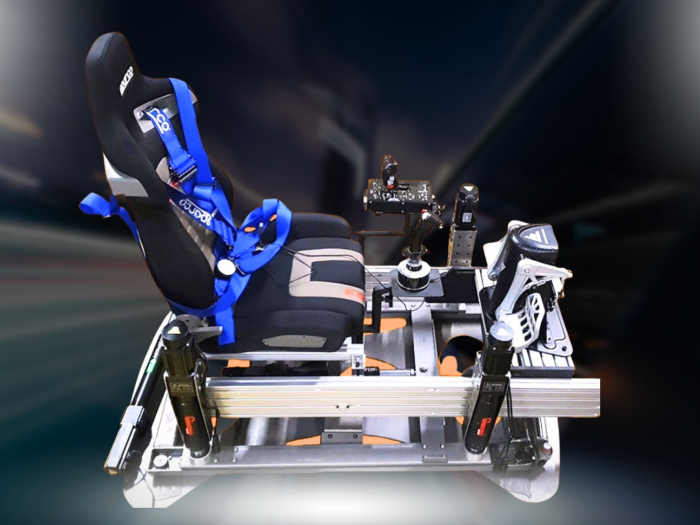

If you've ever felt the jarring disconnect between a visual apex on your screen and the static silence of your cockpit, are you really driving, or are you just playing a game? Choosing a hand built racing simulator is the definitive step towards closing that gap between digital data and physical reality. Most enthusiasts spend years chasing the perfect lap time, yet they're held back by rigs that feel more like office furniture than high-performance machinery. You likely know the frustration of a bulky setup that dominates your floor space whilst failing to translate the visceral snap of oversteer to your senses.
This guide explores why bespoke engineering and hand-built craftsmanship represent the absolute pinnacle of sim racing realism for 2026. You'll discover how to select a motion rig that delivers total sensory immersion without the traditional complexity or space-hogging footprint. We'll preview the transformative power of the LowSlider platform and show you how a compact, precision-tuned instrument can turn your home into a professional-grade racing centre. It's time to move beyond the limitations of static equipment and experience the pride of owning a hand-crafted piece of engineering excellence.
Key Takeaways
- Understand the structural superiority of welded steel over bolted aluminium extrusion to eliminate flex during high-torque manoeuvres.
- Discover how a hand built racing simulator utilising the proprietary LowSlider design provides a compact, ultra-low profile solution for maximum realism.
- Learn why 6 DOF platforms and Twin-Traction-Loss systems represent the absolute pinnacle of sensory feedback in 2026.
- Simplify your logistics with modular shipping innovations that allow for sub-one-hour assembly without sacrificing engineering integrity.
- Compare the performance characteristics of 3DoF and 6 DOF rigs to ensure your investment matches your specific immersion goals.
What defines a hand built racing simulator in 2026?
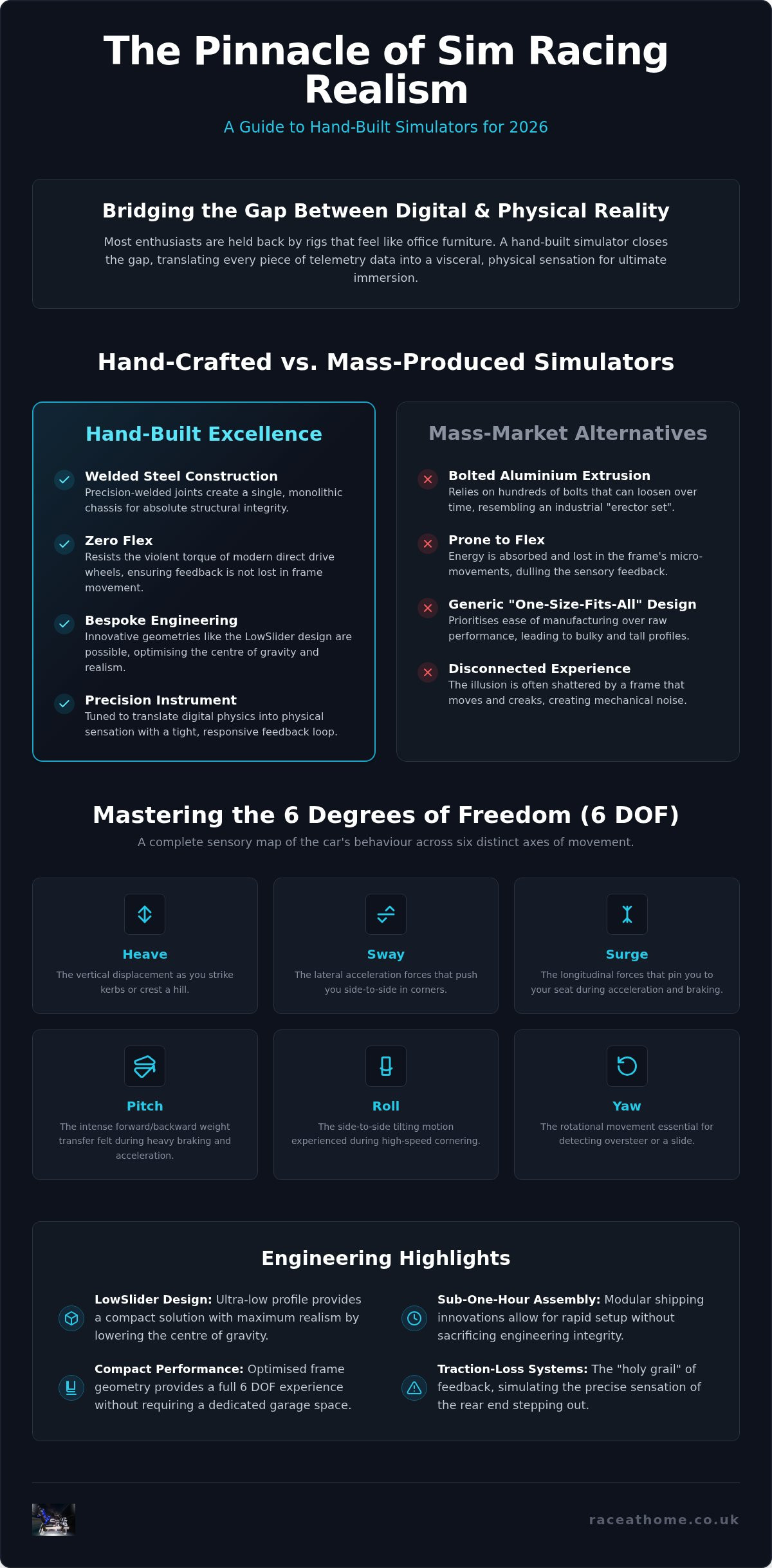
A hand built racing simulator isn't just a collection of off-the-shelf components bolted to an aluminium frame. It's a precision-engineered environment where every weld, joint, and surface is meticulously finished to serve one goal: absolute immersion. In 2026, the distinction between mass-market rigs and bespoke builds has never been clearer. Whilst factory-line products offer a generic "one-size-fits-all" approach, a hand-crafted chassis provides the structural rigidity required to handle the violent torque of modern direct drive wheels without a hint of flex. This rigidity is the foundation of realism; if your rig moves when your steering wheel doesn't, the illusion of the track is instantly shattered.
The philosophy of bespoke sim engineering
Traditional modular designs often resemble industrial "erector sets" that prioritise ease of manufacturing over raw performance. Bespoke engineering flips this script. By utilising precision welding instead of thousands of bolts, builders can create slimmer, more innovative geometries. This is exactly why the LowSlider design works; it achieves an ultra-low profile that places you closer to the centre of gravity, a feat difficult to replicate with bulky, standard-issue extrusions. Every joint is aligned by a master builder to ensure that motion telemetry translates directly to your body, rather than being lost in the mechanical noise of a loosely assembled frame. It's about eliminating the compromises inherent in mass production to deliver a tighter, more responsive feedback loop.
Mass-produced vs. hand-crafted simulators
Factory-produced simulators are built for the average user, but professional drivers and serious enthusiasts demand hardware that mimics the uncompromising nature of a real cockpit. There's a tangible "soul" in a hand-finished rig that mass production simply cannot replicate. You can feel the difference in the hand-finished materials and the tailored ergonomics that support your body through high-G corners. A hand-built simulator is a precision instrument tuned for telemetry, designed to bridge the gap between digital physics and physical sensation. Choosing UK-engineered hardware isn't just about performance; it's about the pride of ownership that comes from a piece of machinery built with a "no-compromise" attitude towards quality. You aren't just buying a seat; you're investing in a legacy of craftsmanship that transforms every lap into a visceral experience.
Engineering precision: The LowSlider motion advantage
The LowSlider design represents a fundamental shift in motion rig geometry. Most off-the-shelf systems sit high off the floor, which creates an artificial "pendulum" effect that can feel disconnected from the road. By contrast, the proprietary LowSlider architecture lowers the centre of gravity significantly. This ensures that every movement feels grounded and immediate. It's a critical feature for any high-end hand built racing simulator, as the ultra-low profile allows the mechanical hardware to disappear, leaving only the visceral sensation of the track. When you pair this geometry with the surgical precision of PT Actuator technology, you get a chassis that translates telemetry data into physical force with zero latency.
Mastering the 6 DOF experience
True realism requires more than just a few bumps and vibrations; it requires a complete sensory map of the car's behaviour. A 6 DOF (Degrees of Freedom) system achieves this by simulating six distinct axes of movement:
- Heave: The vertical displacement as you strike kerbs or crest a hill.
- Pitch and Roll: The intense weight transfer felt during heavy braking and high-speed cornering.
- Yaw: The rotational movement around the vertical axis, essential for detecting a slide.
- Surge and Sway: The longitudinal and lateral acceleration forces that pin you to your seat.
For professional-level driver training, traction loss is often considered the "holy grail" of feedback. It's the specific sensation that tells your brain the rear end is stepping out before your eyes even register the movement on screen. You can dive deeper into these mechanics by reading The Ultimate Guide to 6 DOF Motion Simulators.
Compact performance without compromise
Space is frequently the final barrier for home enthusiasts. Traditional 6 DOF rigs are notoriously bulky, often requiring a dedicated garage or a massive floor area. Bespoke engineering solves this by optimising the frame geometry to fit a full motion system into a footprint comparable to many standard static rigs. It's a difficult engineering challenge to maintain total stability whilst delivering the violent forces of a Twin-Traction-Loss system, but the hand-built nature of the chassis ensures that every component is integrated with zero wasted space. This "no-compromise" approach means you don't have to sacrifice your living area to experience professional-grade g-forces. If you're ready to see how this technology fits into your home, you can explore our motion platform range to find the right configuration for your space.
Comparing hand built rigs to mass-market alternatives
The choice between a mass-market rig and a hand built racing simulator often comes down to the fundamental engineering of the frame. Most commercial offerings rely on aluminium extrusion, commonly known as 80/20. Whilst this material is versatile and cost-effective for manufacturers to ship in flat packs, it relies on thousands of T-slot nuts and bolts to maintain its structure. Over time, and under the violent stress of a 6 DOF motion system, these bolts can loosen. This leads to micro-movements that dull the feedback from your tyres and create distracting creaks. A bespoke chassis avoids these pitfalls by prioritising permanent structural integrity over modular convenience.
The flex-free promise of bespoke frames
If you're using professional-grade pedals or a high-torque wheelbase, any flex in the rig is wasted energy. Hand-welded steel joints provide a level of structural rigidity that bolted systems simply can't match. In real-world testing, a bespoke chassis maintains its calibration far longer because the frame acts as a single, solid unit. There's no mechanical "slop" to account for. This means the telemetry from the software reaches your hands and feet with absolute purity. It's the difference between driving a precision-tuned race car and a kit car that needs constant tightening. Investing in a hand built racing simulator ensures your equipment remains as sharp on its thousandth lap as it was on its first.
Bespoke vs. Mass-Market: A 2026 comparison
When evaluating your investment, it's helpful to look at how these two philosophies compare in practice. While mass-market rigs are often marketed as "pro-grade," the reality of ownership involves long assembly times and a bulky, industrial aesthetic that can clash with your home interior. A hand-crafted platform doesn't just hold its calibration; it holds its appeal as a piece of engineering art. You can explore the broader implications of this investment in our guide: Is a Sim Racing Motion Rig Worth It?
| Category | Hand-built (Race@Home) | Mass-market (Extrusion) |
|---|---|---|
| Assembly Time | Sub-one-hour (4 modules) | 8 to 12 hours (hundreds of parts) |
| Footprint | Ultra-compact/Integrated | Large/Modular/Bulky |
| Rigidity | Zero-flex welded steel | Bolted (prone to dynamic flex) |
| Aesthetic | Precision-engineered instrument | Industrial scaffolding |
Aesthetics shouldn't be an afterthought. A hand built racing simulator provides a level of integration that aluminium scaffolding simply cannot offer. The clean lines and hand-finished materials allow the rig to complement a modern home office or media room rather than dominating it. This long-term value is reflected not just in the performance, but in the durability and resale appeal of a platform that isn't built to a production-line budget.
Planning your bespoke setup: From delivery to first lap
Transitioning from the dream of professional-level immersion to the reality of your first lap requires a clear logistical plan. Many enthusiasts worry that a hand built racing simulator will arrive as a daunting crate of loose steel and complex wiring. However, modern engineering has solved the paradox of bespoke quality and user-friendly setup. Before your rig arrives, you'll need to prepare your environment. Motion platforms generate significant kinetic energy, so a solid floor surface or heavy-duty rubber protection is essential to prevent vibration transfer. You should also ensure your power supply can handle the peak draws of high-torque actuators, ideally utilising a dedicated circuit to maintain electrical stability during intense sessions.
Worldwide shipping and modular assembly
The LowSlider platform is designed to be accessible to global enthusiasts without the need for specialist installation teams. By shipping the chassis in four pre-assembled modules, we've eliminated the "erector-set" frustration associated with mass-market rigs. This innovation allows for a sub-one-hour assembly time, meaning you spend your evening on the track rather than squinting at a manual. Every hand-built UK unit is rigorously tested before being dispatched in easy-to-handle modules that fit through standard doorways. If you're ready to start your journey, you can explore our bespoke motion solutions to see how quickly we can get you on the grid.
Integrating VR and high-end accessories
To truly capitalise on the precision of a hand built racing simulator, your visual and ergonomic setup must match the quality of the motion hardware. Pimax VR headsets are the ideal partner for the LowSlider, offering the wide field of view and high resolution necessary to trick your brain into total immersion. When the physical surge of the rig matches the visual depth of the headset, the digital world becomes indistinguishable from reality. Beyond visuals, optimising your cockpit with professional sim racing accessories ensures that your seating position and pedal distance are tailored to your specific physiology. You can find detailed technical advice on synchronising these systems in The Ultimate Pimax VR Motion Simulator Set-up Guide 2026.
Race@Home: Hand-crafted excellence for the ultimate immersion
Race@Home specialises in bridging the gap between digital telemetry and physical sensation. Our story is rooted in a deep-seated dissatisfaction with mass-market solutions that prioritise profit margins over the driver's visceral experience. Every hand built racing simulator that leaves our workshop is a testament to UK-based engineering excellence. We don't settle for "good enough" because we know that in the heat of a qualifying lap, even a millimetre of structural flex can be the difference between a podium and a retirement. Our "no-compromise" approach defines the LowSlider 6 DOF and 3DoF platforms, ensuring that every actuator movement is as precise as the code that triggers it. This dedication to raw performance is why we've become the trusted partner for those who demand the absolute pinnacle of realism.
Crafted in the UK, raced worldwide
Technical authority comes from years of testing and refining our proprietary designs in real-world scenarios. We've built strong partnerships with industry leaders like PT Actuator to ensure our motion platforms deliver the highest fidelity of feedback available. By integrating Sim Racing Professional gear into our chassis, we provide a level of durability that withstands the rigours of professional training sessions. Race@Home is the definitive gateway to professional-level home racing. This commitment to quality has made us the preferred choice for serious enthusiasts and professional racing teams who require a rig that performs consistently under pressure. We continue to evolve bespoke motion technology by listening to the feedback of the drivers who rely on our hardware to sharpen their skills.
Start your bespoke journey today
Choosing a high-end simulator is a significant investment in your hobby or professional career. We understand that every driver has unique requirements, which is why we offer direct consultations with our specialists to help you configure the perfect setup for your space and goals. You'll benefit from the peace of mind that comes with UK-based technical support and our proven global shipping expertise. Whether you're in London or Los Angeles, your platform arrives in our signature modular format for a seamless introduction to the world of motion. Our team is ready to help you navigate the technical specifications to ensure your setup is future-proofed for years to come. If you're ready to explore your options, read our guide on Buy Motion Simulator UK: The 2026 Professional Guide.
Step into the future of professional sim racing realism
Investing in a hand built racing simulator is about more than just hardware; it's about eliminating the barriers between you and the virtual track. By prioritising the structural integrity of welded steel and the surgical precision of 6 DOF full motion realism, you ensure every lap provides the visceral feedback required for true immersion. We've seen how the proprietary LowSlider design overcomes the limitations of bulky, mass-market rigs, offering a compact yet uncompromising solution for your home. With our innovative worldwide shipping in four easy pieces, professional-grade engineering is now accessible to drivers across the globe.
Every platform is hand-built in the UK with a dedication to craftsmanship that factory lines simply cannot replicate. It's time to move beyond the flex and mechanical noise of standard equipment. Secure your place on the grid with a chassis that evolves with your skills. Explore our hand-built LowSlider motion platforms today and discover the transformative power of bespoke engineering. Your journey toward total sensory immersion starts here, and we're ready to help you cross the finish line.
Frequently Asked Questions
How long does it take to assemble a hand-built racing simulator?
Assembly of a hand built racing simulator takes less than one hour thanks to our modular design. Whilst mass-market rigs often arrive as a daunting collection of hundreds of individual parts, our platforms are shipped in four pre-assembled modules. This approach ensures that you spend your time driving rather than squinting at complex manuals. Every joint is precision-welded in the UK, so you simply bolt the main sections together and connect the electronics to begin your first session.
Can I ship a full-motion simulator globally from the UK?
Yes, we provide global shipping for all our motion platforms directly from our UK workshop. We've engineered the LowSlider chassis to be transported in four easy-to-handle pieces, which significantly reduces the risk of damage during transit. This modular approach also simplifies the customs process and ensures that even a full 6 DOF system can be delivered to your door anywhere in the world. Our logistics team manages the entire process to ensure your bespoke rig arrives safely.
What are the space requirements for a 6 DOF motion platform?
The space requirements for our 6 DOF platforms are surprisingly modest due to the compact LowSlider architecture. Unlike traditional industrial motion rigs that require a dedicated room, our design fits within a footprint similar to a standard static rig. You'll need approximately 1.5 metres by 2 metres of clear floor space to allow for the platform's full range of movement. This makes it an ideal choice for home offices or media rooms where floor space is at a premium.
Do hand-built simulators require more maintenance than mass-market rigs?
Hand-built simulators actually require less routine maintenance than mass-market aluminium extrusion rigs. Because our frames are constructed from hand-welded steel rather than bolted profiles, there are no T-slot nuts to vibrate loose during intense motion sessions. You won't need to spend your weekends tightening bolts to eliminate creaks or mechanical "slop". This structural integrity ensures that your hand built racing simulator maintains its precision and calibration over years of heavy use with minimal intervention.
Is a 6 DOF motion platform compatible with all sim racing software?
A 6 DOF motion platform is compatible with almost all leading sim racing titles that output telemetry data. Software like SimHub or SRS translates the digital physics from games such as iRacing, Assetto Corsa Competizione, and Dirt Rally 2.0 into physical movement. This compatibility ensures that your investment remains versatile across different racing disciplines. Our systems are designed to integrate seamlessly with these software layers, providing a plug-and-play experience that bridges the gap between digital code and physical sensation.
How does traction loss improve the realism of a racing simulator?
Traction loss provides the specific physical sensation of the car's rear tyres losing grip, which is essential for professional-level driver training. In a static rig, you rely solely on visual cues or steering wheel weight to detect a slide. With a Twin-Traction-Loss system, your body feels the chassis rotate before your eyes register the movement on screen. This immediate feedback allows you to react instinctively, catch oversteer more effectively, and push the car closer to its absolute limit.
Can I use a Pimax VR headset with the LowSlider motion platform?
Yes, Pimax VR headsets are perfectly compatible and highly recommended for use with our motion platforms. We maintain a partnership with Pimax because their wide field of view and high resolution complement the intense immersion of a 6 DOF system. When the visual depth of the headset matches the physical weight transfer of the rig, your brain fully accepts the illusion of being in a real cockpit. It's the ultimate combination for enthusiasts seeking total sensory immersion.
What is the benefit of a low-profile motion rig for home use?
The primary benefit of a low-profile rig is the realistic centre of gravity it provides. Most motion systems sit high off the ground, creating a pendulum effect that feels artificial. The LowSlider design keeps you close to the floor, ensuring that heave and roll movements feel grounded and authentic. Additionally, this low-profile geometry makes the rig much less intrusive in a home environment, allowing it to blend into your room whilst still delivering professional-grade performance.


