
The era of the bloated, industrial-sized racing rig is officially over. For too long, the only path to achieving professional 6 DOF realism involved sacrificing vast amounts of expensive floor space and hiring specialised engineers just to manage the assembly. You likely recognise the frustration of watching high maintenance costs and frequent downtime eat away at your margins. Every square metre of your facility must generate revenue; a commercial motion simulator that sits idle is a liability rather than an asset.
This 2026 guide shows you how to implement a platform that delivers authentic, telemetry-based feedback without the logistical nightmares of the past. You'll discover how to select hardware that offers a fast return on investment through high throughput and low-maintenance engineering. We will cover the critical importance of twin-traction-loss for professional driver coaching and explain how compact, modular designs now allow for a one-hour setup. From maximising revenue per square foot to ensuring your drivers feel every nuance of the track, this is your roadmap to professional sim racing success.
Key Takeaways
- Identify the shift from basic vibration to true 6 DOF telemetry, ensuring your hardware is built for 12 plus hours of daily commercial operation.
- Explore the technical advantages of an ultra-low centre of gravity and twin-traction-loss for professional-grade driver coaching accuracy.
- Learn how to maximise your revenue per square metre by choosing a compact commercial motion simulator that delivers high-end performance in a business-friendly footprint.
- Minimise operational downtime through a modular four-piece shipping design that allows for rapid assembly and seamless international logistics.
- Understand why a bespoke, hand-built approach from a technical specialist provides a more reliable long-term ROI than mass-produced industrial rigs.
Defining the 2026 Commercial Motion Simulator Standard
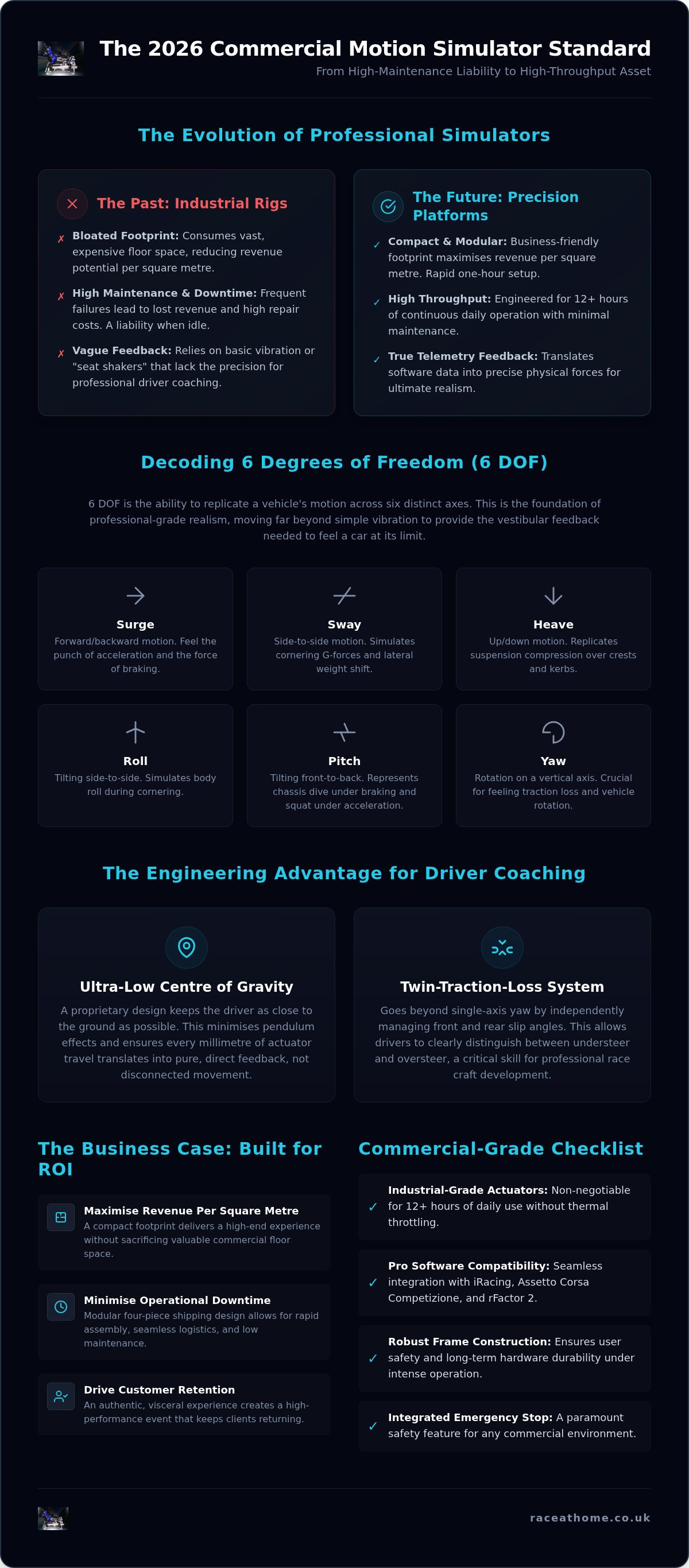
The landscape of sim racing has moved far beyond the flickering screens and vibrating steering wheels of the past. In 2026, the benchmark for a commercial motion simulator is defined by its ability to replicate the complex physics of a race car with surgical precision. We've seen a decisive shift from arcade-style "seat shakers" to sophisticated motion simulator platforms that utilise 6 Degrees of Freedom (DOF). This isn't just about immersion; it's about technical accuracy. Professional driver training centres and high-end esports lounges now demand rigs that can withstand 12 or more hours of continuous daily operation without thermal throttling or mechanical degradation.
A commercial motion simulator is a high-duty-cycle platform that translates software telemetry into precise physical G-forces.
Static vs. Motion: The Evolution of Commercial Sim Racing
Static rigs are rapidly becoming obsolete in the professional driver coaching space. Without the vestibular feedback of yaw, pitch, and roll, a driver cannot develop the "seat of the pants" feel required to detect the limit of grip. This sensory gap hinders the development of genuine muscle memory. When you introduce a 6 DOF platform, you bridge the gap between digital data and physical sensation. This increased realism doesn't just improve lap times; it drives customer retention. When a client feels the visceral surge of acceleration and the sharp snap of traction loss, they aren't just playing a game; they're experiencing a high-performance event that keeps them coming back to your centre.
Key Requirements for Business-Grade Hardware
Reliability is the cornerstone of any business-grade installation. Industrial-grade actuators, such as those from PT Actuator, are non-negotiable for commercial environments where downtime equals lost revenue. These systems must offer seamless integration with professional software to provide consistent telemetry-based feedback. Essential compatibility includes:
- iRacing: For competitive online rankings and professional licensing.
- Assetto Corsa Competizione: For GT3 and GT4 specific training.
- rFactor 2: For the most advanced tyre model physics available.
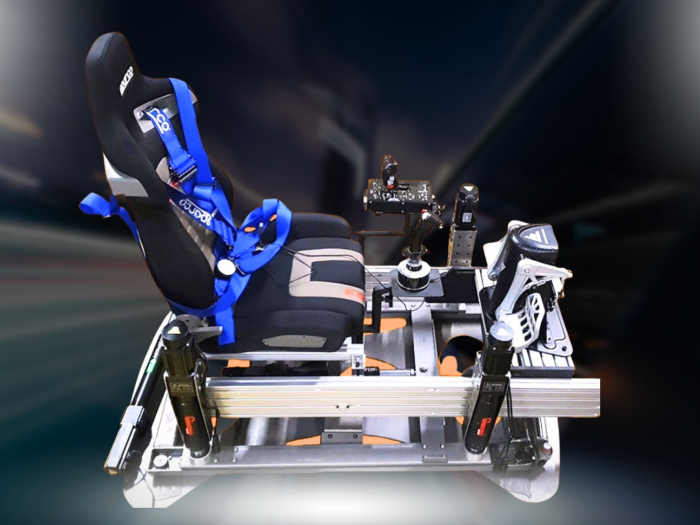
Safety remains paramount; robust frame construction and integrated emergency stop systems ensure that the high-intensity experience remains controlled for every user. The LowSlider 6 DOF Twin-Traction-Loss Motion Platform meets these rigorous standards, offering a no-compromise solution for businesses that prioritise durability and realism.
Technical Excellence: 6 DOF and the LowSlider Advantage
The true power of a modern commercial motion simulator lies in its ability to manipulate physics across six distinct axes. These Degrees of Freedom (DOF) include Pitch, Roll, Heave, Yaw, Sway, and Surge. Each axis corresponds to a specific movement of a real-world vehicle; Surge handles the punch of acceleration and braking, whilst Heave replicates the vertical compression of the suspension over undulations. Whilst NASA operates the world's largest motion flight simulator to test massive aerospace hardware, the goal for professional sim racing is extreme fidelity within a manageable footprint. Traditional commercial rigs often rely on oversized industrial components that result in a high centre of gravity and a massive physical profile. The LowSlider 6 DOF Twin-Traction-Loss Motion Platform redefines this standard. Its proprietary design keeps the driver as close to the ground as possible, minimising pendulum effects and ensuring that every millimetre of actuator travel translates into pure, unadulterated feedback.
The Role of Twin Traction Loss in Driver Training
Feeling the rear end of the car is the difference between a successful save and a race-ending crash. Most simulators use a single-axis yaw to represent traction loss, but this often feels disconnected and "floaty." Race@Home utilises a twin-traction-loss system that independently manages both the front and rear slip angles. This engineering choice allows drivers to distinguish between understeer and oversteer with incredible clarity. If you are training professional drivers, they need to feel the car's balance shifting through the chassis. This level of detail is essential for building the instinctive reactions required on a real circuit, making it a critical feature for any serious commercial motion simulator installation.
Engineering for Immersion: PT Actuators and Precision
Precision requires speed. We utilise high-fidelity PT Actuators to bridge the gap between digital telemetry and physical sensation. In a fast-paced commercial environment, even a few milliseconds of latency can break the immersion and cause motion sickness. The LowSlider frame is hand-built in the UK to eliminate flex. If the frame bends, motion energy is wasted. By ensuring a rigid connection between the actuators and the seat, we guarantee that the driver feels the sharp snap of a kerb or the subtle vibration of a flat-spotted tyre. You can view our full hardware specifications to see how this engineering approach maximises performance without the bulk of traditional industrial systems. This compact footprint allows you to fit more units into your venue, directly increasing your revenue potential through higher throughput.
The Business Case: ROI, Space Efficiency, and Durability
Choosing a commercial motion simulator is a decision that balances the visceral thrill of the drive with the cold reality of the balance sheet. In a professional sim centre, your primary metric isn't just customer satisfaction; it's revenue per square metre. Large-scale, industrial rigs might offer spectacle, but their massive footprint often limits the number of units you can operate simultaneously. By opting for a compact, low-profile design, you can significantly increase your venue's capacity. If you can fit six rigs into a space that previously only held five, you've instantly boosted your earning potential by 20% without increasing your rent or overheads.
High-fidelity motion also justifies a premium pricing model. Customers are willing to pay more for an experience they simply can't replicate at home. Providing a platform with 6 degrees of freedom creates that "must-visit" factor that drives repeat bookings. This isn't just about the initial purchase; it's about the total cost of ownership. Rigs hand-built in the UK with premium components require less frequent servicing, ensuring your investment stays on the floor and out of the workshop where it belongs.
Maximising Floor Space in Sim Centres
Floor plan efficiency is often the difference between a profitable venture and a struggling one. Our LowSlider design allows businesses to fit 20% more rigs into their venue compared to traditional, bulky alternatives. This compact footprint doesn't compromise the experience. Instead, it enhances it by allowing for better customer flow and improved visibility across the lounge. When you are looking for the best motion simulator for sim racing in a space-constrained environment, the ability to maintain professional-grade physics without the industrial bulk is a game-changer for your bottom line.
Reliability and Maintenance in High-Traffic Environments
A commercial motion simulator must be a workhorse. In a high-traffic esports lounge, hardware is subjected to 12 or more hours of daily use. We design our platforms with 24/7 reliability in mind, utilising hand-built UK craftsmanship to ensure every bolt and actuator is fit for purpose. If a component does require attention, our modular design ensures rapid on-site servicing. Because the platform ships in four manageable pieces, accessing critical parts is straightforward. This modularity prevents total rig downtime. You can swap out a single component and have the rig back in service within minutes, protecting your throughput and your professional reputation.
Implementation and Maintenance in Commercial Environments
To further enhance that professional reputation, investing in high-impact visual branding through Banner 4 Sale can help create an immersive atmosphere that draws customers into your sim racing centre.
Speed of deployment is as vital as the physics themselves. A commercial motion simulator that requires weeks of calibration or a team of specialist engineers to assemble is a drain on your operational resources. Race@Home has solved the international shipping headache by delivering our platforms in four manageable, pre-assembled pieces. This modular approach significantly reduces the complexity at customs and freight handling; you don't need to worry about oversized industrial crates or complex mechanical schematics. You can move from unboxing to full-throttle racing in under sixty minutes. This rapid deployment allows businesses to scale their operations quickly or reconfigure their venue layout without significant downtime.
Once the hardware is on the floor, the focus shifts to operational efficiency. Training your staff to manage these rigs is straightforward. Because the system is built for high-duty cycles, the daily reset process is minimal. We provide clear guidance on software calibration and hardware checks to ensure every customer receives a consistent, professional-grade experience. This reliability is what allows a centre to maintain high throughput during peak hours without technical hitches interrupting the revenue stream.
Global Logistics and Rapid Deployment
Shipping high-end engineering across borders often involves navigating a maze of regulations. By breaking the platform down into four easy-to-assemble sections, we've simplified the logistics for our global partners. Setting up your first rig takes less than an hour, meaning your business is ready to generate profit almost immediately upon delivery. Standardising your fleet with identical rigs also simplifies your long-term maintenance. If every unit follows the same mechanical logic, your on-site team can perform routine checks and software updates with total confidence across the entire lounge.
Optimising the User Experience for High Throughput
In a commercial setting, you might host fifty different drivers in a single weekend. Every driver has a different height and weight, so speed of adjustment is critical. Our quick-adjust features for seats and pedals ensure that transitions between sessions take seconds, keeping your throughput high. For venues aiming for the pinnacle of immersion, integrating Pimax VR headsets provides a level of visual depth that traditional screens cannot match. You can also utilise software presets to cater to different skill levels; a novice can enjoy a stabilised "arcade" feel, whilst a professional driver can access the raw, unfiltered telemetry data they need for training. You can view our commercial hardware options to see how these features integrate into a professional workflow.
Why Race@Home is the Premier Partner for Commercial Sim Racing
Race@Home doesn't just manufacture hardware; we engineer the gateway to professional-level driver development. Our LowSlider platform is a testament to UK craftsmanship, designed for those who refuse to compromise on fidelity or floor space. When you invest in a commercial motion simulator from us, you aren't just buying an actuator rig. You're gaining a technical partner who understands the nuances of telemetry and the demands of high-traffic commercial environments. We act as consultants, helping you scale your operations from a single training unit to a multi-rig esports arena with hardware that is built to last.
Our engineering philosophy is rooted in the belief that every vibration felt by the driver should serve a definitive purpose. We bridge the gap between digital data and physical sensation, ensuring that your venue offers an experience mass-market arcade rigs simply cannot replicate. This "no-compromise" attitude toward quality ensures that your business remains at the cutting edge of the industry, providing a service that keeps professional drivers and enthusiasts returning to your centre year after year.
Bespoke Engineering for Specific Business Needs
Different racing disciplines require distinct physical profiles. A rally driver needs violent, high-frequency feedback to navigate loose gravel stages, whilst a GT3 specialist requires subtle, high-fidelity cues to manage tyre wear and aerodynamic balance through high-speed corners. Working directly with our UK-based designers allows you to customise your setup for these specific racing disciplines. Whether you need a formula-style seating position or a rugged GT cockpit, we can tailor the hardware to match your business goals. Our modular hardware also ensures your investment is future-proof; you can upgrade individual components as 2026 technology evolves without needing to replace the entire foundation of your rig.
Join the Global Network of Race@Home Professionals
Our systems are currently powering professional driver training facilities and commercial lounges across the globe. These successful implementations prove that high-end realism and business profitability can coexist when the hardware is designed with efficiency in mind. The long-term value of a Race@Home partnership lies in our dedicated support network and our commitment to continuous innovation. We don't just ship a box and disappear; we provide the ongoing expertise required to keep your fleet performing at its peak. If you're ready to elevate your business and secure a competitive advantage, the commercial motion simulator from Race@Home represents the ultimate 2026 investment. Contact our team today to discuss your specific commercial requirements and discover how we can help you build a world-class sim racing destination.
Secure Your Competitive Edge in 2026
The shift toward high-fidelity, 6 DOF telemetry is no longer optional for businesses aiming to provide professional-grade training. By prioritising a commercial motion simulator with a compact footprint, you can maximise your venue's capacity whilst delivering the visceral sensations that drivers demand. We've explored how the proprietary LowSlider design solves the common pains of massive, high-maintenance rigs through precision engineering and a business-friendly logistics model.
Every unit is hand-built in the UK and shipped worldwide in four manageable pieces, ensuring a setup time of under one hour. This allows you to focus on growth rather than technical troubleshooting. If you're ready to transform your facility into a premier racing destination, it's time to invest in hardware that bridges the gap between digital data and physical reality. You don't need to compromise on realism to achieve a sustainable return on investment.
Enquire about a bespoke commercial LowSlider rig today and join a global network of sim racing professionals. The future of immersion is here; we're ready to help you lead the pack.
Frequently Asked Questions
How much space does a commercial motion simulator require?
A standard commercial motion simulator often requires a large industrial footprint, but the LowSlider is designed for maximum efficiency. Its proprietary ultra-low profile allows you to fit more units into a smaller area, directly increasing your revenue per square metre. Whilst specific dimensions vary based on your choice of cockpit and peripherals, the platform itself is engineered to minimise floor space whilst maintaining full 6 DOF movement.
Can the LowSlider 6 DOF be used for professional driver coaching?
The LowSlider 6 DOF platform is specifically engineered for professional driver coaching. Its twin-traction-loss feature allows drivers to distinguish between understeer and oversteer with surgical precision, which is critical for developing real-world racing instincts. By translating software telemetry into accurate physical G-forces, it enables trainees to build genuine muscle memory that transfers directly to the track, making it a staple in professional training environments.
Is a commercial motion simulator difficult to maintain?
Maintenance for a Race@Home platform is straightforward thanks to its modular, hand-built construction. We utilise industrial-grade PT Actuators that are designed for high-duty cycles and 12 plus hours of daily commercial use. If a component does require attention, the 4-piece assembly model allows for rapid access and servicing. This design philosophy prevents total rig downtime, ensuring your business remains operational during peak hours.
Does Race@Home ship its motion platforms worldwide?
Yes, we provide worldwide shipping for all our motion platforms. To reduce the complexity of international logistics and customs, each rig is shipped in four manageable, pre-assembled pieces. This method ensures that your hardware arrives safely and can be moved through standard doorways without the need for heavy lifting equipment or specialised engineering teams to manage the delivery process.
How long does it take to assemble a LowSlider rig for a business?
A business can fully assemble a LowSlider rig in under one hour. Because the platform arrives in four pre-configured sections, the physical setup is a matter of bolting the main components together and connecting the electronics. This rapid deployment is a key differentiator for commercial clients, as it allows for immediate integration into a venue's workflow without the need for lengthy installation periods or specialist contractors.
What sim racing software is compatible with Race@Home motion platforms?
Our platforms are fully compatible with all major professional sim racing titles. This includes industry standards such as iRacing, Assetto Corsa Competizione, and rFactor 2. The system uses high-fidelity telemetry data to ensure that the physical feedback perfectly matches the digital environment. This seamless integration allows you to offer a wide range of racing disciplines, from GT3 and Formula to Rally, all on a single rig.
Is a 6 DOF motion simulator worth the investment for a sim centre?
A 6 DOF commercial motion simulator is a highly profitable investment for any sim centre looking to offer a premium experience. Customers are consistently willing to pay higher rates for the realism of six degrees of freedom compared to static or basic vibration rigs. This increased immersion drives repeat bookings and strengthens your brand's reputation as a high-end provider, leading to a faster return on investment through higher throughput.
How does motion realism affect driver training results?
Realism is the foundation of effective driver training because it provides the vestibular feedback necessary to detect the limit of grip. Without motion, a driver relies solely on visual cues, which can lead to delayed reactions. A full-motion system provides the "seat of the pants" feel that allows a driver to sense a slide before it becomes unrecoverable. This feedback is essential for building the instinctive behaviours required for competitive racing.


