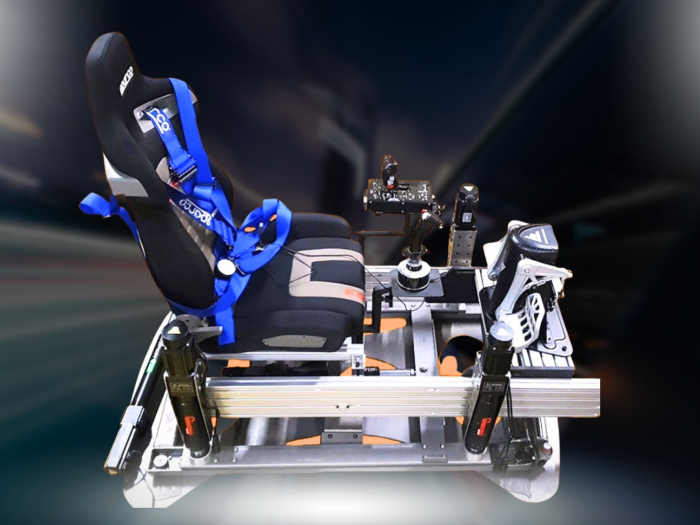

You might assume that more movement always translates to a more realistic drive, yet the most immersive experiences often come down to the precision of data rather than the sheer range of motion. Deciding between a 3 DOF vs 6 DOF motion simulator is a pivotal moment for any serious enthusiast, as it marks the transition from playing a game to mastering a machine. You already know that the right feedback can shave tenths off your lap times, but the fear of motion sickness from high latency or the dread of a bulky, complex setup often stalls the dream of a home-based professional rig.
In this definitive 2026 guide, we'll peel back the layers of telemetry to show you exactly how these platforms communicate with your senses. You'll discover why the LowSlider 3DoF provides the essential movements for most racers, whilst the LowSlider 6 DOF Twin-Traction-Loss offers the ultimate competitive edge for those who refuse to compromise on realism. We'll compare the technical specifications and physical footprints of each system, ensuring you find a high-performance solution that fits your space and your ambitions. By the end, you'll understand which movements are vital for your specific racing style and how to achieve professional-level immersion without the traditional assembly struggles.
Key Takeaways
- Identify how specific degrees of freedom translate digital telemetry into visceral feedback, allowing you to sense the limit of adhesion more accurately than on a static rig.
- Master the technical differences between a 3 DOF vs 6 DOF motion simulator to determine which actuator configuration aligns with your specific performance goals.
- Explore why Twin-Traction-Loss is the professional benchmark for precision, providing the critical yaw feedback needed to catch a slide before it ends your race.
- Learn how the proprietary LowSlider architecture delivers full-spectrum motion within a compact footprint, making professional-level setups viable for home environments.
- Gain clarity on selecting the right platform for your journey, whether it's the focused feedback of the LowSlider 3DoF or the uncompromised realism of a 6 DOF system.
Understanding Degrees of Freedom: Why Motion is the Ultimate Simulation Upgrade
In the pursuit of the ultimate lap time, the difference between a static seat and a motion-equipped cockpit is profound. To understand why, we first need to define the physics at play. In mechanical engineering, a "Degree of Freedom" represents a specific axis of independent movement. Whilst a static rig relies entirely on your eyes and ears, a 3 DOF vs 6 DOF motion simulator translates digital telemetry into physical sensations that your body reacts to instinctively. This shift moves you away from simply observing a screen and places you inside the vehicle's physics engine, where every ripple in the tarmac becomes a tangible data point.
The Core Movements: Pitch, Roll, and Heave
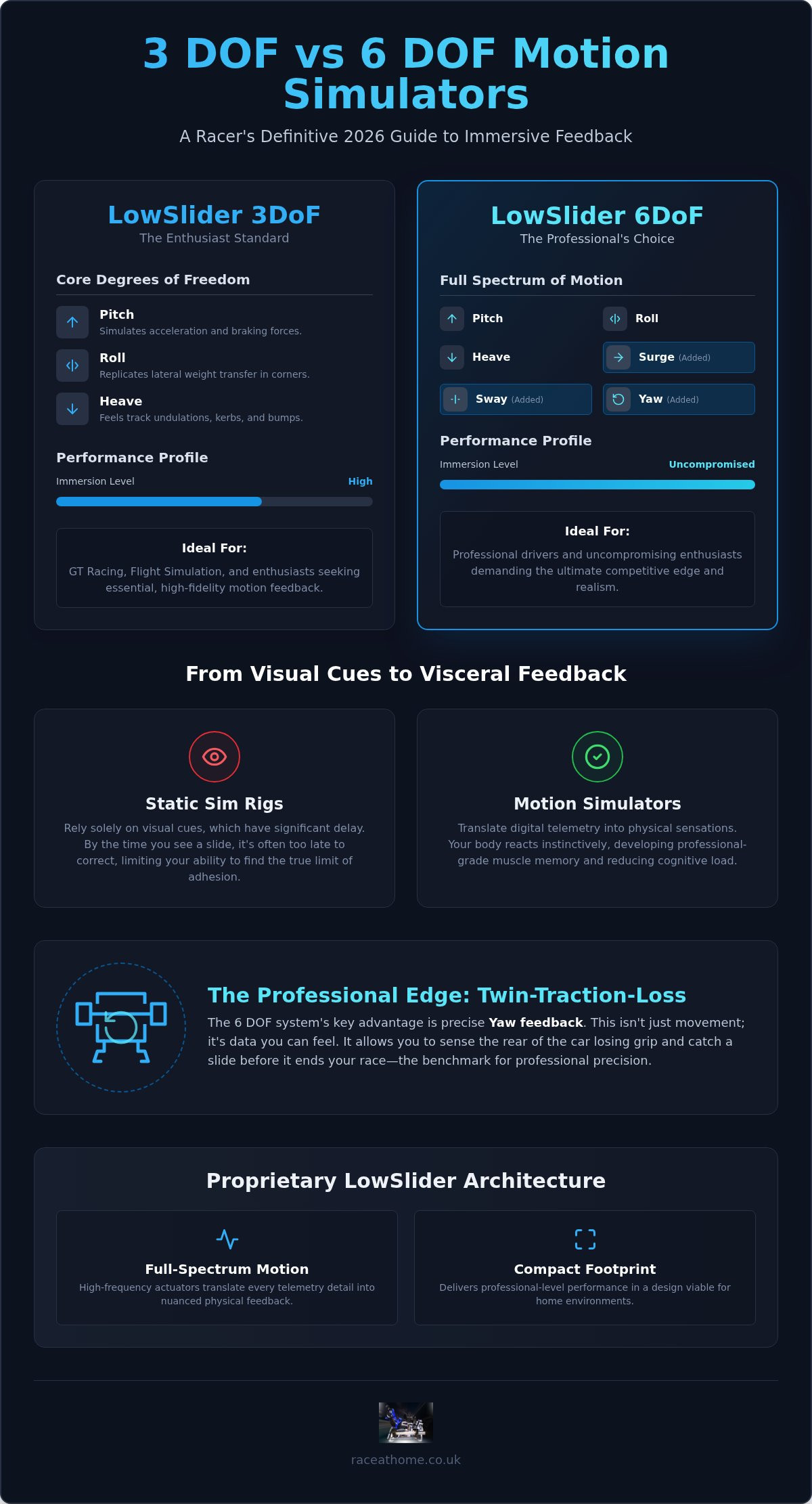
Most entry-level motion systems focus on three primary axes to communicate the car's behaviour. Pitch simulates longitudinal forces, tilting the seat forward during heavy braking or backward as you pin the throttle. Roll captures the lateral weight transfer as you dive into a corner, whilst Heave handles vertical displacement. This vertical movement is vital for feeling the harshness of track kerbs and the subtle undulations of the road surface. By replicating these forces, the rig communicates the car's balance before your eyes even register a slide, providing the visceral feedback required for professional-grade muscle memory.
The Limitations of Static Sim Racing
Visual cues have a significant delay. By the time you see the car's rear end stepping out on screen, you've often already lost the window to correct it. Static rigs limit your ability to sense the limit of adhesion because they ignore the vestibular system, the sensory apparatus in the inner ear that detects acceleration and orientation. Without physical feedback, there's a sensory disconnect between what your eyes see and what your body expects. This gap is a primary cause of motion sickness. For a deeper look at the physics involved, the concept of Six Degrees of Freedom (6DOF) covers the full spectrum of three linear and three rotational movements.
When your body feels the weight transfer, your brain stops calculating the car's position and starts reacting to it. This shift reduces the cognitive load on the driver whilst racing, freeing up mental bandwidth to focus on strategy and race craft. Choosing between a 3 DOF vs 6 DOF motion simulator is often the deciding factor in whether a rig remains a hobbyist tool or becomes a genuine driver-training platform. It's the difference between playing a game and mastering a machine.
The Technical Divide: Breaking Down 3 DOF and 6 DOF Mechanics
The bridge between a virtual circuit and your central nervous system is built on telemetry data. Every millisecond, sim racing software outputs high-frequency G-force values that must be translated into physical movement. In a 3 DOF vs 6 DOF motion simulator, the mechanical architecture determines how much of that data you actually feel. High-performance actuators, such as those from PT Actuator, are essential here. They provide the near-zero latency required to ensure the physical response matches the on-screen action perfectly. If the actuator frequency is too low, the sensory disconnect returns, breaking immersion and potentially inducing motion sickness. These actuators work in unison, performing thousands of micro-adjustments per second to replicate the complex vibrations of a high-revving engine or the sharp jolt of a gear change.
3 DOF: The Enthusiast Standard
The LowSlider 3DoF manages the three primary axes: pitch, roll, and heave. This configuration represents a massive leap over entry-level 2 DOF "seat movers" because it moves the entire cockpit, including your pedals and steering wheel. This maintains the ergonomic relationship between your limbs and controls, preventing the awkward sensation of the wheel moving away from you whilst the seat tilts. It is an ideal setup for flight simulators and GT racing, where sensing weight transfer and track surface is the priority. For many home users, it strikes the perfect balance between performance and simplicity, providing enough data to significantly improve lap times without the complexity of a full hexapod system.
6 DOF: The Professional Requirement
To achieve 360-degree immersion, the LowSlider 6 DOF Twin-Traction-Loss adds three critical axes: sway (side-to-side), surge (forward-backward), and yaw (rotation). This allows the rig to simulate complex forces like "shunting" from other cars or the subtle sideways slide of a drift. Professional racing teams rely on 6 DOF because it captures traction loss, the moment the rear tyres lose grip. Without yaw and sway, you are essentially guessing the car's rotation based on visual cues alone. By using six actuators in a coordinated hexapod or platform arrangement, the system can combine movements, such as pitching forward whilst swaying laterally, to mimic the exact behaviour of a car under heavy trail-braking. If you are looking to bridge the gap between digital data and physical sensation, the hand-built platforms at Race@Home provide the precision required for elite competition.
Traction Loss and Yaw: Why 6 DOF is the Professional Standard for Precision
In the technical evaluation of a 3 DOF vs 6 DOF motion simulator, the most critical differentiator for competitive racers isn't how much the rig moves, but how it rotates. Whilst 3 DOF systems excel at simulating weight transfer and road texture, they often leave the driver blind to the car's rotation. Traction loss is the sensation of the rear tyres losing grip; it is a subtle but violent shift that demands an immediate response. Without yaw feedback, you're forced to wait for visual confirmation that the car is spinning. By the time your eyes see the horizon shift on your monitor, the window to catch the slide has often already closed.
Rally enthusiasts and those mastering rear-wheel-drive GT cars find 6 DOF indispensable for this very reason. The constant yawing and sliding of a vehicle on loose gravel or during high-speed oversteer are impossible to replicate on a 3 DOF system, which can only tilt to simulate the incline. To truly master car control, you need to feel the car's orientation in space, not just its pitch and roll. Choosing between a 3 DOF vs 6 DOF motion simulator ultimately depends on whether you want to play the physics or feel them.
The Mechanics of Twin-Traction-Loss
The LowSlider 6 DOF Twin-Traction-Loss Motion Platform redefines this experience through mechanical independence. Unlike single-point systems that pivot the entire frame from a central point, our twin-traction-loss employs dedicated actuators to simulate front and rear slide independently. This is essential when navigating high-speed complexes like the Maggotts and Becketts sequence at Silverstone. You feel the front end bite as you turn in, followed immediately by the rear end's lateral float as the G-forces peak, providing a nuanced translation of vehicle dynamics.
Improving Lap Times Through Sensory Data
Accessing this level of sensory data transforms your driving style by building deep-seated muscle memory. You begin to feel understeer through the lack of lateral sway and oversteer through the immediate rotation of the platform, reducing the mental processing time required to handle the car at its limit. By translating digital rotation into instantaneous physical feedback, 6 DOF telemetry allows drivers to instinctively correct slides before the visual delay of a monitor forces a reactionary error, directly shaving seconds off lap times.
Practical Considerations: Space, Logistics, and the Reality of Home Installation
The most common barrier to upgrading from a static rig is the assumption that high-end motion requires an industrial-sized space. Many enthusiasts believe that a 3 DOF vs 6 DOF motion simulator comparison always ends with the 6 DOF platform being too bulky for a spare room or home office. This is a misconception rooted in older hexapod designs that sat high off the floor and required significant ceiling clearance. Modern engineering, specifically the LowSlider architecture, has shifted this paradigm. We've focused on a compact footprint that respects the dimensions of the typical British home whilst delivering professional-grade feedback.
Logistically, these rigs are designed to be plug-and-play within a standard domestic environment. You don't need to rewire your house; a standard UK power outlet provides ample current for the high-efficiency actuators. Floor loading is also a non-issue for most modern builds, as the weight is distributed across a broad, stable base. This makes the transition to motion far more accessible than most people realise, allowing you to integrate a world-class simulator without needing a dedicated warehouse.
The LowSlider Advantage
Height is often the forgotten variable in immersion. A rig that sits too high can feel disconnected from the floor, whereas our ultra-low profile design keeps your centre of gravity as close to the ground as possible. This isn't just about safety; it's about the psychological feeling of being in the car rather than on a machine. By using clever actuator placement, the LowSlider 6 DOF occupies roughly the same floor area as a traditional 3 DOF setup. If you're tight on space, you can explore our bespoke motion platforms to see how we fit elite performance into a compact footprint.
One-Hour Assembly and Global Shipping
Complexity is the enemy of the home user. To solve this, we ship every platform in four pre-assembled pieces. This modular approach ensures that your rig can fit through standard doorways and up staircases without a team of engineers. You won't need a PhD in mechanical assembly to get started; most users find they are on the track in under 60 minutes. Because these units are hand-built in the UK, reliability is baked into the craftsmanship. Whether you are in London or Los Angeles, our global shipping ensures that professional-level hardware is delivered to your door, ready for immediate deployment.
Investing in Realism: Why the LowSlider Architecture Redefines Motion Performance
Deciding on a 3 DOF vs 6 DOF motion simulator is about more than just budget; it's about the level of immersion you want to live in. If you're looking to future-proof your setup, investing in a professional-grade platform ensures that your hardware evolves alongside sim racing software. Whilst mass-produced rigs often rely on generic components, our hand-built UK engineering prioritises precision and longevity. Every LowSlider platform is a testament to bespoke craftsmanship, designed to handle the high-torque demands of modern direct-drive wheels and load-cell pedals without a hint of flex. This structural integrity is vital for maintaining the fidelity of the motion data being sent to your body.
The sensory loop isn't finished with motion alone. Pairing a LowSlider rig with Pimax VR Headsets creates a total bypass of your reality. When the motion platform pitches into a corner and the VR headset tracks your head movement with sub-millimetre accuracy, the simulation part of sim racing disappears. You're no longer staring at a screen; you're looking through the apex of a corner at Spa. This synergy between physical feedback and visual depth is what separates a gaming setup from a professional training tool. It provides the visceral intensity that keeps you coming back for one more lap.
Choosing Your Path: 3 DOF or 6 DOF?
For the budget-conscious enthusiast, the LowSlider 3DoF remains a massive upgrade. It provides the essential G-force cues that a static rig simply cannot replicate. It's the perfect entry point into the world of active feedback, offering a focused experience that heightens every braking zone and acceleration phase. However, for the "no compromise" racer, the LowSlider 6 DOF Twin-Traction-Loss is the only choice. It offers the total realism of yaw and sway, providing the full telemetry spectrum required for elite competition. Because our systems are designed with modularity in mind, you can often discuss future expansion paths as your racing journey progresses.
The Race@Home Commitment
We don't just sell boxes; we build gateways to professional experiences. Every rig is hand-built to order in our UK facility, ensuring that the quality of the welds and the calibration of the actuators meet our exacting standards. Beyond the platforms, we provide access to premium sim racing accessories and professional support to help you dial in your telemetry settings. It's time to stop playing and start driving. Explore the LowSlider range and find your perfect motion rig today to experience the ultimate evolution of sim racing.
Elevate Your Drive with Precision Motion Engineering
Choosing between a 3 DOF vs 6 DOF motion simulator is the final step in transitioning from a gaming hobby to a professional-grade training discipline. You've seen how the LowSlider 3DoF provides the essential cues for weight transfer, whilst the LowSlider 6 DOF Twin-Traction-Loss unlocks the critical yaw feedback needed to master car control at the absolute limit. These platforms prove that you don't need a massive dedicated space to achieve elite immersion. Our proprietary ultra-low profile design ensures that even the most complex 6-axis movements fit seamlessly into your home environment.
Every rig we produce is hand-built in the UK and shipped worldwide in four easy-to-handle pieces, allowing for a one-hour assembly that gets you on the grid without the need for specialist engineers. It's time to stop guessing your car's rotation and start feeling the telemetry data exactly as it was intended. Build your ultimate motion rig with Race@Home and redefine what's possible in your cockpit. The track is waiting for you to feel every ripple.
Frequently Asked Questions
What is the main difference between 3 DOF and 6 DOF simulators?
The primary distinction lies in the number of axes the system can move independently. A 3 DOF vs 6 DOF motion simulator comparison highlights that whilst 3 DOF handles pitch, roll, and heave, the 6 DOF platform adds surge, sway, and yaw. This allows you to feel lateral slides and rotational forces that are physically impossible to replicate on a 3-axis system. It's the difference between feeling the track surface and feeling the car's orientation.
Do I need a special PC to run a 6 DOF motion platform?
You don't need a specialised "motion PC", but a high-performance gaming rig is essential to maintain the high frame rates required for sensory synchronisation. The motion software itself has a low overhead, yet any lag in the game telemetry will break immersion. We recommend a modern multi-core processor and a powerful GPU to ensure the physical response from the actuators matches the on-screen action without any perceptible latency.
Does a 6 DOF simulator help with motion sickness?
Yes, a high-fidelity motion platform often significantly reduces motion sickness by aligning your visual input with your vestibular system. Sickness usually occurs when your eyes see movement that your inner ear doesn't feel. By providing the missing physical cues, especially the rotational yaw found in a 6 DOF system, the brain stops sensing a conflict. This makes long endurance stints much more comfortable for those prone to nausea.
How much space do I need for a LowSlider 6 DOF rig?
The LowSlider 6 DOF is engineered specifically for home use, occupying roughly the same floor area as a standard static rig or a 3 DOF setup. Its ultra-low profile design means you don't need high ceilings or a dedicated warehouse. Most users successfully integrate the platform into a spare bedroom or a home office. The compact footprint ensures you get professional-level feedback without sacrificing an entire floor of your house.
Can I use VR with a 6 DOF motion simulator?
VR is the perfect partner for motion, and our platforms are fully compatible with leading headsets like the Pimax VR range. Using VR with a 6 DOF rig creates a 1:1 sensory loop where your head movements and the car's physical rotation are perfectly synced. This combination provides the most immersive experience possible in modern sim racing, making you feel as though you're sitting inside the cockpit rather than staring at a screen.
Is a 6 DOF simulator difficult to assemble at home?
Assembly is remarkably straightforward because we ship the platform in four pre-assembled pieces. You won't need to be a mechanical engineer to get started; most customers are racing in under an hour. We've designed the setup process to be intuitive. You'll only need basic tools to connect the modular sections. This "no-engineer required" approach ensures that your hand-built UK hardware is ready for the track almost immediately after delivery.
What games support 6 DOF motion telemetry?
Most major sim racing and flight simulation titles provide the high-frequency telemetry data needed for full motion. Popular games such as iRacing, Assetto Corsa Competizione, and Dirt Rally 2.0 offer native support for 6 DOF movements. The software translates this digital data into physical actuator responses, allowing you to feel every kerb, gear change, and rear-end slide. This broad compatibility ensures your investment works across your favourite racing library.
Is 6 DOF worth the extra cost for a casual sim racer?
Whilst a 3 DOF vs 6 DOF motion simulator represents a significant investment, the 6 DOF option is the definitive choice for those seeking total realism. If you're a casual racer who values the sensation of car control and catching slides, the 6-axis feedback is transformative. However, the LowSlider 3DoF still offers a massive leap over a static rig, providing high-octane excitement for enthusiasts who want professional-grade immersion on a more focused scale.


