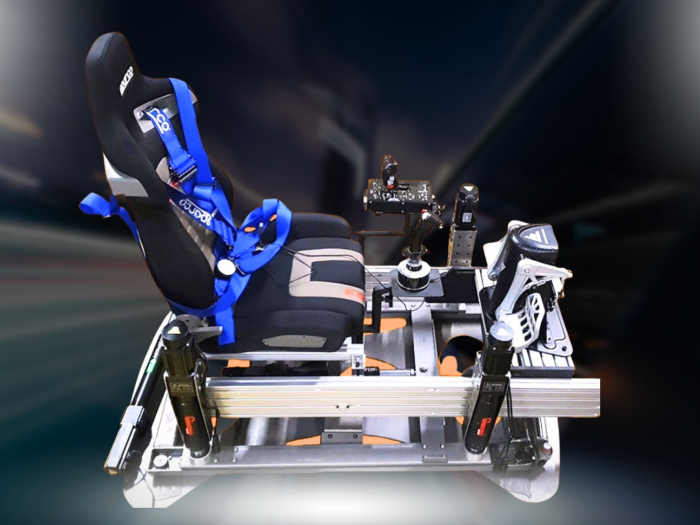

What if your static rig could communicate the precise moment your rear tyres lose grip without requiring a dedicated warehouse to house the hardware? You've likely spent years perfecting your seating position and pedal pressure, yet that vital "seat-of-the-pants" sensation remains frustratingly absent. It's a common hurdle for serious racers who crave the visceral feedback of a real circuit but fear the bulk and complexity of traditional motion systems. You want the immersion, but you don't want to sacrifice the office space or the ergonomics you've worked so hard to refine.
The good news is that adding motion platform to existing sim rig setups has evolved into a streamlined, high-performance reality for 2026. You can transform your cockpit into a professional-grade simulator whilst maintaining its original footprint and control layout. This guide explores how to integrate advanced telemetry-driven movement, specifically focusing on ultra-low profile solutions like the LowSlider 6 DOF. We'll walk you through the technical logistics of compatibility, the sensation of twin-traction loss, and the simple assembly process that bridges the gap between digital data and physical reality.
Key Takeaways
- Learn why moving beyond a static setup is essential for developing real-world racing intuition and reducing reliance on visual data.
- Identify if your current cockpit is structurally prepared for the stresses of motion, with a focus on the benefits of aluminium profile rigs.
- Understand the practical steps involved in adding motion platform to existing sim rig hardware whilst maintaining a compact home office footprint.
- Compare the nuances between 3DoF and 6 DOF systems to determine which level of pitch, roll, and traction loss feedback suits your goals.
- See how the LowSlider's ultra-low centre of gravity provides professional stability and allows for a complete assembly in under an hour.
Beyond Static: Why Upgrading to a Motion Platform is the Ultimate Evolution
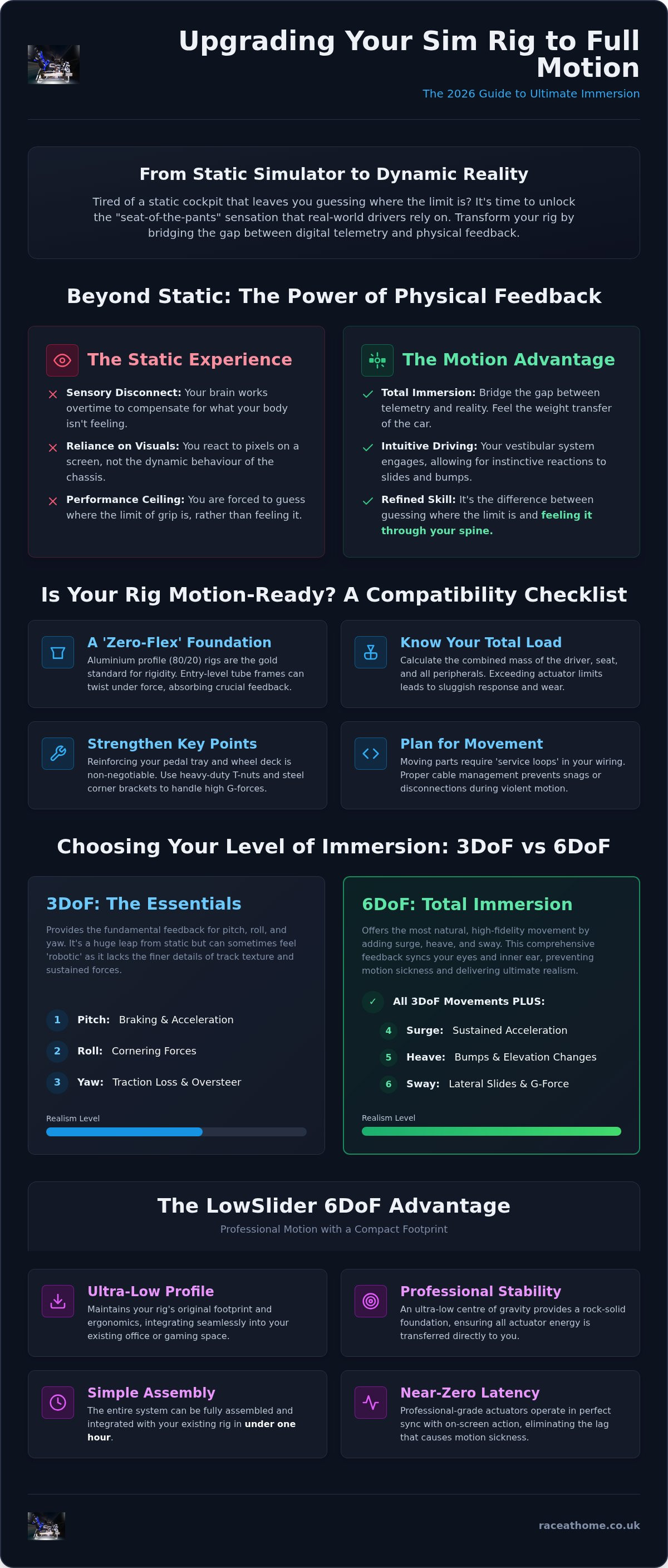
In a static cockpit, your brain works overtime to compensate for what your body isn't feeling. You see the car slide on screen and hear the tyres scream, but your inner ear remains stationary. This sensory disconnect creates a performance ceiling where you're forced to rely solely on visual cues and muscle memory. By adding motion platform to existing sim rig setups, you bridge the gap between digital telemetry and physical reality. You're no longer just reacting to pixels. Instead, you're responding to the weight transfer of a dynamic chassis.
The transformation shifts your perspective from playing a game to operating a vehicle. When you hit the brakes, the pitch forward tells your brain exactly how much grip remains. When the rear steps out, the yaw movement alerts your nervous system before your eyes even register the slide. This is the true power of a professional motion simulator. It translates complex telemetry data, including heave for track undulations and surge for acceleration, into visceral sensations that dictate your driving behaviour. It's the difference between guessing where the limit is and feeling it through your spine.
The Science of Sensory Feedback
Your vestibular system acts as an internal accelerometer. In a high-end static rig, even the best direct drive wheelbases can feel slightly "floaty" because the intense steering torque isn't matched by lateral forces. Integrating motion provides that missing sensory layer. It grounds the steering feedback, making every kerb strike and elevation change feel earned. Motion isn't just an add-on; it's the final piece of the immersion puzzle that validates the data your hands are already receiving through the wheel.
Motion Realism vs. Motion Sickness
Nausea in simulation often stems from high-latency systems where the movement lags behind the visual data. Professional-grade actuators, such as those integrated into the LowSlider 6 DOF, operate with near-zero latency to ensure your eyes and inner ear stay in perfect sync. Whilst a 3DoF system provides the essentials of pitch and roll, a 6 DOF setup offers the most natural movement. It incorporates surge and heave to prevent the "robotic" feel of limited-axis alternatives. This precision is vital for endurance racing, where consistent realism prevents fatigue during long stints. Ultimately, adding motion platform to existing sim rig hardware is about more than just a thrill; it's about refining your technical ability through authentic physical feedback.
Assessing Compatibility: Is Your Current Rig Ready for Motion?
Before you bolt high-performance actuators to your chassis, you must evaluate its structural foundation. adding motion platform to existing sim rig setups demands a level of rigidity that entry-level tube frames or basic wheel stands simply cannot provide. The gold standard for 2026 remains the aluminium profile rig, often referred to as 80/20. Its modular nature allows for the precise mounting of actuators whilst ensuring the frame doesn't twist under high G-forces. If your rig flexes under heavy braking now, that movement will be amplified tenfold once motion is introduced.
You must calculate the combined mass of the driver, the seat, and all peripherals, including monitors if they are rig-mounted. Most high-end actuators are rated for specific loads. Exceeding these limits leads to sluggish response times and premature wear on the motors. Precision feedback relies on a "zero-flex" environment. Every millimetre of frame movement is a millimetre of lost telemetry data. Additionally, consider cable management early. Moving parts require "service loops" in your wiring to prevent snags or disconnections during violent yaw or pitch transitions.
Aluminium Profile Rigs and Motion Integration
The Ultimate Sim Racing Setup Guide highlights how reinforcing your pedal tray and wheel deck is non-negotiable. When adding motion platform to existing sim rig hardware, use heavy-duty T-nuts and steel corner brackets to secure the motion base. This creates a unified structure that handles the violent transitions of a rally stage or the subtle vibrations of a rumble strip without rattling. A rigid frame ensures that the energy from the actuators is transferred to your body rather than being absorbed by a loose joint.
Electronics and Connectivity Requirements
Electronics are the nervous system of your simulator. Professional systems require significant USB bandwidth to process telemetry in real-time. Avoid using unpowered hubs; a dedicated PCIe USB card is often the best solution for stability. High-torque actuators also pull substantial current during peak movements. Whilst consumer rigs don't require the power grid of NASA's Vertical Motion Simulator, they do need a dedicated, surge-protected circuit to ensure consistent performance. Ensure your software stack, including SimHub or proprietary drivers, is updated to the latest 2026 firmware for seamless integration.
Proper preparation ensures your upgrade is a success. If you're unsure about your rig's compatibility, exploring the LowSlider motion platforms can provide a clearer picture of the engineering requirements needed for a professional home setup.
3DoF vs 6 DOF: Choosing the Right Level of Feedback
When you begin the process of adding motion platform to existing sim rig hardware, the first technical crossroads you'll encounter is the degree of freedom (DOF) required. A 3DoF system provides the fundamental sensations: Pitch for braking, Roll for cornering, and Heave for track undulations. It's a massive leap from a static setup. However, for those seeking the ultimate evolution, 6 DOF introduces Surge, Sway, and Yaw. This complete package allows the simulator to recreate longitudinal and lateral G-forces accurately. Crucially, a "full motion" platform moves your entire cockpit; this ensures your relationship with the pedals and wheel remains constant. This is far superior to seat-movers, which can disrupt your muscle memory by moving your body independently of your controls.
Understanding Twin Traction Loss
Traction loss is the specific sensation of the rear tyres losing grip. While basic systems simply swing the back of the rig, Twin Traction Loss provides a more sophisticated simulation. By utilising two actuators at the rear, the platform can mimic the car pivoting around its centre of gravity. This nuanced feedback is critical for identifying oversteer before it becomes unrecoverable. It's the difference between a controlled slide and a session-ending spin. For racers adding motion platform to existing sim rig setups for competitive training, this specific axis is often the most valuable addition to their arsenal.
Cost vs. Performance: The Investment Analysis
The investment in a 6 DOF system is often justified by the sheer volume of data it communicates to the driver. Professional coaches prefer these platforms because they allow students to feel the limit of adhesion through their inner ear and spine, rather than waiting for visual confirmation. If your goal is to reduce lap times, the surge and yaw feedback provided by a 6 DOF setup offers the highest return on investment. It also future-proofs your cockpit for VR integration. In a headset, your eyes expect the physical world to match the digital horizon; a high-precision motion system ensures this synchronisation remains flawless. This level of precision eliminates the sensory disconnect that leads to fatigue during long-stint endurance racing.
The Retrofit Process: Steps to Integrate a Motion Platform
Preparation is the foundation of a successful upgrade. Before you begin adding motion platform to existing sim rig hardware, you must organise a clear workspace. Clear at least a two-metre radius around your cockpit to allow for unhindered movement during the initial testing phases. Ensure you have a high-quality spirit level, a set of metric hex keys, and a dedicated torque wrench ready. This isn't just about assembly; it's about engineering a stable platform that can withstand hours of high-frequency vibration without a single bolt loosening.
The physical mounting phase is where your planning pays off. If you're using a modular system like the LowSlider, the process is remarkably efficient. These systems often ship in just four primary pieces, allowing you to complete the structural integration in under an hour. You'll secure your existing aluminium profile cockpit directly to the motion base using heavy-duty brackets. This direct connection ensures that every bit of telemetry data is transmitted without being lost to mechanical play in the joints.
Physical Assembly and Alignment
Achieving a neutral balance is critical for actuator longevity. Use your spirit level to ensure the platform is perfectly flat before you apply power. If the rig is tilted, the motors will work harder in one direction, leading to uneven wear and inconsistent feedback. High-torque actuators generate significant energy; you must secure them firmly to prevent vibrations from bleeding into your floor. For those operating in a home office, using high-density rubber isolation pads can significantly reduce acoustic transfer whilst maintaining the sharp response of the system.
Software Tuning and Telemetry Setup
Once the hardware is secure, the focus shifts to the digital interface. Software like SimHub or PT Actuator drivers translate game data into physical movement. You'll need to configure "Washout" filters. These filters are essential because they return the platform to a neutral position after a sustained movement, such as a long corner, without you noticing the reset. This prevents the actuators from reaching their physical limits and keeps the sensation continuous.
Create distinct profiles for different racing disciplines. A GT3 car requires subtle, high-frequency feedback to communicate ABS activation and kerb strikes. In contrast, a Formula car profile should emphasise sharp, immediate pitch and roll to match the stiff suspension of the real-world vehicle. Safety is the final step. Always install a physical emergency stop button within easy reach of the driver's seat and define software boundary zones to prevent the rig from colliding with nearby furniture.
If you're ready to start your transformation, you can view the LowSlider assembly guides to see how easily these systems integrate with your current setup.
The LowSlider Advantage: Professional Motion, Compact Footprint
A significant barrier when adding motion platform to existing sim rig setups is the vertical height. Many traditional systems raise the cockpit by several inches, which can disrupt your ergonomic relationship with your desk or monitors. The LowSlider proprietary design addresses this by maintaining an ultra-low profile. This engineering choice preserves your existing setup's geometry whilst providing the most stable base possible. By keeping the centre of gravity close to the floor, the system eliminates the swaying sensation often found in taller, less rigid platforms. It ensures every millimetre of actuator travel translates into precise, high-fidelity feedback rather than frame oscillation.
Unlike mass-produced alternatives, every LowSlider platform is hand-built in the UK to order. This bespoke approach allows for a level of craftsmanship that prioritises durability and precision. The "One-Hour Assembly" promise is a direct result of this meticulous engineering. The system arrives in just four primary components, making the process of adding motion platform to existing sim rig cockpits straightforward for any enthusiast. You don't need a degree in mechanical engineering to get on track; you simply bolt your rig to the base, connect the electronics, and begin your first session.
Engineering Excellence with PT Actuators
Reliability is paramount when you're investing in high-end hardware. We partner with PT Actuator to integrate industrial-grade components that are designed for thousands of hours of peak performance. These actuators aren't just powerful; they are remarkably quiet. This allows you to experience the intensity of a 24-hour race without the mechanical noise disturbing the rest of your household. For a deeper dive into the technical specifications, read The Ultimate Guide to 6 DOF Motion Simulators.
Worldwide Support and Sim Racing Expertise
Race@Home provides a gateway to professional-level simulation regardless of your location. We manage worldwide shipping with components designed for easy transit and rapid deployment. Beyond the hardware, you gain access to a team of specialists who understand the nuances of high-end sim racing accessories. Whether you're integrating Pimax VR headsets or fine-tuning your traction loss settings, our expertise ensures your setup remains at the cutting edge of realism. It's time to evolve your driving experience with a system that refuses to compromise on quality or space.
Explore the LowSlider 6 DOF Platform and discover how our compact engineering can transform your current cockpit into a world-class simulator.
Take the Grid with Professional-Grade Motion
The transition from a static cockpit to a dynamic, high-fidelity simulator is the single most transformative upgrade you can undertake. By adding motion platform to existing sim rig setups, you unlock a level of sensory feedback that makes every lap more intuitive and every race more immersive. You've seen how structural integrity and precise telemetry translation are the cornerstones of a professional-grade experience, allowing you to feel the limit of adhesion through your inner ear rather than just your eyes.
Now is the time to bridge the gap between digital data and visceral physical sensation. With proprietary LowSlider technology, you don't have to compromise on your home office footprint or spend days on complex installations. Our systems are hand-built in the UK and designed for worldwide shipping in four easy pieces; this ensures you can be on track in under an hour. It's time to stop playing and start driving.
Build your dream 6 DOF rig with the LowSlider platform and experience the ultimate evolution of sim racing today. We look forward to helping you reach the next level of performance.
Frequently Asked Questions
Can I add motion to any sim racing rig?
Most aluminium profile cockpits are suitable for adding motion platform to existing sim rig setups due to their inherent rigidity. While high-end 80/20 rigs provide the necessary structural integrity, lighter tube-frame or foldable rigs often flex too much under high G-forces. The LowSlider is specifically engineered to bolt underneath your current chassis, provided the frame can handle the mechanical stress. We recommend checking for any play in your wheel deck before proceeding with the upgrade.
How much space do I need for a 6 DOF motion platform?
You don't need a dedicated warehouse; the LowSlider is designed with a remarkably compact footprint for home use. Ideally, you should clear a two-metre radius around your cockpit to allow for the full range of pitch, roll, and yaw movement without hitting furniture. Because our proprietary design maintains an ultra-low profile, it doesn't raise your seating position significantly. This makes it ideal for standard rooms with normal ceiling heights or dedicated home offices.
Will a motion platform work with my existing VR headset?
Yes, motion platforms are the perfect companion for VR headsets like the Pimax range. In fact, high-precision movement often reduces motion sickness because your inner ear finally feels the G-forces your eyes are seeing. Most modern software includes motion cancellation features that ensure the VR horizon stays level relative to your cockpit's movement. This synchronisation creates a seamless bridge between the digital environment and your physical sensations for total immersion during long stints.
Is it difficult to set up the software for a motion upgrade?
Integrating the software is a straightforward process thanks to modern telemetry drivers and pre-configured profiles. When adding motion platform to existing sim rig hardware, you'll typically use SimHub or proprietary PT Actuator software to bridge the gap. We provide detailed guidance to help you calibrate your centre of gravity and washout filters. Most users find they can move from the initial physical assembly to their first high-fidelity racing session in less than an hour.
Do motion platforms require a lot of maintenance?
Professional-grade systems require very little ongoing maintenance. Because we use industrial-grade PT Actuator components, the motors and gearboxes are designed for thousands of hours of high-intensity use. You should periodically check that the mounting bolts remain tight and ensure the actuators are free from dust or debris. Unlike older hydraulic systems, these modern electric actuators are set and forget units that offer consistent performance over several years of competitive racing and training.
How loud are the actuators during a race?
High-end motion systems are surprisingly quiet during operation. While you will hear the mechanical whirring of the actuators during violent transitions, the sound is generally lower than the cooling fans on a high-performance PC. This makes them suitable for use in domestic environments without causing a disturbance. Using high-density rubber isolation pads under the platform further reduces acoustic transfer through the floor, ensuring the focus remains entirely on the visceral racing experience.
Can a motion platform help me get faster on track?
Motion platforms definitely improve lap times by providing a more immediate sense of the car's limit. Instead of waiting for a visual cue that you're sliding, your vestibular system feels the yaw or traction loss instantly. This allows for faster, more instinctive corrections. Professional driver coaching relies on this physical feedback to build the correct muscle memory. It helps you find those final tenths of a second that are often lost in static simulators.


