
Is your brain constantly playing catch-up with the pixels on your screen? You see the tyres smoke and the horizon tilt, but the physical sensation of traction loss remains frustratingly absent from your cockpit. This sensory gap is exactly why even the most seasoned sim racers struggle to find those final few tenths of a second. We understand that a motion simulator for iRacing shouldn't just shake your seat; it must serve as a precision instrument that translates complex telemetry into actionable physical cues.
In this 2026 guide, we'll show you how to bridge the gap between software and reality with a compact, professional-grade setup. You'll discover how ultra-low latency and twin-traction-loss technology eliminate motion sickness whilst providing the "seat of the pants" feel required for elite-level performance. From seamless software integration to the engineering of a space-saving 6 DOF platform, we're detailing everything you need to build a rig that feels as sharp as the iRacing physics engine itself. Whether you're a veteran looking for more immersion or a newcomer seeking a competitive edge, this is your roadmap to visceral, high-fidelity realism.
Key Takeaways
- Learn how to translate iRacing’s high-frequency telemetry into precise physical sensations that allow you to feel the limit of grip before you lose it.
- Understand why a 6 DOF motion simulator for iRacing featuring Twin-Traction-Loss is the definitive choice for mastering weight transfer in GT3 and Formula series.
- Discover the advantages of bespoke, hand-built British engineering that provides professional-grade rigidity within a compact, home-friendly footprint.
- See how modular, four-piece assembly allows you to transition from unboxing to the starting grid in under one hour.
- Evaluate how ultra-low latency hardware eliminates motion sickness whilst providing the visceral "seat of the pants" feedback required to lower your lap times.
Why iRacing’s Physics Engine Demands a Motion Simulator
iRacing stands as the undisputed gold standard for sim racing physics. Its laser-scanned tracks and intricate tyre models are legendary amongst the community. However, if you're sitting in a static chair, you're only receiving half the information the software is trying to provide. A motion simulator for iRacing acts as the vital bridge between digital data and physical sensation. Whilst your eyes track the apex, your inner ear and body need to feel the shifting g-forces to react with genuine instinct.
Static rigs rely entirely on visual and auditory cues, which creates a cognitive delay. When you're pushing a car to its absolute limit, that delay is the difference between a podium finish and a trip to the barriers. By introducing physical weight transfer, you stop "guessing" where the grip is and start feeling it through your skeleton. This level of immersion isn't just about the thrill; it's about providing the high-fidelity feedback required to master iRacing’s complex, evolving track surfaces.
Translating Telemetry into G-Force
iRacing outputs high-frequency telemetry at rates that demand elite-tier hardware to process. When you clip a kerb at Copse, the software calculates that impact instantly. High-speed actuators take this raw data and convert it into precise physical movement. It's not merely about vibration. It's about the sophisticated replication of pitch, roll, and surge.
Precision is everything here. If there's even a slight millisecond of latency between the screen and the rig, your brain detects a "disconnection," which is a primary cause of motion sickness. Professional-grade systems ensure that the physical feedback is perfectly synchronised with the dynamic weather and track rubbering. To achieve this total immersion, the hardware must utilise 6 degrees of freedom (DOF), allowing the rig to replicate every nuance of a laser-scanned circuit.
The Competitive Edge: Lap Time Consistency
Visual cues are inherently slow. By the time you see the rear of a GT3 car stepping out on your monitor, it's often too late to catch the slide. A motion simulator for iRacing allows you to detect oversteer through your hips and spine milliseconds before the visual alert registers. This early warning system is what builds world-class lap time consistency.
- Faster Track Learning: You'll find yourself learning new circuits more quickly as you "feel" the specific camber and elevation changes of each corner.
- Professional Muscle Memory: Real-world drivers use these systems during the off-season because the physical resistance maintains their specific racing muscle memory.
- Endurance Stamina: In long-distance races, the physical engagement of a motion rig keeps your mind sharp and prevents the mental fatigue that often sets in during static sessions.
When the software's physics engine is this advanced, your hardware must be capable of speaking the same language. Investing in motion transforms your setup from a hobbyist desk into a professional-grade training centre.
Decoding 6 DOF and Twin-Traction-Loss for iRacing
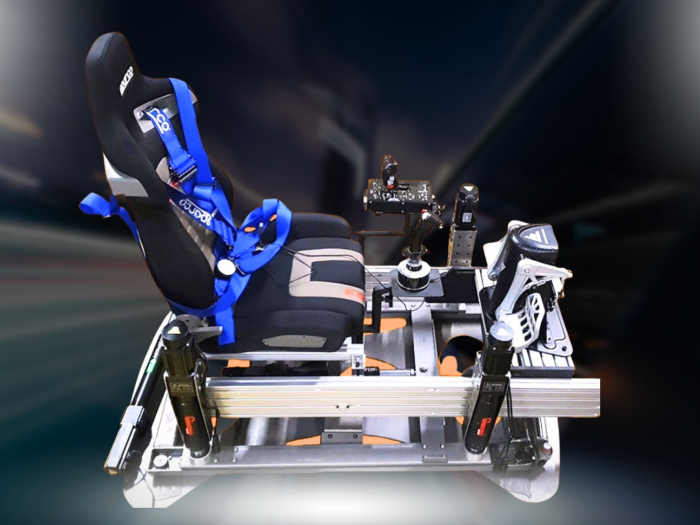
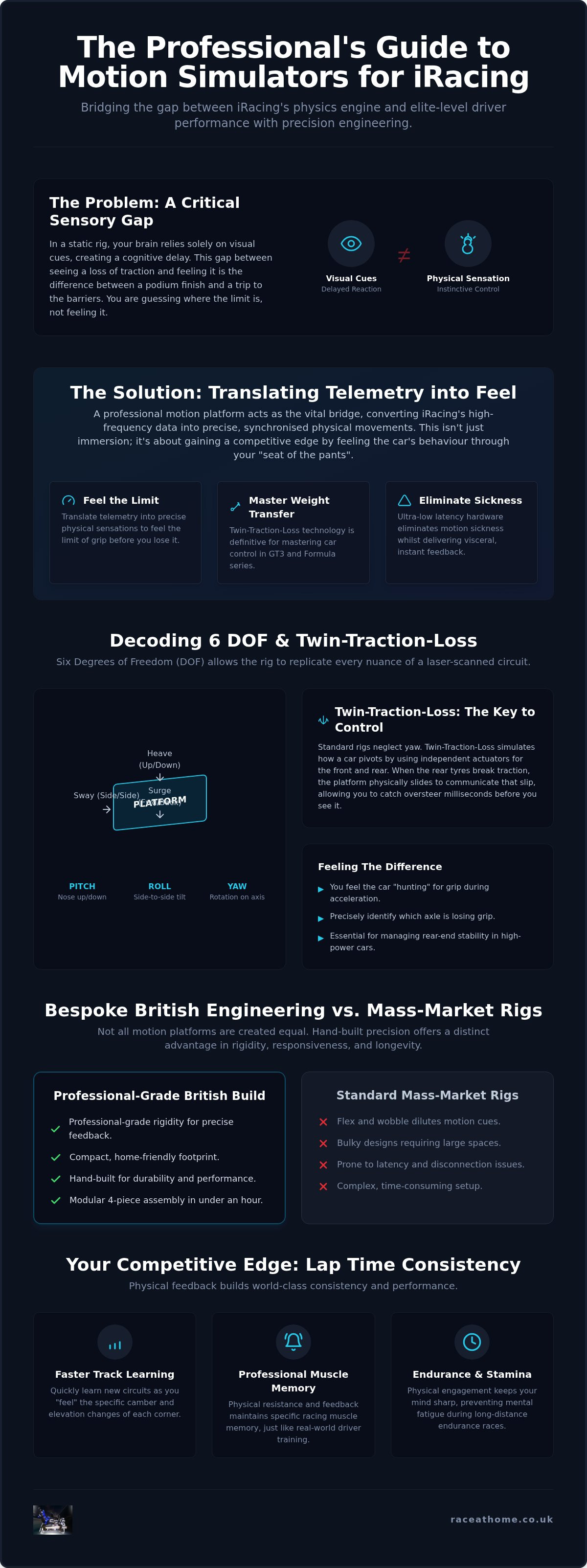
To truly master the digital tarmac, you need more than just a seat that vibrates. Whilst haptic pucks provide excellent surface detail, they can't replicate the physical displacement of a car under load. A professional-grade motion simulator for iRacing utilises six distinct axes of movement: Pitch, Roll, Yaw, Heave, Sway, and Surge. This combination allows the LowSlider 6 DOF Twin-Traction-Loss Motion Platform to provide independent feedback for both the front and rear of the vehicle. It's the difference between feeling a general "shake" and precisely identifying which axle is losing grip.
Mastering Yaw and Traction Loss
In iRacing’s GT3 and Formula series, managing rear-end stability is the key to a fast lap. Standard motion rigs often neglect yaw, which is the rotation of the car around its vertical axis. However, Twin Traction Loss takes this a step further by simulating how a car pivots around its centre of gravity. If the rear tyres break traction, the platform physically slides to communicate that slip. This isn't a single-pivot gimmick. By using independent actuators for front and rear traction loss, you can feel the car "hunting" for grip during a heavy acceleration phase out of a slow corner.
The 6 DOF Advantage in iRacing
Vertical movement, or Heave, is essential for navigating the elevation changes at Spa-Francorchamps or the punishing kerbs of Bathurst. Without it, your brain struggles to reconcile the visual "jump" with the lack of physical impact. Surge and Sway provide the visceral sensations of braking force and lateral Gs, pinning you into your seat as you navigate high-speed sweepers, making a motion simulator for iRacing an indispensable tool for those chasing the ultimate lap.
Beyond the thrill, 6 DOF is a critical tool for driver health. Aligning your inner-ear balance with the on-screen visuals significantly reduces the risk of motion sickness. A simulator study on racing drivers suggests that high-fidelity feedback is fundamental for professional training, as it allows for a more accurate translation of real-world skills. If you're ready to move beyond entry-level equipment, you should explore our bespoke motion solutions to see how precision engineering transforms your performance.
Hand-Built British Engineering vs. Mass-Market Rigs
In 2026, the sim racing market is saturated with mass-produced aluminium extrusion kits that promise total rigidity. Whilst these generic frames are suitable for entry-level setups, they often reveal their limitations the moment you add high-torque actuators. A professional motion simulator for iRacing requires a chassis that acts as a solid foundation, not a spring. Our bespoke, hand-built approach in the UK ensures that every bracket and joint is engineered to withstand the violent forces of a high-performance 6 DOF system without the "flex" that plagues cheaper imports.
Choosing a hand-built rig is an investment in precision and longevity. Mass-market manufacturers prioritse shipping volume and ease of packing, which often results in compromised material thickness and generic fasteners. By contrast, our UK-based production allows for rigorous quality control and the use of premium components that mass-market brands simply cannot justify. This commitment to craftsmanship ensures that your equipment remains a reliable training tool for years, rather than a hobbyist toy that requires constant maintenance.
Rigidity and Material Science
To achieve true realism, 100% of the energy generated by the actuators must reach the driver. In a flexible chassis, much of that vital feedback is absorbed by the frame, resulting in "muddy" sensations that mask the fine details of iRacing’s tyre model. We utilise commercial-grade materials and premium PT Actuators to ensure every kerb strike and weight shift is felt with crystalline clarity. This is precisely why hand-built simulators outperform mass-market rigs in high-torque scenarios, providing the uncompromising stability required for competitive racing.
Space-Saving Innovation: The LowSlider Design
Traditional 6 DOF systems often resemble industrial scaffolding. They are bulky, imposing, and frequently require a dedicated room with reinforced flooring. The LowSlider design challenges this convention by packing professional-grade motion into a proprietary, ultra-low profile footprint. You no longer need to sacrifice your entire home office to accommodate a professional rig.
- Compact Efficiency: The LowSlider occupies a footprint no larger than a standard static rig.
- Stability: A lower centre of gravity improves the mechanical leverage of the actuators, enhancing realism whilst keeping the platform stable during aggressive manoeuvres.
- Aesthetics: Designed to look as good as it performs, the sleek profile integrates seamlessly into a modern home environment.
By keeping the driver closer to the ground, we increase the tactile connection to the simulated track. This design philosophy ensures that your motion simulator for iRacing delivers elite-tier performance without the logistical headaches of a "tower" system. It's engineering that respects both your performance goals and your living space.
Optimising Your iRacing Setup: VR, Assembly, and Logistics
Building a professional cockpit shouldn't feel like a part-time job. Whilst many competitors provide complex assembly manuals that take days to decipher, we've prioritised a streamlined, modular approach. Your motion simulator for iRacing arrives as a four-piece system designed for rapid deployment. This modularity ensures that you spend less time with a spanner in your hand and more time hitting your marks on the track. From the moment you unbox the components, you can expect to be race-ready in under one hour.
Once the hardware is positioned, the focus shifts to the digital handshake between your rig and the software. Configuring iRacing telemetry is a straightforward process through industry-standard platforms like SimCommander or SRS software. These tools allow you to fine-tune the intensity of specific effects, such as gear shifts or road textures, ensuring the physical feedback matches your personal driving style. If you're looking to push your performance even further, you can view our full range of sim racing accessories to complete your professional cockpit.
Maximising Immersion with Pimax VR
Visual fidelity is the final piece of the realism puzzle. Integrating a motion simulator for iRacing with a wide field-of-view (FOV) headset creates a level of immersion that triple-screen setups simply cannot match. We recommend setting up a Pimax VR motion simulator configuration to achieve 1:1 visual and physical alignment. The expansive FOV allows you to look through the side windows during a drift, whilst the high resolution ensures your depth perception remains pin-sharp.
A significant benefit of this synergy is the reduction of motion sickness. Many users struggle with "VR legs" because their eyes see movement that their body doesn't feel. By synchronising the physical heave and surge of the LowSlider with the VR visuals, you eliminate this sensory conflict. This alignment allows for longer, more comfortable sessions, which is vital for competitive endurance racing.
Seamless Worldwide Shipping
We understand that international logistics for heavy-duty engineering can be a concern. To address this, Race@Home has refined a global shipping strategy that protects your investment during transit. Each rig is secured in bespoke, reinforced packaging designed to withstand the rigours of international freight. Our modular, four-piece design isn't just for easy assembly; it also makes the system more efficient and safer to transport across borders.
We handle the complexities of customs documentation to reduce friction when your rig arrives. Whether you're ordering from within the UK or from the other side of the world, our team ensures that your professional-grade hardware arrives in perfect condition. If you have specific questions regarding lead times or regional delivery, contact our specialist team today for a personalised shipping consultation.
The Verdict: Is a Motion Simulator for iRacing Worth It?
Deciding to upgrade to a motion simulator for iRacing is a pivotal moment for any serious competitor. It represents the transition from engaging with a hobby to mastering a professional-grade training instrument. Whilst the initial outlay is significant, the return on investment is measured in lap time consistency and the elimination of the guesswork that plagues static racing. In 2026, the fidelity of simulation software has reached a point where your physical hardware must keep pace to remain competitive at the highest levels; to source the necessary components, you can discover Doper-Tech d.o.o. and their selection of IT equipment.
The LowSlider 6 DOF platform is specifically engineered to bridge this gap. By providing the twin-traction-loss and vertical heave sensations we've explored, it allows you to develop instincts that translate directly to real-world performance. Future-proofing your setup means investing in a chassis that can handle the evolution of telemetry data without requiring a complete overhaul every season. It's about building a foundation that grows with your skill level.
The Investment in Performance
When you compare the cost of a bespoke motion rig to a single season of real-world track days or competitive club racing, the value proposition becomes clear. A high-end setup offers unlimited seat time, zero fuel costs, and no risk of expensive mechanical failures. Many drivers find that a sim racing motion rig is worth it simply for the accelerated rate of driver development a motion simulator for iRacing facilitates. Because our platforms are hand-built in the UK with commercial-grade components, they retain exceptional resale value and durability compared to mass-produced alternatives.
Your Journey to the Podium
There is a profound psychological advantage to total immersion. In high-stakes iRacing events, the ability to feel the car beneath you reduces the mental load, allowing you to focus purely on race craft and strategy. You aren't just buying hardware; you're joining a community of elite racers who prioritise technical precision and engineering excellence. This visceral connection to the car is what separates the casual enthusiast from the podium contender.
If you're ready to stop guessing and start feeling every millimetre of the track, it's time to take the next step. Our team is ready to help you design a setup that fits your space and performance goals perfectly. Enquire about your custom LowSlider build today and experience the ultimate evolution of sim racing realism.
Elevate Your Performance for the 2026 Season
Mastering the limit in iRacing requires more than just visual cues. It demands the visceral, high-fidelity feedback that only a professional motion simulator for iRacing can provide. By translating complex telemetry into precise physical sensations, you bridge the gap between digital data and the tarmac. You've seen how 6 DOF and twin-traction-loss technology provide the early warnings needed to catch a slide or nail a heavy braking zone with absolute confidence.
Our bespoke platforms are hand-built in the UK using commercial-grade PT Actuators to ensure uncompromising rigidity and longevity. The LowSlider's proprietary ultra-low profile design means you don't need to sacrifice an entire room to house a world-class setup; it fits seamlessly into any modern home centre. Precision engineering isn't just about the thrill; it's about the consistency required to win. Stop fighting the software and start feeling the track exactly as the engineers intended.
Ready to transform your cockpit? Explore the LowSlider 6 DOF Twin-Traction-Loss Platform and start your journey toward professional-level realism. It's time to claim your place on the podium.
Frequently Asked Questions
Do I need a specific PC to run a motion simulator with iRacing?
Absolutely. The LowSlider is specifically engineered with an ultra-low profile and a compact footprint that is no larger than a standard static rig. Unlike industrial tower systems that dominate a room, our design allows a full 6 DOF setup to fit comfortably within a standard bedroom or home office. Its space-saving architecture ensures you don't need to sacrifice your living environment to experience professional-grade motion realism at home.
How does motion feedback help me catch a slide in iRacing?
Physical feedback allows you to feel the car's yaw and traction loss through your body milliseconds before visual cues appear on screen. By detecting the rear tyres breaking traction through your hips and spine, you can react instinctively to apply corrective steering. This "seat of the pants" feel is what makes a motion simulator for iRacing so effective, as it builds the muscle memory required to catch slides and maintain lap time consistency.
Is the LowSlider compatible with all sim racing pedals and wheels?
Yes, our platforms are designed with a universal mounting system that supports all major high-end wheelbases and pedal sets. The chassis is built to handle the extreme torque of direct-drive motors and the high pressures of hydraulic brake pedals without any structural flex. This rigidity ensures that every ounce of feedback from your peripherals and the motion actuators is delivered directly to the driver with absolute precision and clarity.
How difficult is it to assemble a 6 DOF motion rig by myself?
It's remarkably simple. We ship our rigs in a four-piece modular design that can be fully assembled by a single person in under one hour. There's no need for complex engineering skills or specialised tools; each section is hand-built and pre-tested in our UK facility to ensure a perfect fit. This streamlined process removes the high barrier to entry often associated with professional 6 DOF systems, getting you on track faster.
Can I use a motion simulator if I suffer from motion sickness?
Many users find that a high-fidelity 6 DOF platform actually cures motion sickness by aligning their physical sensations with the visual movement on screen. Sickness often stems from a sensory mismatch where your eyes see motion that your body doesn't feel. By providing precise, low-latency feedback that mirrors the in-sim physics, the LowSlider helps your brain process the movement naturally, allowing for much longer and more comfortable racing sessions.
What software is required to connect iRacing to the motion actuators?
You'll use professional-grade telemetry software such as SRS (Sim Racing Studio) or SimCommander to bridge the gap between the game and the actuators. These platforms are designed for seamless integration with iRacing, allowing you to customise the intensity of every movement axis. You can create bespoke profiles for different car classes, such as GT3 or Formula, ensuring the physical feedback perfectly matches the specific weight transfer and handling characteristics of each vehicle.
Does Race@Home ship motion simulators to my country?
Yes, we manage global logistics to ship our hand-built platforms to customers worldwide. Each rig is secured in reinforced, bespoke packaging to prevent any damage during international transit. We handle the complexities of customs documentation and work with reliable freight partners to ensure your equipment arrives safely at your door. Whether you're based in the UK or further afield, our team provides a seamless delivery experience for your professional motion setup.


