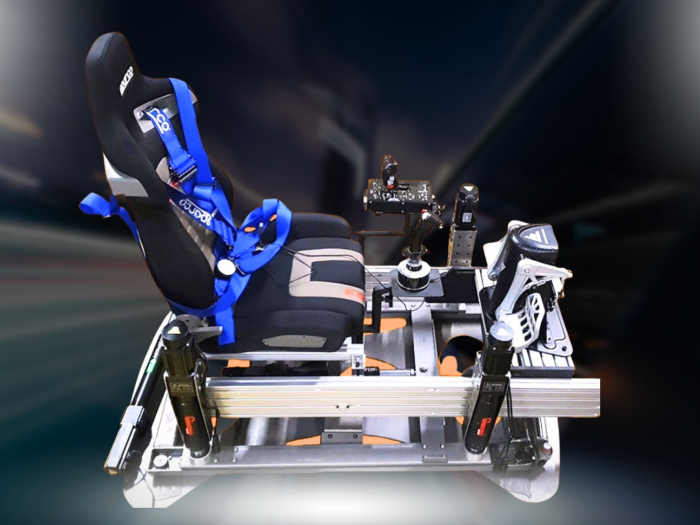

What if the boundary between a digital circuit and a professional qualifying session wasn't found on a screen, but in the subtle, violent shift of your seat as the rear tyres lose grip? For years, the quest for a truly realistic motion racing simulator has forced enthusiasts to choose between bulky industrial frames that ruin a room's aesthetic and underwhelming vibration kits that fail to translate real-world telemetry. You've likely felt the frustration of motion sickness caused by poor latency or the lack of genuine rear-end feedback during a critical corner.
We agree that your home setup shouldn't feel like a compromise. You deserve a rig that mirrors the visceral intensity of the track whilst remaining compact and manageable. In this 2026 guide, you'll discover how cutting-edge 6 DOF technology and bespoke British engineering are redefining professional immersion. We'll examine the mechanics of Twin-Traction-Loss, the impact of ultra-low latency on sensory feedback, and why the future of sim racing is hand-built for precision rather than sheer industrial scale.
Key Takeaways
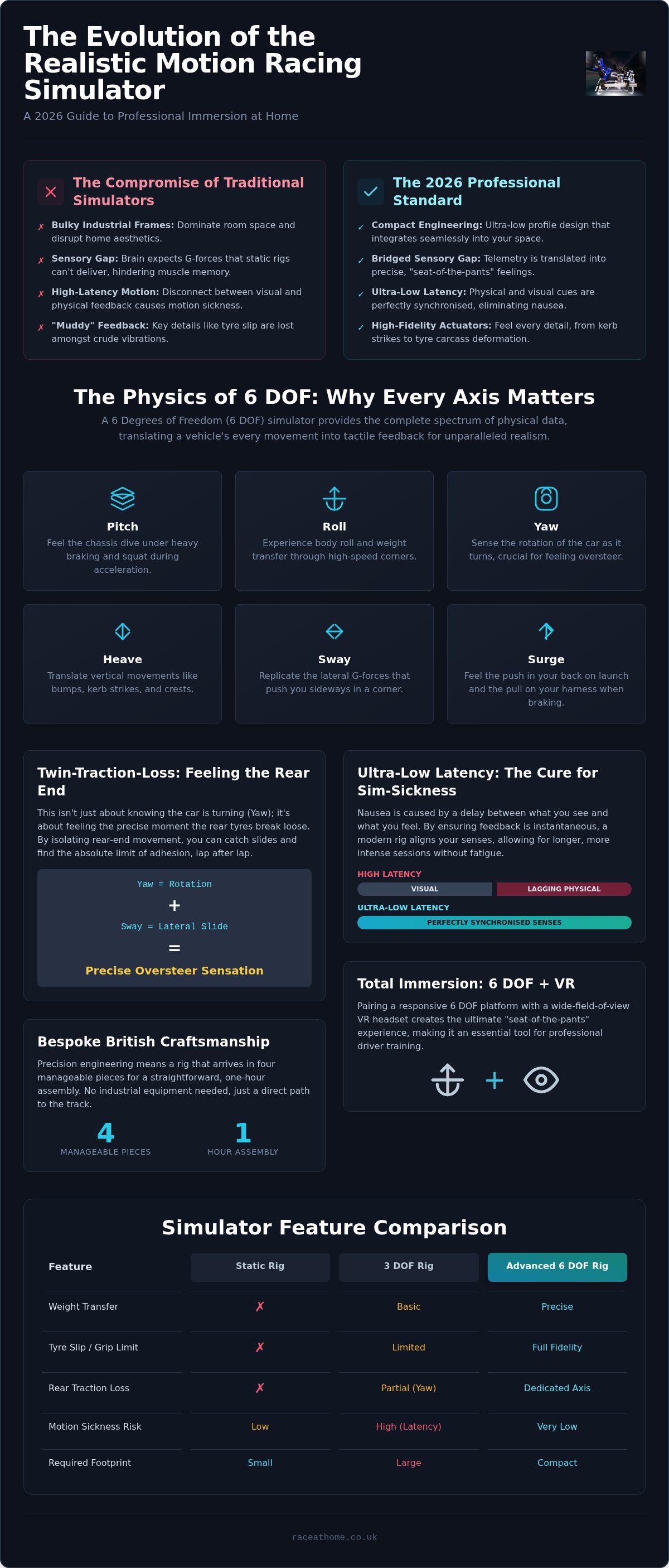
- Learn how 6 Degrees of Freedom (6 DOF) bridge the sensory gap by translating telemetry data into precise physical sensations like weight transfer and tyre slip.
- Discover why a high-end realistic motion racing simulator no longer requires a bulky industrial frame thanks to compact, ultra-low profile engineering.
- Understand the importance of low-latency feedback in preventing motion sickness and ensuring your physical movements match the on-screen action perfectly.
- Explore the benefits of bespoke British craftsmanship, including rigs that arrive in four manageable pieces for a straightforward one-hour assembly.
- See how pairing 6 DOF motion with wide-field-of-view VR headsets creates the ultimate seat-of-the-pants experience for professional driver training.
What Defines a Truly Realistic Motion Racing Simulator?
Realism in 2026 isn't just about high-resolution textures or 4K monitors. It's about the "seat-of-the-pants" feel that tells you exactly where the limit of grip lies. To build a truly realistic motion racing simulator, you have to move beyond the eyes and engage the body's vestibular system. Whilst visual immersion is a powerful starting point, the shift toward physical feedback is what separates a gaming setup from a professional training tool.
Static rigs create a "sensory gap" because your brain expects the push of a G-force that never arrives. When you brake hard into a hairpin, your eyes see the deceleration, but your inner ear feels nothing. This disconnect is more than a nuisance; it's a barrier to developing the muscle memory required for professional racing. High-fidelity, low-latency actuators bridge this gap by mimicking the sharp jolt of a kerb strike or the terrifying lightness of tyre slip. This evolution in motion simulator technology has pushed the industry toward a realism threshold where the hardware provides enough tactile data to be used for genuine competitive preparation.
Telemetry: The Language of Realism
The Psychology of Motion Sickness
Many newcomers fear that adding movement will increase nausea, but the opposite is often true. Sim-sickness usually stems from a disconnect between what you see and what you feel. By aligning your physical sensations with the visual cues of the track, a motion rig actually helps your brain process the experience more naturally. Poor motion with high latency is worse than no motion at all, as it creates a lag that confuses the senses. When you pair a responsive 6 DOF platform with a high-end Pimax VR motion simulator setup, the alignment of your inner ear and your vision becomes total, allowing for hours of high-intensity driving without the usual fatigue.
The Physics of 6 DOF: Why Degrees of Freedom Dictate Realism
To achieve professional-level immersion, your rig must account for every possible movement of a vehicle's chassis. Whilst a 3 DOF system provides the basics, a 6 DOF motion simulator offers the complete spectrum of physical data. This includes Pitch, Roll, and Yaw (rotational movements) alongside Heave, Sway, and Surge (translational movements). Each axis is critical for translating weight transfer with precision. For example, Surge allows you to feel the longitudinal G-forces during heavy braking, whilst Sway replicates the lateral forces pulling you toward the outside of a high-speed bend.
Research into vehicle dynamics, such as The Physics of 6 DOF: Why Degrees of Freedom Dictate Realism, highlights how complex subsystems must work in unison to replicate a vehicle's behaviour accurately. For rally and drift enthusiasts, this level of detail is non-negotiable. Without the ability to feel the car's rotation and lateral slide simultaneously, you're essentially driving blind. A realistic motion racing simulator must integrate these movements seamlessly to ensure the driver's brain receives a coherent story from the hardware.
Twin-Traction-Loss: Feeling the Rear End
Simple yaw movement tells you the car is turning, but Twin-Traction-Loss tells you the car is sliding. By isolating the rear-end movement from the rest of the chassis, the LowSlider 6 DOF Twin-Traction-Loss Motion Platform allows you to feel the exact moment the rear tyres break loose. This tactile feedback is the secret to finding the limit of adhesion. It allows for consistent lap times and faster corrections that a static rig simply cannot provide. We prioritise this sensation because it represents the most critical piece of data for any driver looking to improve their performance on the limit.
Actuator Precision: The PT Actuator Advantage
Feedback is only as good as its delivery speed. We utilise PT Actuator technology because these sim-specific units offer the high-speed response required to mimic track textures and kerb strikes with absolute clarity. Industrial actuators often feel "mushy" because they aren't designed for the rapid-fire telemetry of a realistic motion racing simulator. Our bespoke engineering ensures every jolt and vibration is crisp, providing the professional-grade clarity you need to stay competitive. If you're ready to elevate your setup, exploring our hand-built UK motion platforms is the next logical step in your racing journey.
Compact Realism: Why Footprint Matters for the Home Sim Racer
Many manufacturers equate stability with sheer mass. They produce towering industrial rigs that look more like construction scaffolding than high-end equipment. For the home user, this "Industrial Rig" approach is fundamentally flawed. Large, heavy footprints often force the driver into a high-seated position, which actually introduces more mechanical flex during high-G manoeuvres. A realistic motion racing simulator should enhance your home environment, not dominate it with unnecessary bulk.
By engineering the LowSlider with a proprietary ultra-low profile, we've achieved pro-grade stability within a remarkably compact footprint. A lower centre of gravity isn't just about saving space; it's about the physics of movement. When the driver is positioned closer to the ground, the leverage exerted on the frame during rapid pitch and roll is significantly reduced. This results in a "crisper" feel because the actuators aren't fighting against the momentum of a top-heavy structure. Rigidity is maintained through clever engineering rather than sheer weight, ensuring every bit of telemetry data is felt by the driver.
The LowSlider Design Philosophy
Our design philosophy centres on accessibility and rigidity. We've eliminated the awkward "climb-in" height found on many 6 DOF platforms, making the experience feel more like stepping into a real GT car. This low-profile approach ensures the rig remains stable even when the actuators are operating at maximum velocity. It also makes it easier to integrate essential sim racing accessories without creating a cluttered or unmanageable workspace. By keeping the profile slim, we ensure that every millimetre of movement is translated directly to the seat.
Aesthetics vs. Performance
We believe a realistic motion racing simulator should be a piece of functional art. Most rigs are built from generic industrial aluminium profiles that look out of place in a modern home interior. We use premium materials like stainless steel and bespoke finishes to create a professional cockpit that complements your space. Performance doesn't have to look industrial. By focusing on hand-built quality in the UK, we've created a rig that delivers professional-grade feedback whilst maintaining the elegance required for a standard home office or dedicated gaming room. To further enhance a dedicated leisure space with diverse attractions, you can explore Sales and Rental of Arcade Entertainment Equipment to find professional-grade machines that sit perfectly alongside a bespoke racing rig.
Total Immersion: Integrating VR and High-End Peripherals
A realistic motion racing simulator reaches its zenith when the visual and physical worlds align perfectly. Whilst a triple-monitor setup offers impressive scale, Virtual Reality provides the true depth perception required for professional-grade racing. In 2026, the Pimax partnership becomes essential. These headsets offer a wide Field of View (FOV) that mimics human peripheral vision, allowing you to spot your rivals in the mirrors or judge the apex of a hairpin with natural precision. High-resolution panels ensure that every track detail is crisp, providing the visual data your brain needs to interpret the physical cues from the motion platform.
Synchronisation is the key to this immersion. If there's even a millisecond of lag between the visual frame and the actuator response, the illusion breaks. We focus on ultra-low latency integration to ensure that when you see the car pitch forward under braking, you feel the surge in your chest at the exact same moment. This alignment doesn't just improve the experience; it makes you a faster, more consistent driver. When your eyes and your inner ear receive the same data simultaneously, your brain stops questioning the simulation and starts focusing on the lap time.
Optimising VR for Motion
Operating a VR headset on a moving platform requires specific software compensation to ensure the "camera" stays fixed relative to the cockpit rather than the room. Without this, the motion of the rig would cause the VR world to wobble, leading to instant discomfort. High refresh rates, typically 90Hz or above, are non-negotiable for 2026 setups. These speeds ensure that the visual flow remains fluid during high-speed elevation changes. When the Heave axis of your platform replicates a sudden crest, the VR depth perception amplifies the sensation, making you feel the "stomach-drop" of a real-world track cresting at speed.
The Tactile Ecosystem
Immersion is a loop that begins at your fingertips and ends in your seat. High-end peripherals like direct drive wheels and hydraulic pedals are vital components of this system. A direct drive motor provides the granular detail of the steering rack, whilst load-cell or hydraulic pedals replicate the stiff, progressive feel of a professional race car's braking system. You must ensure proper sim rig motion platform compatibility to prevent these high-force peripherals from introducing unwanted flex into your chassis. By building a cohesive force feedback loop, you create a training environment that translates directly to the real circuit.
If you're ready to build a no-compromise cockpit, you can view our hand-built motion platforms and VR bundles to start your journey toward total immersion.
Bespoke British Engineering: The Race@Home Experience
Choosing to buy motion simulator UK hardware means investing in more than just aluminium and actuators. Mass-produced units often lack the soul and mechanical precision of a hand-built rig. At Race@Home, we treat every realistic motion racing simulator as a bespoke engineering project. This focus on craftsmanship ensures that every bolt is torqued to specification and every component is tested for the rigours of professional use. Our UK-based manufacturing allows us to maintain strict quality control that global mass-market brands simply cannot replicate. You aren't just buying a product; you're gaining access to a gateway of professional-level performance.
We've solved the logistical nightmare typically associated with high-end sim rigs. Instead of receiving a daunting crate filled with hundreds of loose parts, your platform arrives in four substantial, pre-built sub-assemblies. This modular approach is designed for simplicity without sacrificing structural integrity. It allows us to ship our technology globally whilst ensuring the end-user experience remains premium and stress-free.
The 4-Piece Modular System
Our "One-Hour Assembly" promise is a core part of our design philosophy. We've streamlined the transition from unboxing to the track into four logical steps:
- Step 1: Unboxing the hand-built sub-assemblies. Each piece is carefully crated to ensure it arrives in pristine condition.
- Step 2: Connecting the modular motion frame. The components slot together with precision-engineered joints that eliminate mechanical play.
- Step 3: Mounting your favourite peripherals. Our frames are designed for maximum compatibility with high-end wheels and pedals.
- Step 4: Software calibration and your first lap. Our intuitive setup process ensures the telemetry matches your physical movements perfectly.
Professional Support and Global Reach
Our commitment to your experience doesn't end when the crate leaves our workshop. We offer a level of reliability that only a specialist manufacturer can provide. Because we build the hardware ourselves, our support team understands every mechanical nuance of your rig. This makes our platforms a standard choice for a motion simulator for driver training, where uptime and accuracy are paramount. Whilst we are a UK-based leader, our global logistics network ensures that this professional-grade realism is accessible to enthusiasts worldwide. We deliver a no-compromise experience that transforms your home into a world-class training facility with minimal fuss.
Take the Lead in Professional Immersion
The journey to the ultimate home setup requires a transition from passive viewing to active physical feedback. You've seen how 6 Degrees of Freedom and Twin-Traction-Loss technology provide the vital data needed to find the limit of grip. By prioritising a compact footprint and ultra-low latency, you ensure your training remains sharp and your home environment stays refined. A truly realistic motion racing simulator is no longer an industrial luxury; it's a precision tool for those who refuse to compromise on their competitive edge.
Every rig we produce is hand-built in the UK and used by professional drivers for competitive training. We've simplified global logistics by shipping our platforms in four easy-to-assemble pieces, ensuring you spend more time on the track and less time in the workshop. If you're ready to bridge the gap between simulation and reality, it's time to invest in a setup that matches your ambition.
Experience the ultimate in realism; order your bespoke LowSlider 6 DOF today. We look forward to seeing you at the apex.
Frequently Asked Questions
Is a realistic motion racing simulator worth the investment for a hobbyist?
A realistic motion racing simulator is a transformative investment because it shifts the focus from visual gaming to physical training. It builds essential muscle memory by providing the "seat-of-the-pants" feel that static setups lack. For a hobbyist, this level of immersion makes every session more engaging and visceral. It isn't just about chasing lap times; it's about experiencing the true intensity of the track from your own home.
How much space do I actually need for a 6 DOF motion platform?
Traditional industrial rigs often require a dedicated room, but the LowSlider is engineered for a compact footprint. It fits comfortably into a standard home office or spare room without dominating the space. Whilst specific dimensions vary based on your peripheral choices, the ultra-low profile design ensures the rig stays unobtrusive. You get professional-grade 6 DOF motion without the need for a massive, unsightly frame that ruins your room's aesthetic.
Can I use my existing sim racing pedals and wheel with a LowSlider rig?
The LowSlider is designed for maximum compatibility with high-end hardware. Most direct drive wheels and load-cell or hydraulic pedals from leading manufacturers will bolt directly onto our frame. This allows you to upgrade to motion whilst keeping the gear you've already mastered. The rigid stainless steel construction ensures these high-torque components don't introduce unwanted flex, providing a stable platform for even the most aggressive steering and braking inputs.
Does a motion platform help with driver coaching and lap time improvement?
Assembly is remarkably simple and typically takes less than an hour. We ship the simulator in four pre-built sub-assemblies that arrive ready to be connected. You don't need an engineering background or specialised tools to complete the setup. This modular approach ensures that the rig's structural integrity is maintained whilst making the unboxing and installation process as stress-free as possible for any customer, regardless of their technical experience.
What are the maintenance requirements for a high-end motion simulator?
Maintenance is minimal because we utilise professional-grade components like PT Actuators. These systems are designed for high-intensity use and don't require the frequent lubrication or calibration associated with older designs. Simply keeping the actuators free of dust and periodically checking the tightness of the bolts is usually enough to ensure years of reliable performance. This durability is a hallmark of our bespoke British engineering and commitment to a no-compromise racing experience.
Will a motion simulator work with my favourite racing titles like iRacing or Assetto Corsa?
How does the LowSlider design compare to traditional 80/20 aluminium rigs?
Traditional 80/20 aluminium rigs are often bulky and sit quite high, which can feel disconnected during motion. The LowSlider features a proprietary ultra-low profile that brings you closer to the centre of gravity. This reduces mechanical leverage and flex, resulting in a much crisper response from the actuators. It's a purpose-built solution that prioritises both aesthetics and performance, offering a more refined look that complements a modern home interior.


