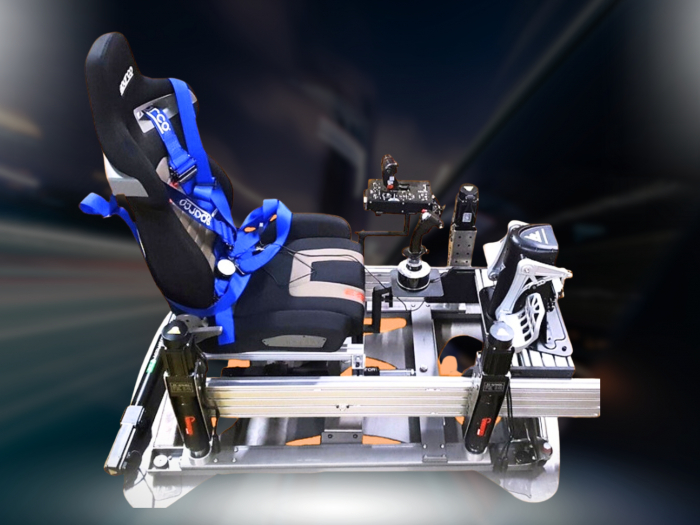

Motion simulator noise levels aren’t one fixed figure: they vary with movement direction and command strength. A platform’s sound changes as it responds to each movement, so a single number cannot describe every racing or flight session. The motion that sharpens the sensation of a kerb strike or turbulence also shapes what you hear.
It’s sensible to consider noise before bringing a moving simulator into your home, especially if the rig will share space with others. But sound isn’t determined by the number of movement axes alone. The platform’s motion, how strongly it is commanded and how its mechanism responds all play a part.
This guide explains what affects noise in home racing and flight simulators, how six-axis simulation and six-degree-of-freedom platforms relate to sound, and why commercial attractions can behave differently. You’ll learn what may affect the noise you hear and how it relates to the physical feedback that makes a virtual drive or flight feel more immersive.
Key Takeaways
- Assess sound in the context of the simulator’s movement: direction and command amplitude can both affect what you hear.
- Understand why motion accuracy matters: unwanted simulator noise can alter the movement cues a user experiences.
- Learn what six degrees of freedom means in practice, and how translational and rotational movement shape a simulation.
- Compare simulator types by how their mechanisms and commanded motion behave, rather than assuming one noise figure fits all.
- Explore how Race@Home’s LowSlider motion platforms can add physical feedback to a home racing or flight setup.
Home racing and flight simulator use
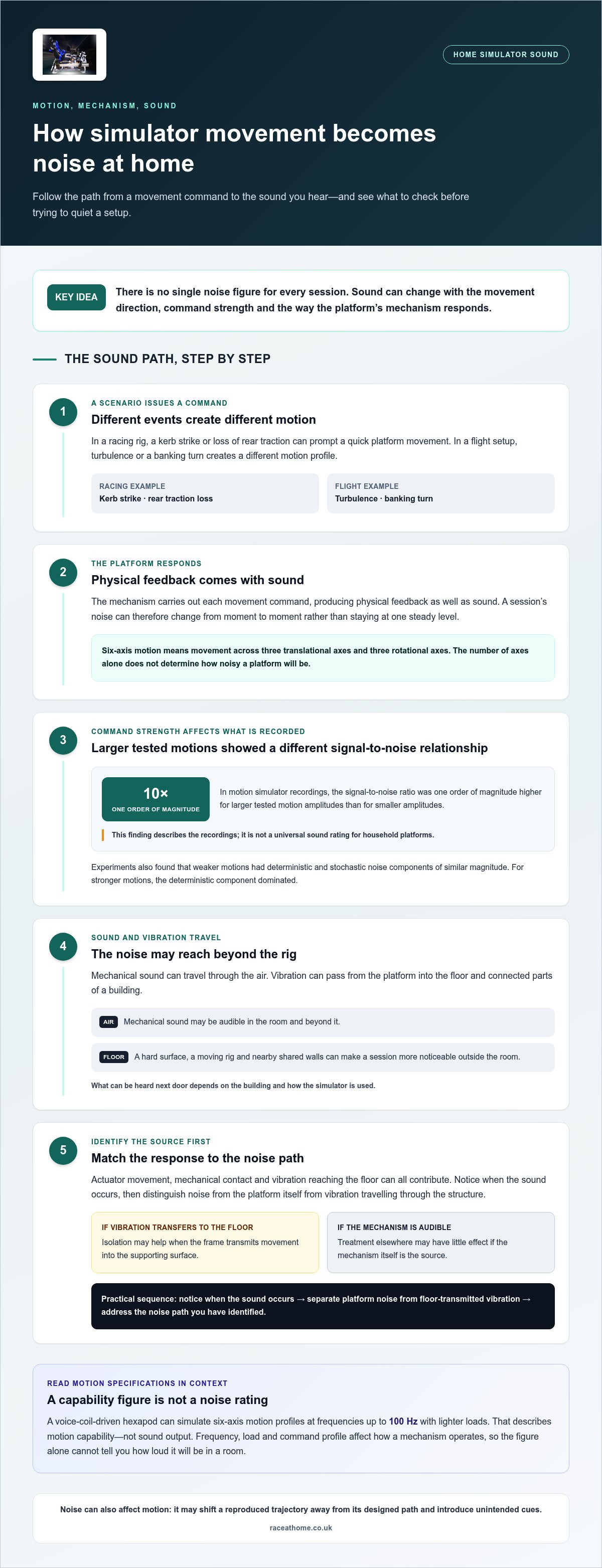
In a home racing rig, a kerb strike or loss of rear traction can prompt a quick platform movement. In a flight setup, turbulence or a banking turn creates a different motion profile. The mechanism responds to those commands, producing sound as well as physical feedback. Noise can therefore change during a session rather than staying at one steady level.
Motion simulator noise levels depend partly on the movement being reproduced. In motion simulator recordings, the signal-to-noise ratio was one order of magnitude higher for larger tested motion amplitudes than for smaller amplitudes. That finding relates to the recordings, not a universal sound rating for household platforms. It illustrates how motion strength can affect the relationship between intended movement and unwanted noise.
Noise can reach neighbours in an apartment or shared building. Mechanical sound may travel through the air, while vibration can pass from the platform into the floor and connected parts of the building. A hard surface, a moving rig and nearby shared walls can make a session more noticeable beyond the room. What can be heard next door depends on the building and how the simulator is used.
Historical flight simulation shows how motion hardware serves a specific purpose. In 1958, a flight simulator for the Comet 4 aircraft used a three-degrees-of-freedom hydraulic system. Its motion helped reproduce selected aircraft movement without recreating every physical condition of flight. In a home setup, the same principle applies: motion cues add to the visual and audio experience, but the platform does not reproduce every real-world force.
That distinction matters during demanding scenarios. A simulator can help a pilot practise dogfighting, but its motion cues do not reproduce the physical forces of flight. A simulator’s motion is designed to communicate cues, not impose the full force of an aircraft manoeuvre. In racing, a platform can signal a slide or impact without making the driver experience the complete forces of a real car.
For a memorable example of flight motion, the National Air and Space Museum in Washington, D.C., has a gallery of two-seat interactive flight simulators that perform 360-degree barrel rolls. The manoeuvre demonstrates how a simulator can create a striking movement cue. At home, consider which effects your racing or flight scenarios actually use, since frequent, pronounced commands can change both the sensation and the sound.
Real aircraft also show why simulators are used for training. Operating an empty real airplane for the described training would burn about 30 gallons of fuel per minute. A simulator instead reproduces selected cues, letting a trainee practise responses without operating an aircraft. For home users, the practical balance is between useful motion feedback and the sound and vibration produced by the chosen movement.
Six-axis motion simulation
Six-axis systems reproduce movement across three translational and three rotational axes. Their noise depends on how the platform generates and carries out each movement command.
Simulator noise can affect the motion itself, not just the listening experience. It can shift a reproduced trajectory away from its designed path and introduce unintended cues. In experiments, weaker motions had deterministic and stochastic noise components of similar magnitude. For stronger motions, the deterministic component dominated. This matters because noise behaviour can vary with the strength of the simulated movement.
A voice-coil-driven hexapod can simulate six-axis motion profiles at frequencies up to 100 Hz with lighter loads. That describes its motion capability, not a sound rating. Frequency, load and command profile all affect how a mechanism operates, so the figure alone can’t tell you how loud a system will be in a room.
Noise Levels Across Simulator Types and Brands
Noise comparisons describe how different simulator mechanisms respond to movement, rather than establishing one level for each type or brand. A voice-coil-driven hexapod, for example, can reproduce profiles up to 100 Hz with lighter loads, but that specification doesn’t reveal its sound output. For a useful comparison, consider the kind of mechanism and how it behaves under the movements you’ll use.
Costs of Quieting a Setup
The right way to reduce noise depends on whether the main issue is mechanical sound, vibration transferred through the floor, or both. If the platform frame transmits movement into the supporting surface, isolation may help. If the mechanism itself is the audible source, treatment elsewhere may have little effect. Identify the source first so any changes address the actual noise path.
Noise Causes and Ways to Reduce It
Actuator movement, mechanical contact and vibration reaching the floor can all contribute to simulator noise. Command strength matters too: stronger movement can make deterministic noise more prominent, while weaker movement may contain comparable deterministic and stochastic components. Notice when the sound occurs, then distinguish platform noise from vibration travelling through the structure. This helps you target the cause rather than changing unrelated parts.
In the US, a simulator’s six-axis capability alone doesn’t establish a noise exposure limit. For home use, assess the sound where you sit and consider how long sessions last; workplace and private-home situations shouldn’t be treated as interchangeable. If you’re comparing equipment, explore how motion platform design relates to the physical feedback you want.
Six-degree-of-freedom motion platforms
A six-degree-of-freedom platform moves along three linear axes and rotates around three axes. This arrangement creates distinct physical cues, but movement capability alone does not provide a noise rating.
Motion platforms commonly use six jacks, or hexapods, to provide all six degrees of freedom. Each jack changes length to reposition the upper platform relative to its base. Working together, the jacks produce combined movements rather than six isolated actions. This coordinated motion lets a racing or flight simulator translate a command into a convincing shift, tilt or rotation.
A typical high-end Stewart platform provides six degrees of freedom: three translational and three rotational. Translational movement shifts the platform through space; rotational movement changes its orientation. For example, a flight profile might combine forward movement with pitch, while a racing cue might combine lateral movement with roll. Each command engages the mechanism differently, so sound may vary with direction and command strength.
A described Level D flight simulator uses a hexapod supported by six hydraulic or electromechanical actuators. Its motion system provides six degrees of freedom: pitch, roll, yaw, heave, sway and surge. These terms describe different movements, from a nose-up rotation to vertical or sideways displacement. They also help explain why platform sound can change as the commanded movement shifts between axes.
In a hexapod positioner, the six axes are XYZ, pitch, roll and yaw. The actuators sit in parallel between the top and bottom platforms. Because they act together, a single movement cue can involve several actuators. A change in direction or command strength can therefore alter the movement pattern and the sound it produces. The six-axis label describes capability, not operating noise.
For home use, separate the platform’s movement specification from its acoustic behaviour. Six degrees of freedom describes the motions it can reproduce, not the sound level in a particular room. Room construction, the supporting surface and the commanded movement all affect what reaches the listener. A simulator replaying gentle pitch changes may sound different from one producing repeated, sharper lateral cues.
When comparing platforms, match the movements you expect to use with their mechanical design. A racing setup may prioritise traction-loss cues, while a flight profile may use coordinated pitch, roll and heave. Then consider how those commands engage the actuators. This is a more useful basis for judging noise than counting axes alone: six degrees of freedom describes motion range, not acoustic performance.
How noisy are commercial motion simulator attractions?
Commercial simulator attractions don’t have one fixed noise level. Their motion varies by direction, and the relationship between command strength and noise is nonlinear. A stronger movement command won’t necessarily produce a proportional change in sound. This matters when comparing a large ride with a home rig: the movement profile, mechanical response and surroundings all shape what people hear.
Consider Star Trek: The Experience, which operated at the Las Vegas Hilton from 1998 to 2008. Its motion simulator ride placed movement within a themed attraction, rather than an isolated room. That context changes how sound is perceived: mechanical noise may sit alongside programmed audio and the reactions of other visitors. A listener’s impression therefore reflects the entire experience, not motion hardware alone.
RiseNY opened to the public in Times Square in 2022. It offers another example of a motion-based attraction operating within a busy visitor setting. The ride’s surroundings matter when judging its perceived sound, because background activity can mask some noises and make others stand out. A visitor’s experience is not a direct measurement of the platform’s mechanical output.
Direction matters too. A simulator may sound different as it moves through distinct axes, while command strength affects its response nonlinearly. For example, a sharp movement in one direction may sound different from gradual movement in another. One observation during a single manoeuvre therefore cannot summarise an attraction’s complete sound profile.
To understand what contributes to the sound, separate the movement system from its surroundings. Listen for changes that coincide with a particular direction or stronger command, then distinguish mechanical sound from programme audio. In a commercial attraction, visitors and ambient activity also shape what reaches the ear. These observations help explain the experience, but they do not provide a measured decibel figure.
For a home simulator owner, the useful lesson from commercial rides is that noise varies, not that the two can be compared directly. A public attraction and a private setup differ in their surroundings and use, while direction and command strength influence simulator sound in both. When assessing a motion profile, note which movement triggers a change. This links the sound to the command rather than treating all motion as equally noisy.
What are the noise levels of different motion simulator types and brands?
There isn’t one noise level that applies to every type or brand of motion simulator. A useful comparison accounts for the mechanism, movement direction, command strength and test conditions. An actuator responding to a sharp command, for example, may sound different from the same system following a gradual profile. A brand name alone cannot describe every sound a user will hear.
Compare simulator categories by how they create movement. A hexapod uses six actuators to position its upper platform, while a voice-coil-driven hexapod is described as simulating six-axis profiles up to 100 Hz with lighter loads. That frequency describes motion capability, not loudness. Hydraulic and electromechanical actuators are also used in flight simulation, including the described Level D system, but their presence alone doesn’t provide a sound measurement.
Direction and command strength matter across simulator types. Noise varies by direction and relates nonlinearly to command strength, so a stronger command does not mean a proportional increase in sound. A platform turning through roll, for instance, may behave differently from one producing vertical heave. Comparisons based on a single manoeuvre can miss differences across a complete racing or flight profile.
For a practical comparison, look for like-for-like conditions rather than relying on an isolated decibel figure. Check whether measurements reflect the same movement, command strength, load, distance and room conditions. A figure for a stationary platform and one for active motion do not represent equivalent tests. The supporting surface matters too: a platform on a rigid floor may transmit vibration differently from one on another surface.
- Hydraulic systems: assess the sound during the movement profile you expect to run.
- Electromechanical systems: distinguish actuator sound from vibration transmitted through the rig or floor.
- Voice-coil hexapods: treat the stated 100 Hz capability as a motion specification, not an acoustic rating.
Use the same scenario when comparing brands. For example, compare a gradual pitch movement on each platform, then assess a sharper command separately. This helps reveal how each mechanism behaves without assuming that six degrees of freedom or a particular brand guarantees quieter operation. It also gives you a more relevant basis for choosing equipment to suit your room and preferred simulation style.
If you’re weighing up motion options for a home rig, explore simulator platform options against the movements you want to feel.
Motion simulator noise can make actual movement differ from the experimenter’s designed trajectories and introduce unintended motion cues. It may therefore affect both movement accuracy and the cues experienced.
Race@Home: LowSlider 6 DOF Twin-Traction-Loss Motion Platform
Race@Home’s LowSlider 6 DOF Twin-Traction-Loss Motion Platform is an option for sim racers seeking movement cues alongside their driving setup. Its six-degree-of-freedom format suits those looking to explore coordinated physical feedback, including traction-loss simulation. Choose a platform by the movements you want to feel, then consider how its setup will fit your room and racing use.
If you’re after a more focused motion setup, the LowSlider 3DoF motion platform is another option. Neither movement specification is, by itself, a sound measurement, so use the distinctions in this guide to assess motion and noise as separate considerations. Race@Home also offers Pimax VR Headsets and Sim Racing Accessories for sim racing setups.
Visit Race@Home’s website to explore its motion platforms.
Shape a simulator setup around your space
Before choosing an upgrade, picture a typical session in the room where you’ll use it. Consider when you race or fly, how the rig fits alongside everyday activities and which movement cues matter most. These priorities can help you make a considered choice instead of focusing on one specification in isolation.
Think of motion simulator noise levels as part of the relationship between your equipment, chosen movement profiles and home environment. The aim isn’t simply to remove every sound, but to understand what you want from the simulation and choose equipment to suit how you use the space. A well-matched setup should support the experience you’re building, not work against it.
If you’re ready to explore motion hardware for your racing or flight simulator, contact Race@Home about your setup. Bring your priorities and the movements you want to feel into that conversation, then take the next step towards a more immersive simulator experience.
Frequently Asked Questions
How loud are motion simulators in decibels during normal operation?
There isn’t one decibel figure for normal operation across motion simulators. Readings vary with the platform, movement profile, command strength, room acoustics and measurement position. A steady, gentle sequence and a sharp movement sequence can produce different results on the same rig. For a useful reading, use a sound meter where you want to assess noise, and record the operating mode and room conditions too.
What noise levels do home motion simulator rigs produce?
Home rigs produce sound from their moving mechanisms and may also transmit vibration into the supporting floor. The level you perceive depends on how the rig is being used and where you’re listening. Sound at the driver’s seat, for example, may differ from sound in an adjoining room. For useful comparisons, keep the rig, room and listening position consistent, and note the movement profile.
How do motion simulator noise levels compare with common household sounds?
A comparison with a household sound is useful only when both are measured under comparable conditions. A simulator’s changing mechanical sound may differ from a fan’s steady hum, while floor vibration can add a sensation that an airborne sound comparison misses. Rather than assigning an unsupported household equivalent, compare the simulator with your room’s background sound during a quiet period and normal household activity.
What are typical motion simulator noise levels at different distances?
Sound travelling through the air generally becomes less prominent farther from its source, but vibration transmitted through the floor can travel differently. Measure at the driver’s seat, room entrance and nearest shared wall to understand how sound changes around your home. Keep the movement profile the same for each reading, and note whether the rig is on a hard floor or another supporting surface.


