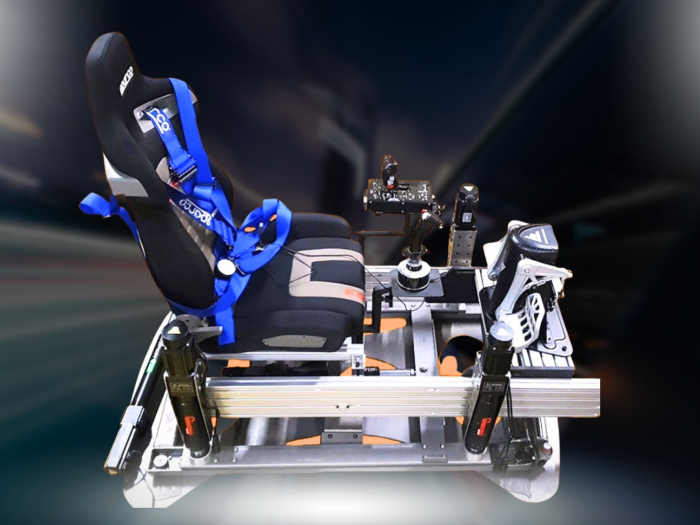

A static simulator can teach you the racing line, but it will never teach you how a car actually behaves at the limit. For the serious enthusiast, the missing link isn't more pixels or a faster processor; it's the physical sensation of weight transfer and tyre slip that only a professional-grade motion platform can provide. You've likely spent hours fine-tuning your lap times, yet you still feel a disconnect between the digital telemetry and your own senses. It's a common frustration when trying to establish a truly effective F1 training simulator at home, especially when high-end equipment often feels too bulky or complex for a standard games room.
This 2026 guide promises to bridge that gap by showing you how to integrate 1:1 physical feedback into a compact, high-performance setup. We'll explore how the hand-built LowSlider 6 DOF system delivers uncompromising realism through precise mechanical movement; all whilst maintaining an ultra-low profile that respects your living space. You'll discover the essential hardware needed to translate game data into tangible G-forces, ensuring your home training is as rigorous and rewarding as a day on the actual circuit.
Key Takeaways
- Understand why static rigs cannot replicate F1 physics and how motion platforms provide the vital sensory feedback needed to master high-downforce cornering.
- Discover how to configure a professional-grade F1 training simulator at home using a compact 6 DOF platform that fits seamlessly into a study or games room.
- Learn how Twin-Traction-Loss technology allows you to feel the rear end stepping out, enabling more precise corrections during limit handling.
- Identify the specific hardware combinations, such as Pimax VR and professional pedals, required to bridge the gap between digital telemetry and physical reality.
- Explore the benefits of a hand-built UK engineering approach that offers global shipping in four modular pieces for rapid, one-hour assembly.
Beyond Static Rigs: Why F1 Training Requires Full Motion
Static simulators are excellent for memorising the layout of Silverstone or Spa, but they fall short when you need to feel the limit of adhesion. In a high-downforce environment, an F1 car communicates through the chassis long before the visual cues reach your brain. If you're building an F1 training simulator at home, relying solely on a static rig creates a perceptual gap where your eyes see a slide that your body hasn't yet felt. This delay often leads to over-correction and inconsistent lap times because you're reacting to what has already happened, rather than what is currently occurring.
Professional-grade motion systems solve this by providing the visceral feedback required to identify the subtle onset of understeer and oversteer. When the rear end begins to rotate during high-speed acceleration, a motion platform provides an immediate physical prompt. This allows you to make micro-adjustments to the throttle and steering with the same instinctual precision as a driver on the actual grid. It's the difference between playing a game and operating a vehicle.
The Role of Muscle Memory in F1 Simulation
Reacting to a slide via a monitor is a visual correction; reacting via the seat is an instinctive one. Physical feedback trains the brain to process telemetry data much faster than visual cues alone. This is particularly vital in long, high-speed corners where sustained G-force representation helps you gauge the car's balance. Professional drivers transition to motion rigs for serious off-track preparation because it builds the specific muscle memory needed to handle a car's weight transfer. Without this sensory input, you're essentially guessing how much grip is left on the tyres.
Defining 6 Degrees of Freedom for the Home User
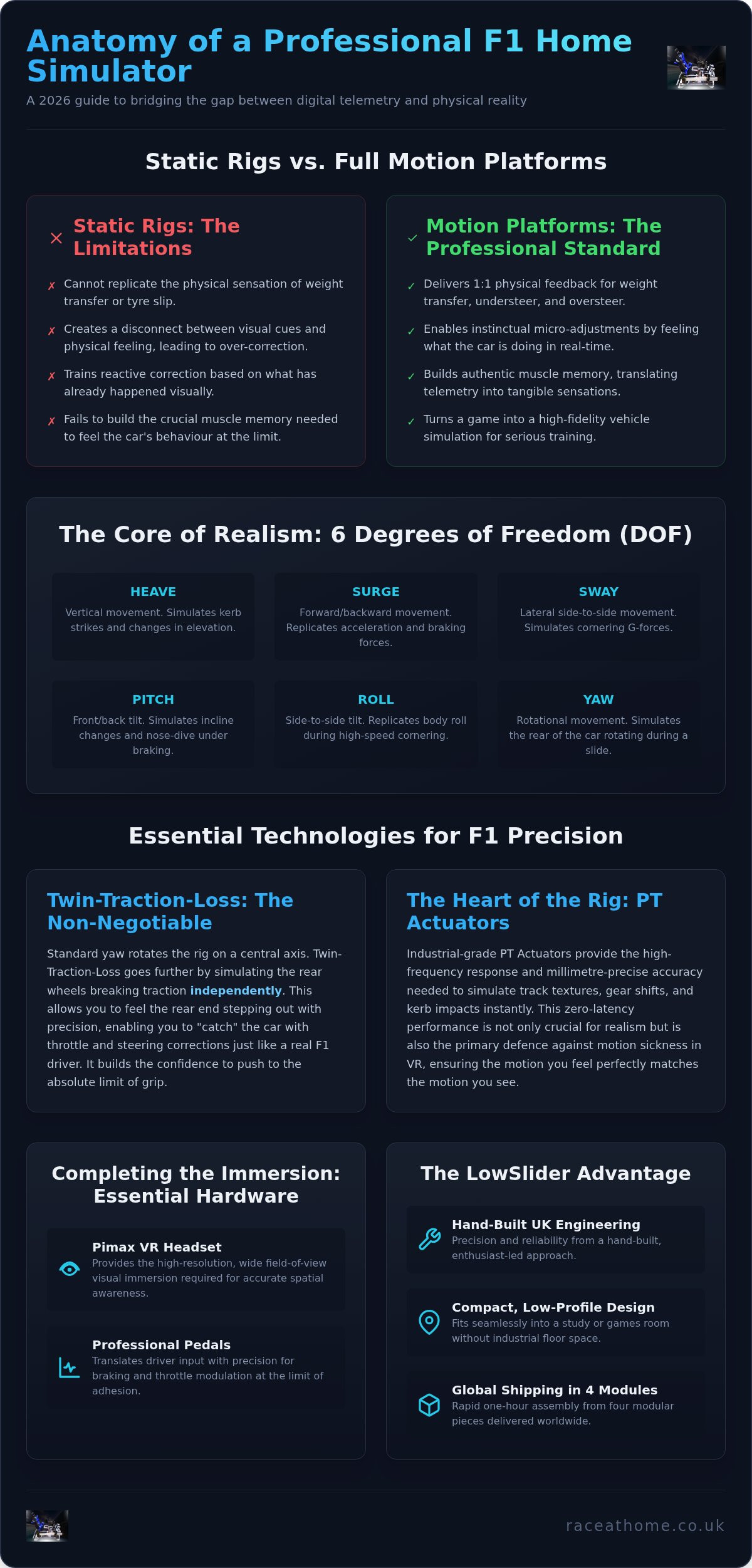
To bridge the gap between software and reality, a platform must operate with six degrees of freedom (DOF). This technical standard encompasses the full range of physical movement: Heave (vertical), Pitch (front/back tilt), Roll (side-to-side tilt), Yaw (rotation), Surge (acceleration and braking), and Sway (lateral movement). In an F1 context, these vectors work in unison to replicate the violent kick of a seamless-shift gearbox and the jarring impact of a kerb strike. A 6 DOF platform is the ultimate method for translating F1 telemetry into physical movement, ensuring every digital input results in a tangible real-world sensation. By utilising a system like the LowSlider 6 DOF, you've got a setup that delivers this professional-level rigour without requiring the floor space of a commercial warehouse.
The Physics of F1 Realism: Degrees of Freedom and Traction Loss
The physics of a modern Formula 1 car are defined by extreme downforce and immediate mechanical response. When you are configuring an F1 training simulator at home, the hardware must replicate these forces with zero latency. Whilst many consumer rigs offer basic vibration, a professional setup relies on sophisticated motion geometry to communicate what the tyres are doing. This is where the concept of Driver-in-loop (DiL) testing becomes relevant for the home user. By placing the driver at the centre of the telemetry loop, the simulator provides the same sensory cues used by world-class teams to refine car setups and driver performance.
Why Twin-Traction-Loss is Non-Negotiable for F1
Standard yaw movement rotates the rig on a central axis, but true Twin-Traction-Loss simulates the rear wheels breaking traction independently. In an F1 context, this is the difference between a controlled exit and a terminal spin. As you accelerate out of a low-speed chicane, the ability to feel the rear end stepping out allows you to "catch" the car through throttle modulation. This physical feedback provides a massive psychological advantage; it builds the confidence to push into the car's limit amongst professional sim racers who cannot afford to guess where the grip ends.
PT Actuators: The Engineering Heart of the Rig
Precision in motion is driven by the quality of the actuators. Industrial-grade PT Actuators are the preferred choice because they offer the high-frequency response necessary to simulate track surface textures and kerb strikes. Unlike consumer-level gear, these systems move with millimetre-precise accuracy. This speed is also the primary defence against motion sickness in VR. If the motion lag is even slightly out of sync with your visual input, the immersion breaks. High-speed actuators eliminate this lag, ensuring the physical surge and sway match the brutal braking zones of Monza or the lateral load of Blanchimont at Spa.
If you are looking for this level of technical fidelity, exploring a professional motion platform is the next logical step in your simulator evolution. These systems ensure that every surge under braking and every sway through a high-speed sweep feels as violent and accurate as the digital data suggests. By synchronising these movements, the rig translates the harsh reality of the track into your training space, allowing you to master the car's behaviour without ever leaving your home.
Space and Setup: Overcoming the Barriers to Home F1 Simulation
A common misconception amongst enthusiasts is that a professional-grade setup requires a dedicated warehouse or a commercial unit. This fear often stalls the dream of owning an F1 training simulator at home. The LowSlider philosophy challenges this assumption by delivering maximum immersion within a minimal footprint. Whilst traditional static rigs can be surprisingly long and cumbersome, a bespoke LowSlider 6 DOF platform is engineered to occupy a similar floor area. It prioritises vertical efficiency and an ultra-low profile, ensuring the rig fits comfortably under standard UK ceiling heights without making the room feel cramped.
Integrating this level of technology into a domestic setting is about more than just dimensions. It's about how the hardware interacts with your lifestyle. For instance, understanding how F1 drivers train with simulators reveals that professional preparation is about consistency and focus. A cluttered, oversized rig in a spare bedroom is a distraction. By contrast, the LowSlider’s compact design allows it to sit in a home office or games room as a piece of high-end engineering rather than an industrial eyesore. This global accessibility is further supported by a modular shipping system that breaks the rig down into four manageable sections.
The One-Hour Assembly Revolution
Moving from a shipping crate to a fully operational rig shouldn't require an engineering degree. Most high-end simulators arrive as complex 'flat-pack' aluminium profile kits that take days to align and bolt together. We've replaced that frustration with a four-piece modular system. This design allows for worldwide delivery, shipping in sections that can be assembled in under 60 minutes. It removes the technical anxiety associated with motion systems. You can focus on the driving rather than the logistics of the build, knowing the system is hand-built for reliability before it ever reaches your door.
Aesthetics and Integration into the Home
A professional rig shouldn't look like a construction site. High-end motion platforms often suffer from exposed wiring and bulky external control boxes. The LowSlider addresses this through integrated cable management and a sleek finish that complements modern interior design. The LowSlider achieves professional-grade motion whilst remaining compact and tidy enough for a domestic setting. This 'clean' look ensures your simulator is a highlight of your home; to further enhance your space with bespoke visual graphics, check out Image Square Printing for high-end décor options. It's a no-compromise solution that respects both your passion for racing and your living space.
Selecting the right peripherals is the final step in perfecting an F1 training simulator at home. A motion rig provides the foundation, but the interface between driver and machine must be equally precise. If the steering torque or braking pressure is too light, the physical feedback from the 6 DOF platform will feel disconnected. You need hardware that translates the violent reality of a Grand Prix car into your hands and feet. This synergy between high-fidelity inputs and motion output is what creates a truly professional-grade experience.
VR vs. Triple Screens for F1 Training
Pimax headsets are often the preferred choice for F1 fans due to their industry-leading field of view. This wide perspective is essential for wheel-to-wheel racing; it allows you to spot a rival's front wing in your periphery without turning your head. VR also provides the depth perception needed to judge braking distances and hit the apex with millimetre precision. To ensure your visual and physical cues stay in perfect sync, you must utilise "Motion Compensation" software. This technical layer keeps your virtual eyes fixed within the cockpit even as the rig pitches and rolls beneath you. For a deeper dive into this technology, read The Ultimate Pimax VR Motion Simulator Set-up Guide 2026.
Bespoke Accessories for the Competitive Edge
An F1 steering column can generate significant torque, so a high-end direct-drive wheelbase is a requirement. You'll want a system capable of sustained peak torque to match the heavy steering feel of a high-downforce car. This should be paired with an F1-style rim featuring integrated telemetry displays and rotary encoders for real-time brake bias adjustments. Pedals are perhaps the most vital component for lap time consistency. F1 braking is about pressure, not pedal travel. High-end hydraulic or load-cell pedals, such as those from Sim Racing Professional, allow you to modulate 100kg+ of force with muscle memory rather than guesswork. This is where you find the final tenths of a second. You can learn more about optimising these components in our Sim Racing Accessories: The Ultimate Guide.
Ready to complete your cockpit? View our range of Pimax headsets and pro-grade accessories to ensure your hardware matches the performance of your motion platform. By choosing components that reflect the physical demands of the real sport, you'll ensure your training is as effective as it is immersive.
The LowSlider Advantage: UK Engineering for Global F1 Enthusiasts
Choosing an F1 training simulator at home represents a significant shift from casual hobbyist to serious competitor. Whilst the market is flooded with mass-produced frames, the LowSlider 6 DOF stands apart as a hand-built, made-to-order engineering project. Every platform is constructed with a focus on structural rigidity and mechanical silence, ensuring that the only thing you feel is the telemetry-driven feedback from the track. This level of craftsmanship is difficult to achieve in a factory-line environment where speed often trumps precision. To match this professional approach to your equipment, you can learn more about how elite athletes use cold therapy to maintain the physical and mental edge required for competition.
Mass-produced rigs often suffer from "flex" under the extreme forces generated by high-end direct-drive wheels and heavy braking. A hand-built system from the UK eliminates these weak points through superior materials and meticulous assembly. This bespoke approach doesn't just improve performance; it significantly reduces the mechanical noise that can plague cheaper motion systems. Additionally, you benefit from direct access to UK-based technical expertise. If you have a question about your setup, you're speaking with specialists who understand the hardware inside out. For those looking to invest, our Buy Motion Simulator UK: The 2026 Professional Guide provides a detailed breakdown of what to look for in a high-end rig.
Investing in the Ultimate Home Experience
The integration of industrial-grade PT Actuators ensures that your simulator is a long-term investment in your racing career. These components are designed for reliability and high-frequency response, offering a level of durability that consumer-grade gear simply cannot match. By moving from a "gaming" mindset to a "training" philosophy, you're preparing yourself for the physical and mental demands of real-world motorsport. The LowSlider 6 DOF is the logical final step in this evolution. It provides a professional-grade platform that is accessible, reliable, and compact enough for any home.
The transition to a full-motion setup is a transformative experience. It bridges the final gap between the digital world and the physical sensations of the cockpit. Our modular four-piece delivery system ensures that this technology is available to enthusiasts worldwide, with a setup process that is straightforward and efficient. Explore the LowSlider 6 DOF and start your F1 journey today.
Master the Grid with Professional Motion
Transitioning from a static rig to a 6 DOF platform is the most significant upgrade you can make to your racing career. By integrating Twin-Traction-Loss and high-frequency actuators, you move beyond visual cues and begin to feel the car's limit with instinctual precision. We've shown that a professional F1 training simulator at home no longer requires a commercial-sized space; it simply requires intelligent, UK-led engineering. Our platforms are hand-built in the UK and used by professional drivers globally, ensuring that every shift and slide is replicated with absolute fidelity.
Whether you're looking for the immersion of Pimax VR or the brutal feedback of hydraulic pedals, the foundation of your success is the motion beneath you. Our worldwide modular shipping means your bespoke rig arrives in four easy-to-assemble pieces, ready for action in under an hour. Build your bespoke F1 training simulator with Race@Home and experience the visceral thrill of the limit. Your journey from the digital screen to the physical cockpit starts here. It's time to stop gaming and start training like the pros.
Frequently Asked Questions
Is a motion simulator realistic enough for actual F1 driver training?
Yes, high-end motion platforms are a standard tool for professional driver preparation. By providing 6 Degrees of Freedom, these rigs allow drivers to feel the car's weight transfer and the onset of traction loss. This physical feedback is essential for mastering limit handling and refining race craft outside of the circuit. Whilst no home setup replaces track time, a 6 DOF rig offers the technical fidelity required for meaningful setup validation and muscle memory development.
How much space do I need for a full 6 DOF motion simulator at home?
The proprietary LowSlider design is specifically engineered for domestic environments, requiring a footprint similar to a traditional static rig. Most enthusiasts find that a standard study or games room provides ample space. Because the platform features an ultra-low profile, it fits comfortably under standard UK ceiling heights. This compact engineering ensures you don't need a dedicated warehouse to host a professional-grade F1 training simulator at home, making high-end motion accessible for residential use.
Does a motion platform cause motion sickness in VR?
Actually, a high-quality motion platform often reduces motion sickness by aligning your physical sensations with your visual inputs. When using a Pimax VR headset, industrial-grade PT Actuators provide immediate physical feedback that matches the movement on screen. This eliminates the sensory conflict that typically triggers nausea. By utilising motion compensation software, the virtual cockpit remains stable, ensuring that your brain perceives a consistent environment even during violent shifts in the car's orientation.
Can the LowSlider motion rig be shipped outside of the UK?
Yes, we provide global shipping for all our motion platforms. To make international delivery as efficient as possible, each rig is shipped in four modular pieces. This system ensures the hardware is protected during transit and can be easily moved into your home upon arrival. Our hand-built UK engineering is available to enthusiasts worldwide, providing a seamless transition from order to assembly regardless of your geographic location.
What sim racing software is best for F1 training on a motion platform?
Professional-grade motion platforms are compatible with all major racing titles that output telemetry data. For dedicated F1 training, software like iRacing and Assetto Corsa are popular choices due to their highly accurate physics engines and detailed track scans. The official F1 series also provides excellent telemetry support. The key is ensuring the software can communicate with the motion platform's controllers to translate digital forces into physical movement with zero latency.
How difficult is it to assemble a Race@Home motion simulator?
Assembly is designed to be straightforward and can typically be completed in under one hour. Unlike complex aluminium profile kits that arrive in hundreds of pieces, our rigs are delivered in four pre-assembled modular sections. You don't need an engineering degree or specialised tools to get started. This user-friendly approach removes the technical barriers often associated with high-end motion systems, allowing you to focus on your driving rather than the build.
Do I need a special floor or reinforced room for a motion rig?
No, a standard domestic floor is perfectly adequate for the LowSlider platform. Despite its industrial-grade performance, the rig is designed to distribute its weight effectively across a compact area. The ultra-low profile and lightweight engineering mean you won't need to reinforce your room or install special flooring. Whether your simulator is situated on carpet, wood, or laminate, the system remains stable and secure during even the most intense racing sessions.
What is the difference between a 3DoF and a 6 DOF simulator for F1?
A 3DoF platform provides Pitch, Roll, and Heave, which covers basic tilting and vertical movement. However, a 6 DOF platform is the professional standard for an F1 training simulator at home because it adds Yaw, Surge, and Sway. These additional vectors are critical for simulating traction loss, acceleration, and lateral G-forces. For F1 enthusiasts, the 6 DOF system is essential for feeling the rear end step out and replicating the brutal braking forces of a Grand Prix car.


