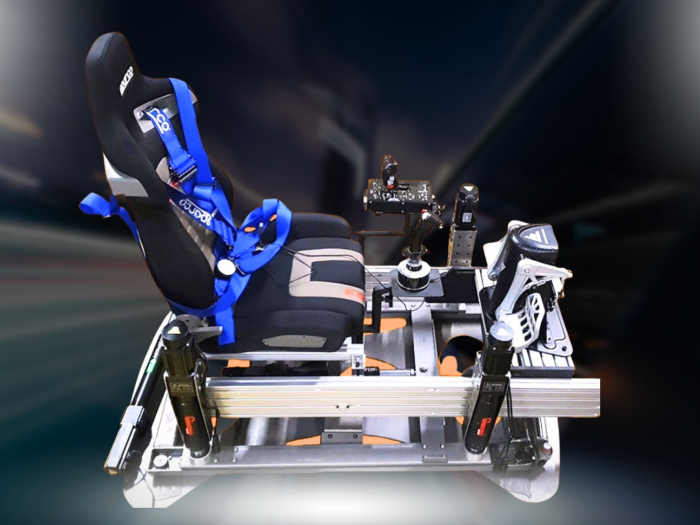

True GT racing realism isn't found in the violent, exaggerated heaves of a commercial simulator; it's felt in the subtle, high-frequency vibration of a tyre losing grip through a high-speed apex. You've likely spent years fine-tuning your FOV and load-cell brakes, yet that final layer of immersion, the physical sensation of oversteer and weight transfer, often remains elusive. Many sim racers worry that adding motion means sacrificing their entire living room to a complex, bulky beast that induces more nausea than adrenaline. We understand that frustration. This guide will show you how to transform your home setup into a professional-grade GT cockpit with a high-fidelity GT racing motion platform that prioritises precision over sheer scale.
By the end of this article, you'll understand how ultra-low profile engineering and twin-traction-loss technology eliminate the latency that causes motion sickness whilst delivering the sensory feedback needed for better lap time consistency. We'll explore the technical transition from digital telemetry to real-world physical sensations. You'll learn why a compact, hand-built UK design can outperform massive commercial rigs by focusing on the high-frequency data that actually makes you faster on track. It's time to stop guessing what your rear tyres are doing and start feeling every millimetre of the circuit.
Key Takeaways
- Understand how modern motion technology translates digital telemetry into precise physical sensations to replicate the visceral experience of a GT cockpit.
- Learn why 6 Degrees of Freedom are vital for capturing the subtle weight transfer and tyre slip characteristics that define GT3 and GTE racing disciplines.
- Evaluate the performance differences between 3DoF and 6 DOF systems to determine which configuration best aligns with your competitive goals and available space.
- Discover how to integrate a professional GT racing motion platform into a standard home environment using compact, ultra-low profile UK engineering.
- Identify the critical PC specifications and power requirements necessary to optimise low-latency feedback and consistent performance during endurance sessions.
What is a GT Racing Motion Platform? Defining the 2026 Standard
A GT racing motion platform is an advanced, actuator-driven ecosystem designed to translate digital telemetry into tangible physical force. It is the bridge between the virtual world and your vestibular system. In 2026, the standard for these systems has shifted away from the slow, sweeping movements of the past. Instead, the focus is on high-frequency, low-latency responses that replicate the granular textures of the track surface. Precision is everything. If the platform can't keep up with the car's physics engine, the immersion breaks instantly.
GT racing requires a unique feedback profile. Unlike the ultra-stiff, instantaneous snap of a Formula car or the violent, long-travel oscillations of a Rally stage, GT3 and GTE cars are defined by their weight transfer. You need to feel the chassis 'set' into a corner as the suspension loads up. You must sense the rear tyres beginning to scrub before the visual cue appears on your screen. Achieving this requires a low centre of gravity. A compact, low-profile design ensures that the rig remains stable during intense sessions, preventing the pendulum effect that can ruin immersion in taller, bulkier setups. It's about feeling the car's behaviour, not just riding a machine.
The Evolution of Home Motion Systems
Home simulators have transitioned from simple seat-movers to sophisticated full-chassis platforms. Early systems often felt disconnected because only the chair moved, which confused the brain's perception of G-forces. Modern engineering prioritises moving the entire cockpit, including the pedals and steering wheel. This approach, combined with superior software integration, has finally eliminated the floaty sensation that once plagued home rigs. Today's high-end platforms synthesise data from direct-drive peripherals and motion actuators to create a seamless sensory loop. It's no longer about just moving; it's about communicating exactly what the car is doing in real-time.
Key Components of a Professional GT Rig
To achieve professional-grade realism, several critical components must work in perfect synchronisation within your GT racing motion platform setup:
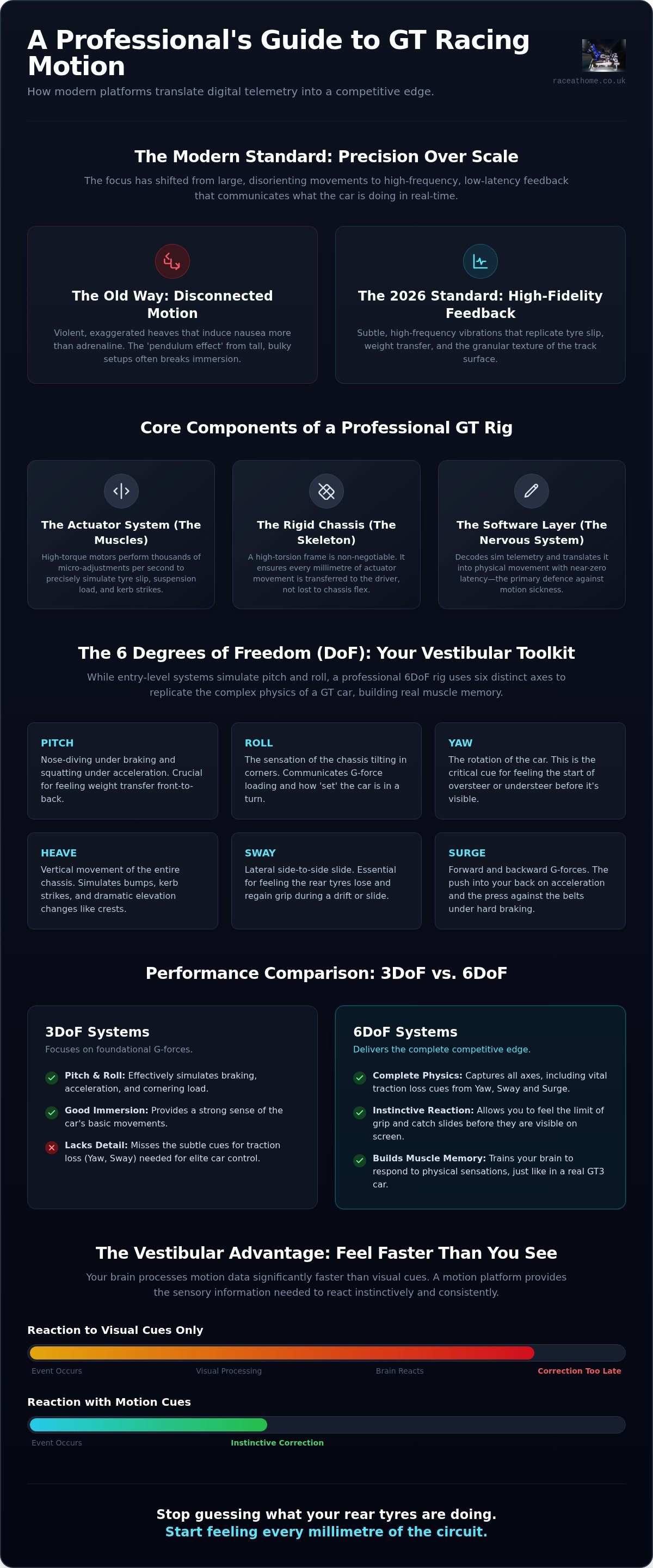
- The Actuator System: These are the muscles of the rig. Modern actuators utilise high-torque motors capable of thousands of micro-adjustments per second to simulate tyre slip and kerb strikes.
- The Rigid Chassis: Motion generates significant kinetic energy. A high-torsion chassis is non-negotiable to ensure that every millimetre of movement is transferred to the driver rather than being absorbed by frame flex.
- The Software Layer: This acts as the nervous system. It decodes telemetry data from the sim and translates it into physical movement with near-zero latency, which is your primary defence against motion sickness.
The Mechanics of 6 DOF: Why Degrees of Freedom Matter for GT3 Realism
Achieving true immersion in a GT3 car requires more than just a vibrating seat; it demands a sophisticated GT racing motion platform capable of simulating six distinct axes of movement. These six degrees of freedom (6 DOF) include Pitch, Roll, Yaw, Heave, Sway, and Surge. Whilst many entry-level systems focus purely on Pitch and Roll, a professional-grade rig uses all six to replicate the complex physics of a heavy GT car. When you're threshold braking into a tight hairpin, the surge and pitch components work in unison to simulate the car's nose diving and the seat pressing into your back. It's this synchronicity that builds real muscle memory.
Psychologically, your brain processes motion data significantly faster than visual cues. If you wait to see the car's rear end step out on your monitor, you're already too late to catch the slide. Motion provides the "cueing" your vestibular system needs to react instinctively. It isn't about moving the rig a full metre to simulate a long corner; it's about the speed and accuracy of the initial impulse. High-fidelity actuators provide these subtle hints, allowing you to develop a consistent feel for the car's limit. This is where the LowSlider 6 DOF Twin-Traction-Loss Motion Platform excels, providing the precise feedback required for competitive sim racing.
Twin Traction Loss: The GT Racer’s Secret Weapon
Traction loss is the sensation of the rear tyres losing grip during oversteer. Standard motion systems often struggle to replicate this without feeling muddy. "Twin" traction loss takes this further by providing independent feedback for both front and rear axles. In a GT3 car, understanding when the front tyres are understeering whilst the rear is starting to rotate is the difference between a podium and a DNF. This nuanced feedback allows for much earlier throttle application. You can feel exactly when the car has "hooked up" out of a corner, giving you the confidence to push harder every lap.
Surge and Sway: Replicating Longitudinal and Lateral G-Forces
Surge captures the physical jolt of rapid acceleration and the mechanical thump of gear shifts. It's the force that pins you to the seat. Sway, on the other hand, replicates the lateral G-forces experienced when carving through high-speed sections like Maggots and Becketts at Silverstone or the climb through Eau Rouge at Spa. In these scenarios, the speed of the actuator travel is far more important than the total distance moved. A fast, high-frequency response tells your body the car is loaded up, allowing you to maintain a tighter line and better lap consistency. It's about the quality of the signal, not the quantity of the movement.
Choosing Between 3DoF and 6 DOF for Your Home Simulator
Selecting the right GT racing motion platform isn't just about your budget; it's about the specific feedback you need to master your chosen discipline. If you primarily compete in GT4 or GTE classes, your requirements for chassis rotation and weight transfer will differ from those racing high-downforce GT3 machinery. You must decide whether you need the granular surface detail of a 3DoF system or the full-body immersion of a 6 DOF rig. Both have their place in a professional home setup, but the decision should be driven by how you intend to train.
Many enthusiasts fall into the "upgrade path" trap. They start with a seat-mover or a modular 3DoF add-on, intending to add traction loss later. This often results in a "stacked" rig with a high centre of gravity and increased mechanical flex. Choosing a dedicated motion chassis from the outset, like the hand-built LowSlider range, ensures a lower profile and better rig stability. It's often more cost-effective to invest in a purpose-built motion frame than to try and bolt actuators onto a static cockpit that wasn't designed for the stress.
The 3DoF Experience: Pitch, Roll, and Heave
A 3DoF system focuses on the vertical and rotational axes that communicate track surface detail. It's ideal for racers who prioritise feeling elevation changes at circuits like Brands Hatch or the sharp kerb strikes at Monza. Whilst it lacks the lateral slide of traction loss, a well-engineered 3DoF platform provides roughly 80% of the immersion found in top-tier rigs. Because these systems often have a smaller physical footprint, they're perfect for home simulators where space is at a premium. The LowSlider 3DoF motion platform delivers this high-frequency feedback without requiring a dedicated warehouse-sized room.
The 6 DOF Experience: Total Immersion
For professional drivers and those seeking the ultimate evolution of the hobby, 6 Degrees of Freedom is the gold standard. The addition of Yaw (traction loss), Sway, and Surge allows you to master the most difficult driving conditions, particularly wet-weather racing where sensing rear-end rotation is vital. If you can feel the car begin to rotate before the visual slip occurs, you can maintain a tighter line and more consistent lap times. This level of detail is why serious sim teams invest in complete systems. To dive deeper into the technical specifications of these high-end rigs, read The Ultimate Guide to 6 DOF Motion Simulators. Unlike bulky commercial units, the LowSlider 6 DOF Twin-Traction-Loss Motion Platform is designed to fit into a standard room whilst providing the same fidelity used by professional racing teams.
Technical Requirements for Integrating a Motion Platform
Integrating a GT racing motion platform into your home requires more than just floor space; it demands a technical ecosystem capable of supporting high-frequency data loops. Your PC is the brain of the operation. Whilst many builders focus on high core counts, sim racing telemetry and motion software prioritise single-core clock speed. A processor with a high boost clock ensures that game data is translated into actuator movement with sub-millisecond latency. If your CPU lags, the physical feedback will feel "rubbery" and disconnected from the visuals, which is a primary cause of motion sickness.
Power management is another critical factor. These actuators are high-torque industrial motors. They draw significant current during rapid weight transfers or sudden kerb strikes. You don't need a dedicated industrial power line, but ensuring your rig is on a stable circuit is essential for consistent performance. Your cockpit must be built for the task. Standard office chairs or entry-level rigs will flex under the kinetic energy generated by a professional platform. You need a high-torsion chassis that ensures every bit of movement reaches your body rather than being lost in frame vibration.
The Low-Profile Advantage
Managing the physical footprint of a motion rig is often the biggest hurdle for home users. Traditional commercial systems use massive mounting frames that raise the driver significantly off the floor. This creates a high centre of gravity, which increases mechanical strain and can lead to rig instability. The LowSlider design solves this by utilising an ultra-low profile architecture. By keeping the mass closer to the ground, you reduce the leverage forces on the actuators, resulting in a more stable and durable setup. Because these rigs ship in four easy-to-assemble pieces, you can transform a standard room into a professional cockpit in under an hour without needing a team of specialist installers.
VR Integration and Motion Compensation
For many, the ultimate GT racing experience involves VR. However, motion can create a "moving world" problem where the headset thinks your head is moving relative to the car when it's actually the car moving relative to the room. Motion compensation software is the essential fix; it subtracts the platform's movement from the headset's tracking data. This keeps your virtual cockpit perfectly stable whilst your body feels the G-forces. Pimax VR headsets are the preferred choice for GT racing due to their wide field of view, which allows you to check your mirrors and apexes with natural head movement. To ensure your visuals match the fidelity of your motion, consult The Ultimate Pimax VR Motion Simulator Set-up Guide 2026.
Ready to build your professional-grade cockpit? Explore the full range of Race@Home motion systems and start your transition to high-fidelity sim racing today.
The Race@Home LowSlider: Bespoke British Engineering for GT Racing
The Race@Home LowSlider represents a paradigm shift in how high-end motion is integrated into the home. Whilst many competitors offer bespoke services that require full turnkey installations and specialist teams, our philosophy focuses on making professional-grade technology accessible without the need for a dedicated warehouse. We've engineered a GT racing motion platform that delivers uncompromising power within a compact, ultra-low profile footprint. Each rig is hand-built to order in the UK, ensuring that every weld and mounting point meets the rigorous standards of professional motorsport.
Setup shouldn't be a barrier to entry. We've simplified the logistics of high-end sim racing by designing a modular system that ships in just four easy-to-handle pieces. Our one-hour assembly promise isn't a marketing gimmick; it's a result of precision engineering that allows you to bolt the chassis together and get on track whilst others are still reading complex manuals. Whether you're based in the UK or overseas, our worldwide shipping ensures this level of British craftsmanship can be delivered directly to your door, ready for the most intense competitive sessions.
Precision Performance with PT Actuators
The heart of the LowSlider's response lies in our strategic partnership with PT Actuator. By combining our proprietary chassis design with industry-leading actuator technology, we achieve a level of fidelity that replicates the finest details of tyre scrub and track texture. Hand-building each unit allows us to maintain much tighter tolerances than mass-produced alternatives. This results in significantly less mechanical noise and a smoother, more direct translation of telemetry data. If you're ready to invest in a rig that prioritises accuracy over theatrics, consult our Buy Motion Simulator UK: 2026 Professional Guide for a deeper dive into hardware selection.
Customisation and Accessories
A world-class GT racing motion platform is only as good as the peripherals connected to it. The LowSlider ecosystem is designed to be a no-compromise platform that supports the highest-torque direct-drive wheels and most sensitive hydraulic pedals on the market. We believe in a curated approach where every component, from the seat to the cable management, contributes to the overall immersion. Tailoring your rig with the right components is essential for maintaining that competitive edge. For expert advice on selecting the best peripherals to complement your motion setup, explore our Sim Racing Accessories: The Ultimate Guide.
Master the Circuit with Professional-Grade Precision
You now have the blueprint to transform your simulator from a static rig into a high-fidelity training tool. By prioritising low-latency feedback and understanding the mechanics of twin-traction-loss, you've moved beyond simple gaming and into the realm of professional driver development. A high-end GT racing motion platform isn't just a luxury; it's the final bridge between digital telemetry and the physical sensations required to push your car to its absolute limit.
Our LowSlider systems are hand-built to order by UK engineering specialists and feature a unique one-hour self-assembly design for seamless global shipping. This is the same technology used by professional GT drivers for their home training sessions, ensuring that your setup meets the highest standards of realism and reliability without the bulk of traditional commercial simulators. You can finally experience the visceral thrill of every apex and gear shift from the comfort of your own room.
Explore the LowSlider 6 DOF Motion Platform and start your journey towards total immersion today. The track is waiting.
Frequently Asked Questions
Does a motion platform help reduce sim racing motion sickness?
Yes, a high-quality platform can significantly reduce motion sickness by synchronising your inner ear's vestibular signals with the visual data from your screen or VR headset. Nausea often occurs when your brain perceives movement that your body doesn't feel. By using high-frequency actuators with sub-millisecond latency, a GT racing motion platform provides the physical cues your brain expects, creating a more cohesive and comfortable sensory experience during long endurance stints.
How much space do I need for a 6 DOF GT racing motion platform?
The space requirements for a 6 DOF system are surprisingly modest due to our proprietary LowSlider design. Unlike bulky commercial rigs, our platforms are engineered for a compact footprint that fits comfortably within a standard spare room or office. Whilst you should allow a small clearance zone around the rig for full-axis movement, the ultra-low profile architecture ensures that the rig doesn't dominate the vertical space or require a reinforced industrial floor.
Can I use my existing sim racing cockpit with a LowSlider platform?
The LowSlider is designed as a complete, high-torsion motion chassis rather than a simple bolt-on accessory. Whilst some high-end aluminium profile cockpits can be integrated, we typically recommend using our hand-built frame to ensure maximum rigidity. A standard static cockpit often lacks the structural integrity to handle the kinetic energy of high-torque actuators, leading to frame flex that absorbs the fine-grained telemetry data you need to feel during a race.
Is the LowSlider motion platform compatible with iRacing and Assetto Corsa Competizione?
Yes, our systems are fully compatible with all major sim racing titles, including iRacing, Assetto Corsa Competizione, and Dirt Rally 2.0. The software layer decodes the raw telemetry data from these games and translates it into precise physical movements. This compatibility ensures you can feel everything from the high-speed aero load in a GT3 car at Spa to the technical kerb strikes at Monza, regardless of your preferred sim racing software platform.
How difficult is it to assemble a Race@Home motion rig by myself?
Assembly is straightforward and designed for the end-user to complete without specialised help. Every Race@Home rig ships in four pre-assembled pieces, allowing for a total setup time of under an hour. You won't need to navigate complex wiring looms or industrial tools. This modular approach makes it easy to move the rig into tight spaces or up stairs before the final, simple bolting process begins in your dedicated simulator room.
What kind of maintenance does a professional-grade motion platform require?
Maintenance requirements are minimal because we utilise industrial-grade PT Actuators designed for high-duty cycles. We recommend a periodic check of all mounting bolts to ensure the rig remains rigid under the constant vibration of the motion system. Keeping the actuator shafts clean and free from dust will prolong the life of the seals. Unlike hydraulic systems, our electric actuators don't require messy fluid changes or complex pressure calibrations, making them ideal for home use.
Do I need a special electrical circuit to run a 6 DOF motion rig at home?
No, you don't require a dedicated industrial power supply to run a 6 DOF rig. Our systems are designed to operate on a standard domestic electrical circuit. However, we do suggest that the rig is plugged into a stable wall socket rather than a crowded extension lead. The high-torque motors draw power in short, intense bursts during rapid weight transfers, so a reliable connection ensures consistent performance and protects your other high-end PC components.
Is a sim racing motion rig worth it for a casual GT enthusiast?
Whilst professional drivers use them for training, a motion rig is a transformative investment for any enthusiast seeking deeper immersion. It removes the guesswork from your driving by providing physical feedback about tyre grip and weight transfer. Even if you don't race every day, the added layer of sensory data makes every session more engaging and intuitive. It's the ultimate evolution of the hobby, turning a digital game into a visceral, real-world experience.


