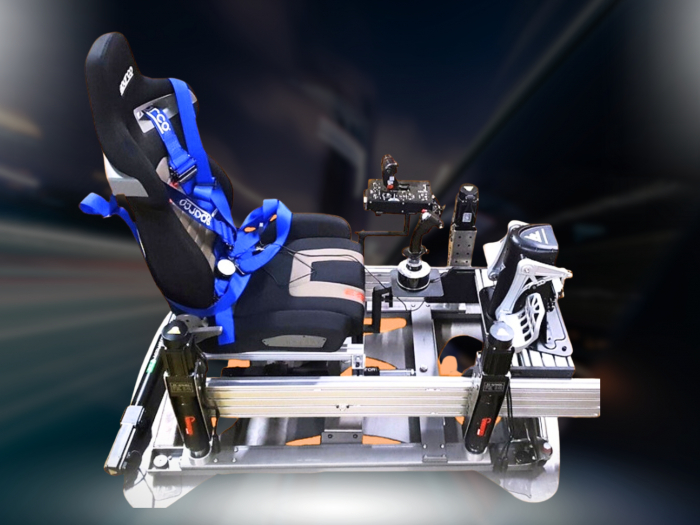

The electrical plan matters as much as the motion hardware. A proposed 6DOF simulator uses six 200 W DC motors, with an 1800 W server power supply proposed and the motors reported running at around 13 V DC. That gives you a useful starting point for understanding the power consumption of a 6DOF simulator, but it isn’t a universal mains-circuit requirement: demand depends on actuator loading and the power-supply arrangement.
It’s natural to focus on the platform’s peak demand when planning a room or dedicated circuit. In practice, the load can change with what the simulator is reproducing: ordinary flight operation may draw less, whilst a crash or spin can place greater demand on the system. Matching the electrical supply to the actual hardware helps you plan with confidence, without treating one motor rating as the whole answer.
This guide explains how motor ratings relate to total demand, what to consider when sizing the electrical supply, and why a dedicated circuit may be relevant. It also looks at peak draw and the practical details to resolve before setting up a 6DOF simulator, so you can move from a thrilling motion concept to a well-planned installation.
Key Takeaways
- Assess the platform’s electrical supply and the other loads on the circuit together; motor ratings alone don’t establish a dedicated-circuit requirement.
- A proposed electric setup uses six 200 W DC motors, an 1800 W server power supply and motors reported running at around 13 V DC.
- Peak demand can change with the motion being reproduced, so consider demanding scenarios as well as typical operation when planning the supply.
- Compare electric and hydraulic systems by the equipment each uses and how it operates, rather than assuming one universal power figure.
- Estimate running costs from actual energy use and your electricity tariff; the platform’s draw during use is the key input.
Dedicated circuit requirement
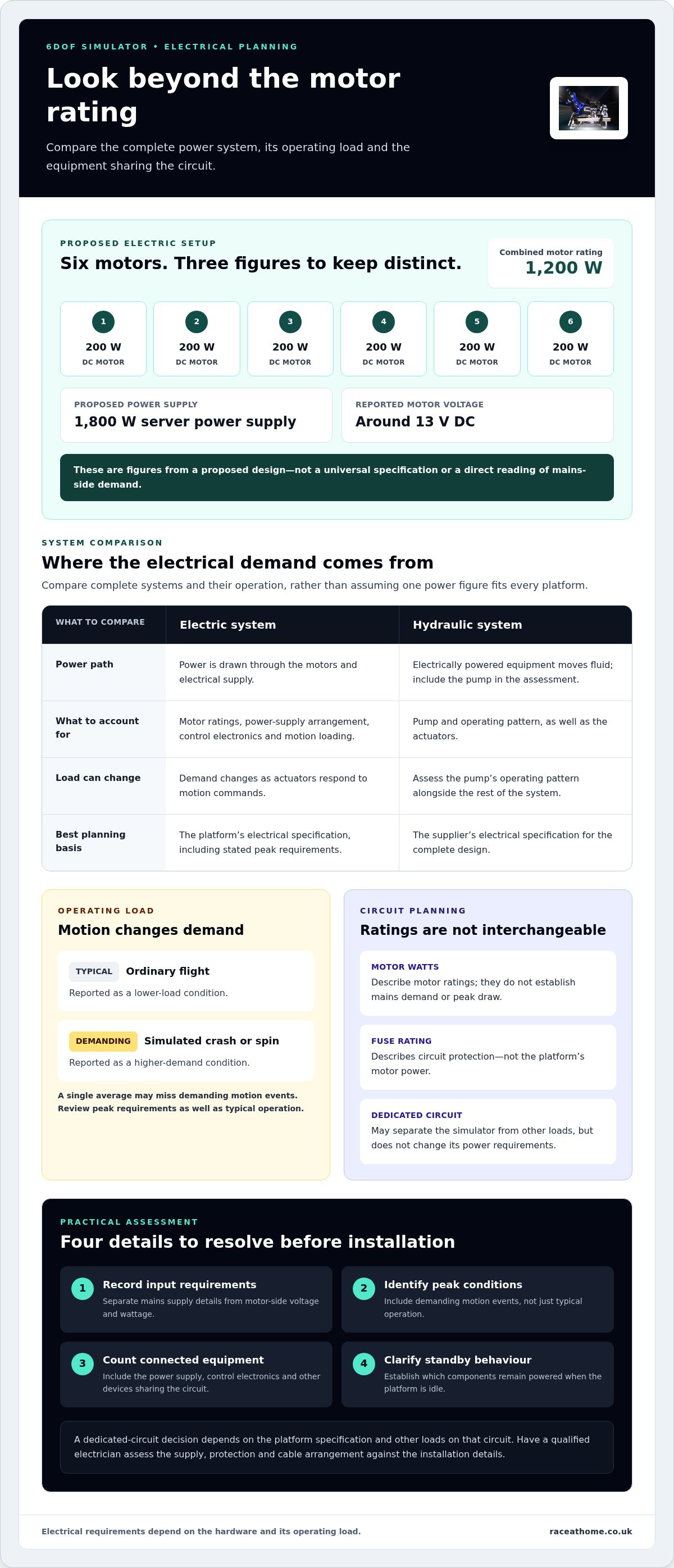
A six-axis platform doesn’t automatically require a dedicated circuit. The decision depends on its electrical specification and the other equipment sharing that circuit. In one proposed design, six DC motors rated at 200 W each give a combined motor rating of 1,200 W. That total helps frame the load, but it isn’t a complete measure of mains demand.
A German owner reported having a standard 16 A fuse before installing a 20-amp fuse for the platform’s extension cable. This is an individual setup, not a recommended circuit rating for your room. Fuse and circuit arrangements depend on the installation, supply and connected equipment. Copying a fuse change from another setup doesn’t establish that your own circuit is suitable.
Consider the entire electrical system, not just the motor figures. The power supply, control electronics and connected equipment all contribute to demand. Because consumption changes as actuators respond to motion, a motor rating alone doesn’t show the platform’s peak draw or the circuit’s total load.
- Read the platform specification. Identify its stated supply and circuit requirements before planning the room.
- List shared equipment. Include the simulator’s power supply and other devices on the proposed circuit.
- Keep ratings distinct. Motor watts describe motor ratings, whilst a fuse rating describes circuit protection.
- Plan the cable route. Include the extension cable and its intended connection in the installation assessment.
These steps help you assess whether a separate circuit is appropriate. A dedicated circuit keeps the simulator’s supply separate from other loads on that circuit, but it does not change the platform’s power requirements. The installation must suit both the equipment and the building’s electrical system, not an anecdotal fuse value.
How does 6DOF simulator power consumption compare with 3DOF and 4DOF simulators? More axes can mean more actuators, which can raise potential demand. However, the number of degrees of freedom alone doesn’t determine consumption: motor ratings, power-supply design and motion loading all affect the result.
For a practical assessment, gather the platform’s electrical specification and note what else uses the intended circuit. Then have a qualified electrician assess the supply, protection and cable arrangement against those details. This turns a motor rating into an installation plan, without treating a German 16 A or 20-amp example as a universal requirement.
Electrical supply requirements
Start with the platform’s electrical specification, then assess its supply, power conversion and operating load together. A motor’s rated wattage is useful information, but it does not describe the demand of every component.
Electric and hydraulic power use
Electric systems draw power through their motors and electrical supply. Hydraulic systems also use electrically powered equipment to move fluid, so account for the pump and its operating pattern as well as the actuators. Compare the complete system, not just its motion axes. For either design, the supplier’s electrical specification is the right basis for assessing the room’s supply.
Understanding peak power draw
Peak demand describes the highest load during operation, rather than a steady figure throughout a session. A reported platform owner described lower loads during typical flight, with higher demand during a simulated crash and spin. That contrast shows why a single average can miss demanding motion events. Review the platform’s stated peak requirements alongside its supply arrangement.
A proposed electric setup uses six DC motors rated at 200 W each, an 1800 W server power supply, and motors reported running at around 13 V DC. These figures describe particular components in a proposed design. They shouldn’t be treated as a universal specification or as a direct reading of mains-side demand. The power supply converts incoming electricity for the motors, and the platform’s load changes as motion commands change.
Factors affecting power consumption
The power consumption of a 6DOF simulator depends on its motor ratings, power-supply arrangement and the load created by each movement. The platform’s motion profile matters too: a demanding event can call for more from the system than ordinary movement. Standby electricity depends on which components remain energised, such as control electronics or a powered supply; it isn’t the same as active motion use.
Use these steps to make the specification useful for planning:
- Record the input requirements. Separate mains supply details from motor-side voltage and wattage.
- Identify peak conditions. Include demanding motion events, not just typical operation.
- Account for connected equipment. Include the power supply and control electronics in the system assessment.
- Clarify standby behaviour. Establish which components remain powered when the platform is idle.
For a motion-platform comparison, the LowSlider 6 DOF Twin-Traction-Loss Motion Platform is a relevant electric platform to consider alongside the electrical requirements above. Use its product specification to inform your setup planning, rather than extrapolating from a different design’s motor figures.
What is the peak power draw of a 6DOF motion platform?
A 6DOF platform has no single peak-power figure that applies to every design. Peak draw is the highest electrical demand during a particular movement, shaped by its actuators, power system and load. Motor ratings help describe capacity, but they don’t reveal the platform’s exact demand during every motion cue.
Actuator specifications such as speed and travel describe motion characteristics, not electrical consumption. Those figures describe actuator behaviour, not electrical consumption. A rapid, extensive movement may create different demands from a small correction, depending on the system’s design and how it controls motion.
Think of peak demand as a moment in a sequence, not a constant draw. When several actuators respond together, their combined demand can rise; a smaller adjustment may require less. Routine movement and a sudden crash or spin also place different loads on the system.
To identify the relevant peak for a particular setup, distinguish between these specifications:
- Motor rating: the stated capacity of each motor, not necessarily its draw throughout operation.
- Power-supply rating: the supply’s output capacity, which needs to serve the connected equipment.
- Operating demand: the electricity drawn during real movement, including more demanding motion cues.
- Mains input: the load drawn from the building supply, distinct from the motor-side figures.
These distinctions prevent a common calculation error: adding motor ratings and treating their total as the platform’s measured peak. That sum describes nominal motor capacity. It doesn’t account for the power supply, control electronics, or how the system distributes movement across its six axes.
For an installation, use the platform’s stated peak input requirement when planning electrical capacity. If you have operating measurements, compare them with the rating during representative movement, including the most demanding cues. Keep the measurement point clear: a mains-side reading and a motor-side reading describe different parts of the system.
Peak demand also differs from average consumption over a session. A brief, high-load event can determine the maximum draw without representing typical operation. For example, a crash cue may call for sharper movement than a steady segment. Peak demand helps assess capacity; average use better describes ongoing consumption.
Record the platform model, supply specification and measurement point together. This gives an electrician or system designer useful information for assessing the installation, without confusing actuator speed, travel or motor ratings with a direct measurement of peak mains demand.
How much power do electric versus hydraulic 6DOF simulators use?
There is no single power figure for every electric or hydraulic six-axis simulator. The drive system affects what draws electricity, but actuator ratings, motion demands and supporting equipment matter too. Compare the complete system’s electrical input rather than assuming its technology determines consumption.
An electric platform uses motors to produce motion directly. One proposed design uses six DC motors rated at 200 W each, with an 1800 W server power supply and motors reported running at around 13 V DC. These figures describe that particular arrangement, not a typical value for every electric simulator. The supply also powers connected control equipment, and motor ratings alone don’t establish measured mains consumption.
A hydraulic platform uses electrically powered equipment to operate its hydraulic system. Its electrical demand can include the motor driving the pump, controls and valves. The pump’s operating pattern matters: demand may differ between a continuously running pump and one activated in response to movement. The design and motion profile determine how these components work together.
That distinction makes a simple electric-versus-hydraulic calculation unreliable. Electric models can differ in motor count and demand, just as hydraulic designs vary in pump operation and control. The technology label tells you what to examine, not the final figure. Look for the stated input requirements and operating data for the specific platform.
- For electric designs: identify motor ratings, supply capacity and control-system input.
- For hydraulic designs: include the pump motor, control equipment and pump operating behaviour.
- For both: distinguish mains input from actuator-side voltage or power ratings.
- For comparison: use the same operating conditions and measurement point.
For example, comparing a hydraulic pump’s input with the 200 W rating of one electric motor would not compare equivalent loads. One figure concerns a system component; the other concerns a single motor. A fair assessment uses each complete platform’s electrical input during comparable motion, alongside its stated peak demand.
Use this sequence when comparing two designs. First, record each platform’s mains input specification. Next, identify which equipment that figure includes. Then compare typical and demanding motion, such as steady movement and a sudden crash cue. Finally, distinguish peak draw from average session use. This keeps the comparison grounded in real operating conditions.
Electric and hydraulic systems can both deliver six-axis motion, but consumption depends on their design. A six-motor example cannot predict a hydraulic platform’s draw, and a pump rating alone cannot describe the whole system. Compare documented input demand, supporting equipment and operating duty to assess each design’s electrical needs.
How much does it cost to run a 6DOF simulator per hour in the US?
There is no single hourly running cost for every US setup. Calculate it from the simulator’s energy use and your electricity tariff, measured in dollars per kilowatt-hour. The basic formula is: average power in kilowatts × operating hours × tariff per kilowatt-hour. For a one-hour session, multiply average kilowatts by your tariff.
Use actual energy consumption where possible. A motor’s rated wattage describes its rating, not necessarily its continuous draw during a session. Motion changes with the simulation, so power consumption can differ between ordinary movement and demanding cues. A peak rating alone cannot represent the energy used over a full hour.
For illustration, a proposed design has six motors rated at 200 W each. Their combined rated capacity is 1,200 W, or 1.2 kW. If all six drew that rated power continuously for one hour, they would use 1.2 kWh. This is a calculation from motor ratings, not a measured platform’s hourly consumption; the actual cost follows the measured use and local tariff.
To work out your own estimate, follow these steps:
- Find energy use. Use a suitable meter to record kilowatt-hours during a representative session.
- Choose a realistic session. Include the kind of motion you expect, rather than relying only on idle or peak conditions.
- Use your tariff. Take the electricity price per kilowatt-hour from your US bill or plan.
- Multiply the figures. For one hour, multiply session-average kilowatts by the tariff; for longer sessions, include the operating time.
For example, if a meter records an average of K kilowatts and your tariff is T dollars per kilowatt-hour, the energy cost for one hour is K × T dollars. Using your own readings for K and T avoids applying an unsuitable US-wide price. Tariffs vary by electricity plan and location, while consumption varies with platform design and motion.
Keep the measurement boundary consistent. If the meter records only the platform’s supply, it excludes a separate computer or display. If you want the full simulator-session cost, measure or account for those devices separately, then add their energy use. The 1800 W rating of a proposed server power supply is capacity, not proof that it draws 1800 W continuously.
Record session duration, measured kilowatt-hours and tariff together. That creates a repeatable estimate for your own setup, and lets you compare different motion profiles without mistaking rated capacity for actual consumption. For an electric motion platform to assess as part of your setup, explore motion platform options.
Race@Home: LowSlider 6 DOF Twin-Traction-Loss Motion Platform
Race@Home’s LowSlider 6 DOF Twin-Traction-Loss Motion Platform brings six-axis movement into a compact, ultra-low-profile design. If you’re weighing motion realism against room layout and electrical planning, its platform specifications give you a concrete starting point for assessing your setup. The LowSlider is hand-built to order and shipped worldwide in four pieces, designed for customer assembly in under an hour.
Review the platform’s electrical requirements alongside your available supply before organising the room. For a different motion configuration, Race@Home also offers the LowSlider 3DoF motion platform. Both options serve sim-racing setups, but the right fit depends on the movement experience you want and the space you have.
Explore the options at raceathome.co.uk.
Shape your setup around the experience you want
Choosing a motion platform is also a chance to decide how your whole sim-racing setup should feel. The power consumption of a 6DOF simulator is one part of that decision, alongside the movement experience, available space and equipment you plan to use. Start by defining what matters most in your sessions, then compare platform options against those priorities.
Race@Home offers the LowSlider 6 DOF Twin-Traction-Loss Motion Platform and the LowSlider 3DoF motion platform, as well as Pimax VR Headsets. These options provide a starting point for shaping an immersive setup around your preferred level of motion and visual experience. For electrical planning, use the chosen platform’s specifications as the basis for assessing your room’s supply.
If you’re ready to explore a motion platform for your setup, contact Race@Home about your setup. A considered choice brings the technical planning and the on-track sensation together, so you can build towards a more immersive sim-racing experience.
Frequently Asked Questions
How much power does a 6DOF simulator consume in kW?
The power consumption of a 6DOF simulator varies by design and motion profile. One proposed design’s six motors, each rated at 200 W, have a combined rating of 1.2 kW. That is the motors’ total rated capacity, not a guaranteed continuous draw from the mains. Kilowatts measure power at a moment; kilowatt-hours measure energy used over time.
What is the average electricity use of a 6DOF simulator during operation?
Average electricity use depends on the simulator’s operating load and how its motion changes during a session. To find your setup’s average, record its energy use over a representative session, then divide the kilowatt-hours by the session length in hours. This gives average power in kilowatts. Include any equipment you want counted, such as a computer or display, in the measurement.
What power supply, voltage, and amperage does a 6DOF simulator require?
Use the electrical specification for the particular platform; there isn’t one universal supply, voltage or amperage. A proposed design uses an 1800 W server power supply, and its builder reported running the motors at around 13 V DC. That motor-side voltage doesn’t state the mains voltage or current. Amperage depends on the electrical input and operating load, so use the platform’s input-current specification.
Can a 6DOF simulator run on a standard household electrical circuit?
Some can. Race@Home describes its motion platforms as drawing hundreds of watts and running from regular outlets. That information applies to its rigs, not every 6DOF simulator. Whether a household circuit can support a particular setup also depends on its electrical specification and what else shares the circuit. Account for connected equipment, rather than treating the platform’s power draw as the circuit’s only load.


