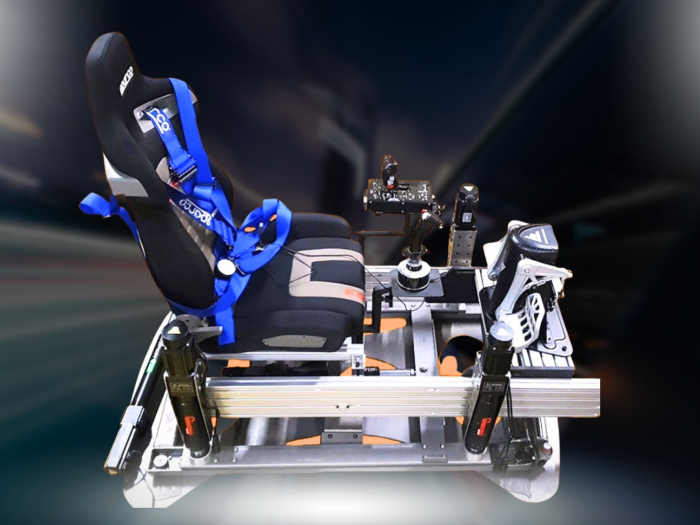

The boundary between a digital simulation and the raw, physical reality of the track isn't defined by how many monitors you own, but by how accurately your body feels the weight transfer of a late-braking manoeuvre. Most enthusiasts assume that professional-grade realism requires a sprawling, industrial-sized rig, yet the 3DOF motion platform sim racing experience has evolved to prove that precision beats bulk every time. You've probably felt the disconnect when your eyes see a hairpin turn but your inner ear feels nothing, or perhaps you've avoided motion systems because of the baffling technical setup and the floor space they consume.
It's time to bridge that gap. We'll show you how a 3DOF motion platform transforms sim racing into a visceral, high-performance activity that communicates every kerb and elevation change directly to your senses. This guide explores the 2026 landscape of immersive home rigs, focusing on bespoke, hand-built hardware like the LowSlider that delivers ultra-low latency within a standard room footprint. We'll walk through the essential technical requirements, the shift towards modularity, and how you can achieve professional-level immersion with a setup that's ready for the grid in under an hour.
Key Takeaways
- Master the physics of pitch, roll, and heave to understand how digital telemetry translates into visceral sensations of acceleration and braking.
- Discover why a low-profile design is critical for maintaining a realistic centre of gravity whilst ensuring your rig fits comfortably in a standard room.
- Compare the performance of industrial-grade actuators against mass-market motors to ensure your hardware delivers granular, high-fidelity feedback.
- Learn how modular engineering allows a professional 3DOF motion platform sim racing rig to be shipped in four pieces and fully assembled in under an hour.
- Identify the technical synergy between motion platforms and VR headsets like Pimax to achieve the ultimate level of professional driver immersion.
What is a 3DOF Motion Platform in Sim Racing?
A 3DOF motion platform sim racing setup functions as the physical translator for digital telemetry. It's the essential bridge between visual data and physical sensation. Whilst a standard static seat leaves your brain to guess the car's balance, a motion-enabled rig provides the visceral feedback required to find the absolute limit of grip. This type of motion simulator operates across three distinct axes: Pitch, Roll, and Heave. Each axis serves a specific engineering purpose in replicating the forces a professional driver experiences on a real-world circuit.
These movements aren't just for show; they are critical data points. When your brain receives consistent physical feedback that matches the visuals in your headset, your lap times become more consistent. You stop reacting to what happened and start feeling what is about to happen. This predictive driving style is only possible when the hardware can keep up with the high-speed data being pumped out by the simulation software.
Pitch, Roll, and Heave: The Core Sensations
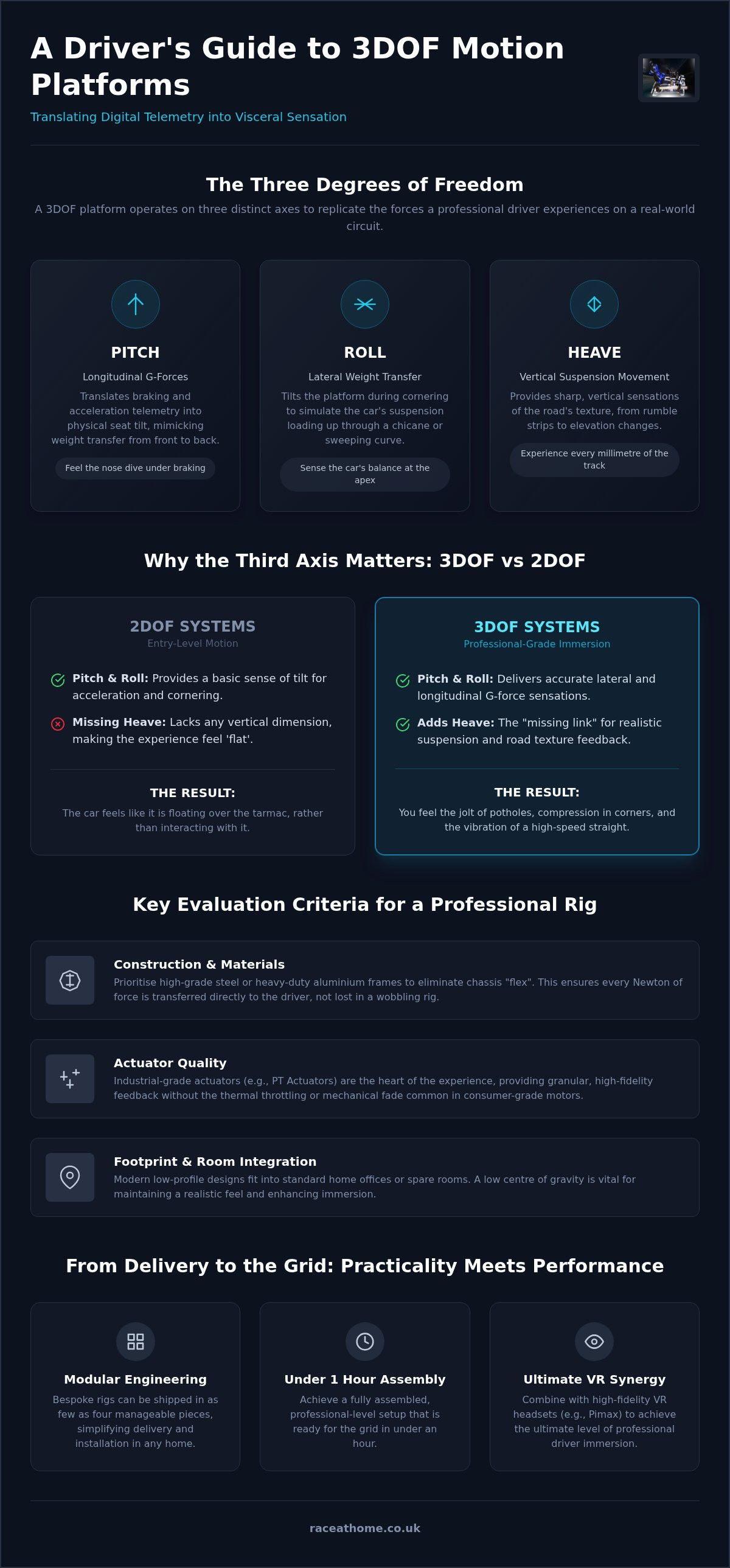
Pitch translates braking and acceleration telemetry into physical seat tilt, pitching the nose down as you slam on the anchors or leaning the cockpit back during a heavy launch from the grid. This movement mimics the longitudinal G-forces that tell your body exactly how much pressure to apply to the brake pedal before the wheels lock up. Roll helps a driver "feel" the apex during high-speed cornering by tilting the platform to simulate the lateral weight transfer as the car's suspension loads up. It's the primary way you sense the car's balance through a complex chicane or a long, sweeping curve. Heave provides the sharp, vertical sensation of hitting a rumble strip at Silverstone or Spa, ensuring you feel every millimetre of the road's texture through your spine as the actuators respond to the track's surface.
3DOF vs 2DOF: Why the Third Axis Matters
Many entry-level systems only offer two degrees of freedom, focusing purely on Pitch and Roll. Whilst this provides a basic sense of tilt, it often feels "flat" because it lacks any vertical dimension. 3DOF introduces the Heave axis, which is the "missing link" for realistic suspension feedback. Without Heave, the car feels like it's floating over the tarmac rather than interacting with it. Heave allows the actuators to replicate the sharp jolt of a pothole, the compression at the bottom of Eau Rouge, or the rhythmic vibration of a high-speed straight. If you're ready to explore the absolute summit of physical feedback, read the ultimate guide to 6 DOF motion simulators for professional realism. However, for most home setups, 3DOF provides the most efficient path to professional-grade immersion without requiring a massive industrial footprint.
Choosing the Right 3DOF Platform: Key Evaluation Criteria
Selecting the right 3DOF motion platform sim racing hardware requires a shift in mindset from "gaming peripheral" to "precision engineering". Whilst many mass-market options rely on plastic components and belt-driven motors, a professional-grade rig prioritises high-fidelity feedback and structural rigidity. The materials used in construction dictate the lifespan and accuracy of the experience. A bespoke frame built from high-grade steel or heavy-duty aluminium profile will eliminate the "flex" that often plagues consumer-level rigs, ensuring every Newton of force from the actuators is transferred directly to the driver rather than being lost in a wobbling chassis.
Actuator quality is the heart of this investment. Industrial-grade PT Actuators offer a level of granular detail that consumer motors simply cannot replicate. These components are designed for high-cycle environments, providing consistent performance without the thermal throttling or mechanical fade common in cheaper alternatives. When you invest in a bespoke motion solution, you're buying the ability to distinguish between a slight loss of traction and a full-blown slide.
Footprint and Room Integration
One of the most significant hurdles for UK enthusiasts is the physical space required for a motion rig. Many industrial simulators are gargantuan, requiring dedicated garages or commercial units. However, modern engineering has enabled a compact footprint that fits comfortably into a standard spare room or home office. A low-profile design is vital here. By keeping the seat as close to the floor as possible, you lower the centre of gravity, which significantly increases stability during violent manoeuvres. A compact rig doesn't have to compromise on the range of motion; it simply requires smarter geometry to deliver the same Pitch and Roll angles within a smaller spatial envelope.
The Importance of Ultra-Low Latency
Immersion is fragile. If the physical movement lags even slightly behind the visual cue, the result is an immediate "inner ear" conflict that leads to motion sickness and a total loss of realism. High-end actuators ensure that the physical move happens whilst the visual data is being rendered. This synchronisation, often referred to as Visuo-haptic Feedback, is what allows your brain to accept the simulation as reality. Bespoke engineering allows for much tighter telemetry integration than mass-market options, utilising high-speed controllers that process game data with near-zero delay. This responsiveness is the difference between a rig that feels like a fairground ride and one that feels like a professional racing machine.
The Engineering of Realism: Actuators and VR Integration
Realism in a 3DOF motion platform sim racing rig isn't achieved through movement alone; it's the result of a sophisticated multi-sensory loop. Your brain is a master at detecting inconsistencies. If the visual data from your screen doesn't perfectly align with the physical forces acting on your body, the illusion of speed collapses. Achieving a "no-compromise" simulation requires hardware that speaks the same language as the software. This is where the synergy between industrial-grade actuators and high-fidelity VR headsets becomes the defining factor of a professional home rig.
PT Actuators: The Gold Standard of Motion
The backbone of any high-performance 3DOF system is the actuator technology. PT Actuators are widely regarded as the gold standard because they provide granular, high-fidelity feedback that consumer-level motors cannot match. There is a fundamental difference between "vibration" and "true motion". Many entry-level rigs use transducers to create a buzzing sensation, but true motion requires linear actuators capable of moving the entire mass of the driver and chassis with millimetre precision. These actuators translate digital telemetry into immediate physical displacement, allowing you to feel the car's suspension compress as you crest a rise. For those looking to fine-tune this interaction, our Pimax VR motion simulator set-up guide offers deep insights into synchronising these physical forces with a virtual environment.
Maximising Immersion with Pimax VR
Whilst triple-monitor setups are common, they still present a "window" effect that reminds you you're in a room. VR headsets, specifically those from Pimax, eliminate this barrier by providing a wide Field of View (FOV) that mimics human peripheral vision. This is essential for the sensation of speed; you don't just see the track ahead, you feel the world rushing past your windows. When paired with a 3DOF platform, the "presence" felt in the cockpit is transformative. You aren't just looking at a car seat; you're sitting in one.
To ensure this immersion remains stable, motion compensation software is vital. Without it, the VR camera would bounce around inside the virtual car as the rig moves, leading to instant nausea. Proper compensation ensures your view stays fixed relative to the car's interior, even whilst the platform is pitching and rolling violently. Aligning your physical seat position with the virtual cockpit is the final step in this engineering puzzle. When your hand reaches out to where the gear shifter appears in VR and feels the cold metal of the physical shifter, the boundary between digital and reality finally disappears.
Practical Setup: From Delivery to the Race Track
Transitioning from the abstract thrill of the track to the physical reality of your spare room requires a focus on logistics. Whilst the engineering of a 3DOF motion platform sim racing rig is complex, the ownership experience shouldn't be. A common barrier for many enthusiasts is the fear of a permanent, noisy, and sprawling construction project. Modern bespoke rigs address this by prioritising room integration and noise management, ensuring your high-performance hobby doesn't clash with household life. Modern actuators are remarkably quiet, producing a subtle mechanical hum that won't disturb the rest of the house whilst you're chasing lap records.
Software configuration has also become significantly more streamlined. Leading platforms now offer deep integration with your favourite racing titles, allowing you to map telemetry data with a few clicks. This ensures that the physical feedback you feel is perfectly tuned to the specific car and track combination you've selected. If you're ready to start your journey, you can explore our bespoke 3DOF solutions to see how they integrate into your home environment.
The One-Hour Assembly Promise
The "Four-Piece" shipping philosophy has revolutionised how motion simulators are delivered. Instead of receiving a mountain of loose bolts and confusing diagrams, the rig arrives in four main pre-assembled components. Connecting these sections is a straightforward process of securing the frame and plugging in the pre-configured electronic centres. This "plug and play" approach means that building a professional motion rig in 2026 is now accessible to non-engineers. You don't need a workshop full of tools; you just need an hour and a bit of floor space.
Global Shipping and Support
Bespoke rigs are hand-built to order in the UK, but they are engineered for a global audience. Each platform is carefully crated and protected to withstand international transit, ensuring it arrives in pristine condition regardless of your location. Beyond the delivery, the value of UK-based support cannot be overstated. Having access to the experts who actually built your hardware provides peace of mind that mass-produced alternatives can't match. This support also extends to ensuring your new rig is fully compatible with your existing sim racing accessories, from high-end direct drive wheels to professional-grade pedal sets. This compatibility ensures that your 3DOF platform acts as the foundation for a truly unified racing ecosystem.
The LowSlider 3DoF: Bespoke British Craftsmanship
The LowSlider 3DoF represents a departure from generic, mass-produced rigs that prioritise high-volume sales over technical precision. Whilst those platforms often rely on standardised components and retail-friendly packaging, our approach is rooted in the traditions of British engineering. Every unit is hand-built to order in the UK, ensuring that the structural integrity and mechanical tolerances meet the demands of professional drivers. This isn't a toy; it's a dedicated training tool designed for those who recognise that a 3DOF motion platform sim racing setup is only as good as the frame it sits upon.
Mass-market alternatives often suffer from "chassis flex", where the energy from the actuators is absorbed by a wobbling frame rather than being transmitted to your body. By utilising high-grade materials and proprietary construction techniques, the LowSlider ensures that every granular detail from the track surface is delivered with absolute clarity. This rigidity is what allows a driver to develop the consistent muscle memory required for competitive racing. It's the difference between feeling a vague vibration and sensing exactly when your rear tyres begin to lose grip on a damp exit.
The LowSlider Advantage
The defining characteristic of the LowSlider design is its ultra-low profile footprint. Most motion systems raise the driver significantly off the ground, which can create a pendulum effect that feels unnatural and disconnected. Our engineering team prioritised a low centre of gravity, keeping the seat as close to the floor as possible whilst maintaining a full range of motion. This design choice minimises unwanted lateral sway and maximises the fidelity of the Pitch and Roll sensations. It makes the LowSlider the preferred choice for compact home setups where stability and realism are paramount.
Investing in Your Racing Future
Upgrading from a static rig to a motion-enabled platform is a significant milestone in any sim racer's journey. It's an investment in your ability to read the car and react to the limit of adhesion in real-time. Many hobbyists find that a sim racing motion rig is worth it because it accelerates the learning curve, providing the physical cues that visual-only setups simply cannot replicate. Whether you are a professional driver looking for a home-based training rig or a serious hobbyist seeking the ultimate upgrade, the LowSlider 3DoF provides a logical, high-performance path forward.
The 2026 racing season demands more than just fast hardware; it requires a rig that can translate digital data into professional-level performance. You can customise your bespoke rig and explore our full range of professional hardware at the Race@Home shop to begin your transition from gamer to driver.
Dominate the Track with Professional-Grade Precision
The transition from a static rig to a 3DOF motion platform sim racing setup is the single most significant leap you can make in your driving career. By integrating the physical sensations of pitch, roll, and heave, you move beyond mere gaming and into the realm of professional driver training. We've explored how the synergy of industrial PT Actuators and wide-FOV VR headsets creates a level of immersion that mass-market alternatives simply cannot replicate. Precision engineering ensures that every kerb and weight transfer is felt with absolute clarity, whilst a low-profile design keeps your centre of gravity realistic and stable.
Your journey to the podium doesn't require a commercial-sized warehouse or a degree in mechanical engineering. Our rigs are hand-built in the UK and designed for the modern home, shipping worldwide in four manageable pieces that you can assemble in under an hour. It's time to stop watching the race and start feeling it. Customise your hand-built LowSlider 3DoF platform today and experience the ultimate evolution of home-based simulation. We look forward to seeing you at the apex.
Frequently Asked Questions
What is the difference between 3DOF and 6 DOF sim racing platforms?
3DOF systems simulate pitch, roll, and heave, which are the primary forces needed for a realistic driving sensation. In contrast, 6 DOF platforms add surge, sway, and yaw to provide a full range of movement. Whilst 6 DOF is the ultimate for realism, a 3DOF motion platform sim racing rig offers a more compact and cost-effective entry point. It provides the essential feedback required for professional-level training without the industrial-sized footprint.
Does a 3DOF motion platform include traction loss?
A standard 3DOF platform prioritises pitch, roll, and heave rather than dedicated traction loss. If you require specific yaw movement to simulate the rear end stepping out, you would typically look at a 6 DOF system like the LowSlider Twin-Traction-Loss model. However, the high-fidelity actuators in a 3DOF rig communicate lateral weight transfer so precisely that many drivers find they can still accurately sense the limit of adhesion during cornering.
How much space do I need for a 3DOF motion rig at home?
The LowSlider 3DoF is specifically designed to integrate into a standard UK home office or spare bedroom. You'll need a floor area of approximately 1.5 metres by 2 metres to allow for a safe range of movement. Because of its proprietary ultra-low profile design, the rig maintains a low centre of gravity. This makes it far easier to manage in domestic environments than traditional, bulky motion simulators that require significant vertical clearance.
Can I use a 3DOF motion platform with a VR headset?
VR integration is one of the most effective ways to enhance a motion rig. Headsets like the Pimax VR range eliminate the "window" effect of monitors, placing you directly inside the car. When using a motion platform with VR, it's essential to use motion compensation software. This ensures your eyes see a stable cockpit whilst your body feels the physical forces, preventing motion sickness and creating a seamless "visuo-haptic" experience.
Is the 3DOF LowSlider compatible with my existing wheel and pedals?
Broad compatibility is a core feature of our bespoke engineering. The LowSlider 3DoF is fully compatible with most high-end sim racing accessories, including direct drive wheel bases and professional pedal sets. Its rigid steel and aluminium construction is designed to handle the high torque and pressure of enthusiast-grade hardware. This allows you to integrate your existing peripherals into a full-motion ecosystem without needing to purchase entirely new controls or mounting brackets.
How noisy is a 3DOF motion simulator during a race?
Modern industrial-grade actuators are surprisingly quiet compared to older, belt-driven systems. Whilst there is a faint mechanical sound during rapid transitions, it's usually masked by the audio from your speakers or headset. The noise level is comparable to a high-end PC under load. This means you can enjoy a 3DOF motion platform sim racing experience at any time of day without causing a significant disturbance to other people in your home.
Do I need special flooring to install a motion platform?
You don't need a reinforced floor, but the surface must be level and sturdy. A standard concrete or wooden floor is perfectly adequate for the weight of the rig and driver. We suggest placing a high-density equipment mat beneath the frame. This protects your flooring from scratches and helps to isolate any mechanical vibrations, ensuring that the only thing moving is the platform itself during high-intensity racing sessions.
How long does it take to set up a Race@Home 3DoF platform?
Our "Four-Piece" shipping philosophy ensures that setup is a straightforward task. The rig arrives in four major pre-assembled components, which reduces the mechanical assembly time to less than an hour. The electronics are pre-configured at our UK workshop, so you don't need to be an engineer to get started. Once the sections are bolted together and the cables are connected, you'll be ready to calibrate your software and hit the track.


