
What if the technology designed to immerse you in the cockpit is actually the very thing holding your performance back? You've likely felt that familiar, unsettling disconnect whilst tearing through a corner in virtual reality, where your eyes see a high-speed apex but your inner ear feels absolutely nothing. This sensory mismatch is more than just a distraction; it's the primary cause of sim sickness. However, when you experience sim racing VR and motion combined using a precision 6 DOF platform, that barrier vanishes. By aligning digital telemetry with physical feedback, you aren't just playing a game; you're inhabiting a machine.
We understand that achieving this level of realism often feels like a battle against complex software and bulky, industrial hardware. It's a common frustration for enthusiasts who want a professional-grade setup without sacrificing an entire room. This guide will show you how to eliminate motion sickness and achieve a no-compromise racing experience using compact, hand-built UK engineering and cutting-edge Pimax optics. We'll break down the technical synergy required to synchronise your motion platform with VR, ensuring every kerb, gear shift, and weight transfer feels exactly as it should in 2026.
Key Takeaways
- Understand how sensory alignment transforms a simulation from a visual game into a visceral, high-performance driving experience.
- Learn why sim racing VR and motion combined is the definitive solution to sim sickness by synchronising your visual inputs with your vestibular system.
- Identify the hardware requirements for total immersion, including why wide field-of-view headsets like Pimax are essential for professional motion rigs.
- Master the science of motion compensation to ensure your software telemetry translates into precise physical feedback without latency.
- Discover how to integrate a professional 6 DOF motion platform into a home environment using compact, hand-built UK engineering.
Why Sim Racing VR and Motion Combined is the Final Frontier of Realism
True realism isn't just about what you see; it's about what your body believes to be true. Whilst a high-resolution headset provides the visual canvas, the physical feedback provides the soul of the experience. When you experience sim racing VR and motion combined, you transcend the boundaries of traditional gaming. You stop playing a software title and begin operating a vehicle. This synergy is the "final frontier" because it solves the ultimate limitation of home simulation: the lack of physical consequence. In a static setup, your brain is constantly working to fill in the gaps where sensation should be. In a motion-integrated rig, those gaps are filled with precision telemetry that validates every visual input.
Static VR setups often suffer from a "floaty" sensation. You might be hurtling down the Mulsanne Straight at 200mph, but your body tells you that you're sitting perfectly still. This disconnect shatters the illusion of reality. By integrating a full motion racing simulator with six degrees of freedom (6 DOF), you replicate the complex chassis behaviour of a real race car. From the subtle vibration of an idling engine to the violent heave of a high-speed compression, every digital data point is translated into a tangible, physical event.
The Sensory Disconnect in Static Sim Rigs
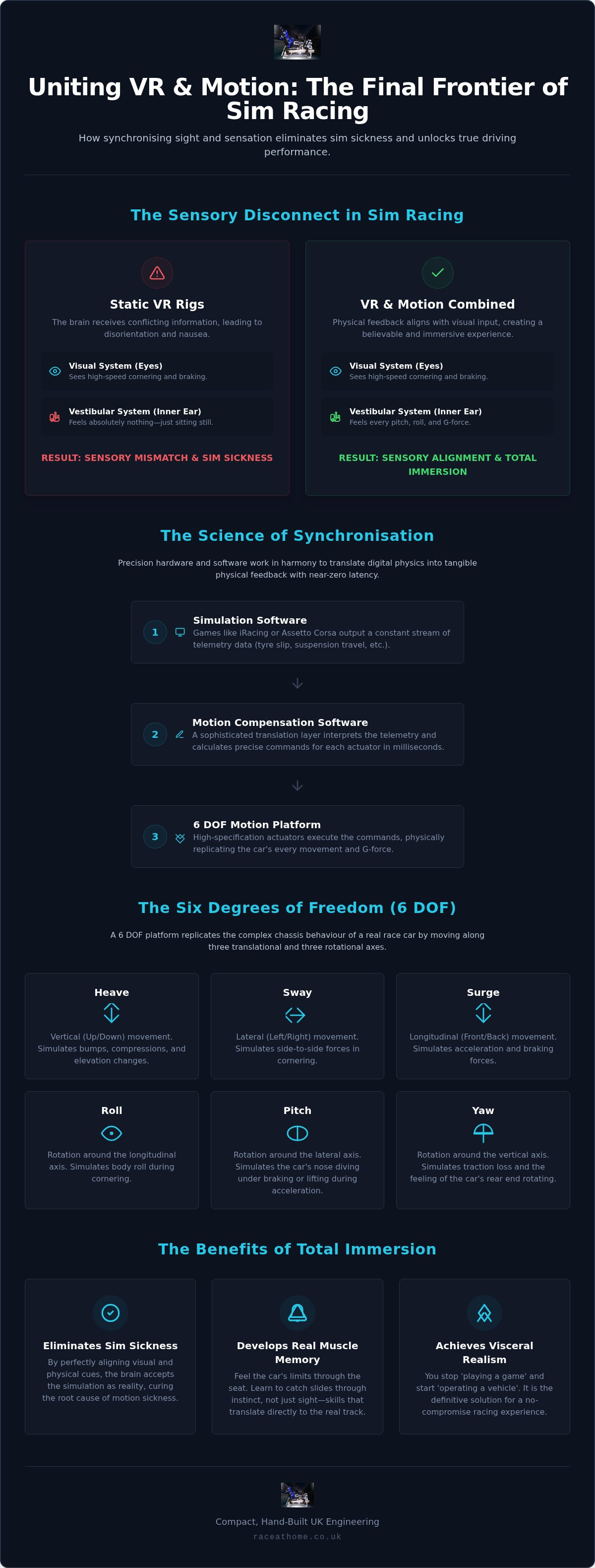
The primary hurdle for many enthusiasts is the visual-vestibular conflict. Your eyes perceive rapid acceleration or heavy braking, yet your inner ear, the vestibular system, detects no change in equilibrium. This mismatch is the root cause of sim sickness. It's not a failure of the VR technology itself, but rather a lack of physical context. Even a high end sim racing rig without motion cannot fully bridge this gap. Without the physical cues of weight transfer, your brain struggles to process the depth and speed presented in the headset, often resulting in nausea and a forced end to your session.
Moving Beyond Visual Immersion
Professional drivers don't just look for apexes; they feel them through the seat of their pants. This "G-seat" sensation is critical for limit-handling and consistent lap times. When the rear end of a GT3 car begins to rotate, a driver feels that slip in their hips long before their eyes register the slide. A sim racing VR and motion combined setup provides these essential cues through pitch, roll, and traction loss. Contrary to the myth that professionals avoid VR, many are now adopting these integrated systems for home training. The combination allows them to build genuine muscle memory that translates directly to the track. The physical feedback validates the visual data, allowing for more intuitive and aggressive driving.
The Science of Synchronisation: How Motion Compensation Works
To achieve a truly immersive drive, your hardware must act as a seamless extension of the simulation's physics engine. When considering sim racing VR and motion combined, the technical challenge lies in synchronisation. It isn't enough for the rig to move; it must move with sub-millimetre precision at the exact moment the digital tyres interact with the tarmac. This is why the LowSlider 6 DOF utilises high-specification PT Actuators. These industrial-grade components translate raw telemetry into physical force in milliseconds, ensuring that what you see in your headset is exactly what your body experiences in the seat.
Software Telemetry and Physical Feedback
Modern simulators like iRacing and Assetto Corsa Competizione output a constant stream of physics data, detailing everything from suspension travel to tyre slip. A sophisticated translation layer takes this telemetry and calculates the necessary extension or retraction for each actuator. For those chasing the ultimate edge, "Twin Traction Loss" is a game-changer. It allows the rig to pivot, mimicking the sensation of the rear tyres breaking traction. This physical cue is vital. It allows you to catch a slide through instinct rather than waiting for a visual confirmation that often comes too late.
Whilst large-scale movements handle the weight transfer, high-frequency transducers add the "texture" of the road. These vibrations simulate engine rumble, gear shifts, and the harsh clatter of driving over serrated kerbs. Without this granular feedback, even the most expensive motion rig can feel sterile. By layering these micro-vibrations over the primary 6 DOF movements, the simulation gains a level of grit and realism that makes the cockpit feel alive.
The Role of Low-Latency Actuators
In the world of virtual reality, latency is the ultimate immersion killer. Research into Reducing Cybersickness suggests that even minor delays between visual movement and physical sensation can trigger nausea. The industry-standard threshold for maintaining presence is approximately 20ms. If your motion platform lags behind your headset's refresh rate, the "Brain-Body Loop" breaks. Race@Home minimises this signal delay through hardware-level optimisations, ensuring the physical response is instantaneous. Motion Compensation is the software process that cancels out the rigs movement within the VR space. This ensures your "virtual eyes" stay fixed relative to the cockpit, even as the platform beneath you tilts and pitches violently.
Achieving this level of technical harmony requires more than just off-the-shelf parts; it demands an engineered ecosystem where software and hardware speak the same language. If you are ready to move beyond basic vibration and into the world of professional-grade feedback, exploring professional motion platforms is the logical next step in your sim racing journey.
Solving the Sim Sickness Puzzle with Full Motion
A common misconception amongst newcomers is that adding physical movement to a virtual environment will inevitably lead to nausea. In reality, the opposite is true. When you experience sim racing VR and motion combined, the motion platform acts as the missing piece of a biological puzzle. Sim sickness occurs because of a fundamental conflict between your visual system and your vestibular system. By providing the physical cues your brain expects, you resolve this conflict and allow for significantly longer, more comfortable driving sessions. You aren't just moving; you're aligning your senses.
The human brain is hard-wired to detect mismatches in sensory data. If your eyes see a car pitching forward under heavy braking but your inner ear detects zero change in equilibrium, your brain interprets this as a hallucination often triggered by toxins. This biological "fail-safe" is the root of sim sickness. Advanced research on vection and motion sickness in VR highlights how providing even subtle physical cues can mitigate this effect. By tilting the rig forward during deceleration, a motion platform simulates the forward "surge" of G-forces, convincing your brain that the visual data is accurate. Feeling the mechanical "hit" of a gear shift provides the physical punctuation that your nervous system craves.
Why 6 DOF is Superior for VR Comfort
Whilst basic 3DoF systems provide pitch and roll, they often lack the nuance required for total VR stability. A 6 DOF system introduces heave, surge, and sway, which are essential for satisfying the inner ear's complex requirements. Specifically, the inclusion of Twin Traction Loss is vital for comfort. It prevents the disorienting "spinning" sensation that occurs when a car slides, as your body physically feels the rear-end rotation. This physical feedback grounds you within the cockpit, preventing the "floaty" feeling that often triggers nausea.
To maintain this level of immersion, a rigid, flex-free chassis is non-negotiable. Any independent movement between your VR sensors and the motion platform can cause visual jitter, which quickly shatters the illusion of presence. Acclimatising to a high-end rig is a personal journey. We recommend starting with shorter sessions and gradually increasing the motion intensity as your "VR legs" develop. Don't try to power through discomfort; instead, let your brain slowly learn to trust the synchronised feedback. Once that trust is established, the result is a no-compromise experience where you can focus entirely on your lap times rather than your equilibrium.
Essential Hardware for a Combined VR and Motion Rig
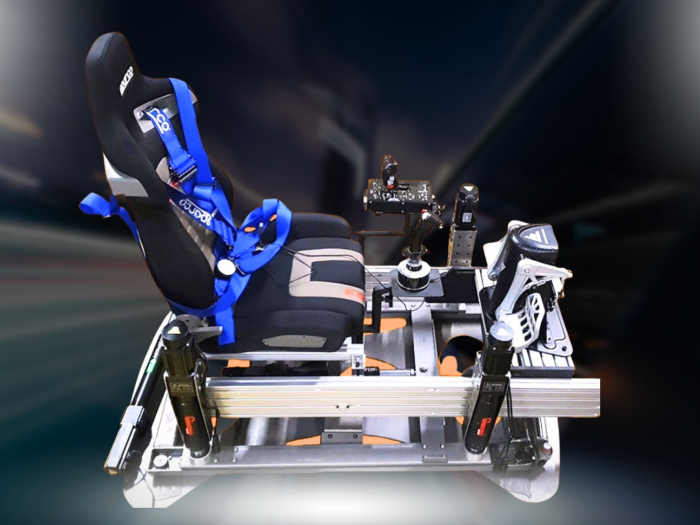
Building a world-class simulator requires a delicate balance between visual fidelity and physical response. When you pursue sim racing VR and motion combined, you're essentially creating a "Holy Trinity" of hardware: a high-refresh VR headset, a 6 DOF motion platform, and a powerhouse PC. If any one of these components underperforms, the entire experience suffers. The LowSlider footprint is a game-changer for UK enthusiasts in this regard. Traditionally, 6 DOF rigs required dedicated garages or industrial spaces. Our hand-built UK engineering ensures professional performance within a compact footprint that fits comfortably into a standard home office or spare room.
Cable management is a critical consideration for a rig that moves in every direction. A 6 DOF platform doesn't just vibrate; it pitches, rolls, and heaves with significant travel. You must utilise high-flex cabling and strategic routing to prevent snags or tension during high-intensity sessions. Any resistance from a cable can damage your actuators or, worse, pull the headset from your face whilst you're hitting an apex at 150mph.
PC Specifications for 2026 Sim Racing
By 2026, the demand on your PC has reached new heights. To drive 8K+ VR resolutions at 120Hz or higher, a top-tier GPU is mandatory. However, enthusiasts often overlook the CPU's role in motion telemetry. Motion software requires high single-core clock speeds to process complex physics data without introducing micro-stutters. Even a tiny delay in the data stream can lead to a perceptible lag between the visual and physical worlds. For a deeper dive into minimising these delays, refer to our VR Motion Simulator Lag guide.
Choosing the Right VR Headset
Pimax headsets have become the gold standard for motion rigs due to their industry-leading Field of View (FOV). A wide FOV is essential because it engages your peripheral vision, which is far more sensitive to movement and speed than your central vision. The Pimax Crystal offers unmatched clarity for reading dashboard telemetry, whilst the 12K model provides a panoramic view that replicates the interior of a real racing helmet. When choosing your headset, prioritise a secure, rigid head-strap. The high G-forces generated by a 6 DOF platform can cause a loose headset to shift, which shatters your immersion and ruins your calibration. Explore our Best VR Headset for Sim Racing 2026 roundup to find the perfect match for your rig.
Ready to experience the pinnacle of immersion? Explore our range of professional sim racing hardware to begin your journey toward a no-compromise home setup.
Building Your Professional Setup with Race@Home
The transition from a standard enthusiast setup to a professional-grade simulator requires more than just a collection of high-end parts; it demands a cohesive, engineered system. At Race@Home, we specialise in bridging the gap between digital telemetry and physical sensation. Our philosophy centres on providing a "no-compromise" experience that fits within the realities of a modern home. Whilst many 6 DOF systems are bulky and industrial, the LowSlider range is designed with a compact footprint that brings world-class motion to your private office or dedicated gaming room without requiring a warehouse-sized space.
Choosing a hand-built UK platform over mass-produced aluminium extrusions offers a distinct advantage in rigidity. High-performance motion generates significant lateral and vertical forces that can cause lesser rigs to flex, which ultimately dulls the feedback and ruins the immersion. Our rigs are engineered to handle the violent transitions of a GT3 car or the high-frequency vibrations of a formula chassis with absolute precision. This structural integrity is what allows sim racing VR and motion combined to feel truly authentic, as every millimetre of actuator travel is transferred directly to the driver rather than being lost in a flexible frame.
The LowSlider Advantage
The LowSlider 6 DOF Twin-Traction-Loss platform features an ultra-low profile design that keeps your centre of gravity as close to the floor as possible. This engineering choice is critical for motion fidelity. By reducing the distance between the pivot points and the driver, we minimise the "pendulum effect" found in taller rigs, resulting in snappier, more accurate weight transfer. The specific inclusion of Twin-Traction-Loss ensures you feel both the front-end scrub and the rear-end slide. This granular level of detail is exactly what is needed to master limit-handling whilst wearing a VR headset, providing the physical cues that allow you to react instinctively to the car's behaviour.
Bespoke Engineering and Support
We understand that the complexity of a full-motion rig can be daunting, which is why we've streamlined the logistics of global ownership. Our rigs ship worldwide in four easy-to-assemble pieces, backed by a "One-Hour Assembly" promise that ensures you spend your time on the track rather than in the workshop. Beyond the platform itself, we provide a curated ecosystem of Pimax VR headsets and essential sim racing accessories to complete your cockpit. Our consultative approach means we don't just sell you a product; we help you architect a dream simulator tailored to your specific performance goals. If you are ready to experience the definitive 2026 evolution of sim racing VR and motion combined, you can Explore the LowSlider range today and take the first step toward total immersion.
Claim Your Place on the Professional Grid
Elevating your simulator to a professional standard is no longer a matter of choosing between visual immersion and physical feedback. The synergy of sim racing VR and motion combined is the definitive solution to simulation sickness and the key to unlocking genuine muscle memory. By aligning your vestibular system with high-fidelity optics, you move beyond the limitations of a static cockpit and into the seat of a high-performance machine. This isn't just about faster lap times; it's about the visceral thrill of feeling every weight transfer and tyre slip as if you were on the tarmac.
This pursuit of visceral, tech-enhanced experience is also driving innovation in the arts, where movements like the AI art studio Antigua Guatemala are redefining the boundary between human instinct and artificial intelligence.
Achieving this level of realism requires precision engineering that doesn't overwhelm your home environment. Our LowSlider platforms are hand-built in the UK and trusted by professional drivers who demand accuracy for their home training. With worldwide shipping and a straightforward four-piece assembly, the transition to a world-class rig is simpler than ever before. It's time to stop compromising on your immersion and start feeling the race. Experience the ultimate in realism; order your LowSlider 6 DOF Motion Platform. We can't wait to help you build a setup that finally feels as fast as it looks.
Frequently Asked Questions
Does sim racing VR and motion combined cause motion sickness?
Adding a motion platform is often the most effective way to eliminate sim sickness. Whilst many assume movement causes nausea, the true culprit is the sensory mismatch between your eyes and your inner ear. When you experience sim racing VR and motion combined, that disconnect vanishes. If your eyes see the car dive under braking and your body feels the physical surge, your brain accepts the simulation as reality.
What is VR motion compensation and why do I need it?
Motion compensation is a software layer that subtracts the physical movement of your rig from your virtual head position. Without it, as your platform tilts back under acceleration, your virtual eyes would move through the roof of the car. This technology ensures you remain perfectly seated within the digital cockpit. It is an essential component for maintaining presence and preventing the disorienting visual jitter that occurs during high-G manoeuvres.
Can I add motion to an existing VR sim racing rig?
You can integrate a motion platform into an existing rig provided the chassis is sufficiently rigid to handle the forces involved. Most high-end aluminium profile rigs are compatible with our actuators. However, you must ensure that all components, including pedals and wheelbase, are securely bolted down. Any flex in the chassis will absorb the motion telemetry, which dulls the feedback and reduces the overall fidelity of the experience.
What are the minimum PC specs for a VR motion simulator in 2026?
Driving a high-resolution VR environment alongside motion telemetry requires a powerhouse PC with a top-tier GPU and a high-clock-speed CPU. By 2026, you should aim for a GPU capable of sustained 8K output at 120Hz to match the refresh rates of modern Pimax headsets. High single-core CPU performance is equally vital. If your processor cannot calculate physics data and VR frames simultaneously, you will experience latency that breaks immersion.
How much space do I need for a 6 DOF motion platform?
The LowSlider 6 DOF platform is engineered for a compact footprint, requiring very little more space than a standard static rig. Our ultra-low profile design ensures that the entire system remains stable without the need for large, industrial outriggers. If you have enough room for a traditional sim racing seat and a triple-monitor stand, you likely have enough space to house a full-motion sim racing VR and motion combined setup.
Which VR headset is best for a full-motion simulator?
Pimax headsets are the preferred choice for motion rigs due to their expansive field of view and secure mounting options. Models like the Crystal or the 12K engage your peripheral vision, which is critical for sensing speed and movement. It is also important to use a headset with a rigid head-strap. If the headset moves independently of your face during violent weight transfers, it can cause blurriness and break the illusion.
Is it difficult to set up a combined VR and motion system?
Setting up a professional system is straightforward when you utilise a curated ecosystem like those provided by Race@Home. Our rigs ship in four easy-to-assemble pieces, allowing for a setup time of approximately one hour. We handle the complexity of software synchronisation and hardware compatibility, so you don't have to be a mechanical engineer to get started. We provide a guided path from unboxing to your first competitive lap.
Does motion feedback actually make you faster in sim racing?
Motion feedback makes you faster by providing seat-of-the-pants data that visual cues alone cannot replicate. You feel the rear end of the car rotate or the front tyres begin to scrub long before you see it on screen. This allows you to make micro-adjustments to your steering and throttle inputs instinctively. By reacting to physical sensations, you can drive closer to the absolute limit of the car's grip with greater consistency.


