
What if the secret to a professional-grade sim rig isn't how fast your actuators move, but exactly when they decide to fire? You have likely felt that jarring disconnect where your eyes hit the apex whilst your body is still catching up. It's a common frustration for enthusiasts who invest in premium hardware only to be met with a "floaty" sensation or the dreaded onset of motion sickness. This desync often stems from a misunderstood vr motion simulator lag, where the high-fidelity visual data in your headset and the mechanical response of your platform aren't perfectly aligned.
We know that even a delay of over 20 milliseconds is enough to shatter your immersion and trigger a sensory mismatch that ruins the experience. Whilst native DisplayPort headsets can achieve motion-to-photon latency as low as 5 to 15 milliseconds, your mechanical response must keep pace to avoid a jarring desync. In this guide, you will discover how to synchronise your telemetry with your hardware to eliminate latency for good. We will explore the technical nuances of timing and show you how to transform a disjointed setup into a perfectly fluid, high-performance racing machine.
Key Takeaways
- Learn to distinguish between visual frame drops and mechanical response delays to identify the true root cause of your vr motion simulator lag.
- Discover why prioritising high refresh rates and consistent frame timing is more critical for immersion than pushing for maximum visual resolution.
- Understand how high-speed PT Actuators and a rigid, hand-built chassis eliminate the mechanical "flex" that creates a sluggish, disconnected sensation.
- Master the implementation of motion cancellation and dedicated tracking sensors to ensure your virtual camera remains perfectly synchronised with your physical movements.
- Explore how a bespoke approach to hardware integration maintains the integrity of your telemetry data for a buttery-smooth, professional-grade racing experience.
Understanding VR Motion Simulator Lag: Visual vs Mechanical
True immersion is a fragile state. It relies on a delicate contract between your inner ear and your eyes. When you dive into a corner at Silverstone, your brain expects a specific sequence of sensory events. If your eyes see the turn but your body feels the G-force a fraction of a second later, the contract is broken. This desynchronisation is the essence of vr motion simulator lag. It isn't just about things being "slow"; it's about the timing being wrong. You aren't just fighting a delay; you're fighting a sensory mismatch that the human brain isn't evolved to handle.
The "Visual Face" of lag is often easier to spot. You'll notice dropped frames, stuttering, or a slight delay when you move your head whilst wearing your headset. This is usually a bottleneck in your PC's processing chain or tracking system. Conversely, the "Mechanical Face" is the delay between the game engine outputting telemetry data and the physical movement of your actuator pistons. If these two faces don't smile at the same time, the result is a disjointed experience that feels more like a carnival ride than a high-performance vehicle. It’s the difference between feeling the car and merely being shaken by it.
Even a 50ms delay is catastrophic in a VR environment. Whilst 50ms sounds fast, it's an eternity for your vestibular system. Research into Virtual reality latency requirements suggests that delays over 20 milliseconds are perceptible and can lead to severe motion sickness. Your brain is hardwired to detect these discrepancies as a sign of poisoning, leading to the nausea and cold sweats that plague many sim racers. To achieve true realism, we must drive that latency down into the single digits.
The "Motion to Photon" Pipeline
To solve the lag, you must understand the data's journey. On one side, the game engine sends data to your GPU, which renders a frame and sends it to your display. This is the "motion to photon" path. Simultaneously, the engine sends telemetry data to your motion software, which then commands the actuators to move. For a perfectly fluid experience, these two paths must be perfectly aligned. If the actuators respond faster or slower than the display, the immersion collapses. Achieving this alignment requires a high-speed data chain that treats physical movement with the same urgency as visual pixels.
Why Traditional "Industrial" Actuators Often Fail
Many off-the-shelf motion rigs repurpose industrial PLC (Programmable Logic Controller) systems. These are built for raw power and reliability in factories, not the split-second demands of sim racing. Industrial systems often include built-in "smoothing" filters to protect the hardware from sudden shocks. In a factory, this is a feature; in a sim rig, it's a fatal flaw. This smoothing introduces significant mechanical latency, often exceeding 100ms. Enthusiast-grade hardware, such as the PT Actuators used in our LowSlider platforms, prioritises response speed and telemetry-driven precision over industrial-grade dampening. You need a system that reacts to the track surface as it happens, providing a raw, unfiltered connection to the digital tarmac.
Optimising Your PC and Headset for Visual Fluidity
Whilst hardware speed is vital, your visual settings often dictate whether you feel "in the car" or merely watching a screen move. To eliminate vr motion simulator lag, you must prioritise frame rate over raw resolution. A crystal-clear 4K image is useless if it stutters at 45 frames per second. High-refresh-rate headsets, specifically those capable of 90Hz or higher, are essential for reducing the persistence of motion blur. When your visuals update at high speeds, the brain can more easily map the virtual movement to the physical sensations provided by your actuators.
You should immediately disable all forms of "motion smoothing," "asynchronous reprojection," or "time-warping" in your VR software. Whilst these features are designed to mask frame drops by creating artificial intermediate frames, they introduce significant processing latency. Extensive NASA research on latency in flight simulators highlights that visual delay is the primary driver of pilot disorientation, a principle that applies directly to sim racing. In a motion rig, the "fake" frames created by reprojection will always be out of sync with the telemetry-driven physical movement, leading to instant nausea.
Physical tracking is the final piece of the visual puzzle. Ensure your base stations or tracking sensors are positioned high and wide to avoid occlusion. During high-G movements, a motion platform can easily block the line of sight between your headset and the sensor. If the tracking skips even for a millisecond, the virtual world will "jump," creating a spike in perceived vr motion simulator lag that shatters your concentration.
Fine-Tuning Your GPU Settings
To bring your high-end sim racing rig to its full potential, you must minimise the queue between your CPU and GPU. Within the NVIDIA Control Panel, set "Low Latency Mode" to "Ultra." This forces the GPU to render frames just-in-time, reducing the buffer of pre-rendered frames that often causes a "floaty" steering feel. Using dedicated software like Pimax Play can further optimise data throughput, ensuring that your headset receives data with the lowest possible overhead. If you want to maximise your performance, you might explore our professional-grade Pimax VR headsets designed for ultra-low latency.
The Importance of FOV and Refresh Rates
A wider Field of View (FOV) provides incredible immersion, but it also makes motion desync more noticeable in your peripheral vision. This is why 90Hz is considered the absolute minimum "comfort floor" for motion simulator users. If your PC cannot maintain a native 90Hz output to match your headset, you should lower your in-game graphical settings until it can. Matching the refresh rate to your PC's actual output capability ensures a consistent data stream, preventing the micro-stutters that frequently trigger motion sickness in high-performance environments.
Reducing Mechanical Latency in Your Motion Platform
Whilst your PC handles the pixels, your motion platform handles the physics. If the mechanical side of your rig is sluggish, you'll experience a profound sense of vr motion simulator lag that no amount of GPU power can fix. Mechanical latency is often the "hidden" delay, caused by slow motor response times and structural flex. To eliminate this, you must choose actuators that prioritise acceleration and response over raw travel distance. High-speed components like PT Actuators are engineered for this exact purpose, offering response times typically under 10ms. This ensures that when the car's telemetry signals a bump, your body feels it instantly.
Software configuration is equally vital. Most motion software, such as SimTools or Sim Racing Studio (SRS), offers a "Direct Mode" or high-speed processing option. This bypasses unnecessary calculation layers, delivering data straight to the controller. Ensuring your firmware is up to date is another simple yet critical step. Manufacturers frequently release patches to optimise the handshake between your PC and the motion controller; this shaves off precious milliseconds that accumulate across the data chain. If your hardware isn't talking to your software at peak efficiency, you're leaving immersion on the table.
Minimising mechanical flex is the final hurdle. In many lower-end rigs, the frame itself acts as a shock absorber. When the actuator fires, the frame bends slightly before the seat moves. This energy absorption mimics latency, making the rig feel "mushy" and disconnected. A rigid, high-performance frame ensures that telemetry data is translated into physical sensation without any dampening, providing the sharp, visceral feedback required for professional-level simulation.
Actuator Tuning: Speed vs Smoothing
Software "smoothing" is often the enemy of a responsive rig. Whilst it might make the movement feel less violent, it adds artificial delay by averaging out telemetry spikes. To reclaim your immersion, you should reduce smoothing filters to the absolute minimum your hardware allows. You must also fine-tune your "Washout" settings. These dictate how quickly the rig returns to centre after a movement. If these are too aggressive or too slow, the rig will feel sluggish and out of sync with the visuals. It's worth noting that 6 DOF motion simulators require significantly more precise tuning than 3DOF systems to maintain this delicate balance.
The LowSlider Advantage
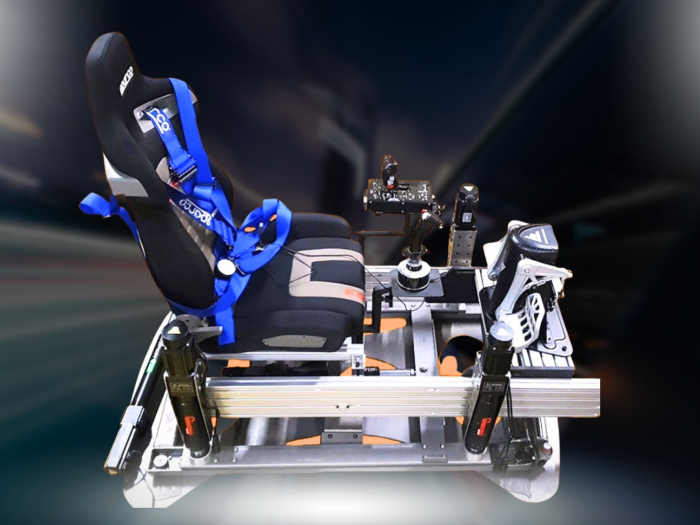
The physical architecture of your rig plays a massive role in perceived latency. Traditional aluminium extrusions often suffer from flex under high-torque movements. Our hand-built LowSlider platforms are designed with extreme rigidity to ensure every bit of energy is transferred directly to the driver. The ultra-low profile design also minimises the "pendulum effect," where a high centre of gravity creates a delayed swaying sensation. By shipping our rigs in four precision-welded pieces, we maintain a level of structural integrity that mass-market kits simply cannot match. Technical studies, such as the research on motion cancellation in VR from the KTH Royal Institute of Technology, emphasise that mechanical precision is the foundation of any low-latency simulation environment.

Implementing VR Motion Cancellation for Perfect Alignment
One of the most jarring experiences in a motion rig occurs when your virtual world "stutters" because your headset tracking is fighting the physical platform. Without motion cancellation, your VR software assumes every movement is coming from your head. If the rig pitches up, the software thinks you've stood up. This creates a nauseating visual oscillation. It's a specific type of vr motion simulator lag that can only be solved by teaching your software to ignore the movement of the platform itself. You aren't just adjusting a setting; you're realigning the digital and physical worlds.
You achieve this by mounting a dedicated tracking sensor, such as an OpenVR tracker, directly to your motion platform. By using software like "OpenVR-MotionCancellation," you can subtract the rig's physical movement from the headset's tracking data. This ensures your virtual eyes remain fixed within the cockpit, regardless of how much the actuators are tossing you around. Careful calibration of the offset is essential; if it's off by even a few millimetres, your virtual head will clip through the car seat or dashboard, instantly breaking the illusion of reality.
Hardware vs Software Cancellation
Whilst telemetry-based software cancellation is an option, it often lacks the precision required for high-intensity 6 DOF platforms. Physical trackers are generally more reliable because they account for the actual mechanical movement rather than just the theoretical data. When mounting a tracker to a LowSlider frame, choose a rigid, central point away from high-vibration areas. This provides the cleanest data stream. It ensures the cancellation software has a stable reference point to work from, preventing the "drift" that ruins long endurance sessions. A solid mount is the difference between a professional-grade setup and a frustratingly "floaty" experience.
Testing Your Synchronisation
Once installed, perform the "Head-Still" test. Sit in the rig and trigger a movement whilst keeping your head perfectly still. If the virtual world appears to drift or jump, you need to adjust your "Gain" settings. These settings ensure the software's virtual subtraction matches the rig's physical travel exactly. You may need to fine-tune these offsets for different car types. A stiff F1 suspension requires a sharper, more immediate cancellation than the softer, more progressive roll of a GT3 machine. Precision tuning here is what separates the veterans from the novices.
If you're ready to experience this level of precision, view our LowSlider motion platforms and see how we integrate these technologies for ultimate realism.
Why Bespoke Engineering is the Cure for Sim Racing Lag
Eliminating vr motion simulator lag requires more than just buying the fastest components; it demands a holistic engineering philosophy where every link in the chain is optimised for speed. At Race@Home, we don't believe in "good enough" industrial parts or mass-produced kits that flex under pressure. Our hand-built approach ensures that the visual data from your headset and the mechanical response from your actuators exist in a state of perfect, instantaneous synchronicity. By specialising in bespoke rigs, we provide a solution that addresses the root causes of latency at every level, from the software handshake to the physical stiffness of the chassis.
Maintaining this data chain is impossible without the right peripherals. Using professional-grade sim racing accessories ensures that your inputs, from steering angle to brake pressure, are captured and processed with zero unnecessary overhead. When you combine high-fidelity inputs with a rig that responds in under 10ms, the result is a transformative level of immersion. This isn't just a piece of gaming equipment; it's a lifetime investment in a professional-grade simulation environment that remains as sharp on its thousandth lap as it was on its first.
The LowSlider Philosophy
Our LowSlider platforms are built on the principle of maximum rigidity within a compact footprint. This design allows for a professional-level experience in home environments without compromising on structural integrity. The LowSlider 6 DOF Twin-Traction-Loss Motion Platform is a prime example of this philosophy. It provides instant, low-latency feedback for oversteer and rear-end slip, allowing you to catch a slide before your brain even processes the visual cue. Because our rigs are engineered and hand-built in the UK, you benefit from a level of craftsmanship and global support that mass-market providers simply cannot match. Whether you are in London or Los Angeles, our worldwide shipping service ensures your path to realism is seamless.
Your Journey to Professional Realism
Transitioning from a static rig to a fully synchronised motion experience is the ultimate evolution for any sim racer. If you've struggled with vr motion simulator lag in the past, follow this final checklist to ensure your next session is buttery smooth:
- Set NVIDIA Low Latency Mode to Ultra within your control panel.
- Ensure your VR headset is running at a native 90Hz or higher to maintain the comfort floor.
- Enable "Direct Mode" in your motion software to bypass unnecessary calculation layers.
- Verify that your motion cancellation tracker is securely mounted to a rigid part of the frame to prevent data drift.
The difference between "playing a game" and "driving a car" lies in these technical margins. If you are ready to stop fighting your hardware and start feeling the track, explore our LowSlider motion platforms today and discover the true potential of your sim racing career.
Mastering the Art of Instant Immersion
Eliminating vr motion simulator lag is the final frontier for any serious sim racer. By synchronising your PC's visual output with high-speed mechanical feedback and implementing precise motion cancellation, you move beyond mere gaming into the realm of professional training. You've learned that true realism requires a "no-compromise" approach to hardware rigidity and software calibration. When these elements align, the disconnect between your eyes and your inner ear vanishes, leaving only the raw, visceral thrill of the track.
If you're ready to leave latency behind, our hand-built solutions provide the ultimate foundation for your home rig. Powered by precision PT Actuators and engineered right here in the UK, the LowSlider platform is designed for those who demand absolute technical authority. We offer worldwide shipping in four easy pieces, ensuring your transition to a professional-grade experience is as fluid as your lap times. Explore the LowSlider 6 DOF Motion Platform today and feel the difference that bespoke engineering makes. Your seat in the cockpit is waiting; it's time to drive without limits.
Frequently Asked Questions
What is the most common cause of VR motion sickness in sim racing?
Sensory mismatch is the primary culprit, occurring when your eyes perceive motion that your inner ear doesn't immediately feel. This desynchronisation, often a symptom of unresolved vr motion simulator lag, triggers a defensive biological response similar to poisoning. To prevent this, your visual frame rates must align perfectly with your rig's mechanical response times, ensuring your brain receives a single, unified signal of movement.
Can a high-end PC fix motion platform latency?
A powerful PC can only resolve the "visual face" of latency by maintaining high frame rates and low render times. It cannot compensate for slow mechanical hardware or sluggish actuator response. Whilst a high-end GPU is essential for a fluid display, you still require enthusiast-grade actuators, such as PT Actuators, to ensure the physical rig moves as quickly as the digital world renders.
Does motion cancellation require extra hardware?
Whilst telemetry-based software solutions exist, a dedicated physical tracker is the gold standard for reliable motion cancellation. Mounting a tracker directly to your rig's frame provides a stable reference point that allows the software to subtract the platform's movement from your headset's tracking data. This hardware-based approach is significantly more robust for high-intensity 6 DOF systems where precision is paramount.
Why do industrial actuators feel "sluggish" in a sim rig?
Industrial actuators are engineered for safety and durability in factory environments, often featuring aggressive internal smoothing filters. These filters average out sudden movements to prevent hardware wear, which translates to a perceptible delay in a racing simulation. Sim racing demands components that prioritise raw acceleration and telemetry-driven precision, providing the sharp feedback that industrial systems are designed to suppress.
How do I know if my VR lag is visual or mechanical?
You can identify the source by isolating your movements; visual lag appears as stuttering or "ghosting" when you move your head whilst the car is stationary. Mechanical vr motion simulator lag is felt when you see the car hit a kerb or turn a corner, but your body only feels the corresponding G-force a fraction of a second later. If the visuals are smooth but the "kick" feels late, the bottleneck is mechanical.
Is the LowSlider compatible with all VR headsets?
The LowSlider platform is designed to work seamlessly with any headset that supports standard PCVR runtimes, including SteamVR and OpenXR. Whilst it is compatible with entry-level hardware, we recommend high-performance Pimax VR headsets to fully leverage the platform's speed. These headsets offer the wide field of view and high refresh rates necessary to match the ultra-low latency of our PT Actuator systems.
How much space do I need for a 6 DOF motion platform?
Our LowSlider 6 DOF platform is remarkably compact, but you should allow for a footprint of approximately 1.5 metres by 1.5 metres for safe operation. This space ensures the rig has sufficient clearance for its full range of pitch, roll, and heave without striking nearby walls or furniture. Because the rig ships in four manageable pieces, it's easier to position in standard home environments than traditional one-piece industrial simulators.


