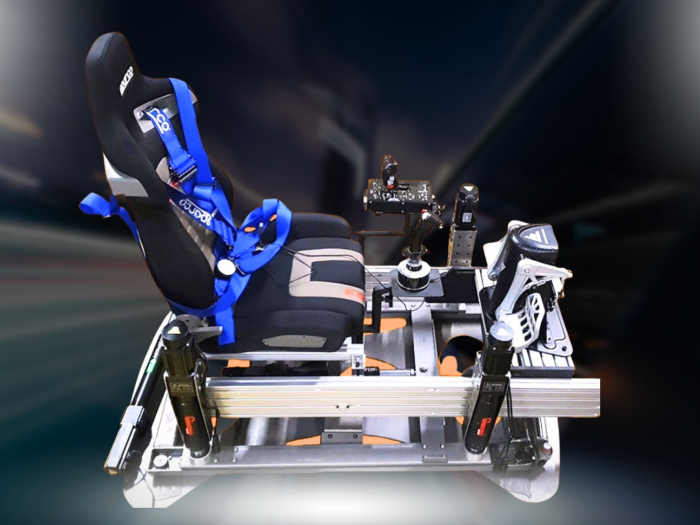

What if the missing tenth on your qualifying lap isn't hidden in your software settings, but in the way your body senses the track? It's a common frustration for dedicated racers; you've mastered the lines and the braking zones, yet the lack of physical feedback makes your static cockpit feel disconnected from the tarmac. You want the visceral intensity of a real GT3 car, but the fear of complex software calibration or a rig that swallows your entire spare room often stalls the upgrade. We understand that for the serious enthusiast, immersion isn't just a luxury; it's a vital component of driver performance.
This 2026 guide shows you exactly how to add motion to sim rig configurations to bridge that gap between digital data and physical sensation. You'll discover a technical roadmap for transforming your setup into a professional-grade simulator that delivers precise, low-latency feedback without the traditional headache of bulky machinery. We'll break down the logistics of choosing compact, high-performance hardware and explain how to achieve a seamless transition that improves your lap times through superior sensory immersion and engineering precision.
Key Takeaways
- Learn how translating digital telemetry into physical weight transfer can significantly sharpen your lap time consistency and on-track intuition.
- Understand the technical distinctions between 3DOF and 6DOF platforms to select the movement profile that best aligns with your immersion requirements.
- Follow a professional roadmap to add motion to sim rig configurations by auditing your chassis rigidity and calculating the essential "swing area" for your space.
- Discover practical strategies for managing noise and motion sickness to ensure your high-performance upgrade remains a comfortable, professional experience.
- Explore the advantages of bespoke, ultra-low profile engineering that delivers elite sensory feedback with a compact, hand-built UK footprint.
From Static to Sensational: Why Upgrade to a Motion Sim Rig?
For years, sim racing was primarily a visual and auditory pursuit. You stared at a screen, listened to the engine's roar, and relied on your eyes to judge the car's behaviour. But a static rig often feels "dead" because it lacks the physical dialogue between the car and the driver. By 2026, the standard for home enthusiasts has shifted significantly. High-end setups now prioritise the translation of digital telemetry into precise physical movement. When you choose to add motion to sim rig configurations, you aren't just buying a gadget; you're installing a sophisticated motion simulator that communicates every kerb strike and weight shift directly to your body.
This evolution represents a move toward professional-grade home hardware that bridges the gap between gaming and reality. In a static cockpit, you're guessing the limit of grip. In a motion-equipped rig, you're living it. The result is a sensory-rich experience where G-forces and weight transfer become tangible tools for improving your lap time consistency.
The Science of Sensory Feedback
Your brain processes physical cues much faster than visual ones. Whilst your eyes wait for the screen to show the start of a slide, your vestibular system, the balance centre in your inner ear, has already detected the yaw. This is the secret to elite car control. If you can feel the weight transfer as you trail-brake into a corner, you can adjust your inputs with surgical precision. Haptic feedback adds another vital layer. It allows you to identify tyre slip or a momentary brake lock-up through subtle, high-frequency vibrations. You aren't just reacting to what you see; you're reacting to what you feel in your core.
The Evolution of the Home Simulator
The market has moved far beyond basic seat shakers that simply vibrate under your chair. Modern enthusiasts now demand full-chassis motion that replicates the complex physics of a racing vehicle. This evolution focuses on low-latency actuators that ensure the movement happens in perfect sync with the on-screen action. If there's even a millisecond of delay, the illusion breaks and performance suffers. Professional-grade home hardware now offers the same fidelity once reserved for commercial pilot training or top-tier motorsport facilities. To ensure your current setup is ready for this level of performance, consult The High-End Sim Racing Rig Checklist: Essential Components for 2026. This shift toward bespoke, high-performance engineering ensures that your simulator isn't just a toy, but a genuine training tool for the track.
Decoding Degrees of Freedom: Choosing Your Motion Upgrade Path
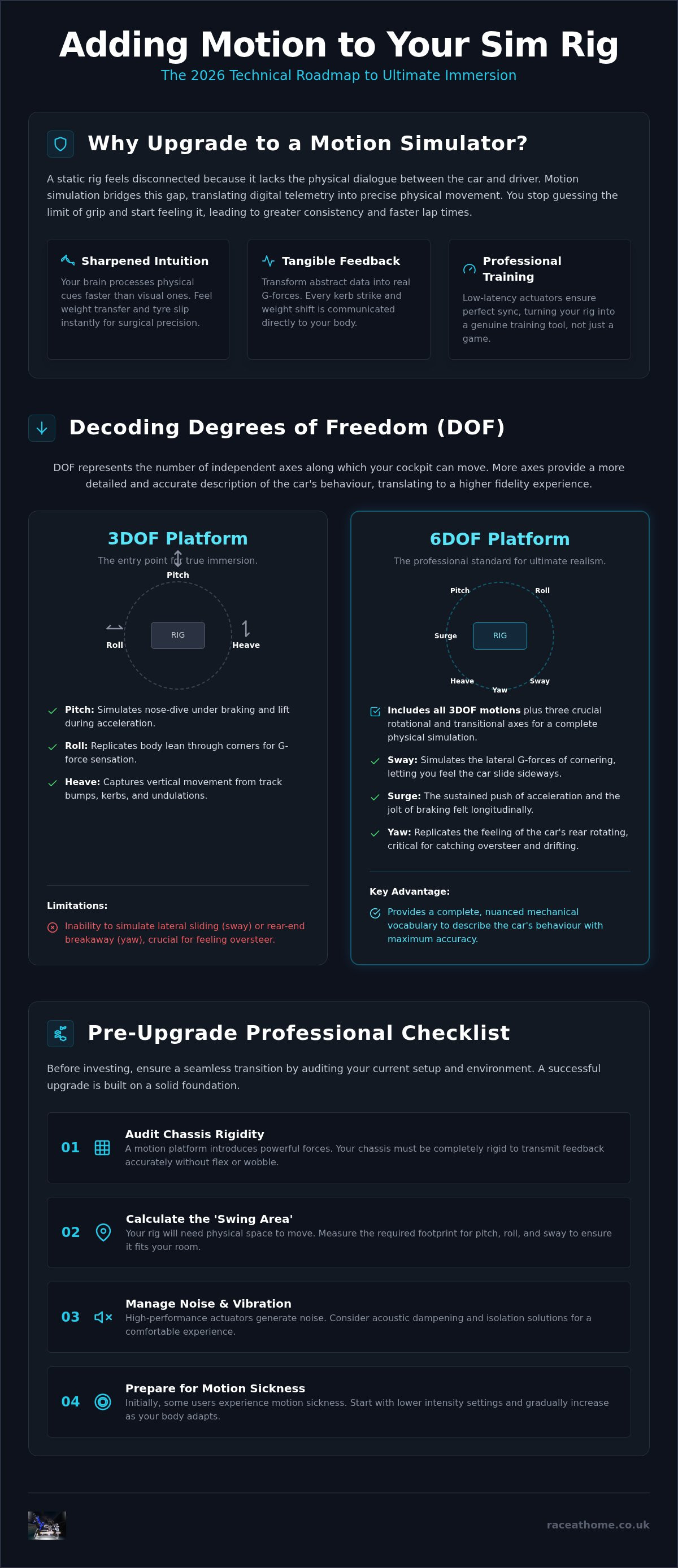
Understanding Degrees of Freedom (DOF) is the first step in your engineering journey. It represents the number of independent axes along which your cockpit can move. When you decide to add motion to sim rig configurations, you're essentially choosing how many physical "layers" of data you want to receive from the car. In the world of high-end simulation, more axes translate to a more articulate mechanical vocabulary. This allows the rig to describe the car's behaviour with greater nuance and accuracy.
The choice between different configurations often comes down to your primary racing discipline and your dedication to realism. Whilst a basic setup might tell you when you're hitting a kerb, a professional-grade system tells you exactly how the rear tyres are struggling for grip. If you're looking for the ultimate evolution of your hobby, you can explore our range of bespoke motion platforms to see how these axes translate into real-world performance.
3DOF: The Entry Point for Immersion
A 3DOF setup typically focuses on Pitch, Roll, and Heave. This configuration is the "sweet spot" for many enthusiasts because it covers the fundamental sensations of racing. Pitch simulates the nose-dive under heavy braking and the lift during acceleration. Roll handles the lean through corners, whilst Heave replicates the vertical movement from track bumps and kerbs. It's an excellent entry point that provides a massive leap over a static rig. However, its main limitation lies in its inability to simulate lateral sliding or rear-end breakaway. This makes it a solid choice for flight simulators or casual racing, but GT and drift specialists may find it leaves them wanting more.
6 DOF: The Professional Standard
For the driver who refuses to compromise, 6 DOF is the only logical path. This configuration adds Surge (fore and aft movement), Sway (side-to-side movement), and Yaw (rotation). In a racing context, Yaw is often utilised for Traction Loss. This is arguably the most critical upgrade for anyone racing GT3 cars or drifting. It allows you to feel the rear of the car stepping out before your eyes even register the slide. By incorporating twin-traction loss, you gain a surgical level of feedback that lets you catch oversteer with muscle memory alone. For a deeper dive into this technology, read The Ultimate Guide to 6 DOF Motion Simulators. A 6 DOF system creates a complete physical envelope, ensuring every bit of telemetry from the game is felt in your core.
Step-by-Step: How to Plan and Execute Your Sim Racing Motion Upgrade
Planning the transition to a dynamic setup requires more than just purchasing hardware; it demands a methodical engineering approach. When you prepare to add motion to sim rig environments, your first task is a comprehensive audit of your existing infrastructure. A motion platform generates significant torque and rapid directional changes. If your foundation isn't up to the task, the energy intended for your body will be absorbed by a flexing frame, dulling the precision of the feedback and potentially damaging your equipment over time.
Beyond the rig itself, you must consider the physical logistics of your room. Measure your floor space carefully, accounting for the "swing area" of the platform. This is the maximum displacement of the rig at full tilt and rotation; failing to account for this can lead to collisions with walls or furniture. You'll also need to evaluate your power requirements. High-performance actuators can draw substantial current during peak movements. We recommend dedicated circuits for your motion controllers and PC to prevent tripped breakers or electrical interference that could disrupt your telemetry signal during a race.
Chassis Compatibility and Rigidity
Aluminium profile rigs, often referred to as 80/20, are the gold standard for motion integration. Their modular nature allows for the extreme rigidity required to translate actuator movement into pure sensory feedback. If you're using a lighter, tubular frame, you may need to reinforce weak points with additional gussets or bracing to prevent "flex" from ruining the experience. For a detailed breakdown of structural requirements, check out our guide on sim rig motion platform compatibility. This ensures your chassis is a stable partner for the high-frequency data it's about to receive.
Software Setup and Calibration
The software acts as the translator between your game's telemetry and the physical actuators. Whether you're using SimTools or a proprietary platform, the goal is a low-latency connection via USB or dedicated controllers. Calibration is a fine art. You'll need to adjust "washout" filters, which are the algorithms that return the rig to a neutral position without you noticing the movement. This prevents jarring sensations and maintains the illusion of sustained G-forces. Once configured, test your setup with popular titles like iRacing or Assetto Corsa Competizione. This allows you to verify that the physical behaviour matches the on-screen physics with surgical accuracy.
Overcoming Common Hurdles: Space, Noise, and Motion Sickness
The transition to a dynamic cockpit often brings a set of practical anxieties that can stall even the most enthusiastic upgrade plans. You might worry that a moving platform will dominate your room, disturb the neighbours, or leave you feeling nauseous after a ten-lap stint. Deciding to add motion to sim rig setups shouldn't mean sacrificing your living space or your comfort. Modern engineering has addressed these "elephants in the room" through smarter design and higher-fidelity components that prioritise the home environment.
Maintaining physical well-being is a crucial part of this professional environment; many dedicated racers look to high-end wellness solutions like Elite Massage Chairs to ensure their bodies can handle the increased physical demands of a motion-equipped cockpit.
Noise management is a primary concern for those in flats or shared houses. Whilst the actuators themselves are remarkably quiet, the vibration transmitted through the floor can be an issue. High-end actuators operate with a level of mechanical refinement that budget alternatives lack, producing a smooth hum rather than a jarring clatter. Utilising heavy-duty vibration dampening mats and ensuring your cable management is secured with a professional loom will prevent unwanted rattles. A clean, safe, and professional-looking cockpit isn't just about aesthetics; it's about ensuring that nothing interferes with the rig's range of movement during high-intensity sessions.
Fitting Motion into Small Spaces
The assumption that you need a dedicated garage for a motion simulator is outdated. Low-profile designs have revolutionised home setups by keeping the centre of gravity close to the floor. This reduces the overall footprint and makes the rig feel less imposing in a home office or bedroom. Integrated electronics also play a vital role, as they eliminate the need for massive external control boxes that create floor clutter. If you're working with limited square footage, our guide on Apartment Sim Racing Setup: How to Fit a High-End Motion Rig in Small Spaces provides a blueprint for maximum immersion in minimal space. You can also view our compact motion solutions to see how we prioritise a small footprint without compromising on performance.
Mitigating Motion Sickness
It sounds counter-intuitive, but a high-fidelity motion rig can actually reduce sim sickness. Nausea typically occurs when your eyes see movement on the screen that your body doesn't feel, a phenomenon known as sensory conflict. Laggy or imprecise motion platforms exacerbate this by providing delayed feedback that confuses the brain. However, 1:1 low-latency motion aligns your visual and vestibular systems, creating a cohesive sensory experience. This synergy is particularly powerful when using VR headsets, where visual-vestibular alignment is critical for comfort. If you're new to motion, we recommend a short "bedding in" period with lower intensity settings to build your "sim legs" before cranking up the G-forces to professional levels.
The LowSlider Revolution: Bespoke Motion Without the Bulk
Many racers hesitate to add motion to sim rig setups because they fear the industrial bulk and complexity associated with traditional platforms. The LowSlider revolution represents a fundamental shift in how we integrate movement into the home environment. It's a no-compromise upgrade that combines the visceral intensity of a professional simulator with a design that respects your home's aesthetics. By utilising a proprietary, ultra-low profile architecture, we've eliminated the need for the towering frames and sprawling footprints that once defined the hobby.
Every LowSlider is hand-built in the UK and features premium PT Actuator components, ensuring that every millimetre of movement is delivered with surgical precision. We've simplified the logistics of the upgrade process; the entire platform arrives in four manageable pieces. This modular approach means you can complete your assembly in under an hour, even if you aren't a technical specialist. If you want to add motion to sim rig configurations without turning your living space into a laboratory, our ultra-low profile design is the definitive solution. It's about providing a gateway to elite performance without the engineering headache.
Why Hand-Built Matters
There's a significant divide between mass-produced components and bespoke engineering. Mass-market rigs are often designed for ease of shipping and high-volume sales, which can lead to compromises in material thickness and structural rigidity. When you're subjecting a frame to the violent forces of a 6 DOF system, those weaknesses become apparent through flex and lost detail. Our hand-built approach ensures that every platform is a rigid, reliable partner for your racing career. Whilst mass-produced alternatives may focus on cost-cutting, we prioritise the pursuit of realism and long-term durability. You also benefit from personalised support and global shipping logistics that treat your equipment as a precision instrument rather than just another box. To understand the deeper technical differences, read our comparison on Hand-Built Racing Simulators vs Mass-Market Rigs.
Ready to Move? Your Next Steps
The path to a professional setup depends on your specific racing goals. If you're looking for a massive leap in immersion with a focus on pitch and roll, the LowSlider 3DoF is a formidable choice. However, for the driver who demands the ultimate in telemetry translation, the 6 DOF Twin-Traction-Loss model provides the complete physical envelope required to master oversteer and weight transfer. We're here to guide you through the selection process and organise global delivery for your bespoke rig. Enquire about your custom LowSlider motion platform today and transform your static cockpit into a professional-grade simulator.
Mastering the Next Evolution of Your Cockpit
The transition from a static seat to a dynamic, professional-grade simulator is the ultimate evolution for any serious racer. By choosing to add motion to sim rig setups, you're investing in a sophisticated training tool that translates digital telemetry into the visceral language of weight transfer and traction loss. You've seen that high-fidelity feedback doesn't require a sprawling laboratory; it requires precise engineering and a commitment to realism. Whether you're chasing tenths in iRacing or perfecting your drift angle, the physical dialogue between you and the car is what creates true consistency on the track.
Don't settle for mass-market compromises when you can have a system hand-built in the UK to your exact specifications. Our ultra-low profile design ensures your simulator integrates seamlessly into your home whilst delivering world-leading 6 DOF precision with PT Actuators. It's time to stop guessing the limit and start feeling it in every corner. Upgrade your sim racing experience with a bespoke LowSlider motion platform and take your place at the front of the grid. The track is waiting. We're here to help you feel every inch of it.
Frequently Asked Questions
Can I add motion to any sim racing rig?
You can add motion to most sim racing rigs, provided the chassis is structurally rigid enough to withstand the forces. Aluminium profile rigs are the preferred choice for this upgrade, but other frames can be adapted with structural reinforcement. If you plan to add motion to sim rig setups using tubular steel, check for flex at the mounting points to ensure the telemetry data isn't lost in the frame.
Is a motion rig too loud for an upstairs flat or apartment?
High-end motion platforms are remarkably quiet, though vibration transmission to the floor requires careful management. Actuators themselves produce a low hum, but the mechanical movement can resonate through floorboards. Using heavy-duty vibration dampening mats effectively isolates the rig. This makes it suitable for apartment living without disturbing your neighbours during late-night racing sessions.
How much space do I need for a 6 DOF motion platform?
You typically need a space slightly larger than the rig's static footprint to allow for the "swing area" during full displacement. Whilst our low-profile designs are compact, you should maintain at least 30 to 50cm of clearance around the rig. This ensures the cockpit can tilt and rotate freely without colliding with walls or furniture in your home office or bedroom.
Will adding motion to my rig actually make me faster?
Motion improves your lap times by providing immediate sensory feedback about the car's limit of grip. By feeling the rear end step out or the front tyres scrub, you can react with muscle memory rather than waiting for visual confirmation on the screen. This leads to better consistency and faster recovery from slides, which ultimately translates to higher performance on the track.
Do I need a special PC to run a motion simulator?
You don't need a specialised PC, but a high-performance processor is recommended to handle telemetry data alongside the game. Most modern gaming PCs with a dedicated graphics card can manage the extra load of motion software without a drop in frame rate. Ensure you have a spare USB port and a stable power supply to keep the actuators running at peak performance.
How long does it take to assemble a Race@Home LowSlider rig?
Assembly typically takes approximately 60 minutes due to our modular four-piece design. We've engineered the platform to be as straightforward as possible for the end-user. It arrives in manageable sections that bolt together quickly, allowing you to transition from a static cockpit to a professional-grade motion platform in a single afternoon without needing an engineering degree.
Does motion sim racing cause motion sickness?
High-fidelity, low-latency motion actually reduces the risk of sim sickness by aligning your visual and vestibular senses. Nausea often stems from sensory conflict where your brain sees movement but your body feels nothing. When you add motion to sim rig configurations with 1:1 response times, this conflict is significantly minimised, especially when paired with a high-end VR headset.
What sim racing games support motion platforms?
Most major sim racing titles support motion telemetry, including iRacing, Assetto Corsa Competizione, and the F1 series. These games output real-time physics data that our motion software translates into physical movement. Compatibility is widespread across the industry, ensuring your favourite simulators will work seamlessly with our hardware to provide the ultimate professional-level experience.


