
What if the only thing standing between your living room and a professional-grade 6 DOF experience isn't the square footage of your floor, but the height of your expectations? Many enthusiasts believe that a high-end apartment sim racing setup requires a dedicated garage or a sprawling basement. It's a common frustration to feel that you must compromise on realism just because you're working with limited room dimensions. You shouldn't have to settle for a static seat whilst dreaming of the visceral feedback only a motion platform can provide.
This guide will demonstrate exactly how to plan and execute a professional-grade rig in a compact 3x3m space without sacrificing the intensity of six degrees of freedom. We'll break down the crucial relationship between footprint and motion clearance, ensuring your hardware performs at its peak without clashing with the furniture. You'll discover how ultra-low profile engineering and smart cable management can transform a cluttered corner into a sleek, high-performance cockpit that rivals professional training facilities. It's time to stop measuring your limitations and start building your ultimate home circuit.
Key Takeaways
- Distinguish between the static footprint and the dynamic "Motion Arc" to ensure your rig has the clearance required for safe, high-performance movement.
- Master a logical planning process to map your floor plan and organise data points for a professional apartment sim racing setup whilst eliminating cable clutter.
- Challenge the myth that small spaces require budget equipment by understanding why structural rigidity remains essential for high-end direct drive wheelbases.
- Learn how leveraging Pimax VR technology acts as a space-saving "cheat code" by removing the requirement for massive triple-monitor configurations.
- Discover how the LowSlider platform delivers full 6 DOF motion within a compact footprint designed specifically for high-end residential living.
Measuring Up: Understanding Sim Racing Rig Space Requirements
Achieving a professional-grade apartment sim racing setup begins with a tape measure and a dose of technical realism. Whilst a static frame might occupy a modest corner, a motion-enabled rig demands a more sophisticated spatial strategy. You aren't just housing a piece of furniture; you're installing a high-performance machine that interacts with the physical world through telemetry-driven movement. To understand the logistics, one must first ask: What is Sim Racing in the context of a modern flat? It's the translation of digital speed into physical force, and that force requires room to breathe.
Static vs Dynamic Footprint
Your static footprint is the floor area the aluminium profile actually touches. Typically, a standard rig might measure 1.5m by 0.8m. However, if you're installing a 6 DOF or 3DoF system, that footprint is merely the starting point. You must account for the "Motion Arc", which is the total volume of space the rig occupies when tilting, surging, or swaying at maximum intensity. A rig with a 1.5m x 0.8m frame often requires a 2m x 1.2m "safe zone" to operate without compromise. Motion clearance is the safety buffer required for full-actuator extension and chassis tilt. This zone ensures you don't strike radiators, skirting boards, or door swings whilst chasing a lap record.
The Ergonomic Minimums
Vertical space is another critical factor. You must factor in the elevation of your racing seat and the height of monitor mounts, especially when planning a high-end sim racing rig that includes integrated screens. Don't forget to measure your "elbow room". This is the lateral space required to enter and exit the cockpit comfortably and to allow for the natural range of motion during aggressive steering inputs. If you're squeezed too tightly against a wall, your immersion will suffer as you subconsciously limit your movements to avoid contact.
- Length: Ensure at least 1.6m of longitudinal space to accommodate a comfortable pedal-to-seat distance, especially for taller drivers.
- Width: Whilst a single monitor setup is compact, triple-monitor configurations can expand your width requirement to 1.8m or more.
- Height: Ensure there's enough clearance for your head and any VR sensors, particularly in rooms with low ceilings or hanging light fixtures.
Properly measuring your space isn't just about making the equipment fit; it's about protecting your investment. A rig that is too close to a wall won't just ruin your wallpaper; it will restrict the very motion you've invested in. Take the time to map out these zones before the hardware arrives. A well-planned apartment sim racing setup transforms a cramped corner into a precision engineering hub that feels as expansive as the track itself.
How to Plan Your Small-Room Sim Layout: A Step-by-Step Guide
Planning an apartment sim racing setup requires a methodical transition from abstract measurements to a physical layout. You aren't just placing a chair; you're integrating a high-performance cockpit into your daily living environment. Follow this structured approach to ensure your installation is as professional as the hardware itself.
- Step 1: Visualise with Masking Tape. Don't rely on mental images. Use masking tape to outline the static footprint on your floor. This allows you to walk around the space and feel the impact on the room's flow before committing to a position.
- Step 2: Map Power and Data. Identify your nearest wall sockets and ethernet points. High-end rigs require stable power and low-latency data. Planning this now prevents hazardous "spaghetti" cabling across your floor later.
- Step 3: Select Your Visual Solution. If room depth is a luxury you don't have, VR headsets are transformative. They eliminate the need for bulky monitor stands that often consume more space than the rig itself.
- Step 4: Designate an Assembly Zone. You'll need extra room to build. Our LowSlider platforms are designed for a swift one-hour assembly, but you'll still need enough clearance to access all four sides of the frame during the process.
- Step 5: Execute a Motion Clearance Test. Before you bolt everything down, manually cycle your actuators through their full range. Check that nothing strikes a wall or piece of furniture at maximum pitch or roll.
Zoning Your Racing Space
In multi-use rooms, creating a distinct "racing centre" is vital for focus and aesthetics. Corner placements are often the most efficient, as they utilise dead space that wouldn't otherwise accommodate furniture. If you're integrating a custom motion simulator into a living area, consider using a rug to define the racing zone. This subtle physical boundary helps separate your high-octane sessions from your relaxation time whilst protecting your flooring from the rig's weight.
Cable Management in Tight Quarters
Nothing ruins the premium feel of an apartment sim racing setup faster than a chaotic tangle of wires. In small rooms, clutter creates a sense of claustrophobia. Utilise professional trunking and braided cable sleeves to bundle your power and USB leads into a single, clean run. High-end platforms often feature integrated electronics that reduce the number of external boxes and wires, keeping the aesthetic sharp and organised. If you're ready to start your build, you can explore our compact motion solutions to see how precision engineering simplifies the logistics of home racing.
Foldable Chairs vs Professional Motion Platforms: The Footprint Debate
Many enthusiasts assume that a compact apartment sim racing setup necessitates a compromise in hardware quality. The prevailing logic suggests that if you lack a dedicated room, you must settle for a foldable chair or a budget-tier wheel stand. This is a myth. In reality, the quest for portability often introduces more problems than it solves, especially when your goal is professional-grade realism. High-end direct drive wheelbases produce significant torque that will easily overwhelm a lightweight, folding frame. If your rig flexes under load, the precision of the force feedback is lost, muting the vital telemetry data your brain needs to find those last few tenths of a second.
The Hidden Compromise of Portability
The primary draw of a foldable rig is the ability to stash it away, yet this leads to "setup fatigue". Dragging a heavy frame out of a cupboard, connecting cables, and recalibrating your seating position becomes a barrier to entry. A permanent, compact rig encourages consistent training sessions because it is always ready. Paradoxically, a folded chair often occupies an awkward, non-stackable volume of space. When you factor in loose pedals and peripherals, the total storage footprint can actually exceed that of a well-engineered, fixed-frame solution. Stability is the foundation of immersion; without a rigid chassis, you cannot effectively utilise high-torque motors or load-cell pedals.
Engineered Compactness
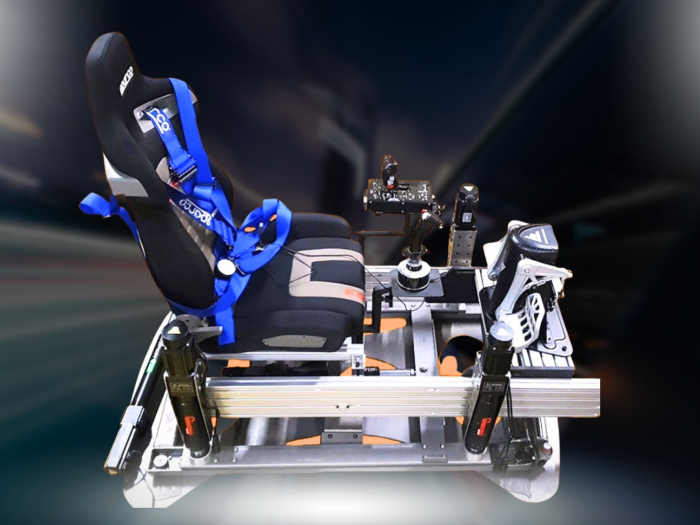
True space efficiency isn't about being able to fold; it's about being designed to fit. Our hand-built approach prioritises a "no-waste" philosophy regarding dimensions. By utilising an ultra-low profile, the LowSlider platform allows you to integrate a 6 DOF motion simulator into rooms where traditional, bulky actuators would hit the ceiling. This proprietary design delivers full traction loss and pitch-and-roll sensations within a footprint comparable to many static rigs.
- Structural Integrity: Aluminium profile construction provides the rigidity required for 20Nm+ wheelbases without adding unnecessary bulk.
- Vertical Optimisation: Low-slung chassis designs keep the centre of gravity close to the floor, making the rig feel less imposing in small rooms.
- Functional Aesthetics: A professional apartment sim racing setup should look like a piece of high-end engineering, not a temporary piece of garden furniture.
Choosing a fixed, motion-capable platform over a budget foldable option is an investment in your performance. It eliminates the physical distractions of a vibrating frame and replaces them with the curated, high-fidelity feedback of a professional simulator. By selecting hardware engineered for compactness, you can maintain the highest standards of the hobby without needing a dedicated warehouse to house it.

Maximising Every Millimetre: VR and Compact Hardware Integration
If floor space is your most expensive commodity, virtual reality is the ultimate "cheat code" for a high-end apartment sim racing setup. Traditional triple-monitor arrays provide incredible peripheral vision, but they require massive, heavy-duty stands that dominate a room's floor plan. By switching to a high-fidelity headset, you reclaim several square metres of living space whilst actually increasing your immersion. This shift allows you to place your rig in narrow corridors or alcoves where a screen-based setup would be physically impossible.
Immersion Without the Bulk
Modern Pimax VR headsets are a game-changer for the space-conscious driver. They provide a staggering 200-degree field of view, matching the natural human vision range without the need for a single physical monitor. There is also a powerful synergy between VR and motion platforms. When your inner ear feels the pitch and roll from a LowSlider platform that matches the visual data in your headset, it significantly reduces the sensory conflict that causes sim sickness. VR allows a 1m wide rig to feel like a full-scale cockpit because the physical boundaries of your flat vanish the moment you lower the visor.
Choosing Space-Efficient Peripherals
Every component in a compact build must justify its footprint. When selecting sim racing accessories, look for hardware that prioritises integrated functionality. For example, choose pedal sets with slim load-cell designs that offer professional resistance without requiring a massive baseplate. Instead of mounting separate tablets or bulky button boxes that bleed into your room's walkways, utilise integrated controls on your steering wheel or compact, rig-mounted modules.
- Monitor Arms: If you still require a screen for UI navigation or work, use a heavy-duty gas-sprung arm to swing the monitor over your desk when you aren't racing.
- Integrated Electronics: Opt for wheelbases with built-in power supplies to reduce the number of "bricks" cluttering your floor.
- Future-Proofing: Ensure your choices maintain sim rig motion platform compatibility so your compact peripherals can handle the forces of a high-end 6 DOF system.
By focusing on hardware that performs beyond its physical size, you can build a world-class simulator that leaves your living area feeling open and unorganised. If you're ready to eliminate the bulk, you can view our Pimax VR headsets and LowSlider platforms to start your compact journey. Precision engineering means you no longer have to choose between a professional experience and a tidy home.
The LowSlider Solution: High-End Motion in a Compact Footprint
Building an apartment sim racing setup shouldn't feel like a series of compromises. We've explored the constraints of small rooms and the inherent flaws of foldable gear; now it's time to introduce the hardware that bridges the gap between residential living and professional performance. The LowSlider motion platforms, available in both 6 DOF and 3DoF configurations, are specifically engineered for the high-end enthusiast who refuses to let square footage dictate their level of immersion. Our proprietary design ensures that full 6 DOF motion, including the vital twin-traction-loss sensation, fits within a physical footprint comparable to many static aluminium rigs.
Logistics are often the biggest hurdle for flat-dwellers. Large, pre-assembled simulators simply won't fit through standard door frames or around narrow hallway corners. We solve this by shipping our hand-built platforms worldwide in a modular, four-piece assembly. This approach allows you to move the components into your racing zone with ease. Once in position, the system is designed for a straightforward one-hour assembly, getting you onto the grid whilst others are still wrestling with instruction manuals. It's the ultimate evolution for the urban driver.
Precision Engineering for Small Spaces
The LowSlider platform distinguishes itself through an ultra-low profile that keeps your centre of gravity close to the floor. By integrating high-performance PT Actuators into a compact, rigid frame, we've eliminated the "towering" height issues common with traditional motion systems. If your room has standard ceiling heights, this low-slung architecture ensures you have ample clearance even at maximum pitch. The result is a rig that feels grounded and powerful, translating digital telemetry into precise physical sensations without dominating the visual volume of your room.
Ready to Transform Your Room?
Precision racing is about more than just speed; it's about the confidence that comes from a perfectly calibrated environment. Race@Home specialises in providing that professional-grade experience to customers worldwide, backed by expert support and a dedication to engineering excellence. Don't let a small room limit your potential on the track. Measure your space, visualise your layout, and prepare for the most transformative upgrade in your sim racing career. You can explore the LowSlider 6 DOF and reclaim your racing space today to see how we turn compact corners into world-class cockpits.
Take the Grid in Your Own Living Room
You've seen that limited square footage is no longer a barrier to professional-grade motion. By understanding the dynamic requirements of the "Motion Arc" and leveraging space-saving VR technology, you can build a world-class cockpit in any corner. A high-performance apartment sim racing setup is about smart engineering; it's about choosing hardware that respects your floor plan whilst delivering uncompromising feedback.
Our LowSlider platforms are hand-built in the UK to provide full 6 DOF immersion within a compact footprint. With a simple one-hour assembly time, you'll spend less time measuring and more time mastering every apex. It's time to stop compromising and start experiencing the visceral reality of the track. Ready to transform your home? View the Compact LowSlider Motion Platforms and reclaim your racing space today.
Frequently Asked Questions
How much floor space do I need for a 6 DOF motion rig?
You typically require a dynamic "safe zone" of approximately 2 metres by 1.2 metres to operate a 6 DOF rig without restriction. Whilst the static aluminium frame itself is smaller, this additional clearance accounts for the pitch, roll, and heave movements of the actuators. Ensuring you have this dedicated area prevents the chassis from making contact with walls or furniture during high-intensity racing sessions.
Can I fit a full-motion simulator in a standard 3x3 metre bedroom?
Yes, a standard 3x3 metre room is more than sufficient for a professional apartment sim racing setup. Since a compact rig only occupies about 2.4 square metres of dynamic space, you still have plenty of room for a desk, chair, and walkways. The key is positioning the rig in a corner or along a single wall to maintain a natural flow through the rest of the room.
Do I need to reinforce my floor for a motion rig in a flat?
Reinforcement is rarely necessary for modern residential buildings as the weight of a motion rig is distributed across a wide base. Most high-end platforms weigh between 100kg and 250kg, which is comparable to a large bookshelf or two adults standing together. We recommend using high-density rubber isolation mats to protect your flooring and further dampen any mechanical vibrations that might travel through the joists.
Is VR better than triple monitors for a small sim racing room?
VR is the superior choice for small rooms because it completely eliminates the physical footprint of bulky monitor stands. A triple-monitor array often requires a width of 1.5 to 2 metres, which can make a small room feel cramped and unorganised. By using a Pimax VR headset, you gain a full field of view whilst keeping your rig's width to roughly 80cm, allowing for a much cleaner layout.
What is the minimum clearance required for a motion platform?
You should maintain a minimum clearance of 30cm on all sides of the platform to ensure safe operation. This buffer prevents the moving components from striking obstacles during maximum actuator extension or sudden traction loss movements. It's also vital to check vertical clearance if you're installing the rig under a low shelf or a sloped ceiling, as the seat height will change during heave and pitch movements.
Can a motion rig be easily disassembled if I need to move house?
Our LowSlider platforms are specifically designed for easy transit and can be dismantled as quickly as they are built. The system breaks down into four primary sections that are light enough to be carried by one person and small enough to fit into a standard car. This modularity is a significant advantage for enthusiasts in flats who may need to relocate their apartment sim racing setup in the future.
Will a motion platform be too noisy for a small apartment or flat?
Modern PT Actuators are surprisingly quiet and produce a mechanical hum that is often quieter than the cooling fans on a high-end PC. The primary sound comes from the vibrations of the rig itself, which is why we prioritise ultra-low profile designs and isolation mounting. When paired with a set of vibration-dampening feet, the noise levels are perfectly acceptable for residential living, even during late-night sessions.
What is the footprint of the Race@Home LowSlider platform?
The LowSlider 6 DOF platform features a static footprint that is comparable to a standard static aluminium profile rig. Its proprietary design focuses on keeping the actuators tucked within the primary frame dimensions as much as possible. This engineering choice ensures you don't have to sacrifice the thrill of twin-traction-loss just because you're working with the limited floor space typical of urban apartments.


