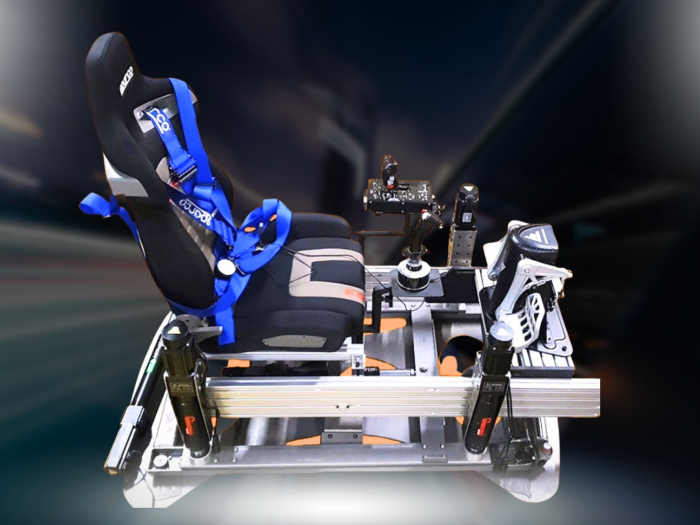

Why does your brain only realise you have lost the rear end when the tyre smoke starts filling your screen? If you are searching for authentic sim racing g-force feedback, you already know that a static rig often feels disconnected; it's a fundamental deficit of sensory information that leads to missed apexes and avoidable spins. You likely feel that your current setup is missing that crucial "seat of the pants" sensation that tells you exactly when the rubber is beginning to protest against the tarmac.
This guide explores how professional-grade motion platforms transform digital telemetry into precise physical loads to sharpen your driving precision and immersion. By using advanced hardware like the LowSlider 6 DOF Twin-Traction-Loss Motion Platform, you can finally align your vestibular system with your visual cues to eliminate motion sickness and find the absolute limit of grip. We will examine the engineering of motion realism, where precision of movement is prioritised over simple travel distance, and how to configure a world-class setup that delivers professional-grade feedback within a compact home footprint.
Key Takeaways
- Learn the fundamental difference between steering wheel torque and true sim racing g-force feedback, and why both are essential for professional-level immersion.
- Understand the engineering behind motion platforms, including how washout filters ensure you feel sustained acceleration whilst the rig returns to its neutral centre.
- Discover how 6 DOF systems provide the "seat of the pants" feel required to sense the limit of grip and correct slides before they lead to a spin.
- Compare the technical advantages of 3DoF and 6 DOF configurations to determine which level of motion realism aligns with your competitive goals.
- Explore how the LowSlider 6 DOF Twin-Traction-Loss Motion Platform delivers high-fidelity feedback and precision within a compact, home-friendly footprint.
Understanding G-Force Feedback in Sim Racing
In the world of high-end simulation, sim racing g-force feedback represents the final frontier of realism. It is the physical manifestation of raw telemetry data, turning digital numbers into tangible pressures against your body. Whilst a high-quality steering wheel provides torque to your hands, it cannot convey the weight of a car leaning into a high-speed corner or the violent snap of a gear change. These sensations are vital for a driver to understand the limits of their machine.
True immersion relies on proprioception. This is your body's innate ability to sense movement, force, and position without relying solely on visual cues. Professional drivers use this "sixth sense" to feel how the chassis behaves before their eyes can register a change in direction. By integrating advanced motion simulator technology, we can trick the vestibular system in your inner ear. This creates a sensory bridge between the virtual world and your physical surroundings, allowing you to drive by feel rather than just by sight. It's the difference between watching a race and being in the cockpit.
Gravity vs. Acceleration: The Physics of Sim Motion
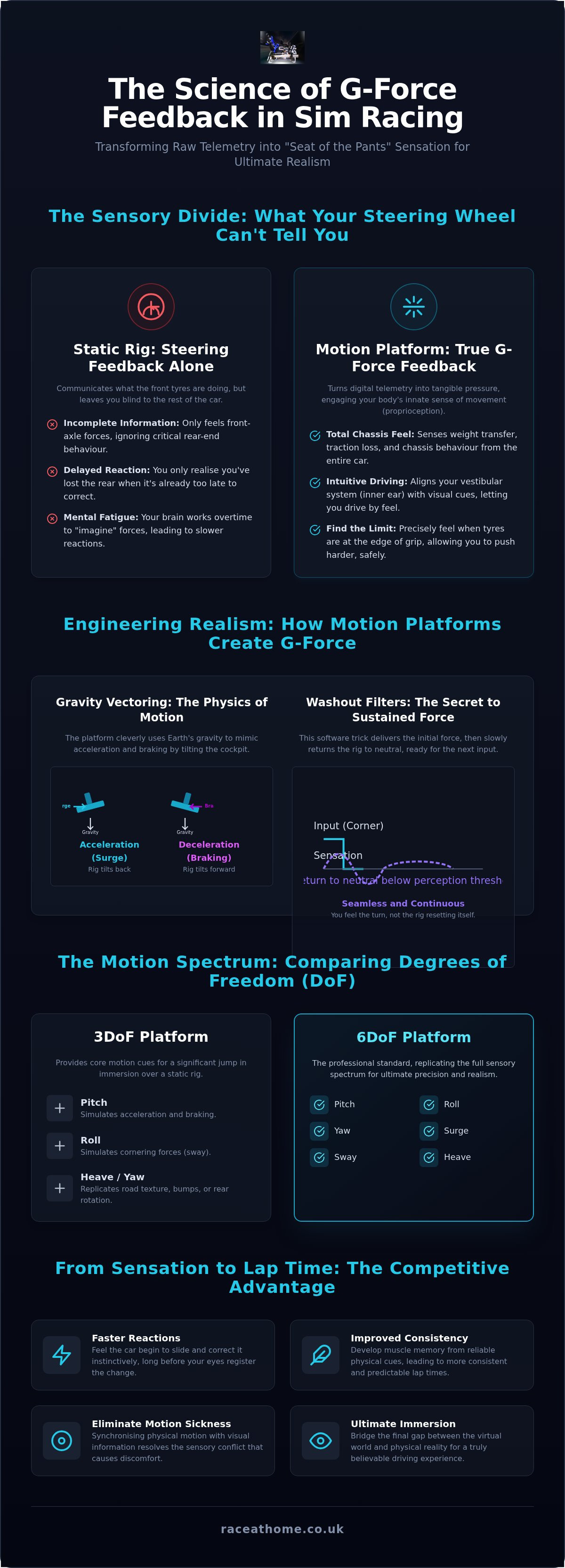
Simulating sustained forces in a limited space requires a clever application of physics known as gravity vectoring. Since we cannot move your rig across a hundred metres of tarmac, we use Earth's own gravity to mimic acceleration. By tilting the seat backwards, your body weight is pushed into the seat, simulating "surge" or forward acceleration. Conversely, tilting forward mimics the heavy nose-dive of braking. Lateral "sway" is achieved by tilting the rig side-to-side, pushing you against the bolsters of your seat to replicate cornering forces. Static rigs lack these cues, forcing your brain to work harder to "imagine" the forces; this often leads to mental fatigue and slower reaction times.
Why Steering Feedback Alone Isn’t Enough
Your steering wheel is a vital tool, but it only tells half the story. It communicates what the front tyres are doing, but it leaves you blind to the rear axle. You won't feel the weight transfer as you crest a hill or the subtle loss of traction at the back until it's often too late to save the car. High-quality sim racing accessories like load-cell pedals and tactile transducers can bridge some of this gap, but they cannot replicate the visceral sensation of a car's mass shifting under you. Without motion, you are essentially driving a detached pair of front wheels rather than a complete, living machine.
How Motion Platforms Replicate Sustained G-Forces
The heart of any high-performance rig lies in its actuators. These precision components receive telemetry packets directly from the simulation software, converting digital speed and acceleration data into physical displacement with millimetre precision. This rapid translation is where sim racing g-force feedback becomes a reality, providing the physical resistance your body expects when pushing a car to its limits.
Creating a realistic sensation of sustained force presents a unique engineering challenge. Since a motion rig cannot travel across a room, it relies on a "washout filter" to manage its range of movement. When you accelerate, the platform tilts to use gravity as a proxy for G-force. Once the initial sensation is delivered, the washout filter gradually returns the rig to a neutral position. This transition From Sensation to Information occurs at a speed below the human threshold of perception. It ensures you are always ready for the next corner without ever feeling the rig "resetting" itself. High-speed, low-latency software is essential here; even a few milliseconds of lag can cause a visual-vestibular mismatch, leading to the motion sickness that plagues inferior setups.
The Role of Pitch and Roll in Simulating Surge and Sway
Pitch involves tilting the entire cockpit along its lateral axis. When you bury the throttle, the rig tilts back to press you into your seat, mimicking the feeling of forward surge. Under heavy braking, it tilts forward to replicate the deceleration Gs. Roll tilts the rig side-to-side. In a long, sweeping corner, this sustained tilt creates a constant pressure against your torso, tricking your brain into perceiving lateral sway. When these movements are perfectly synchronised with your visual field, the illusion of mass and velocity is absolute.
High-Frequency Haptics vs. Large-Scale Actuation
True realism requires a sophisticated, dual-layered approach to feedback. Large-scale actuation handles the heavy G-loads of cornering and braking, but high-frequency haptics provide the essential "texture" of the drive. You need to feel the engine's vibration through the chassis and the sharp "thwack" of a kerb strike alongside the lean of the car. Our PT Actuator sim racing technology is engineered to deliver both simultaneously. This ensures that no detail of the road surface is lost to the broader motion cues. If you want to experience this level of precision first-hand, exploring a bespoke motion rig solution is the logical next step for any serious competitor.
3DoF vs. 6 DOF: Replicating the Full Sensory Spectrum
Choosing between 3DoF and 6 DOF is the most significant decision you'll make when building a motion rig. Whilst both systems utilise telemetry to generate sim racing g-force feedback, the depth and accuracy of the information they provide are vastly different. A 3DoF system serves as the essential entry point for many enthusiasts, offering Pitch, Roll, and Heave. These movements cover the basic tilt-based sensations of acceleration, braking, and vertical displacement. However, to reach the standard required for professional sim racing simulators, you must move beyond simple tilting and into true linear translation.
A 6 DOF platform adds Surge, Sway, and Yaw to the mix, creating a complete physical simulation. This doesn't just make the experience more exciting; it makes it more informative. By providing a 1:1 physical representation of the car's chassis movement, a 6 DOF rig removes the mental guesswork. You no longer have to interpret a tilt as a lateral force. Instead, your body feels the actual slide or surge, allowing your subconscious to handle the driving whilst your conscious mind focuses on race strategy and apexes.
Surge, Sway, and Heave: The Linear Trio
These three degrees of freedom manage the linear forces that act upon a driver's body. Surge is the sensation of being physically pressed into your seat during acceleration or thrown forward under heavy braking. It replicates that "heavy chest" feeling as you shed speed for a tight hairpin. Sway provides the lateral centrifugal force that pulls you toward the outside of a bend, whilst Heave replicates the vertical compression and lift of the suspension. When you hit a dip at high speed or crest a rise, Heave provides that essential stomach-churning vertical G-force that a static rig simply cannot replicate.
The Critical Importance of Traction Loss (Yaw)
Yaw, commonly referred to as traction loss, is the "holy grail" of motion simulation. It allows the platform to rotate or slide laterally, mimicking the exact moment the rear tyres lose their purchase on the tarmac. This is arguably the most important piece of feedback for any competitive driver. It provides the "seat of the pants" warning required to catch a slide before your eyes even register the movement on screen. Our twin traction loss motion platform technology takes this further by providing independent movement for the front and rear axles. This creates a 360-degree sensory map of the car's behaviour, giving you the confidence to push into oversteer and find the absolute limit of performance.
From Sensation to Information: Improving Your Lap Times
A common misconception amongst static rig users is that motion is a luxury intended only for "fun". In reality, high-fidelity sim racing g-force feedback is a critical performance tool. It bypasses the slower visual processing centres of the brain, delivering data directly to your nervous system. When you rely solely on your eyes, you are reacting to events that have already happened. With a professional motion platform, you are reacting to the physics as they occur.
This physical data stream allows for far more precise control, particularly during heavy deceleration. By feeling the "surge" of the car's weight shifting forward, you can modulate brake pressure with surgical accuracy. This tactile information helps you find the threshold of a lock-up far more effectively than waiting for the visual cue of a tyre smoking or a dashboard light. It transforms the driving experience from a series of reactive corrections into a proactive, fluid rhythm.
Feeling the Limit: Detecting Understeer and Oversteer
Sway and yaw are your primary indicators for tyre saturation. When the front tyres begin to wash out in an understeer scenario, the lateral sway cues will subtly change, signalling that the car is no longer holding the intended line. Similarly, yaw allows you to detect the rear end breaking loose before the car has actually rotated significantly on screen. This allows you to "catch" slides instinctively. Professional-grade motion systems can reduce a driver's reaction time by up to 100ms, as the body's vestibular system identifies movement significantly faster than the eyes can process a change in pixels.
Reducing Motion Sickness Through Accurate Proprioception
Many sim racers avoid motion because they fear nausea, yet the opposite is often true. Motion sickness typically stems from a visual-vestibular mismatch, where your eyes see a high-speed corner but your inner ear feels nothing. By implementing a high-fidelity motion sickness sim racing solution, you align these senses, often curing the discomfort associated with static VR racing. This is particularly vital when using a Pimax VR motion simulator setup, where "motion compensation" software ensures the virtual camera stays locked to your head's position relative to the cockpit, not the room. If you are ready to upgrade your performance and comfort, you can explore our range of professional motion platforms to find the perfect fit for your rig.
Race@Home LowSlider: Engineering Ultimate G-Force Realism
Bridging the gap between digital telemetry and physical sensation requires hardware that prioritises precision over simple travel distance. The LowSlider range represents the pinnacle of UK-based engineering, designed to deliver high-fidelity sim racing g-force feedback within a footprint that respects the constraints of a home environment. Every unit is hand-built in the UK, ensuring that the craftsmanship matches the sophisticated software driving the actuators. Whilst many professional rigs require dedicated rooms and industrial power supplies, the LowSlider is engineered for the modern enthusiast who demands professional-grade realism without the logistical headache.
One of the most significant barriers to entry for high-end motion has traditionally been the complexity of setup. We've eliminated this by designing a modular system that boasts a one-hour customer assembly time. It's a "no-compromise" approach to quality that ships worldwide, bringing professional-grade immersion to drivers from Silverstone to Sydney. You don't need an engineering degree to start feeling the Gs; you just need a passion for the ultimate driving experience.
Twin Traction Loss: The Race@Home Edge
The defining feature of the LowSlider 6 DOF Twin-Traction-Loss Motion Platform is its ability to separate front and rear yaw cues. In a standard motion rig, yaw is often a single point of rotation. Our proprietary Twin-Traction-Loss technology allows the front and rear of the chassis to move independently, replicating the exact sensation of a car pivoting around its vertical axis. This is particularly vital for detecting the subtle transition from grip to slip in a high-speed GT3 car. It's why this configuration is frequently the preferred motion simulator for driver training. It provides the "seat of the pants" data required to master car control at the limit.
Compact Design Without Compromising Dynamic Range
Traditional motion platforms are often tall and unstable, raising the driver's centre of gravity and introducing unwanted oscillations. The LowSlider's ultra-low profile design solves this by keeping the entire rig as close to the floor as possible. This increased stability allows for more aggressive, high-frequency movements without shaking the room. The modular nature of the system means it fits comfortably into a standard spare room or office, proving that you don't need a warehouse to house a world-class simulator with authentic sim racing g-force feedback. Ready to feel the Gs? Explore the LowSlider 6 DOF today and transform your driving forever.
Master the Physics of the Virtual Track
Mastering the limit of grip requires more than just visual focus; it demands a physical connection to the car's chassis. By integrating authentic sim racing g-force feedback into your setup, you move from reacting to on-screen events to anticipating them through your body's own vestibular system. We've explored how 6 DOF motion platforms bridge the gap between telemetry and reality, allowing you to sense weight transfer and rear-end rotation with professional-grade precision.
If you're ready to stop guessing and start feeling every Newton of force, it's time to evolve your rig. Our LowSlider motion platforms are hand-built in the UK and used by professional drivers for elite coaching and training. These systems ship worldwide in just four easy-to-assemble pieces, ensuring you can go from unboxing to the apex in under an hour. Upgrade your rig with a LowSlider 6 DOF Twin-Traction-Loss Platform to experience the ultimate in motion realism. The track is waiting for you to find those final tenths.
Frequently Asked Questions
How does a sim rig simulate G-force without moving forward?
Sim rigs simulate G-force by using gravity vectoring and rapid linear acceleration. By tilting the cockpit, the platform uses the Earth's gravity to pull you into the seat during acceleration or against the bolsters whilst cornering. This tilt, when perfectly synchronised with visual cues in the simulator, tricks your inner ear into perceiving sustained momentum. It is a sophisticated method of translating digital telemetry into physical sensations that mimic a real race car.
Do I need a 6 DOF rig to feel G-forces, or is 3DoF enough?
Whilst a LowSlider 3DoF motion platform provides essential cues like pitch and roll, a 6 DOF rig is the professional standard for total immersion. A 3DoF system is an excellent entry point for vertical Gs and basic weight transfer. However, only a 6 DOF platform offers the full linear spectrum, including surge, sway, and yaw. This additional data is vital for drivers who need to feel the rear end stepping out.
Does G-force feedback actually make you a faster sim racer?
Authentic sim racing g-force feedback can improve your performance by reducing the mental processing time required to understand car behaviour. Instead of waiting for a visual cue on screen, your body feels the weight transfer and loss of traction instantly. This allows for instinctive corrections rather than reactive ones. Many professional drivers find that this "seat of the pants" information leads to more consistent lap times and better tyre management.
Can motion feedback help reduce sim racing motion sickness?
Motion feedback often reduces simulator sickness by resolving the visual-vestibular mismatch. Sickness typically occurs when your eyes see movement that your body doesn't feel. By providing physical cues that match the on-screen action, a high-fidelity motion rig aligns your senses. When using VR, this effect is even more pronounced, provided you use motion compensation software to keep your head position locked correctly within the virtual cockpit during rig movements.
What is the difference between G-force feedback and tactile haptics?
G-force feedback involves large-scale physical movement of the entire rig to simulate mass and momentum. In contrast, tactile haptics use transducers to create high-frequency vibrations that represent road texture, engine RPM, and kerb strikes. For the ultimate sim racing g-force feedback experience, these two technologies work in tandem. The actuators handle the heavy G-loads, whilst haptics provide the fine-grain detail of the track surface, creating a layered sensory environment.
Is the LowSlider 6 DOF compatible with all major racing sims like iRacing and ACC?
The LowSlider 6 DOF Twin-Traction-Loss Motion Platform is fully compatible with all major titles, including iRacing, Assetto Corsa Competizione, and Dirt Rally. The system interfaces directly with the game's telemetry output to ensure that every bump and weight shift is translated accurately to the actuators. This universal compatibility makes it a versatile tool for drivers who switch between GT3 racing, open-wheelers, and rally stages, ensuring consistent feedback across all disciplines.
How much space do I need for a full G-force motion simulator?
Modern engineering has made it possible to house a professional simulator in a standard spare room or office. Unlike bulky commercial rigs, the LowSlider 6 DOF Twin-Traction-Loss Motion Platform features a compact, ultra-low profile design. You generally only need enough floor space to accommodate the rig's footprint plus a small safety margin for movement. This makes it an ideal solution for home users who want professional-grade feedback without sacrificing an entire floor.
Is it difficult to calibrate G-force feedback for different car types?
Calibrating your rig for different car types is straightforward thanks to advanced telemetry software. Most users utilise pre-configured profiles that automatically adjust the motion intensity and washout filters based on the vehicle being driven. A lightweight formula car requires sharper responses, whilst a heavy GT3 car needs smoother, more sustained cues. These profiles ensure that the feedback remains authentic to the specific physics of the car, providing a bespoke driving experience every time.


