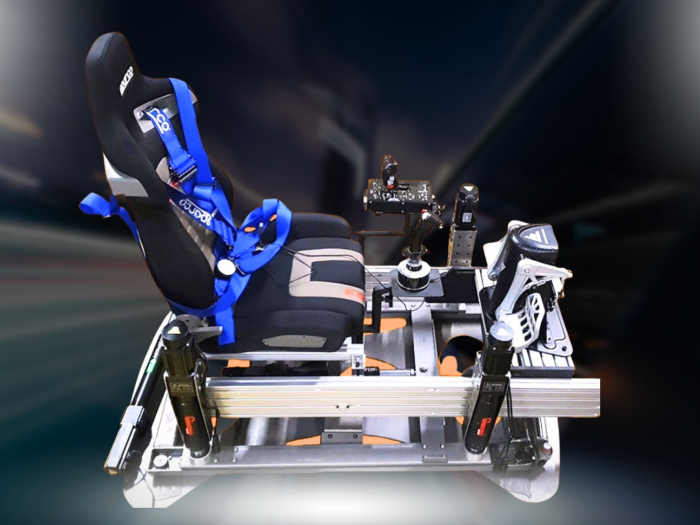

If you cannot feel the weight transfer as you clip the apex at Maggotts, you aren't truly racing; you are simply managing a simulation. You've likely invested heavily in high-end peripherals, yet that frustrating sense of physical disconnection remains because your inner ear isn't receiving the same data your eyes are processing. It's a common frustration for enthusiasts who crave total immersion but fear the latency and complexity often associated with professional motion platforms.
This article explores how PT actuator sim racing systems serve as the industrial-grade muscle behind the world's most realistic rigs. You'll discover how these precision-engineered components translate raw telemetry into the visceral G-forces required for professional-level training. We will examine the technical superiority of the Scorpion series, the benefits of pairing them with a UK-built LowSlider chassis, and how you can achieve a plug-and-play setup without the anxiety of international shipping or a lack of local support. By the end, you'll understand exactly how to turn your static cockpit into a living, breathing racing machine that responds with millimetre-perfect accuracy to every kerb and gear shift.
Key Takeaways
- Learn why PT Actuators are the industrial gold standard for translating digital telemetry into high-fidelity physical sensation.
- Understand the critical differences between 3DOF and 6DOF systems, specifically how traction loss transforms your ability to feel the limit of grip.
- Discover why a bespoke, low-profile chassis is required to manage the immense torque and precision of PT actuator sim racing hardware effectively.
- Identify the logistical advantages of UK-based support to bypass the hidden costs, duties, and technical hurdles of direct international imports.
- Gain professional insights into fine-tuning your motion software to prioritise realistic driver feedback over exaggerated movement.
What is a PT Actuator and Why Does it Dominate Sim Racing?
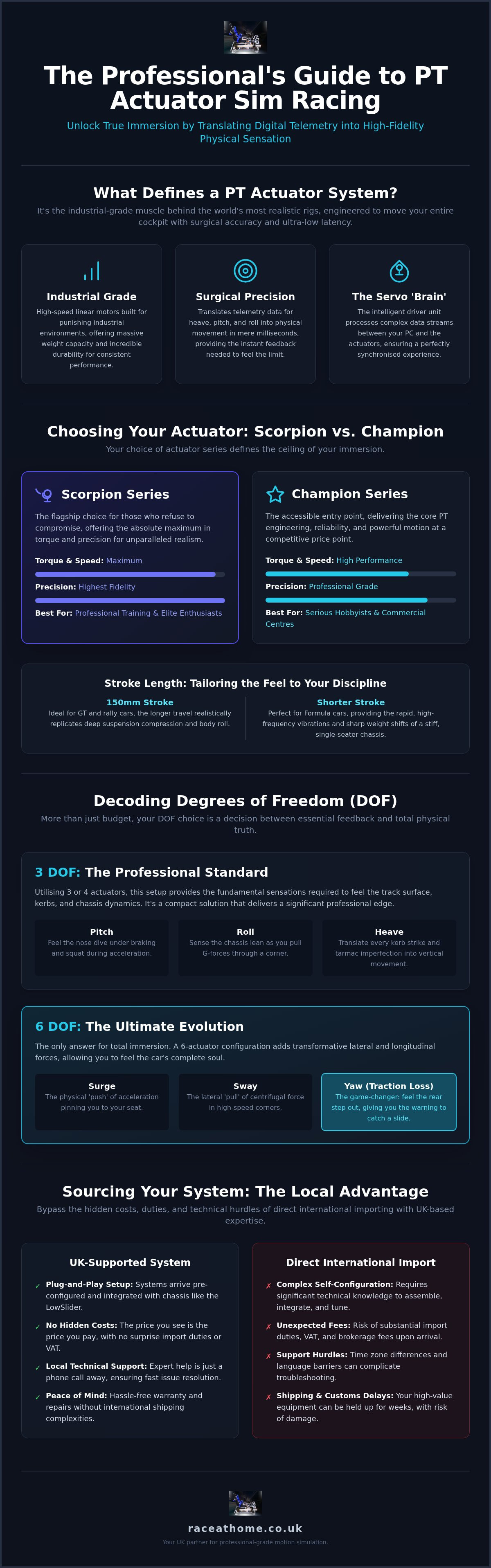
A PT Actuator is a high-speed, industrial-grade linear motor engineered to translate digital telemetry into immediate physical movement. While hobbyist equipment often relies on simple vibration, these systems utilise electromagnetic force to shift your entire cockpit with surgical accuracy. This is why professional racing teams and elite flight schools rely on this specific hardware as their gold standard for training. To understand the broader engineering context, one might ask: What is a Motion Simulator? In the high-stakes world of PT actuator sim racing, it's the difference between playing a game and mastering a vehicle.
The system's intelligence resides in the Servo Driver. This unit acts as the "brains" of the operation, sitting between your PC and the hardware to process complex data streams. It commands the actuators to react with ultra-low latency, ensuring that what you see on screen is exactly what you feel in your seat. Because these components are built for industrial environments, they offer a massive weight capacity and incredible durability. They don't just perform; they endure.
The Science of High-Fidelity Motion
Precision is everything. These actuators interpret heave, pitch, and roll data in mere milliseconds, providing the instant feedback required to catch a slide or judge a braking zone. The "throw", or travel distance of the actuator, is critical here. Longer travel allows the system to replicate the deep compression of a GT car's suspension, whereas shorter, faster movements are better suited to the stiff chassis of a Formula car. Using industrial-grade components ensures that this fidelity remains consistent even during 24/7 commercial operations or the most punishing home endurance races. This commitment to durability is also why similar technology is essential in healthcare; you can learn more about RIHA Industries and how they apply these engineering standards to advanced patient transfer systems.
PT Actuator Product Tiers: Scorpion vs. Champion
When building a PT actuator sim racing rig, the tier you select defines the ceiling of your immersion. The Scorpion Series stands as the flagship choice, offering maximum torque and the highest level of precision for those who refuse to compromise on realism. If you're looking for a more accessible entry point, the Champion Series provides the core PT engineering and reliability without the flagship price tag. Your choice of stroke length should reflect your primary discipline. GT racers often prefer the 150mm stroke for its realistic suspension feel, whilst Formula enthusiasts may opt for shorter travel to replicate the high-frequency vibrations and rapid weight shifts of a single-seater.
Comparing 3DOF and 6 DOF PT Actuator Setups
Deciding on the number of degrees of freedom (DOF) for your rig is about more than just budget. It's a choice between essential feedback and total physical truth. Whilst 3DOF systems provide the fundamental sensations required to feel the track surface, a 6DOF platform introduces the lateral and longitudinal forces that define high-performance driving. In the context of PT actuator sim racing, the hardware you choose dictates how much of the car's soul you can actually feel through your seat. You'll need to consider your space, your training goals, and your desire for absolute realism before committing to a specific configuration.
The 3DOF Experience: Suspension and G-Force
A 3DOF setup is the industry standard entry point for motion. It typically utilises three or four actuators to manage pitch, roll, and heave. Pitch allows you to feel the nose dive under heavy braking. Roll replicates the lean of the chassis as you pull through a high-speed corner. Heave is perhaps the most vital element here, as it translates every kerb strike, gear shift, and tarmac imperfection into vertical movement. It's a compact solution that fits into most home offices whilst still providing enough data to significantly improve your lap times. If you're limited on space but crave a professional edge, starting with a 3DOF setup is a logical move.
The 6 DOF Revolution: Surge, Sway, and Yaw
For those seeking the ultimate evolution of the hobby, 6DOF is the only answer. This configuration adds surge, sway, and yaw to the mix, requiring a more complex arrangement of six actuators. Surge and sway are transformative; they allow you to feel the "push" of acceleration and the lateral "pull" of centrifugal force. However, the real secret is yaw, often referred to as traction loss. This component allows the rear of the rig to slide independently, giving you the split-second warning needed to catch a slide before it ends your race. This is The Secret to Realistic Sim Racing that professional drivers use to hone their instincts.
Achieving this level of fidelity requires robust hardware and precise synchronisation. A 6DOF PT actuator sim racing rig demands more from your controllers and your chassis alike. If you're ready to bridge the gap between simulation and reality, you might consider viewing our LowSlider platforms, which are engineered to house these advanced 6DOF configurations with a minimal footprint and maximum structural integrity. This setup isn't just about movement; it's about the precision of the data being fed to your brain.
The LowSlider Advantage: Engineering the Perfect Chassis
High-performance actuators are only as good as the frame they're bolted to. If your chassis flexes under load, you're losing the very telemetry you paid to feel. Standard aluminium profile rigs, whilst popular, often fail to manage the immense torque and rapid-fire transients of PT actuator sim racing hardware. They creak, they groan, and they muffle the feedback. The LowSlider was engineered from the ground up to solve these specific mechanical challenges, providing a rock-solid foundation that translates every digital impulse into physical reality.
The core of the LowSlider design is its ultra-low profile. By keeping the centre of gravity as close to the floor as possible, we minimise unwanted oscillations and ensure the rig remains stable during violent 6 DOF movements. This isn't a mass-produced kit designed for a generic market. Every platform is hand-built in the UK with a focus on precision engineering that mass-market alternatives simply cannot match. It's the difference between a bespoke racing chassis and a flat-pack desk. This dedication to craftsmanship ensures that your investment provides a reliable, high-fidelity experience for years to come.
Eliminating Flex and Maximising Feedback
To achieve true immersion, there can be no compromise on structural rigidity. Every millimetre of actuator movement must reach the driver's seat without being absorbed by a bending frame. We utilise zero-play joints and reinforced mounting points to ensure that the feedback from your Scorpion actuators is crisp and immediate. This level of rigidity is why the LowSlider is the preferred partner for high-end motion kits; it allows the hardware to perform at its absolute limit without the distraction of mechanical flex. When the software commands a kerb strike, you feel a sharp, metallic thud, not a dampened vibration.
Space-Saving Engineering for Home Users
One of the biggest hurdles for UK enthusiasts is the physical footprint of a motion simulator. Most professional systems require a dedicated warehouse space, but the LowSlider is designed for the British home. We've engineered a way to fit a full 6 DOF system into a standard room size without sacrificing performance or aesthetics. It's a sleek, low-profile solution that looks as good as it feels. If you're planning your next upgrade, Building a Professional Motion Rig in 2026 requires a chassis that balances professional-grade muscle with a compact, home-friendly footprint. You don't need a commercial unit to experience world-class motion; you just need the right engineering.
Direct Import vs. UK-Supported Systems: What You Need to Know
Choosing your hardware is only half the battle. The logistical path you take to acquire your PT actuator sim racing kit determines whether your journey ends in a podium finish or a pile of expensive, non-functional metal. While direct imports from overseas might appear cost-effective at first glance, the reality of UK customs duties and 20% VAT can quickly erase any perceived savings. If a component arrives damaged or develops a fault, the cost of return shipping to an international manufacturer is often prohibitive, leaving you with a very expensive paperweight.
Technical support is the true differentiator. Configuring software like SimTools or FlyPT Mover to work in perfect harmony with your hardware requires precision. Having a UK-based expert at the end of the phone to guide you through these complexities is invaluable. A local guarantee provides the peace of mind that high-value electronics demand. Instead of waiting weeks for an international response, you get immediate, professional assistance from specialists who understand the specific requirements of the British sim racing community.
Solving the "Reddit" Anxiety
If you spend any time on community forums, you'll see the anxiety surrounding component reliability and the "box of bits" headache. We address these concerns by vetting every single PT Actuator component before it ever reaches your door. This curated approach ensures that your VR headset, pedals, and motion platform work in a seamless ecosystem. By choosing a UK-supported system, you aren't just buying parts; you're investing in a refined experience where the hardware has already been tested to meet professional standards. This eliminates the guesswork and the fear of a mid-race hardware failure.
One-Hour Assembly: From Box to Track
The transition from delivery to driving shouldn't take days of frustration. Our LowSlider rigs feature a modular, four-piece design that simplifies the entire process. You don't need an engineering degree or a workshop full of specialised tools to get started. Most users can move from unboxing to their first lap in approximately one hour. This efficiency is a core part of our philosophy. We believe your time should be spent on the track, not under the rig. For a deeper look at the logistics of upgrading, see our Buy Motion Simulator UK: The 2026 Guide. If you're ready to bypass the import risks and get racing sooner, you can explore our UK-supported motion platforms today.
Optimising Your PT Actuator Rig for Maximum Realism
Owning the hardware is only the first step toward professional-grade immersion. To truly unlock the potential of PT actuator sim racing, you must master the calibration between digital telemetry and physical response. A poorly tuned rig can feel like a carnival ride, whereas a perfectly optimised system provides the nuanced feedback required for millimetre-perfect car control. It's about finding the balance between intensity and accuracy, ensuring the motion enhances your driving rather than distracting from it.
Choosing your software layer is the most critical decision in this process. SimTools remains a popular, community-driven choice with vast compatibility. However, many professional users prefer FlyPT Mover for its granular control over complex 6 DOF kinematics. Regardless of your choice, the "less is more" philosophy is paramount. You don't want the rig to move just for the sake of moving. Instead, you want it to communicate the weight of the chassis and the texture of the tarmac with subtle, high-frequency vibrations that mimic a real-world racing environment.
The Software Layer: Translating Telemetry
Effective calibration requires distinct profiles for different racing disciplines. A GT3 car demands stiff, rapid weight transfers and detailed suspension feedback to help you judge the limit of the ABS. In contrast, a Rally profile requires longer travel and more violent yaw movements to replicate the chaos of a gravel stage. Implementing washout filters is essential here; these algorithms return the rig to its neutral position during sustained cornering, preventing the actuators from hitting their physical limits and ruining the illusion.
- Active Belt Tensioners: Integrating PT Actuator’s Tension R Pro adds a layer of sustained G-force simulation that actuators alone cannot provide.
- Vibration Cues: Use software to inject engine RPM and tyre slip data directly into the actuators for a multi-sensory experience.
- VR Synchronisation: Pairing a Pimax headset with your motion platform creates the ultimate "brain-trick," where your inner ear and eyes receive perfectly aligned data.
The Future of Motion: 2026 and Beyond
The PT actuator sim racing ecosystem is designed for longevity. With the unified CAN bus architecture now standard across the product line, the communication protocol between your PC and the hardware is faster and more reliable than ever. This modular approach means you can add components like traction loss or active belts as your budget and space allow. Maintenance is straightforward; a simple wipe of the linear shafts and occasional lubrication ensures your actuators remain quiet and smooth for years of service. Investing in industrial-grade quality now doesn't just provide a better experience today; it saves you from the cycle of upgrading sub-par hobbyist gear tomorrow.
Elevate Your Training with Professional-Grade Motion
Transitioning from a static rig to a motion-capable platform is the single most significant upgrade a sim racer can make. By choosing PT actuator sim racing hardware, you're investing in industrial-grade precision that translates digital telemetry into the physical truth of the track. We've explored how the right software calibration and a rigid, low-profile chassis are essential to ensure this power isn't lost to mechanical flex or poor tuning. The combination of high-fidelity actuators and bespoke UK engineering creates a training tool that sharpens your instincts and shaves tenths off your lap times.
As an official PT Actuator partner, Race@Home provides the bridge between these world-class components and your home setup. Our LowSlider platforms are hand-built in the UK and designed for a seamless, 60-minute assembly, giving you professional realism without the logistical headaches of direct imports. We offer worldwide shipping to ensure every driver has access to this level of performance. Explore the LowSlider 6 DOF Motion Platform Powered by PT Actuator and take your place on the grid with the confidence that only professional engineering can provide.
Frequently Asked Questions
Are PT Actuators compatible with all sim racing games?
PT Actuators are compatible with almost any modern racing title that outputs telemetry data. Popular simulators such as iRacing, Assetto Corsa Competizione, and rFactor 2 are fully supported through third-party software like SimTools, SimHub, or FlyPT Mover. If a game provides data for pitch, roll, and heave, the actuators can translate it into motion. This broad compatibility ensures that your hardware remains useful across multiple racing disciplines, from GT3 endurance to off-road rally stages.
How much noise does a PT Actuator motion rig make in a home environment?
These actuators are engineered for industrial environments, making them remarkably quiet for home use. You'll hear a subtle electromagnetic hum and the mechanical sound of the linear shafts moving, but it's far less intrusive than older hydraulic systems. Most of the audible noise actually comes from the chassis or the driver's seat as it reacts to the movement. Using high-quality isolation feet can further reduce vibrations that might otherwise travel through your floor.
Do I need a special electrical circuit to run a 6 DOF motion platform?
A standard UK three-pin 240V socket is usually sufficient to power a PT actuator sim racing rig. However, a full 6 DOF setup can draw significant peak current during violent transients or high-load cornering. We recommend using a dedicated wall outlet rather than a daisy-chained extension lead to ensure stable power delivery. For peace of mind, some users choose to install a dedicated 16-amp circuit, though this isn't strictly necessary for most home environments.
What is the difference between PT Actuators and D-BOX systems?
The primary difference lies in the balance between travel distance and haptic detail. PT Actuators offer industrial-grade muscle with significantly longer stroke lengths, providing a more realistic sensation of large-scale suspension movements and weight transfer. Whilst D-BOX systems are renowned for their high-frequency haptic vibrations and plug-and-play simplicity, PT hardware is often preferred by those seeking higher weight capacities and more customisable motion profiles at a competitive price point for professional-grade hardware.
Can I add PT Actuators to my existing aluminium profile sim rig?
It is possible to mount these actuators to a standard aluminium profile rig, but you must be wary of structural flex. The immense torque generated by a PT actuator sim racing system can easily twist or stress standard 8020 joints, leading to lost feedback and annoying creaks. For the best experience, a bespoke chassis like the LowSlider is advised. It is specifically engineered with reinforced mounting points and zero-play joints to handle these forces without compromise.
How does motion feedback help improve lap times in sim racing?
Motion feedback improves your performance by reducing the time it takes for your brain to perceive car behaviour. In a static rig, you rely entirely on visual and audio cues, which have a slight processing delay. Physical sensations, such as the rear end stepping out or the nose diving under braking, are processed by your vestibular system almost instantly. This allows you to react faster, catch slides earlier, and maintain a more consistent racing line.
What maintenance do PT Actuators require over time?
Maintenance requirements are minimal thanks to the industrial-grade construction of the linear motors. You should regularly wipe the actuator shafts with a clean, lint-free cloth to remove dust and debris that could compromise the seals. Applying a small amount of manufacturer-recommended lubricant every few months will ensure the movement remains smooth and silent. It is also good practice to periodically check that all mounting bolts and electrical connections remain secure after heavy use.
Is a 3DOF system enough, or should I wait for a 6 DOF budget?
A 3DOF system provides the essential heave, pitch, and roll movements required to feel the track surface and weight transfer. It's a fantastic entry point for most enthusiasts. However, if your budget allows, a 6 DOF system is a transformative upgrade. The addition of yaw (traction loss) and lateral sway is what truly bridges the gap to reality. If you're serious about professional driver training, waiting for a 6 DOF system is often the better long-term investment.


