
What if the only thing standing between you and a professional-grade 6 DOF motion simulator isn't your budget, but a simple misunderstanding of floor tiles? Most enthusiasts assume that graduating to world-class immersion requires a dedicated garage or a structural extension. You likely feel that a high-end setup will inevitably overwhelm your home, leaving you trapped between a desire for realism and the reality of your floor plan. This hesitation is entirely understandable, as navigating sim racing rig space requirements often feels like a difficult choice between performance and practicality.
It’s a common misconception that professional motion platforms must be massive to be effective. We're here to show you that a "no-compromise" attitude toward quality doesn't have to result in a "no-space" reality for your home. In this 2026 guide, you’ll discover the exact dimensions required for a professional motion rig whilst learning how to calculate the critical "motion envelope" for safe operation. We will provide a clear breakdown of how clever engineering and hardware integration can shrink your footprint without losing an ounce of the visceral, high-octane feedback you crave.
Key Takeaways
- Distinguish between a stationary footprint and the dynamic "motion envelope" required for high-performance pitch, roll, and yaw.
- Master the specific sim racing rig space requirements for 3DoF and 6 DOF systems to ensure safe clearance in your home.
- Identify why integrated, ultra-low profile designs offer a more efficient use of floor space compared to bulky, bolt-on actuator kits.
- Learn how to optimise your room layout and choose the correct floor surface to ensure maximum stability during intense motion sessions.
- Discover how modular hardware and VR integration can transform even a small spare bedroom into a professional-grade racing centre.
Understanding Sim Racing Rig Space Requirements: Static vs Motion
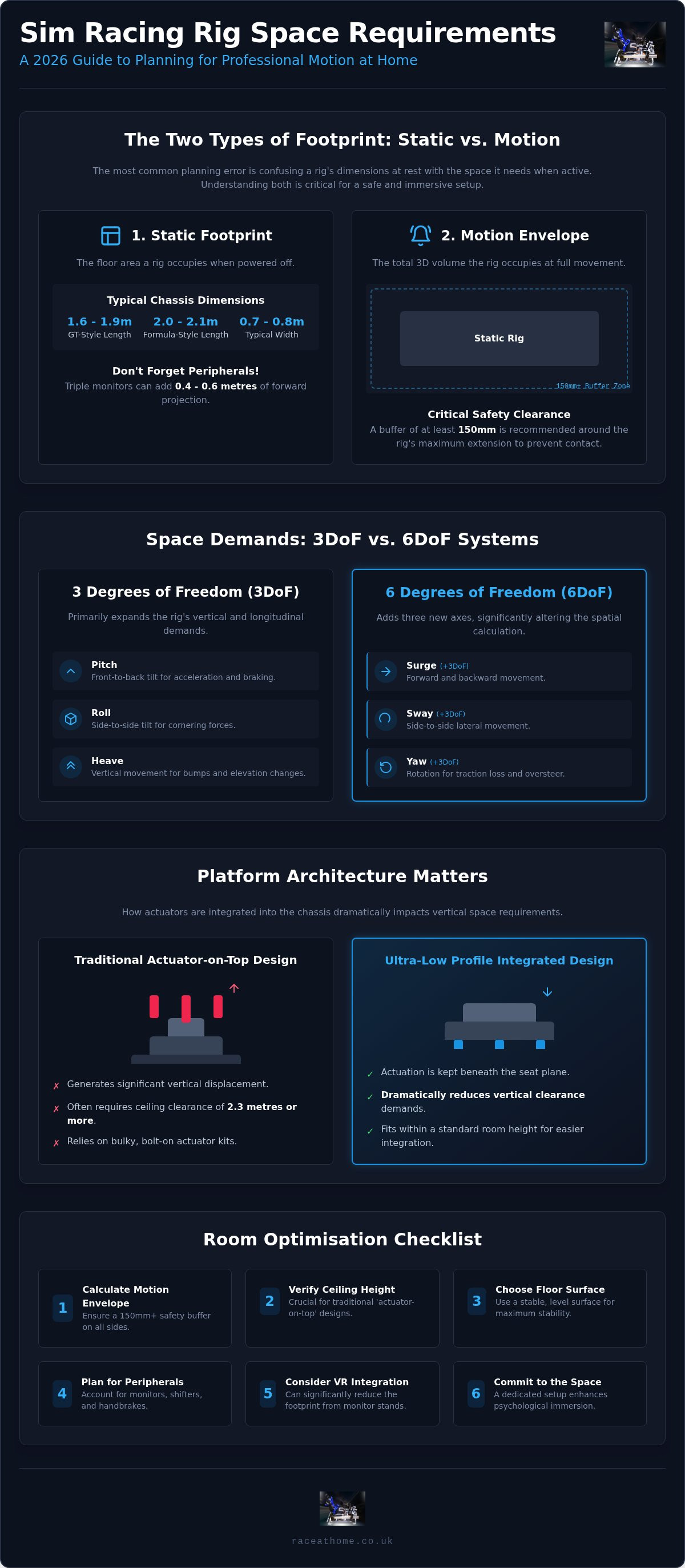
There's a fundamental distinction that separates enthusiasts who struggle with space from those who plan for it successfully. A rig's static footprint tells you how much floor it occupies when switched off. Its motion envelope tells you how much space it actually needs to operate safely. Conflating the two is the single most common planning error in home simulator setup, and it's one that competitors focused on foldable chairs and compact aluminium profiles consistently fail to address.
Understanding both dimensions is the first step toward calculating your true sim racing rig space requirements with confidence.
The Static Footprint: Standard Dimensions
A GT-style seating position, with its reclined bucket seat and extended pedal tray, typically produces a rig length of roughly 1.6 to 1.9 metres, with a width of approximately 0.7 to 0.8 metres. Formula-style positions, which place the driver lower and more horizontally extended, can push that length closer to 2.0 to 2.1 metres. These are the numbers most guides stop at. They shouldn't.
The actual floor area required expands considerably once you account for peripheral hardware. A triple-monitor stand adds roughly 0.4 to 0.6 metres of forward projection. Wheel-mounted button boxes, handbrake mounts, and shifter stalks extend the lateral footprint on either side. Even the concept of "rig flex" plays a role: a chassis that twists or vibrates under load needs additional clearance from walls and furniture to avoid structural contact during intense sessions.
Why Motion Changes the Spatial Equation
A stationary aluminium profile rig occupies a fixed rectangle of floor. A full motion racing simulator occupies a dynamic volume of space that shifts with every corner, braking zone, and kerb strike. That's a fundamentally different planning challenge.
Traditional actuator-on-top designs, where pneumatic or electric actuators are mounted above the seat frame, generate significant vertical displacement. Some configurations require ceiling clearance of 2.3 metres or more during full pitch extension. Horizontal travel during roll and yaw cycles adds a safety buffer requirement of at least 0.3 to 0.5 metres on each side of the static footprint.
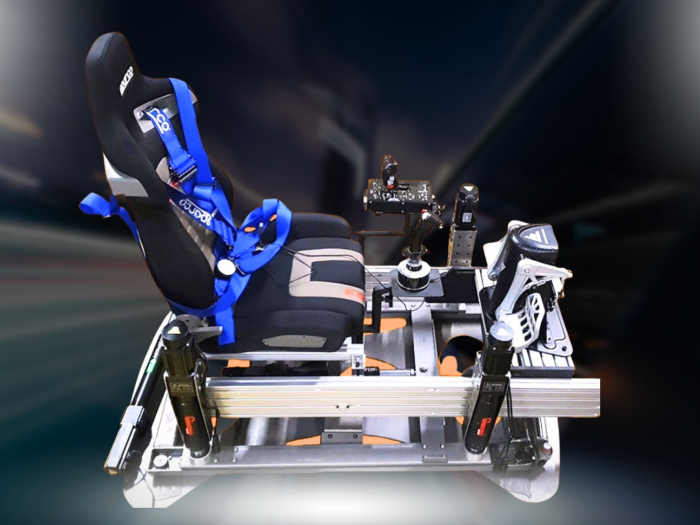
This is precisely where platform architecture matters. 6 DOF motion simulators built with an ultra-low profile chassis keep actuation beneath the seat plane rather than above it, dramatically reducing vertical clearance demands whilst preserving the full fidelity of pitch, roll, heave, surge, sway, and yaw. The result is a motion envelope that fits within a standard room height rather than requiring a converted garage or a structural modification.
Choosing a dedicated, permanent installation over a temporary foldable setup also delivers a measurable psychological benefit. A purpose-built racing centre, however compact, signals commitment to the craft. It conditions your mindset before you even sit down, and that psychological immersion is part of what separates enthusiast-grade space management from a compromise solution.
Calculating Your 'Motion Envelope': Clearance for Pitch, Roll, and Yaw
To master your sim racing rig space requirements, you must look beyond the floor. You are not just placing furniture; you are installing a high-performance machine with a dynamic range of movement. We define the motion envelope as the total three-dimensional volume the rig occupies at full tilt. More specifically, the motion envelope is the maximum reach of all actuators during extreme telemetry spikes. If you fail to account for this volume, you risk mechanical interference or physical damage to your surroundings during high-intensity manoeuvres.
A standard 3DoF system, which manages pitch, roll, and heave, primarily expands the rig's vertical and longitudinal demands. However, stepping up to a 6 DOF system introduces surge, sway, and yaw, which significantly alters the spatial calculation. To ensure total safety, we recommend a "buffer zone" of at least 150mm beyond the maximum extension of every moving part. This clearance prevents the chassis from making contact with walls, furniture, or spectators whilst you are fully immersed in the cockpit.
Traction Loss and Yaw: The Horizontal Demand
Traction loss is the most spatial-hungry component of a professional simulator. Whilst pitch and roll happen within the frame's general width, yaw and traction loss require the rear of the rig to swing laterally. This creates a wider horizontal demand at the back of the platform than at the front. When calculating the swing radius for twin-traction-loss systems, you must measure the distance from the pivot point to the furthest corner of the rear frame.
Positioning your rig diagonally in a room or away from corners can often provide the necessary arc for these lateral movements. If you’re restricted by a narrow room, integrated designs like our LowSlider 6 DOF motion platform are engineered to deliver this professional-grade realism whilst maintaining a remarkably tight horizontal arc compared to bulky, bolt-on alternatives.
Vertical Clearance: Avoiding Ceiling and Monitor Collisions
Vertical movement, or heave, can lift the entire cockpit by several centimetres in a fraction of a second. When combined with a steep pitch during heavy braking or climbing, the height of the steering wheel and the driver's head can increase dramatically. You must ensure that your monitor mounts are either decoupled from the motion frame or positioned with enough clearance to avoid the "nose" of the rig striking the screen during an upward heave.
Cable management is equally critical for vertical safety. Every power lead, USB cable, and display cord must have sufficient slack to accommodate the full stroke of the actuators without snagging. Using high-quality, flexible cable trunking ensures that as the rig pitches and rolls, your connections remain secure and your hardware remains undamaged. Low-profile engineering is vital here; by keeping the centre of gravity closer to the floor, you reduce the total vertical height required, making professional motion feasible even in rooms with standard UK ceiling heights.
Footprint Comparison: How Much Floor Space Does a Professional Rig Actually Need?
Most planning guides suggest a rigid cockpit requires a baseline of roughly 155cm by 60cm. Whilst technically accurate for a stationary frame, this figure ignores the "functional footprint" of a working simulator. You need to account for ingress and egress; the space required to comfortably climb into a deep bucket seat without striking your knees on a peripheral mount. Professional sim racing rig space requirements must balance this human element with the mechanical reach of the hardware.
Bespoke manufacturing allows for much tighter tolerances than mass-market solutions. When a rig is hand-built with integrated motion in mind, the actuators are nested within the chassis architecture rather than being "bolt-on" afterthoughts. Traditional actuator kits often hang off the corners of an aluminium profile, ballooning the width and creating trip hazards. Integrated platforms consolidate these mechanicals, ensuring every millimetre of floor space contributes directly to your immersion rather than just housing a bracket.
The LowSlider 6 DOF Footprint
The Race@Home LowSlider 6 DOF platform is engineered to defy the "bigger is better" myth of professional simulators. By integrating our proprietary Twin-Traction-Loss system directly into the ultra-low profile base, we've maintained a width that remains remarkably slim. In practical terms, this setup occupies a footprint comparable to a standard executive office desk. It's a professional-grade racing centre that doesn't demand a dedicated warehouse. Because it ships in four manageable pieces, you can easily move it through standard UK doorways and assemble it in rooms where a pre-built turnkey rig simply wouldn't fit.
Static vs Motion: A Side-by-Side Analysis
To help you visualise how different tiers of hardware impact your floor plan, consider the following specifications. These figures represent the typical space required for the hardware itself, excluding the additional motion envelope buffer discussed previously.
| Rig Category | Length (mm) | Width (mm) | Recommended Room Area |
|---|---|---|---|
| Foldable/Entry-Level Rig | 1200 - 1500 | 500 - 600 | Small Bedroom / Nook |
| Mid-range Aluminium Profile | 1350 - 1600 | 650 - 800 | Home Office / Spare Room |
| LowSlider 6 DOF Motion Rig | 1550 - 1750 | 800 - 950 | Dedicated Racing Centre |
It is a testament to modern British engineering that a professional 6 DOF rig can occupy less than 2 square metres of floor space whilst delivering world-class realism. This compact efficiency ensures that even if you're restricted to a spare bedroom, you don't have to compromise on the fidelity of your motion experience.
Optimising Your Room Layout for Immersion and Safety
Integrating a professional motion rig into a standard home doesn't require a dedicated wing. It requires a strategic approach to spatial geometry. If you're placing your setup in a multi-use home office or a spare bedroom, consider positioning the rig as the room's anchor point rather than an afterthought tucked into a corner. This allows for the necessary motion envelope whilst keeping the primary walkways clear. When you organise your sim racing rig space requirements around the room's natural flow, the hardware feels like a premium feature rather than an intrusion. If you are also looking at wider residential accessibility to ensure your environment supports your lifestyle long-term, you can discover HomeSafe Living Solutions for professional aging-in-place modifications.
Floor surface is a critical, often overlooked factor in motion stability. Hardwood, laminate, or polished concrete floors are superior for professional simulators. They allow the platform to shift and vibrate with clinical precision. If you must race on carpet, the inherent friction can dampen the subtle tactile feedback of the actuators or even cause the frame to snag during high-yaw manoeuvres. A high-quality, industrial-grade floor mat provides a level surface and protects your home's interior from the rig's mechanical energy. This also creates a visual boundary that keeps the "centre" of the room tidy and professional.
While optimising your living space for high-tech simulator equipment, it is equally important to consider the maintenance of other essential motorised aids in the home; for those who rely on wheelchairs or scooters, UK Mobility Batteries offers expert guidance on ensuring your mobility equipment remains fully powered and reliable.
The most transformative space-saving strategy in 2026 is the shift toward high-fidelity virtual reality. By opting for a Pimax VR motion simulator setup, you effectively eliminate the need for bulky triple-monitor arrays. These stands often consume more floor space than the rig itself, creating a massive visual and physical barrier in small rooms. Moving to a VR-only configuration can reduce your physical footprint by up to 40%, reclaiming significant square footage for other activities. You simply need to ensure there's enough vertical "headroom" for tracking sensors to maintain a clear line of sight during extreme pitch and heave movements.
Power and Connectivity Logistics
High-performance actuators demand reliable, clean power. If you're running a full 6 DOF system, it's wise to plan for a dedicated circuit to avoid tripping domestic breakers during intense telemetry spikes. Position the rig close to wall sockets to keep cable runs short. This minimises trip hazards and keeps the aesthetic clean. Ventilation is equally vital in compact spaces. Professional gaming PCs and motion controllers generate significant heat during long endurance stints. Ensure there's at least 300mm of clearance behind the PC tower and actuator housings to allow for consistent airflow.
Ready to reclaim your floor space without sacrificing the thrill? Explore our compact motion platforms to see how we maximise realism in minimal square footage.
Why the LowSlider Design is the Ultimate Solution for Compact Professional Sim Racing
Engineering a simulator that delivers true 6 DOF realism within the constraints of a domestic floor plan requires a departure from traditional, bulky architecture. Whilst mass-market manufacturers often rely on oversized frames to maintain stability, the LowSlider platform achieves its performance through surgical precision and structural integrity. By nesting the actuators within an ultra-low profile base, we have effectively decoupled professional performance from massive sim racing rig space requirements. This design ensures that the visceral sensations of surge, sway, and traction loss are delivered without the hardware dominating your entire living area.
Logistical accessibility is often the silent killer of high-end home setups. Many turnkey solutions arrive as monolithic structures that are impossible to navigate through narrow UK corridors or up steep staircases. We solved this by designing the LowSlider to ship in four manageable pieces. This modular approach allows you to move a world-class simulator into an upstairs bedroom or a converted attic with ease. Once in position, the proprietary assembly system allows for a one-hour setup time, ensuring your room doesn't remain a construction zone for days on end. If you are ready to transform your home environment, you can buy a motion simulator in the UK that was engineered specifically for these practical challenges.
Engineering for the Home Environment
The visual impact of a simulator is just as important as its physical footprint. Traditional "actuator-on-top" rigs create a towering mechanical silhouette that can feel oppressive in a standard room. The LowSlider’s ultra-low profile keeps the centre of gravity and the visual line close to the floor, allowing the rig to sit comfortably below window sills and furniture lines. Every unit is hand-built in the UK with a focus on tight tolerances, ensuring the final assembly fits through standard door frames without the need for structural modifications. It is the logical choice for drivers who refuse to compromise on the fidelity of their experience simply because they lack a dedicated warehouse.
Next Steps: Measuring Your Space
Before you finalise your setup, conduct a final audit of your intended racing centre. Use this checklist to ensure your room is ready for a professional motion installation:
- Verify the Static Footprint: Ensure you have a clear area of at least 1750mm x 950mm for the LowSlider 6 DOF.
- Confirm the Motion Envelope: Allow for a 150mm safety buffer beyond the maximum swing of the traction-loss system.
- Check Power Proximity: Ensure a dedicated wall socket is within two metres of the rig's rear controller housing.
- Assess VR Headroom: If using a headset, check for ceiling obstructions like low-hanging light fixtures.
If you have unique room dimensions or architectural quirks, the Race@Home team is available to provide bespoke advice on your specific sim racing rig space requirements. For a deeper dive into the technical specifications of our hardware, consult our full motion simulator guide to see how we bridge the gap between digital telemetry and physical sensation.
Transform Your Space into a Professional Racing Centre
Mastering sim racing rig space requirements is the final hurdle between you and total immersion. You've seen how the distinction between a static footprint and a dynamic motion envelope allows for precise planning in even the most compact home environments. By prioritising ultra-low profile engineering and considering the space-saving dividends of high-fidelity VR, you can achieve professional-grade realism without a dedicated warehouse. Realism is no longer gated by the size of your room, but by the intelligence of your hardware choice.
At Race@Home, we specialise in bridging the gap between digital telemetry and physical sensation. Our platforms are hand-built in the UK for ultimate precision and feature an ultra-low profile design specifically for seamless home integration. With worldwide shipping in four easy-to-assemble pieces, your journey to the podium starts in under an hour. Explore the LowSlider 6 DOF Motion Platform today and discover how we've redefined what's possible in a domestic setup. It’s time to stop compromising and start racing at the highest level.
Frequently Asked Questions
How much space does a 6 DOF sim racing rig actually need?
A high-end 6 DOF rig typically requires a static footprint of approximately 1750mm x 950mm. However, the total space must account for the motion envelope, which adds roughly 150mm of clearance on all sides. When calculating sim racing rig space requirements, you should aim for a total floor area of at least 2.0m x 1.3m to ensure the yaw and traction-loss movements operate without any restriction or furniture interference.
Can I fit a motion simulator in a standard spare bedroom?
Yes, a professional motion simulator can easily fit within a standard UK spare bedroom. Most bedrooms provide at least 3m x 3m of floor space, which is more than enough for a compact platform like the LowSlider. By positioning the rig strategically and perhaps opting for a VR setup, you can maintain a functional room layout whilst still enjoying the visceral, high-performance feedback of a full 6 DOF professional system.
Do I need a special floor to support a motion rig?
You don't need a reinforced floor, but a solid, level surface like hardwood or laminate is highly recommended. These surfaces allow the actuators to transmit precise telemetry data without the dampening effect found in thick carpets. If you have carpeted floors, using an industrial-grade floor mat provides the necessary stability and protects the pile from the rig's mechanical energy. This ensures the sensory feedback remains sharp and clinical during intense racing sessions.
Is VR better than monitors for a small sim racing space?
VR is significantly better for space management because it removes the need for bulky triple-monitor stands. A Pimax VR headset provides 1:1 immersion whilst reducing the physical footprint of your setup by up to 40%. This allows you to meet sim racing rig space requirements in rooms that simply couldn't accommodate a wide monitor array. It also keeps the room's aesthetic cleaner by centralising the hardware around the cockpit itself.
How much clearance should I leave around my motion platform for safety?
We recommend a minimum safety clearance of 150mm to 200mm beyond the maximum reach of the actuators. This buffer zone prevents the chassis from striking walls, furniture, or bystanders during extreme pitch, roll, or yaw movements. It’s vital to measure the swing radius of the traction-loss system specifically, as this horizontal arc often represents the rig's widest point of travel during high-speed cornering or aggressive slides.
Will a motion rig fit through a standard internal door?
Most turnkey professional rigs won't fit through a standard 762mm internal door without being dismantled. However, the LowSlider is specifically engineered for home accessibility and ships in four manageable pieces. This modular design ensures that you can move the components through narrow hallways and standard door frames with ease. It's the ideal solution for drivers installing a professional-grade racing centre in an upstairs room or a converted attic.
Does the LowSlider rig require permanent installation or bolting to the floor?
No, the LowSlider does not require bolting to the floor or any permanent structural modifications. Its ultra-low profile and high-mass engineering provide exceptional stability even during violent 6 DOF movements. The weight of the platform and the driver keeps the rig firmly planted on any level surface. This makes it a perfect choice for renters or homeowners who want professional realism without damaging their property's interior or floorboards.
How long does it take to assemble a professional motion rig at home?
Assembly of a LowSlider motion platform typically takes under an hour for a single person. Because the rig arrives in four pre-assembled sections, you simply need to connect the main modules and secure the electronics. This rapid setup time prevents your home from becoming a construction zone for days. It allows you to transition from unboxing to the starting grid with minimal downtime, ensuring a professional experience from the very first moment.


