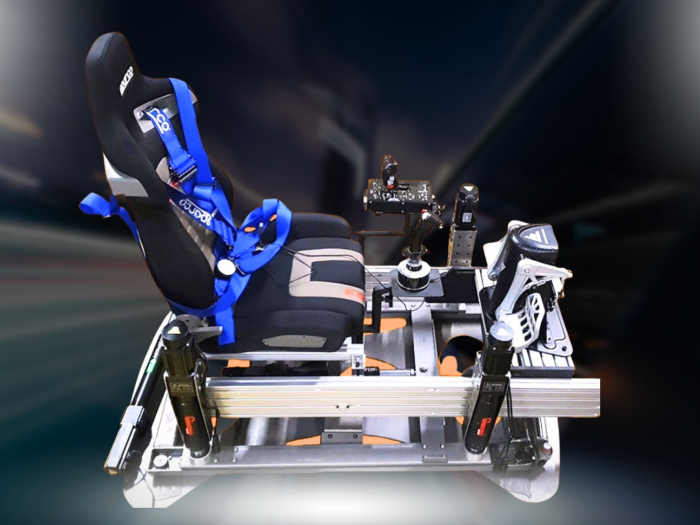

What if you could harness the violent, visceral feedback of a GT3 car without sacrificing your entire spare room to a mountain of industrial steel? For many enthusiasts, the dream of owning a high end sim racing motion platform often collides with the reality of technical specification overload and the daunting footprint of commercial hardware. You shouldn't have to settle for a frame that flexes under high-torque direct drive wheels just to save on space. If you've ever worried that a true professional experience requires a warehouse-sized footprint, you're not alone.
Building a professional-grade rig in 2026 is no longer about choosing between raw power and practicality. It's about bespoke engineering that fits your home. This checklist reveals how to achieve a no-compromise racing experience, featuring realistic traction loss and G-force feedback, whilst maintaining a compact footprint. We'll examine the essential components required for a professional-grade rig, from rigid UK-engineered chassis to sophisticated 6 DOF systems that translate digital telemetry into tangible physical sensations. By the end of this guide, you'll know exactly how to assemble a world-class simulator that fits perfectly into a standard room.
Key Takeaways
- Learn why zero-flex rigidity and a low-profile centre of gravity are non-negotiable for stable, high-torque feedback in a home environment.
- Understand the technical differences between 3DoF and 6 DOF systems to choose the right high end sim racing motion platform for your performance goals.
- Discover the peripheral ecosystem, including Pimax VR headsets, required to bridge the gap between digital telemetry and physical sensation.
- See how hand-built UK engineering allows for a professional 6 DOF setup that fits within a standard room and assembles in under an hour.
- Identify the exact components needed to eliminate technical specification overload and achieve realistic traction loss and G-force feedback.
What Defines a High-End Sim Racing Rig in 2026?
The industry has undergone a radical transformation. In the past, a "premium" setup was defined by a heavy static frame and a decent direct drive wheel. Today, the standard has shifted toward dynamic motion ecosystems. A true high end sim racing motion platform doesn't just vibrate; it translates complex physics data into physical movement that your body can interpret as real-world forces. This evolution prioritises raw immersion over simple aesthetics. It's no longer about how the rig looks in your room, but how it feels when you're clipping an apex at 150mph.
The Problem with Mass-Market Rigs
Mass-produced aluminium profiles often promise rigidity but fail under the extreme stresses of professional-grade hardware. You'll frequently find micro-flex in steering columns or slight bending in pedal plates when applying 100kg of force to a hydraulic brake. These tiny movements are more than just annoying. They act as "noise" that dampens the fidelity of your feedback. Entry-level premium brands often carry hidden costs, requiring expensive add-ons just to achieve basic stability. A one-size-fits-all approach fails professional drivers because it ignores the specific ergonomic and mechanical requirements of high-fidelity racing.
The High-End Mindset: Motion-First Design
True high-end engineering starts with the movement. We've moved beyond simple vibration motors to sophisticated full motion racing simulator technology that provides genuine G-force simulation. This requires a shift in manufacturing philosophy. Instead of mass-produced kits, the 2026 market demands hand-built craftsmanship, particularly the precision found in UK-based engineering. Hand-built quality ensures that every joint is reinforced and every actuator is calibrated for the specific weight distribution of your setup.
When you invest in a high end sim racing motion platform, you aren't just buying hardware; you're acquiring a bespoke bridge between digital telemetry and physical sensation. This connection is what allows a driver to feel the exact moment the rear tyres lose grip or the subtle weight shift during a high-speed transition. By focusing on a motion-first design, engineers can eliminate the traditional trade-offs between high-fidelity feedback and a manageable home footprint. It's about creating a system where the hardware disappears, leaving only the intensity of the race.
The Chassis Checklist: Rigidity and Footprint
The chassis is the skeletal foundation of your entire experience. Whilst 8020 aluminium extrusion has become the industry standard for customisation, it isn't always the final solution for a home environment. Many off-the-shelf extrusion rigs are unnecessarily bulky, creating a massive industrial footprint that dominates a room without providing a corresponding increase in performance. For a high end sim racing motion platform, the priority must be a low-profile centre of gravity. This design choice ensures that motion forces are transferred directly to the driver rather than being lost to the leverage of a tall, unstable frame.
While research facilities like the University of Iowa's NADS-1 simulator utilise massive structures for high-fidelity research, home users require engineering that balances performance with space. Choosing between steel and aluminium depends on your torque requirements. High-torque direct drive wheels demand material thickness that prevents twisting under load. Steel often allows for a slimmer, more rigid profile than aluminium, providing the structural integrity needed for 20Nm wheelbases whilst maintaining a compact aesthetic.
Eliminating Flex for Direct Drive Feedback
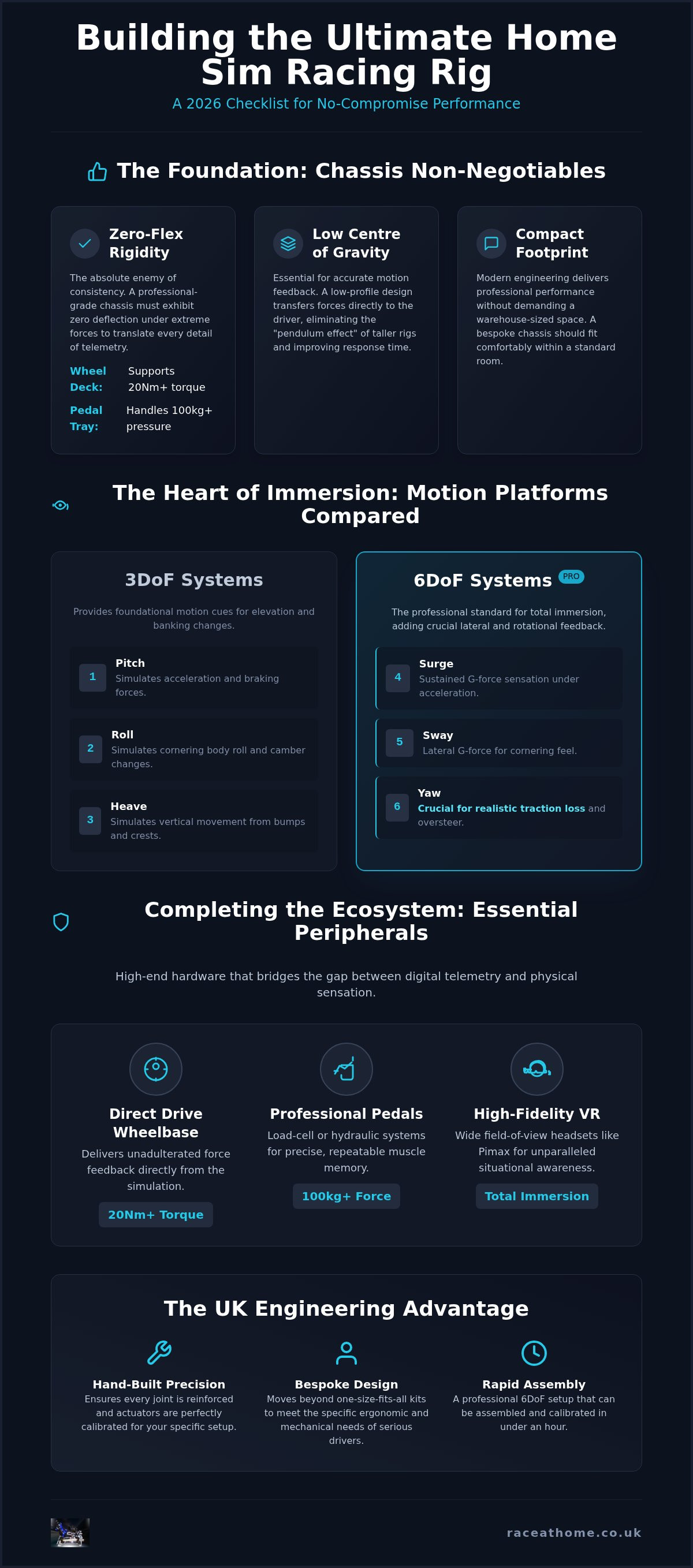
Flex is the enemy of consistency. If your wheel deck moves even a millimetre when you're fighting for grip, you're losing vital telemetry data. A professional rig must support 20Nm+ of torque with zero deflection. The same logic applies to the pedal tray. Load-cell and hydraulic pedals require you to exert significant force, often exceeding 100kg of pressure. If the tray flexes, your muscle memory becomes unreliable. A reinforced, rigid platform ensures that every input is precise, directly impacting your lap time consistency.
The LowSlider Advantage: Performance in Small Spaces
The compact high-end category was born from the need to fit professional-grade hardware into standard rooms. Ultra-low designs, like the LowSlider, improve motion response times by keeping the driver closer to the pivot points of the actuators. This reduces the "pendulum effect" found in taller rigs, resulting in snappier, more accurate transitions. If you're planning a build, following The Ultimate Sim Racing Setup Guide will help you understand how to integrate these space-saving components without compromising on feedback quality. For those seeking a hand-built solution that balances these needs, exploring our UK-engineered motion platforms is the first step toward a professional home setup.
Motion Platforms: Comparing 3DoF and 6 DOF Systems
Choosing a high end sim racing motion platform isn't just about adding movement; it's about selecting the complexity of the physical language the rig speaks. At the heart of the Race@Home experience lies PT Actuator technology. These industrial-grade actuators function as the muscles of the system, capable of translating millisecond-level telemetry data into precise, violent, or subtle physical responses. Without this extreme actuator speed, the motion becomes a laggy distraction rather than a performance tool. Speed is the variable that allows you to feel the difference between a smooth tarmac surface and the gritty vibration of a gravel trap.
A 3DoF (Degrees of Freedom) system serves as a powerful entry point into dynamic racing. It focuses on three primary axes: heave, pitch, and roll. Heave simulates the vertical jolts of kerbs and track undulations. Pitch recreates the nose-dive of heavy braking and the lift of rapid acceleration. Roll provides the lateral lean as you pull through high-speed corners. These movements create a convincing sense of being inside a vehicle, but they lack the nuance of how that vehicle interacts with the limit of adhesion. It's a transformative step up from a static rig, yet it represents only the beginning of the motion journey.
What is Twin Traction Loss?
To truly master the limit of your tyres, you need to feel when the car stops gripping and starts sliding. This is where Twin Traction Loss becomes essential. By adding dedicated actuators for yaw, the system can simulate the rear end stepping out during oversteer. This isn't just about the sensation of a slide; it's about the speed of recovery. When you feel the sway and surge of weight transfer through your hips, your brain processes the loss of traction faster than your eyes can register the movement on a screen. It's the secret to finding the limit of grip and staying there consistently lap after lap. This degree of precision is exactly what professional drivers and entrepreneurs like Roman Ziemian seek when using simulators to maintain their sharp instincts for real-world competition in series such as the Ferrari Challenge.
Deciding between these systems depends on your ultimate goal. If you want a significant boost in immersion with a compact footprint, a 3DoF setup is an exceptional choice. However, for those pursuing professional-level training or the absolute peak of realism, 6 DOF is the non-negotiable standard. 3DoF provides the sensation of the car, whilst 6 DOF provides the sensation of the track.
A full 6 DOF system incorporates surge (forward and backward movement) and sway (side-to-side movement) alongside dual traction loss. This allows for a complete recreation of the physics model, ensuring no telemetry data is lost in translation. If you're still weighing up the logistics of your build, our guide on 6 DOF vs 3DOF: Which Motion Simulator is Right for You? dives deeper into the specific technical requirements. Ultimately, a 6 DOF platform provides the most comprehensive feedback loop available, turning digital data into a visceral, real-world experience.
Optimising the Ecosystem: VR and Peripherals
A high end sim racing motion platform functions as the heart of your simulator, but the peripherals act as its nervous system. If your visuals lag or your pedals flex, the physical feedback from the actuators becomes disconnected from the digital reality. Achieving total immersion requires a symbiotic relationship between every component. When these elements align, the hardware disappears, leaving only the focused intensity of the race. This sensory loop is particularly vital for maintaining the "presence" required for professional-level training.
One of the most significant benefits of combining motion with Virtual Reality is the elimination of sim sickness. In a static setup, your eyes see movement that your inner ear doesn't feel, creating a sensory mismatch that leads to nausea. A high-fidelity motion system solves this by providing the physical cues your brain expects. When you see a high-speed corner in your headset and simultaneously feel the roll and lateral G-force through your seat, your senses align. This synchronisation allows for longer, more comfortable sessions without the fatigue associated with entry-level VR racing.
Visual Immersion with Pimax
Pimax VR headsets have become the favourite amongst high-end sim racers for a specific reason: Field of View (FOV). Standard headsets often feel like looking through binoculars, which forces you to turn your head constantly to check your mirrors or spot an apex. Pimax offers a wide FOV that mimics human peripheral vision, providing the spatial awareness needed for close-quarters racing. High resolution is equally critical. You need to be able to read dashboard telemetry and track markers at 200mph without squinting. To ensure your hardware is calibrated correctly, consult The Ultimate Pimax VR Motion Simulator Set-up Guide 2026 for optimal performance settings.
Control Peripherals: Pedals and Wheels
While the wheel gets the glory, the pedals are where you find your lap time. Load-cell or hydraulic pedals are mandatory for a motion rig because they rely on pressure rather than distance. In a moving environment, your body shifts under G-force, making it difficult to judge pedal position accurately. Pressure-based systems, such as SRP high-fidelity pedals, rely on muscle memory that remains consistent even whilst the rig is pitching and rolling. Similarly, selecting a direct drive wheelbase with sufficient torque (typically 20Nm or higher) ensures that the steering feedback isn't drowned out by the motion of the chassis. You can find a detailed breakdown of these components in our Sim Racing Accessories Guide.
Managing cable spaghetti is the final, often overlooked, step in a professional build. A moving rig creates constant stress on connectors. Utilising industrial-grade cable routing and ensuring sufficient slack for all 6 DOF movements prevents hardware failure mid-race. If you are ready to complete your professional ecosystem, explore our curated range of Pimax headsets and high-end sim accessories today.
The Implementation: Bespoke Quality and Easy Assembly
The final hurdle for most enthusiasts isn't the price or the technical specs; it's the daunting prospect of assembly. Traditional high-end rigs often arrive as a chaotic collection of hundreds of aluminium profiles and thousands of bolts. This mass-produced approach forces you to spend your entire weekend with a hex key, often resulting in a frame that isn't perfectly square. By choosing a hand-built high end sim racing motion platform engineered in the UK, you bypass this industrial headache. Hand-built quality means every component has been pre-fitted, checked for tolerance, and verified by a specialist before it ever leaves the workshop.
One-Hour Assembly: A High-End Luxury
Time is the ultimate luxury. When your LowSlider 6 DOF Twin-Traction-Loss Motion Platform arrives, it doesn't come as a flat-pack puzzle. Instead, it ships in four substantial, pre-assembled pieces. This plug-and-play philosophy means you can move from unboxing to your first lap in under an hour. Because the core structure is already professionally aligned, you won't suffer from the creaks or micro-movements associated with amateur-built extrusion frames, whilst the hand-built nature ensures total rigidity. It's a bespoke solution designed for the driver who values performance over the mechanical frustration of a complex build.
Longevity is baked into this process. Every actuator mount and pivot point undergoes rigorous quality checks to ensure it can handle the violent forces of a 6 DOF system over years of use. This isn't a mass-market product designed for a shelf; it's a piece of precision machinery crafted for a specific purpose. The result is a rig that remains silent and stable even during the most aggressive weight shifts.
Global Reach, Local Support
This philosophy of bespoke, high-performance engineering is often mirrored in other areas of a premium home setup. If you are looking to house your audio equipment with the same level of precision and craftsmanship, you can learn more about HiFi Rack and their specialist furniture designed for high-fidelity sound.
Shipping heavy, high-precision motion hardware across the globe requires more than just a standard courier. Race@Home manages the complex logistics of international shipping, ensuring that your rig arrives in perfect condition regardless of your location. But the relationship doesn't end when the pallet drops. Professional racing is a continuous pursuit of perfection, and our technical support reflects that commitment. You'll have access to expertise that helps you fine-tune your setup as your skills evolve.
Whether you need assistance with software telemetry calibration or advice on integrating new peripherals, you're backed by a UK-based team that understands the hardware intimately. You aren't just buying a product; you're joining a community of dedicated racers who demand the absolute best. If you're ready to stop building and start driving, enquire about your bespoke LowSlider build today and experience the peak of home-based simulation.
Master the Limit of Grip
Achieving the ultimate home simulation experience requires moving beyond static frames and embracing a dynamic ecosystem. A truly high end sim racing motion platform bridges the gap between digital data and physical sensation; it allows you to feel every weight shift and rear-tyre slide with professional precision. By prioritising a low-profile centre of gravity and a rigid, zero-flex chassis, you ensure that no telemetry detail is lost to mechanical noise. When you pair this motion with high-fidelity VR and load-cell peripherals, the hardware disappears. You're left with nothing but the focused intensity of the race.
You don't need to spend your weekend struggling with complex assembly or sacrifice an entire room to industrial steel. Race@Home provides a bespoke solution that is hand-built in the UK, utilising proprietary LowSlider technology to deliver 6 DOF realism in a compact footprint. Our rigs ship worldwide in four easy-to-assemble pieces, allowing you to reach the track in under an hour. It's time to stop compromising on immersion and start experiencing the race as it was meant to be felt. Build your dream high-end sim racing rig with Race@Home and take your place on the starting grid today.
Frequently Asked Questions
How much does a high-end sim racing rig with motion cost?
Investing in a professional-grade simulator involves costs that reflect the high-fidelity engineering required for realistic movement. In the current 2026 market, a full motion system typically sits in the premium bracket of the enthusiast industry. These costs generally cover the specialised actuators, the rigid chassis, and the sophisticated control software. Whilst prices vary based on your choice of peripherals and displays, you should view a motion-capable rig as a long-term investment in professional-level training.
Do I need a dedicated room for a 6 DOF motion simulator?
You don't necessarily need a warehouse-sized space for a professional experience. Whilst commercial-grade simulators were once massive, modern engineering focuses on efficiency. A high end sim racing motion platform like the LowSlider is specifically designed to fit within the footprint of a standard spare room or home office. Its ultra-low profile reduces the vertical clearance required, making it practical for home environments without compromising the visceral 6 DOF feedback that defines the experience.
Can I add motion to my existing static sim rig later?
Adding motion to a static rig is possible, provided your existing chassis is sufficiently rigid. Most "8020" aluminium profile rigs can be adapted, but you must ensure the frame doesn't flex under the added stress of the actuators. If your current rig is a mass-produced entry-level model, it might require reinforcement to handle the high-torque forces. Upgrading in stages is a common path for many enthusiasts as they transition toward professional-grade hardware.
Does a full motion simulator cause motion sickness?
A full motion simulator actually helps eliminate sim sickness by aligning your physical sensations with your visual inputs. Sickness typically occurs when your eyes see movement that your inner ear doesn't feel. By providing realistic pitch, roll, and heave, the motion platform gives your brain the cues it expects during high-speed manoeuvres. This sensory alignment allows for longer, more comfortable racing sessions, especially when you're using high-fidelity VR headsets for total immersion.
What are the PC requirements for a high-end VR sim racing setup?
To drive a high end sim racing motion platform alongside a VR headset like a Pimax, you'll need a top-tier PC. A powerful GPU, such as an RTX 4090 or its latest equivalent, is essential for maintaining the high frame rates required for smooth motion. You'll also need a modern multi-core processor and at least 32GB of high-speed RAM to process the complex physics telemetry and high-resolution textures simultaneously without any lag.
How long does it take to assemble a Race@Home LowSlider rig?
Assembly of a LowSlider rig typically takes under an hour. Unlike mass-produced kits that arrive as hundreds of individual profiles, this system is hand-built and shipped in four major pre-assembled pieces. This plug-and-play approach ensures that all critical components are professionally aligned before they reach you. You won't need to spend your entire weekend with a hex key; you'll be on the track almost immediately after unboxing and connecting your peripherals.
Is a 6 DOF rig significantly better than a 3DoF setup?
A 6 DOF rig offers a more comprehensive simulation by adding surge, sway, and yaw to the experience. Whilst a 3DoF setup provides the essential sensations of the car's body movement, 6 DOF includes Twin Traction Loss. This allows you to feel the rear end sliding out and the lateral weight shift during high-speed corners. For professional training or the absolute peak of realism, the additional degrees of freedom provide vital telemetry.
Do you ship motion simulators internationally from the UK?
Yes, we ship our hand-built motion platforms to customers all over the world. International logistics for heavy, high-precision hardware are managed carefully to ensure your rig arrives in perfect condition. Each platform is securely crated in its four pre-assembled sections to simplify the import and setup process. Whether you're in Europe, North America, or beyond, you can access the same UK-engineered quality and dedicated technical support for your build.


