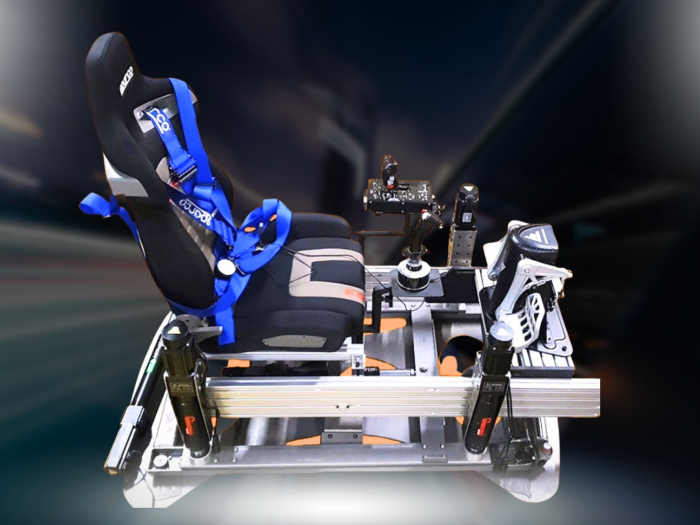

What if the difference between a high-end toy and a professional training tool isn't the price tag, but the way your body interprets the physics of a hair-pin turn? You've likely felt that jarring disconnect when your eyes see a slide that your seat doesn't mirror, or perhaps you've been deterred by the sheer bulk of industrial simulators. Mastering the immersive sim racing essentials is the only way to overcome these hurdles, ensuring that every input from the track translates into a precise physical response. You shouldn't have to sacrifice your entire floor plan or endure motion sickness to achieve professional-grade realism.
Discover how to synchronise motion, visuals, and tactile feedback to build a world-class racing simulator in your own home. We're detailing a no-compromise strategy that integrates cutting-edge telemetry with compact, high-performance hardware. This guide provides a roadmap for harmonising your rig's behaviour, from the nuances of twin traction loss to the seamless integration of VR headsets. You'll learn how to transform digital data into tangible sensations, creating a simulator that feels as intense and accurate as a seat in a GT3 cockpit.
Key Takeaways
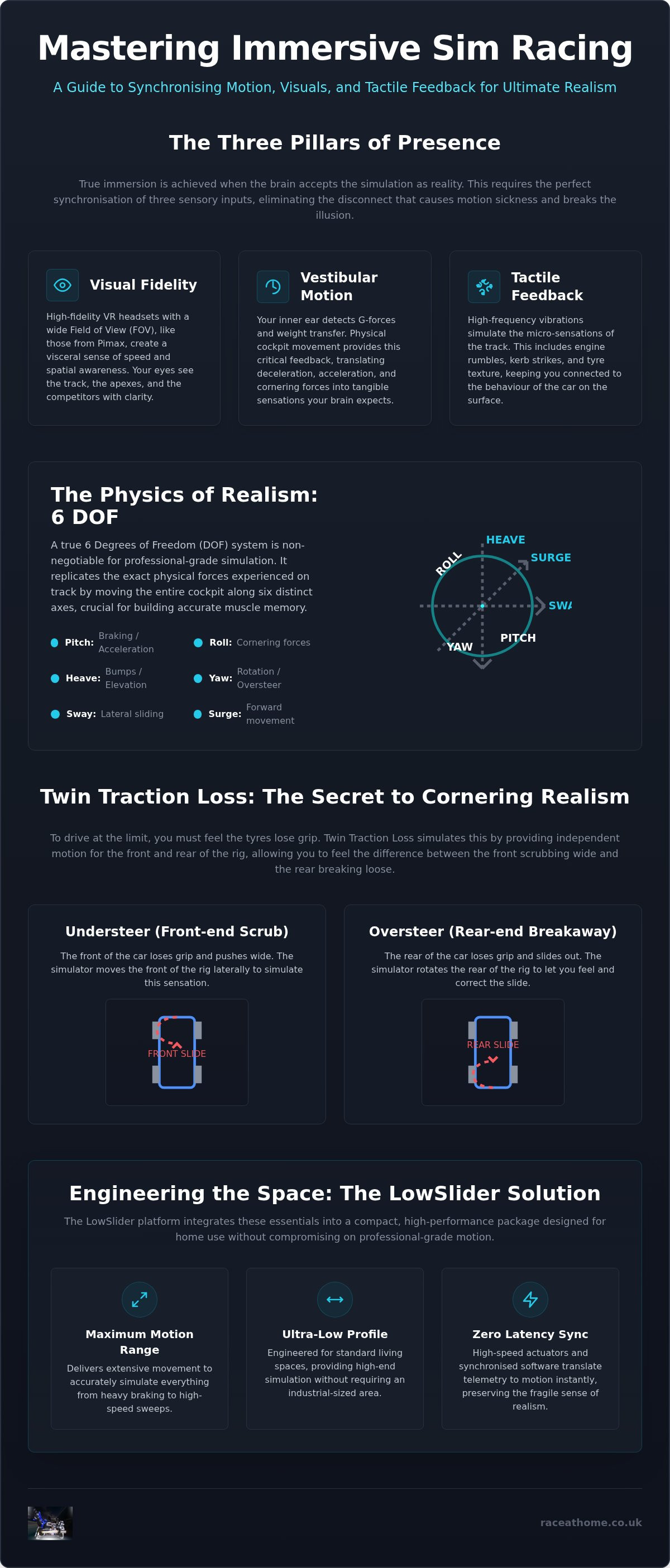
- Understand the three pillars of presence, consisting of visual, tactile, and vestibular feedback, to master the immersive sim racing essentials for your home cockpit.
- Learn why 6 Degrees of Freedom and Twin Traction Loss are vital for eliminating motion sickness and accurately simulating tyre behaviour.
- Discover how high-fidelity Pimax VR headsets with wide fields of view create a visceral sense of speed and spatial awareness.
- Explore how the LowSlider platform maximises motion range whilst maintaining an ultra-low profile suitable for standard living spaces.
- Gain insights into synchronising software telemetry with hand-built hardware to bridge the gap between digital data and physical sensation.
Beyond the Screen: Defining the Immersive Sim Racing Essentials
Immersion is the psychological state where the digital medium vanishes. You're no longer looking at a pixelated rendering; you're bracing for the compression at Eau Rouge. To reach this level, you must master the immersive sim racing essentials that satisfy the human brain's need for sensory coherence. True presence occurs when your subconscious accepts the simulation as reality. When these elements align, the hardware becomes invisible, leaving only the experience of the drive.
The three pillars of immersion are visual fidelity, tactile feedback, and vestibular motion. If any of these are missing, the illusion breaks almost instantly. A static rig, regardless of its cost or build quality, eventually hits a realism ceiling because it fails to communicate the actual physics of the vehicle chassis. By 2026, the industry has moved beyond mere entertainment. We're now in an era where home setups are used for genuine driver training, requiring hardware that mimics the six degrees of freedom found in professional simulators. This transition from playing a game to training a driver is defined by how accurately a rig replicates real-world forces.
The Vestibular System: Why Your Brain Needs to Move
Your inner ear is a sophisticated sensor designed to detect weight transfer and G-forces. When you dive into a heavy braking zone, your brain expects the forward surge of deceleration. If your eyes see the car slowing down whilst your body remains perfectly still, a sensory disconnect occurs. This conflict is the primary cause of motion sickness in VR and high-end rigs. Without physical movement, your brain interprets the visual data as a hallucination or a sign of illness. Vestibular feedback functions as the critical physical bridge that translates digital telemetry into tangible sensations for your human equilibrium.
Tactile vs. Motion: Understanding the Difference
It's easy to confuse tactile feedback with motion, but they serve distinct purposes in a professional setup. Tactile feedback involves high-frequency vibrations that simulate engine rumbles and kerb strikes. These are the micro sensations that keep you connected to the track surface. Motion feedback focuses on displacement, physically moving the entire cockpit to represent chassis pitch, roll, and heave. An elite setup requires both to work in perfect synchronisation to avoid muddy or confusing feedback. Achieving the ultimate immersive sim racing essentials means ensuring these two systems operate in harmony, providing a clear picture of what the car is doing at every millisecond.
The Physics of Realism: Why 6 DOF Motion is Non-Negotiable
In the pursuit of professional-grade realism, the hardware must replicate the exact physical forces experienced on track. This is where the immersive sim racing essentials pivot from visual flair to mechanical accuracy. A true 6 Degrees of Freedom (DOF) system manages Pitch, Roll, Heave, Yaw, Sway, and Surge. These axes allow the simulator to mimic everything from the compression of the suspension under braking to the lateral G-forces of a high-speed sweeper. Whilst some rigs rely on simplified movement, moving the entire chassis ensures that your relationship with the steering wheel and pedals remains constant, which is vital for developing accurate muscle memory.
Twin Traction Loss: The Secret to Cornering Realism
To truly master a car on the limit, you need to feel when the tyres lose their grip. Twin Traction Loss is the specific mechanic that simulates the rear end breaking loose (oversteer) and the front end scrubbing wide (understeer). The LowSlider 6 DOF motion simulator achieves this by integrating independent movement for both the front and rear of the rig. It's a level of sophistication that transforms a static lap into a dynamic battle with the car's balance. Because the LowSlider utilises an ultra-low profile design, it delivers these immersive sim racing essentials without requiring the industrial space usually associated with high-end simulators.
Telemetry Synchronisation: Reducing Latency to Zero
Realism is fragile; it's easily broken by latency. If the motion lags even a few milliseconds behind the visual data, your brain will reject the experience. High-speed actuators are the only way to translate game telemetry into instant physical feedback. This rapid response is also the most effective motion sickness sim racing solution, as it aligns what your eyes see with what your inner ear feels. By focusing on physics-based motion rather than generic "canned" effects, you ensure that every jolt and slide is a direct reflection of the car's behaviour. If you're looking for a professional motion solution that delivers this level of precision, the engineering behind the LowSlider provides the necessary technical authority.
Visual and Tactile Synergy: VR, FOV, and Haptic Feedback
Achieving professional realism requires a visual solution that matches the mechanical fidelity of your platform. By 2026, the standard for immersive sim racing essentials has shifted towards high-resolution, wide-angle optics that fill the driver's entire field of vision. Whilst triple 32-inch or 42-inch monitor setups remain a staple for gruelling 24-hour endurance events due to their physical comfort, VR has become the benchmark for raw presence. The choice between them often depends on your primary racing discipline, but the goal remains the same: total spatial awareness.
Pimax VR headsets lead the industry by offering a field of view (FOV) that closely mimics human peripheral vision. This wide FOV is vital for a visceral sense of speed; when trackside objects blur in your periphery, your brain registers velocity with far greater accuracy. Without this, you're effectively looking through a letterbox, which diminishes your ability to judge distances and apexes. Tactile transducers complete this sensory loop by translating micro-telemetry, such as engine RPM and ABS activation, into high-frequency vibrations. When layered over a motion platform, they provide the "grit" of the track surface that motion actuators alone are not designed to replicate.
Pimax VR and Motion: The Ultimate Immersive Duo
A 6 DOF motion platform is the ultimate companion for high-end VR. It anchors your physical body to the digital cockpit, which is the most effective way to reduce the nausea often associated with static VR setups. To maintain this illusion, you must use motion compensation software. This technology ensures your head position remains stable relative to the car's interior, even as the rig pitches and rolls. For a deep dive into synchronising these complex systems, consult our Pimax VR motion simulator setup guide for expert optimisation tips.
Direct Drive Wheels and Hydraulic Pedals
Your control interface must be robust enough to match the intensity of your motion platform. High-torque direct drive wheels are one of the immersive sim racing essentials because they provide the steering resistance needed to fight against the rig's physical movement. Similarly, hydraulic or load-cell pedals are non-negotiable for hitting consistent braking markers whilst your body is under load. Integrating these sim racing accessories into a unified, rigid cockpit ensures that every driver input is translated with zero flex. This synergy between controls and motion is what separates a gaming setup from a professional training tool.
Engineering the Space: Logistics of a Professional Home Setup
Many enthusiasts assume that integrating a full motion platform requires a dedicated garage or an industrial unit. This misconception often prevents drivers from upgrading their hardware to the next level of realism. In reality, the modern immersive sim racing essentials are designed to fit within the footprint of a standard home office or spare bedroom. The engineering challenge is no longer about sheer size; it's about efficiency and power density. By prioritising a compact design, you can achieve professional-grade feedback without sacrificing your entire living space.
If you're planning an upstairs installation, floor loading and acoustic dampening are critical considerations. Unlike industrial simulators that can weigh hundreds of kilograms, a well-engineered home platform distributes weight effectively across its base. Acoustic isolation is equally vital for domestic harmony. Low-profile designs reduce the mechanical leverage that creates floor-borne noise, making it possible to race late into the night without disturbing the rest of the household. These logistics, alongside managing secure digital access to global racing accounts via Anosim for SMS verification, are just as important as the torque of your wheel base when building a sustainable home setup.
The LowSlider philosophy focuses on an ultra-low profile that keeps the centre of gravity as close to the floor as possible. This design choice aids stability during high-frequency movements whilst significantly reducing the physical bulk of the rig. When comparing the footprint of a traditional, high-end static rig with a bespoke motion platform, the difference is often negligible. Organising cables and power supplies is the final step in maintaining a professional aesthetic. Using integrated cable channels and discrete mounting points ensures that your setup looks as clean as it performs.
Worldwide Delivery and Easy Assembly
Building a professional simulator shouldn't require an engineering degree or a weekend of frustration. A rig that arrives in four pre-built, easy-to-handle sections simplifies the logistics of international shipping and home setup. Hand-built British engineering ensures a precise bolt-together experience where every component aligns perfectly. You don't need a workshop full of specialised equipment; most setups require only basic tools to complete. For a detailed breakdown of the process, see our guide on sim racing rig easy assembly to get on track in under 60 minutes. If you are ready to revolutionise your home cockpit, you can view our range of motion platforms to find the perfect fit for your space.
Bespoke Performance: Why the LowSlider Platform Redefines Immersion
The Race@Home philosophy is rooted in the belief that a simulator should be as unique as the driver behind the wheel. Unlike mass-produced, turnkey systems that often rely on generic actuator kits, the LowSlider is hand-built to order in the United Kingdom. This bespoke approach allows for a level of precision that mass production simply cannot match. Every weld and component is scrutinised to ensure it meets our rigorous standards for professional realism. By focusing on proprietary designs rather than off-the-shelf solutions, we provide the immersive sim racing essentials that bridge the gap between digital data and physical sensation with absolute clarity. For those who enjoy the strategic side of the gaming industry as much as the driving, Studio Showdown offers a board game experience centred on video game development and entrepreneurship.
Proprietary engineering means that the motion profile is tuned specifically for the chassis, eliminating the "slop" or mechanical noise often found in universal kits. This results in a much sharper translation of telemetry, where you feel the exact moment the tyres find grip or lose it. It's the difference between a rig that merely shakes and one that communicates. Because these platforms are built by specialists who understand the nuances of vehicle dynamics, the feedback is consistent, predictable, and, most importantly, authentic to the car you're driving in the simulation.
The 3DoF to 6 DOF Upgrade Path
Starting your journey into motion doesn't require an all-or-nothing commitment. The LowSlider 3DoF motion platform is the perfect foundation, delivering the core sensations of pitch, roll, and heave that any static rig lacks. As you shave tenths off your lap times and your driving style matures, the logical next step is adding traction loss. This modularity is a core part of our engineering, allowing you to upgrade your existing frame with twin traction loss actuators as your requirements evolve. You can further enhance your setup by integrating premium peripherals from specialists like PT Actuator, ensuring your hardware remains at the cutting edge of the 2026 season.
The Investment in Realism
A bespoke motion rig is a long-term investment in your craft. Mass-market electronics often suffer from rapid obsolescence, but a hand-built British platform holds its value through its robust construction and upgradeable nature. There's a significant psychological advantage to training on a professional-grade tool; it commands a level of focus that a desktop setup cannot replicate. When your physical environment matches the intensity of the simulation, your brain develops the muscle memory required for real-world track success. If you're ready to transform your home cockpit into a world-class training centre, explore the LowSlider range today and experience the ultimate evolution of the hobby.
Master the Grid: Your Path to Ultimate Realism
Achieving the ultimate home cockpit is no longer a matter of compromise between space and performance. By mastering the immersive sim racing essentials, you've learned that true presence comes from the precise synchronisation of 6 DOF motion, high-fidelity VR, and tactile feedback. Whether it's feeling the rear end snap through twin traction loss or hitting your braking markers with hydraulic precision, the right hardware transforms every session into a professional training experience. You don't need an industrial unit to host a world-class rig; you simply need engineering that respects both physics and your floor plan.
Race@Home provides the specialist expertise to bring this vision to life. Our platforms are hand-built in the UK and shipped worldwide in four easy-to-assemble pieces, ensuring you can go from delivery to the track in under an hour. It's why our rigs are the preferred choice for professional drivers and serious enthusiasts globally. Don't settle for a static experience when you can feel every ripple of the tarmac. Build your bespoke immersive sim racing setup with Race@Home and redefine what's possible in your own home. The track is waiting.
Frequently Asked Questions
Does an immersive sim racing setup cause motion sickness?
High-fidelity motion platforms are designed to prevent motion sickness by aligning your physical sensations with your visual environment. When your eyes see a car turn and your inner ear feels the corresponding lateral G-force, the sensory disconnect that causes nausea is eliminated. High-latency systems or static rigs are often the true cause of discomfort. By prioritising these immersive sim racing essentials, you ensure your brain accepts the digital data as a real-world physical event.
How much space do I need for a 6 DOF motion simulator?
You don't need a massive industrial unit to house a professional 6 DOF motion simulator. The LowSlider 6 DOF platform is engineered with an ultra-low profile that fits comfortably within a standard home office or spare bedroom. Its physical footprint is remarkably similar to a high-end static aluminium profile rig. This compact design allows you to enjoy full-scale motion feedback without sacrificing your entire living space or requiring a dedicated garage for your setup.
Can I use my existing sim racing pedals and wheel with a LowSlider rig?
Yes, the LowSlider platform is built to integrate seamlessly with most professional-grade sim racing accessories. Whilst we recommend high-torque direct drive wheels and load-cell pedals to match the intensity of the motion, the rig's mounting points are highly versatile. This compatibility ensures that you can upgrade your current setup with a motion platform without needing to replace your entire inventory of existing wheels, pedals, or shifters during the transition to full immersion.
Is VR better than triple screens for an immersive setup?
Both solutions have distinct advantages for a professional setup. Pimax VR headsets offer unparalleled presence and a field of view that mimics human peripheral vision, which is vital for judging speed. Conversely, triple screen setups provide better physical comfort for long-duration endurance racing. VR is generally considered the peak of the immersive sim racing essentials checklist, but the best choice ultimately depends on your tolerance for wearing a headset for extended periods.
How difficult is it to assemble a full-motion racing simulator at home?
Assembling a LowSlider rig is a straightforward process that typically takes under an hour to complete. The system arrives in four pre-built, easy-to-handle sections that simply bolt together with basic tools. This hand-built British engineering removes the complexity often associated with industrial-grade simulators. You won't need an engineering degree or a full weekend of work to get your platform on track, making it a highly accessible solution for home enthusiasts globally.
What is the benefit of Twin Traction Loss in a sim rig?
Twin Traction Loss allows you to feel the front and rear axles of the car losing grip independently. This mechanical movement simulates oversteer and understeer with incredible precision, providing the tactile data needed to catch a slide or adjust your racing line. Without this feature, a motion rig cannot fully communicate the balance of the vehicle chassis. It is a critical component for any driver looking to develop authentic, real-world muscle memory on track.
Do I need a special floor to support a motion platform?
A standard domestic floor is usually sufficient for a LowSlider platform because the low-profile design distributes weight evenly across its base. You don't need reinforced concrete or industrial flooring for a home installation. However, if you are setting up in an upstairs room, we recommend using acoustic dampening mats. These help to isolate high-frequency vibrations from tactile transducers, ensuring that your high-performance racing doesn't cause unwanted mechanical noise for the rest of the household.
How does motion compensation work in VR sim racing?
Motion compensation is a software-based solution that keeps your virtual cockpit stable whilst the physical rig is moving. It subtracts the movement of the motion platform from the tracking data of your VR headset. Without this, your head would appear to bounce around inside the car as the actuators respond to the track surface. This technology is essential for maintaining a clear view of your apexes and preventing the visual glitches that break immersion during intense racing.


