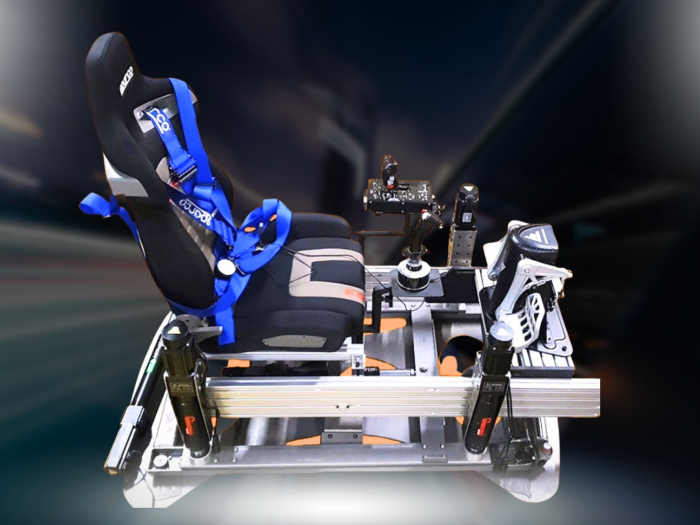

Peak torque is a vanity metric if your wheelbase cannot survive the violent physics of a professional 6 DOF motion platform. You've likely experienced that frustrating moment where your steering feedback feels "lost" or muddled the second your actuators kick in during a high-G manoeuvre. It's a common hurdle for those building elite rigs; finding the best direct drive wheel for motion simulator use isn't just about raw power, but about how that power translates through a moving chassis. If your mounting solution isn't rock-solid, the finest telemetry in the world will simply dissolve into mechanical vibration.
In this 2026 professional guide, you'll discover which high-end wheelbases provide the fidelity and mounting rigidity required to complement a professional motion system like our LowSlider series. We'll examine the latest units from Simucube and Fanatec to ensure you achieve seamless integration between wheel feedback and chassis movement whilst maintaining total signal clarity. By the end of this guide, you'll know exactly how to eliminate flex and electromagnetic interference to secure the professional-grade immersion your setup deserves.
Key Takeaways
- Understand why telemetry synchronisation and high slew rates are more critical than raw torque when choosing the best direct drive wheel for motion simulator rigs.
- Learn how to manage wheelbase inertia to ensure your LowSlider platform maintains its lightning-fast response during complex weight transfers and high-G manoeuvres.
- Compare the 2026 professional landscape, including the latest Simucube 3 series and the bespoke UK favourite, the Simagic Alpha-U.
- Discover how to solve advanced engineering hurdles such as motion compensation for Pimax VR and secure cable routing for maximum 6 DOF excursions.
Why Direct Drive Wheels Behave Differently on Motion Platforms
Static rig reviews rarely tell the full story for motion users. Whilst a standard sim rig stays rooted to the floor, a 6 DOF platform introduces complex kinetic forces that can muddle the communication between the software and your hands. Selecting the best direct drive wheel for motion simulator setups demands more than just checking a torque chart; it requires an understanding of how digital data survives physical violence. To truly appreciate the engineering involved, one must understand what a direct drive wheel is and how its lack of internal friction allows for such high-speed data translation during intense manoeuvres.
The "G-Force Masking" effect is a primary challenge for motion enthusiasts. When your rig pitches or rolls to simulate weight transfer, your body is flooded with vestibular input. On a low-fidelity wheelbase, these subtle road textures and slip-angle vibrations simply vanish behind the rig's movement. You need a motor with high enough fidelity to "cut through" the physical noise of the actuators. Without this clarity, the immersion breaks because the steering feels disconnected from the chassis behaviour.
The Fight Against Rig Flex
High-torque wheels don't just provide heavy steering; they create immense rotational energy that can amplify "chatter" throughout a moving chassis. If your mounting solution is built from modular aluminium profile, you'll often find that the motion of the actuators combines with the torque of the wheel to create unwanted resonance. At Race@Home, we solve this by opting for bespoke, hand-built steel frames. We engineer every LowSlider to handle 25Nm+ wheelbases without a millimetre of flex. This rigidity ensures that every bit of torque goes into your hands rather than being absorbed by a vibrating mounting plate.
Telemetry Synchronisation
The relationship between your wheel and your motion platform is a high-speed conversation. If your actuators refresh at a different frequency than your wheelbase, the physical "kick" of a kerb might arrive a fraction of a second after the "snap" of the steering wheel. This latency is particularly noticeable in high-yaw states, such as a drift or a sudden snap-oversteer correction. Achieving total synchronisation means choosing a wheelbase with a high slew rate that can match the lightning-fast response of our PT Actuator systems. When these two components align, the result is a seamless translation of digital physics into tangible reality.
Key Performance Metrics for Motion-Ready Wheelbases
Raw torque is often a distraction in sim racing marketing. Whilst a 30Nm peak might sound impressive, it is practically useless on a moving rig if the motor lacks the speed to keep up with the chassis. When you are searching for the best direct drive wheel for motion simulator applications, you must look past the headline numbers and focus on the mechanical and electrical stability of the unit. A high-performance motion rig is a violent environment; your wheelbase must be an anchor of precision amidst the chaos.
Slew Rate and Detail Fidelity
Slew rate is the speed of torque change measured in milliseconds. In a professional 6 DOF environment, this metric is far more important than peak torque. You want a motor that can snap from 0 to 15Nm instantly to simulate a kerb strike whilst the platform is simultaneously pitching or rolling. If the slew rate is too low, the force feedback feels "rubbery" and disconnected. High-fidelity motors allow you to feel the granular texture of the tarmac even as the LowSlider platform simulates heavy braking or high-speed cornering. This level of detail relies on Hardware-in-the-Loop simulation principles, where the motor acts as a dynamic load that must react to software telemetry in real-time.
Inertia and mass also play a significant role in rig balance. A massive, heavy wheelbase sitting at the end of a steering mount creates a pendulum effect. During rapid 6 DOF transitions, this extra weight can introduce unwanted oscillations that confuse the motion actuators. Opting for a compact, high-density motor ensures your rig's centre of gravity remains manageable, allowing for sharper, more accurate movement.
Managing Electromagnetic Interference (EMI)
Motion rigs are electrically "noisy" environments. The high-power actuators used in 6 DOF systems can generate significant electromagnetic interference, which often manifests as "ghosting" or erratic button behaviour on the steering wheel. Professional-grade wheelbases feature superior internal shielding to combat this. To ensure a stable connection, we recommend using grounded, hand-built chassis and high-quality shielded cabling. You can find more detail on harmonising these components in The Ultimate Sim Racing Setup Guide.
Rigidity is the final piece of the puzzle. We generally favour front-mount or side-mount configurations for motion rigs because they offer the highest degree of structural integrity. A bottom-mounted wheel can flex under the combined forces of 20Nm torque and 2G motion excursions. If you want to experience zero-flex performance, our bespoke motion solutions are engineered to provide the most rigid mounting platforms in the industry.
The Top Direct Drive Ecosystems for 6 DOF Rigs in 2026
Selecting the best direct drive wheel for motion simulator builds involves moving beyond consumer-grade peripherals. By 2026, the market has split between mass-market toys and industrial-grade hardware designed for the rigours of 6 DOF movement. If you're investing in a professional platform like the LowSlider, your wheelbase must be as robust as the steel frame it's bolted to. A mismatch here leads to mechanical failure or, at the very least, a significant loss in sensory fidelity.
Simucube remains the industrial gold standard for high-end motion rigs. The Simucube 3 Pro, delivering a precise 25Nm of torque, and the range-topping 35Nm Simucube 3 Ultimate are engineered with a "no-compromise" approach to durability. For bespoke UK builds, the Simagic Alpha-U has emerged as a firm favourite. Its 23Nm output provides the necessary headroom to overcome G-force masking whilst maintaining a compact form factor that doesn't interfere with complex 6 DOF geometry.
Other notable contenders include the Asetek SimSports Invicta, which offers 27Nm of torque and a unique mounting system that simplifies front-mount integration on moving platforms. For those focusing on commercial driver training, the VRS DirectForce Pro continues to be the "no-frills" performance choice, offering exceptional reliability and raw feedback without the cost of wireless ecosystems.
Why We Recommend Industrial-Grade Motors
The difference between consumer electronics and bespoke engineering is longevity. A hand-built rig deserves components that can survive a decade of high-torque use. At Race@Home, we don't just sell hardware; we integrate it. We often look to the high standards of industrial consultants like DL Safety when considering the technical durability required for our equipment. We partner with Sim Racing Professional to source accessories that match the industrial quality of our LowSlider platforms. Choosing professional-grade motors ensures that the internal bearings and sensors can withstand the constant, violent vibrations inherent in professional motion simulation.
Quick Release Systems: The Weakest Link
The quick release (QR) is often the point of failure on a motion rig. Any "play" or rattle in the QR is magnified tenfold the moment your actuators kick in. Whilst consumer-grade plastic systems may suffice for static setups, they quickly degrade under the stress of 6 DOF excursions. We prioritise systems like the Simucube SQR or the Simagic D-shape QR because they provide a zero-flex connection. When your rig simulates sudden traction loss, you need to feel that snap through a rigid wheel rim, not a vibrating coupling. Secure, metal-on-metal connections are the only way to maintain the professional-grade immersion required at this level.
Solving the "Motion Rig vs DD Wheel" Engineering Challenges
Integrating the best direct drive wheel for motion simulator use introduces a unique set of mechanical and digital hurdles. It's one thing to mount a high-torque motor to a static desk; it's another entirely to secure it to a platform capable of violent 6 DOF movement. The primary challenge lies in ensuring that the rapid excursions of the rig don't compromise your visual tracking or your electrical connections. When your chassis is pitching and rolling at high speeds, every millimetre of cable slack and every software setting becomes a critical point of failure.
Integrating Pimax VR and Motion
A frequent frustration amongst sim racers is the "shaking" sensation in VR when a motion platform kicks in. This occurs because the headset tracks your physical movement in the room rather than your relative position inside the cockpit. To achieve true immersion, we utilise motion compensation software to "cancel out" the rig's telemetry from the VR viewpoint. This ensures that when the LowSlider pitches up under acceleration, your virtual horizon remains stable whilst your body feels the G-force. Our LowSlider design features an ultra-low profile that creates a stable environment for sensor placement, making it the perfect partner for high-fidelity headsets. You can learn more about this in The Ultimate Pimax VR Motion Simulator Set-up Guide.
Bespoke Cable Routing
Cable management is a safety-critical concern during maximum 6 DOF excursions. A professional direct drive wheel can pull significant current, and if your power delivery isn't carefully isolated, you risk starving the actuators or inducing signal noise. We solve this through a "Four-Piece" assembly approach that organises high-torque power leads into dedicated channels to avoid interference. We favour industrial-grade connectors for our UK builds because they won't vibrate loose under the intense frequencies generated by PT Actuator systems.
The LowSlider's low-profile advantage is particularly evident here. By reducing the distance between the wheelbase and the motion pivot points, we minimise the leverage and "pendulum effect" that can plague taller, modular rigs. This architectural choice results in a more responsive system where the steering and the chassis act as a single, unified entity. If you're looking to eliminate the logistical headaches of high-end sim racing, you can browse our professional motion platforms to see how we bridge the gap between hardware and reality.
The Professional Conclusion: Building Your Ultimate Motion System
The journey to the perfect sim racing experience often ends with the steering wheel, yet it's the foundation beneath your seat that dictates its success. You can spend thousands on the best direct drive wheel for motion simulator duty, but without a chassis that can handle the feedback, you're only seeing half the picture. In a professional 6 DOF environment, the wheel choice represents the final 10% of the masterpiece. It's the sensory bridge that translates digital physics into your fingertips, but it relies entirely on the rigidity of the rig to do its job. Choosing bespoke engineering over mass-market modularity ensures that every Newton-metre of torque is felt by the driver rather than lost to structural flex.
Before you finalise your 2026 setup, run through this essential checklist to ensure your hardware is truly motion-ready:
- Torque: Do you have at least 20Nm of headroom to overcome G-force masking?
- Slew Rate: Is the motor fast enough to match the response of our PT Actuators?
- Rigidity: Is your mounting plate hand-built from steel to eliminate chassis chatter?
- Support: Do you have access to UK-based engineering specialists for bespoke integration?
Why Hand-Built Matters
There is a specific "smile factor" that comes from a rig with zero rattles and 1:1 telemetry. When you're cornering at the limit, the last thing you want is the distraction of a vibrating bolt or a flexible steering column. This level of precision is why professional racing teams choose the LowSlider for driver coaching. They need a tool that mimics the visceral reality of the track with absolute accuracy. If you're still weighing up the investment, our guide on Is a Sim Racing Motion Rig Worth It? breaks down the long-term ROI of professional-grade hardware.
Start Your Build
At Race@Home, we don't believe in a one-size-fits-all approach. Whether you've already settled on a Simucube 3 or you're still debating the merits of the Simagic Alpha-U, we can consult with you on your specific hardware favourites. We provide the engineering peace of mind that comes from a UK-based specialist, ensuring your best direct drive wheel for motion simulator integrates perfectly with our hand-built frames. It's time to stop compromising on immersion and start feeling every detail of the circuit. Explore the LowSlider 6 DOF Motion Platform today and discover the ultimate evolution of sim racing.
Elevate Your Racing Reality
Finding the best direct drive wheel for motion simulator use is about more than just matching torque numbers. It's about ensuring your hardware can survive and thrive amongst the violent telemetry of a 6 DOF rig. You've seen that slew rate and electrical shielding are the true differentiators when the rig is in motion. Without a zero-flex foundation, even the most expensive industrial motor will lose its clarity during high-G manoeuvres.
Our proprietary LowSlider 6 DOF technology offers an ultra-low centre of gravity, providing the perfect platform for high-torque wheelbases. Every rig is hand-built in the UK with bespoke fabrication to ensure your feedback remains crisp and undistorted. We specialise in the expert integration of Pimax VR and PT Actuators, solving the complex engineering hurdles that often hold back standard modular setups.
It's time to stop fighting your hardware and start feeling the track exactly as the engineers intended. Build your bespoke racing simulator with Race@Home and experience the ultimate evolution of immersion. Your fastest lap is waiting for a rig that can finally keep up.
Frequently Asked Questions
What is the best direct drive wheel for a 6 DOF motion simulator?
The best direct drive wheel for motion simulator setups in 2026 is typically the Simucube 3 series or the Simagic Alpha-U. These units provide the industrial-grade build quality and high torque headroom required to overcome the physical noise of a 6 DOF platform. Simucube is widely regarded as the gold standard for reliability, whilst Simagic offers exceptional performance for bespoke UK builds. Both ecosystems feature the zero-flex quick release systems essential for professional immersion.
Does a direct drive wheel cause more flex on a motion rig?
High-torque wheels can amplify flex if you're using a standard modular aluminium rig. The rotational energy from a 25Nm motor creates significant leverage on the mounting plate during intense manoeuvres. To solve this, we hand-build our LowSlider frames from steel with bespoke fabrication. This provides a rigid foundation that eliminates chatter and ensures the wheel's feedback isn't absorbed by a vibrating chassis. It's the difference between a toy and a professional simulator.
How much torque do I actually need for a motion simulator?
You generally need a wheelbase capable of at least 20Nm to avoid the G-force masking effect. When your 6 DOF rig is pitching and rolling at high speeds, the physical forces on your body can make lower-torque wheels feel light or muddled. Having a motor with 25Nm or 32Nm of peak torque doesn't mean you'll always use it all. It provides the necessary headroom to deliver sharp road textures whilst the rig simulates heavy weight transfers.
Will a heavy direct drive wheel affect my motion platform performance?
Excessive mass at the end of the steering column can create a pendulum effect during rapid motion transitions. Whilst a heavy motor won't break a professional platform like the LowSlider, it can introduce unwanted oscillations if the software tuning isn't precise. We recommend compact, high-density wheelbases that offer high torque without excessive bulk. This helps maintain the platform's balance and ensures the actuators can react with maximum speed and accuracy during high-yaw states.
How do I stop my VR headset from shaking on a motion rig?
Visual shaking in VR is caused by the headset tracking your movement relative to the room rather than the cockpit. The solution is motion compensation software, which subtracts the rig's telemetry from your virtual viewpoint. This aligns your vision with the car's interior even when the rig is pitching violently. Our LowSlider rigs are designed with a compact footprint that makes sensor placement straightforward, ensuring your Pimax VR headset remains perfectly synchronised with the digital horizon.
Can I use a Fanatec wheel on a Race@Home LowSlider rig?
Yes, you can certainly use Fanatec hardware on our platforms. Whilst we often recommend industrial-grade wheelbases like Simucube for the most intense 6 DOF applications, our bespoke fabrication service allows us to create zero-flex mounting plates for any major brand. We'll ensure your Fanatec Podium or ClubSport DD unit is secured with the same engineering precision as an industrial motor, providing a stable foundation for your favourite sim racing ecosystem.
What is motion compensation and why do I need it for sim racing?
Motion compensation is a software layer that cancels out the physical movement of your rig from your VR or screen perspective. Without it, the world appears to bounce around you as the actuators move. By feeding the rig's real-time telemetry back into the visual software, we ensure your eyes see exactly what your body feels. It's a critical component for professional-grade immersion, preventing motion sickness and keeping your focus entirely on the apex.
Why is slew rate more important than torque for motion simulators?
Slew rate defines how quickly a wheelbase can change its torque output in milliseconds. On a motion platform, speed is more vital than raw power because the feedback must cut through the rig's movement instantly. A high slew rate allows you to feel a sudden kerb strike or a loss of traction whilst the actuators are simultaneously simulating a high-speed corner. If the response is slow, the steering feels rubbery and disconnected from the chassis physics.


