
Max Verstappen famously prefers a static rig for his competitive iRacing stints, leading many to believe that a motion simulator is a vanity project that actually hampers performance. It's a valid concern. If you're chasing every thousandth of a second on a digital leaderboard, the fear that physical movement might disrupt your precision is real. You've likely worried about the massive footprint of traditional setups or the looming threat of motion sickness ruining a long endurance stint. The motion simulator vs static rig debate has traditionally been split between those who want to win and those who want to feel every kerb.
However, as we move into 2026, the technology has shifted. This guide discovers whether raw speed or absolute realism should define your next investment. We'll break down the technical differences between 3DoF and 6 DOF systems, debunk the myths surrounding lap times, and introduce space-efficient solutions like the LowSlider that bring professional-grade immersion to the home office. You'll learn how modern engineering translates digital telemetry into the physical muscle memory required for real-world performance, ensuring your setup provides the ultimate evolution of the hobby.
Key Takeaways
- Understand why top eSports drivers often choose static rigs for pixel-perfect records and how motion bridges the gap to real-world driver development.
- Decode the technical hierarchy of mechanical movement, from basic 3DoF seat-movers to the full-chassis immersion of a 6 DOF platform.
- Resolve the motion simulator vs static rig dilemma by identifying whether your priority is digital leaderboard supremacy or visceral, physical feedback.
- Discover how compact engineering allows for a professional 6 DOF setup in a domestic environment without the traditional noise or space constraints.
- Learn why hand-built UK craftsmanship and ultra-low profile designs offer a superior alternative to mass-produced aluminium extrusions whilst maintaining a compact footprint.
The Great Sim Racing Debate: Static Rig Stability vs Motion Immersion
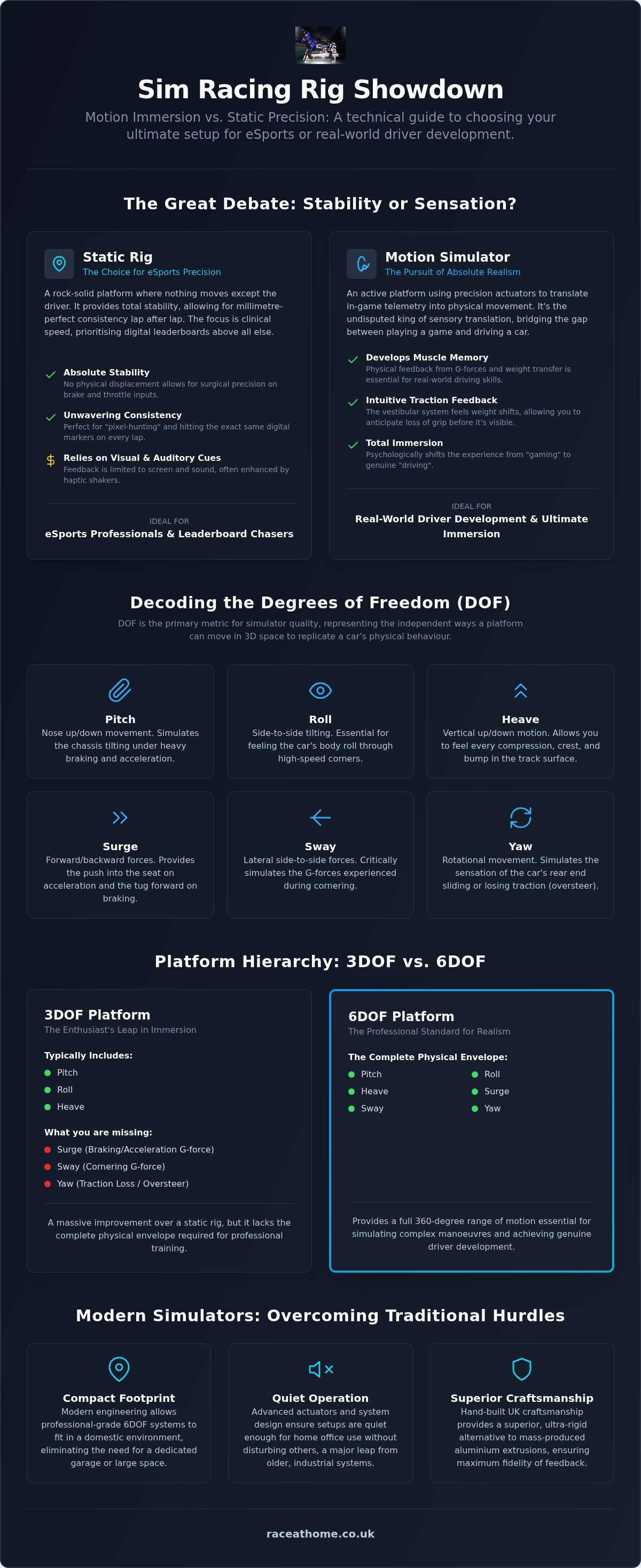
The foundation of any high-end setup begins with the choice between a rigid structure and a dynamic one. A static rig is the traditional bedrock of the hobby, featuring a fixed seat, pedals, and steering wheel mounted to a heavy-duty frame. Its purpose is total stability, providing a rock-solid platform where nothing moves except the driver. In contrast, a motion simulator is an active platform that uses precision actuators to translate in-game telemetry into physical movement. This choice often dictates your entire sim racing philosophy: are you here to game, or are you here to train? The fundamental distinction in the motion simulator vs static rig debate lies in how you receive information; a static rig relies entirely on visual and auditory cues, whilst a motion system adds the vital layers of haptic feedback and G-force simulation.
The Static Rig: Precision and eSports Dominance
Top-tier eSports professionals often favour static rigs because the lack of physical movement allows for millimetre-perfect consistency. When your seat doesn't tilt during a heavy braking zone, your foot can modulate brake pressure with surgical precision. This is the world of "pixel-hunting," where the priority is hitting the same digital markers lap after lap without the distraction of physical displacement. Even in this unmoving environment, high-end static platforms aren't entirely "dead." Many enthusiasts rely on haptic shakers and transducers to provide tactile feedback, such as engine vibrations or kerb strikes, through the seat and pedals. It's a focused, clinical approach to speed that prioritises the leaderboard above all else.
The Motion Simulator: The Pursuit of Absolute Realism
True immersion requires more than just a high refresh rate monitor. For a professional driver, the eyes only tell half the story. The vestibular system in your inner ear needs to feel the car's weight shift to anticipate a loss of traction before it even appears on screen. When the chassis pitches under braking or rolls through a high-speed sweeper, your brain undergoes a psychological shift. You stop "playing a game" and start "driving a car." This physical feedback is essential for developing the muscle memory required for real-world racing. It's why 6 DOF motion simulators are considered the pinnacle of this pursuit, offering the complex, multi-axis cues needed for genuine driver development and visceral engagement. In the battle of motion simulator vs static rig, motion is the undisputed king of sensory translation.
Understanding the Degrees of Freedom: From 3DoF to 6 DOF Platforms
To truly navigate the motion simulator vs static rig debate, you must understand how movement is measured and translated. Degrees of Freedom (DOF) is the primary metric for simulator quality, representing the independent ways a platform can move in 3D space. Modern racing software outputs thousands of telemetry data points every second. A sophisticated motion controller processes this digital data, directing precision actuators to replicate the car's physical behaviour in real-time. Whilst a static rig leaves your body in a neutral state, an active platform uses these physical cues to inform your brain about the car's mechanical grip and balance.
Specific sensations are critical for developing professional-level intuition. Heave and surge are amongst the most vital for braking and acceleration feel. Heave simulates vertical movement, allowing you to feel every compression and crest in the track surface. Surge handles the longitudinal forces, providing the visceral "push" into the seat under acceleration and the forward "tug" during heavy braking. Without these cues, you're essentially guessing the car's weight distribution, relying solely on visual references to judge your stopping distances.
3DoF vs 6 DOF: What Are You Missing?
A 3DoF platform is often the entry point for enthusiasts, typically covering pitch (nose up/down), roll (side to side tilt), and heave. It's a massive leap in immersion over a fixed frame, but it lacks the complete physical envelope. Professional standards require 6 DOF. By adding surge, sway (lateral G-forces), and yaw (rotation), you gain a 360-degree range of motion. This is essential for simulating complex manoeuvres like high-speed weight transfer during cornering. If you're aiming for the ultimate in realism, exploring a 6 DOF motion platform ensures that no physical force is left to the imagination.
The Role of Twin-Traction-Loss in Realism
Traction loss is the physical sensation of the rear tyres losing grip, commonly known as oversteer. In a static rig, you rely on your eyes to see the car's rear end stepping out on screen. By the time the visual cue registers, it's often too late to correct the slide effectively. Twin-traction-loss technology physically rotates the rear of the chassis, allowing your body to feel the slip the instant it begins. This feedback loop is a game-changer for GT3 racers and drifters alike, providing the split-second window needed to "catch" the car and maintain a perfect racing line. It's the difference between a controlled recovery and a race-ending spin.
The Verstappen Theory: Does Motion Actually Make You Slower?
The "Verstappen Theory" is the most common argument used to dismiss active platforms. It's built on the fact that Max Verstappen, and many of the world's elite eSports drivers, often utilise static rigs for their world-record attempts. There is a clinical logic here. If your goal is to hunt pixels and exploit every digital loophole in a sim's physics engine, any physical movement is technically a variable that could disrupt your precision. However, this perspective frames sim racing as a purely digital sport rather than a tool for real-world driver development. In the motion simulator vs static rig debate, the choice depends on whether you value a virtual trophy or the physical skill required to handle a GT3 car at Silverstone.
High-end engineering, particularly in platforms like the LowSlider, focuses on managing sensory overload. Poorly calibrated motion systems can bombard the driver with "noise," leading to fatigue and slower lap times. Professional-grade setups filter this telemetry to ensure every movement is purposeful. This creates a bridge between digital speed and physical reality, ensuring that whilst you might be a tenth slower on a leaderboard, you are significantly more prepared for the forces of a real track. The table below outlines how these two philosophies compare across key performance metrics.
| Metric | Static Rig | 6 DOF Motion |
|---|---|---|
| Digital Speed | Superior consistency for leaderboard hunting. | Real-world accuracy; mimics physical limits. |
| Immersion | Limited to visual and auditory cues. | Absolute; engages the vestibular system. |
| Training Value | Visual and tactile only. | Builds physical muscle memory. |
| Investment | Lower entry cost. | Premium professional-grade hardware. |
Lap Times vs Muscle Memory
Static rigs allow drivers to "cheat" the physics by ignoring the physical consequences of aggressive driving. You can strike a high kerb or unsettle the car without feeling the violent jolt that would occur in a real cockpit. Motion platforms eliminate this disconnect. By forcing you to react to the car's balance, you build the correct muscle memory for transitioning to real track days. This is why motion simulators for driver training are now essential for reducing the costs of real-world testing; they teach you to respect the car's limits through physical feedback rather than just visual markers.
Combating Motion Sickness in High-End Rigs
Sim-sickness is usually caused by a latency gap between what your eyes see and what your inner ear feels. High-end rigs utilise low-latency actuators, such as PT Actuators, to ensure physical cues are perfectly synchronised with the on-screen action. The LowSlider's ultra-low profile design is also critical here. By keeping the centre of gravity as low as possible, it reduces the "floaty" sensation found in taller, mass-produced rigs. This precision engineering ensures that the movement feels grounded and realistic, allowing for hours of use without the nausea associated with entry-level motion systems.
Practical Considerations: Space, Noise, and Assembly Time
Historically, the transition from a static frame to a dynamic one meant sacrificing an entire room to a tangle of wires and industrial-sized pistons. This is no longer the case. Modern actuators operate with a surgical hum rather than a mechanical roar, making them perfectly suitable for a spare bedroom or a dedicated home office. However, the physical forces at play mean that rig rigidity is more critical than ever. Whilst a high-torque direct drive wheel requires a stiff frame, a 6 DOF system demands an even higher standard of engineering to prevent the structure from flexing under load. If the chassis isn't rock-solid, the subtle telemetry cues you've invested in will be lost to mechanical vibration. For those planning a high-end build, consulting a professional sim racing setup guide is essential to ensure your flooring and power requirements are up to the task.
The Compact Revolution: Low Profile Motion
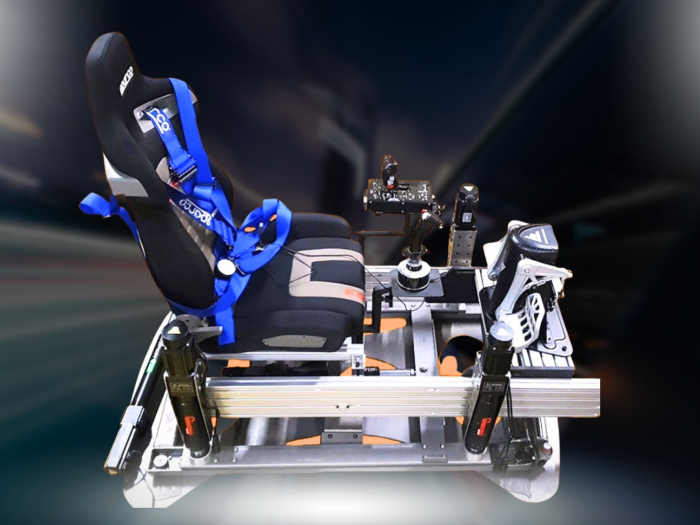
The motion simulator vs static rig debate often centres on logistics, yet the LowSlider proves that you don't need a warehouse to achieve professional immersion. By integrating the actuators into an ultra-low profile chassis, it provides a full 6 DOF experience within the footprint of a standard static rig. This compact nature makes it a favourite choice for UK-based enthusiasts where space is often at a premium. Beyond the footprint, the low centre of gravity improves both the realism of the weight transfer and the safety of the floor-loading. It ensures the forces are distributed evenly, preventing the top-heavy swaying found in taller, less stable designs.
One-Hour Assembly: From Crate to Cockpit
Assembly time is another area where professional engineering outshines mass-market alternatives. Many DIY motion kits arrive as a daunting collection of aluminium extrusions and unlabelled bolts, often taking days to organise. Race@Home's hand-built approach utilises a four-piece modular design that allows for a one-hour assembly process. It arrives in manageable, pre-tested sections that bolt together with precision. This crate to cockpit speed provides peace of mind, knowing that your hardware has been expertly aligned before it even leaves the workshop. If you're ready to transform your driving experience without rebuilding your home, explore the LowSlider range today.
Conclusion: Why the LowSlider is the No-Compromise Choice
The motion simulator vs static rig debate often forces drivers to choose between clinical consistency and visceral immersion. If you're purely chasing digital trophies on a leaderboard, a static rig provides the unyielding stability needed for pixel-perfect inputs. However, if your goal is to replicate the physical reality of motorsport, only a 6 DOF system can translate telemetry into tangible sensation. The LowSlider 6 DOF platform bridges this gap, offering the precision engineering required for elite competition whilst delivering the physical feedback necessary for professional driver development. It isn't just a piece of hardware; it's the ultimate evolution of your sim racing career that refuses to compromise on either speed or realism.
Choosing a platform hand-built in the UK ensures you aren't just buying a product off a shelf. You're investing in a piece of engineering craftsmanship designed to withstand the violent forces of high-fidelity actuators. This bespoke approach provides a level of rigidity that mass-market aluminium extrusions simply cannot match. By choosing a system that prioritises an ultra-low profile and a compact footprint, you're ensuring that your professional-grade setup remains practical for a domestic environment without losing the "real-world" translation of digital data.
Bespoke Engineering for Enthusiasts
Mass-produced aluminium profiles are versatile, but they often lack the structural integrity required for active motion. A hand-built LowSlider chassis is engineered specifically to manage the stresses of 6 DOF movement, eliminating the unwanted flex that can muddy the feedback from your actuators. This dedicated foundation allows you to integrate premium sim racing accessories into a seamless, high-performance ecosystem. It's an investment in long-term value, providing a platform that stays relevant as you upgrade your wheelbases and pedals throughout your racing career.
The Ultimate VR Integration
Total presence is the "holy grail" of simulation, and nothing shatters it faster than sensory mismatch. When your eyes see a high-speed corner through a Pimax VR headset but your body remains stationary, the brain identifies the experience as artificial, often leading to nausea. The LowSlider 6 DOF platform eliminates this disconnect by synchronising physical movement with virtual visuals. This level of integration is why serious drivers looking to buy a motion simulator in the UK choose UK-engineered solutions. It's time to move beyond the static world and feel the intensity of every lap. Your journey from a virtual gamer to a precision driver starts with a rig that moves with you.
Elevate Your Performance Beyond the Fixed Frame
The choice in the motion simulator vs static rig debate ultimately defines your journey as a driver. Whilst a static rig serves the needs of leaderboard hunters, only a dynamic platform translates digital data into the physical muscle memory required for real-world mastery. You now understand that 6 DOF motion is the professional standard for true immersion, providing the complex cues that a fixed seat simply cannot replicate. Space and complexity are no longer obstacles to this transition.
Hand-built in the UK by engineering specialists, our proprietary LowSlider design offers an ultra-low profile that fits seamlessly into your home. We provide global shipping with a simple one-hour assembly process from four main pieces, ensuring you spend your time on the track rather than in the workshop. If you're ready to experience the visceral intensity of every kerb and weight shift, it's time to invest in a setup that evolves with your ambitions. Explore the LowSlider 6 DOF Motion Platform and redefine your limits today.
Frequently Asked Questions
Is a motion simulator better than a static rig for lap times?
A static rig is often better for chasing world-record lap times because it provides a perfectly stable platform for surgical brake modulation. However, the motion simulator vs static rig comparison isn't just about the clock. Motion builds the muscle memory required for real-world racing. Whilst you might find yourself a tenth slower on a digital leaderboard, your ability to sense the car's limit and catch slides becomes significantly more accurate to real-life driving.
Does a motion rig cause motion sickness more than a static one?
Motion sickness is more common on dynamic platforms than static ones, but it's usually caused by a latency gap between your eyes and your inner ear. High-end systems with low-latency actuators and ultra-low profile designs, like the LowSlider, synchronise movements perfectly with the on-screen action. This reduces the "floaty" sensation that triggers nausea. If you use VR, a 6 DOF platform actually helps prevent sickness by providing the physical cues your brain expects.
How much space do I need for a 6 DOF motion platform?
Traditional motion setups required a massive footprint, but modern engineering has changed these requirements. Our LowSlider 6 DOF platform is designed to fit within the same space as a standard static rig. You don't need a dedicated warehouse; a typical spare room or home office is sufficient. The ultra-low profile ensures the centre of gravity remains grounded, whilst the four-piece modular design makes it easy to organise within a domestic environment without sacrificing immersion.
Can I upgrade my existing static rig to a motion system?
You can often upgrade a high-quality aluminium extrusion rig with motion actuators, but structural rigidity is the primary concern. A standard frame might flex under the intense forces of a 6 DOF system, which muddies the telemetry feedback. It's often more effective to invest in a purpose-built system like the LowSlider. This ensures the actuators are integrated into a hand-built foundation that's specifically engineered to handle high-performance movement without mechanical vibration.
What is the "Verstappen Theory" in sim racing?
The "Verstappen Theory" refers to the observation that elite eSports drivers, including Max Verstappen, often prefer static rigs for competitive events. This is because a fixed seat eliminates physical variables, allowing for total focus on digital inputs. It's a valid choice for professional gaming where pixel-perfect consistency is the only goal. However, for those using simulation as a training tool for real-world tracks, motion remains the superior choice for developing physical intuition and car control.
Are motion simulators noisy for home use?
Modern motion simulators are surprisingly quiet and suitable for home use. Whilst older industrial systems were loud, current precision actuators produce a refined electronic hum rather than a mechanical roar. The sound is comparable to a high-end direct drive wheelbase under heavy load. If you're concerned about neighbours or family, using a solid floor or a vibration-dampening mat ensures the experience remains immersive for you without being disruptive to the rest of the household.
How difficult is it to assemble a full motion simulator?
Assembly difficulty varies wildly amongst manufacturers. Many mass-market kits arrive as a confusing pile of aluminium profiles and bolts that can take days to organise. In contrast, our UK-engineered platforms are designed for a "bolt-together" experience. The LowSlider arrives in four pre-tested, modular pieces that allow for a complete one-hour assembly. You won't need specialised engineering tools or a degree in robotics to get from the crate to the virtual cockpit.
Is a 6 DOF motion rig worth the investment for casual racers?
Whether a 6 DOF motion rig is worth the investment depends on your dedication to the hobby. For a casual racer, a static rig provides a great entry point. However, if you're looking for the ultimate evolution of the experience, motion provides a level of sensory feedback that visuals alone cannot match. It transforms the activity from a game into a visceral, high-performance event. It's a premium investment in the pursuit of absolute realism.


