
Your wheelbase provides the spectacle, but your feet are what actually win the race. If you've ever missed a braking marker because of a mushy pedal or felt the immersion-breaking flex of a budget set, you know that consistency is the hardest thing to master in a digital cockpit. Finding the best sim racing pedals isn't just about spending more; it's about translating your physical intent into precise telemetry data without a millimetre of wasted movement.
We understand that the choice between high-end load cells and bespoke hydraulic cylinders can be daunting, especially when you're building a professional-grade setup. You want a pedal feel that mimics the resistance of a GT3 or Formula car, ensuring every trail-braking manoeuvre becomes second nature. This guide explores the elite hardware of 2026, detailing how the right choice will improve your lap times and complement a high-performance motion rig. We'll examine engineering specifications, sensor accuracy, and the structural rigidity required for a truly no-compromise experience that stands up to the forces of a 6 DOF platform.
Key Takeaways
- Understand why pressure-based braking is superior to travel distance for building the muscle memory needed for perfect trail braking.
- Compare the latest load cell, hydraulic, and active technologies to identify the best sim racing pedals for your professional-grade simulator.
- Learn how to eliminate performance-robbing mechanical flex by ensuring your pedals are mounted to a rigid, motion-compatible chassis.
- Discover why 2026 flagship hardware requires the stability of a bespoke motion platform like the LowSlider to translate telemetry into realistic physical feedback.
Why Sim Racing Pedals are Your Most Vital Rig Upgrade
While a high-torque wheelbase often captures the headlines, it's the pedal set that truly dictates your position on the leaderboard. In the high-stakes environment of sim racing, your feet handle the most critical telemetry inputs. They aren't just simple switches; they're the primary interface for weight transfer and mechanical grip. Professional drivers understand that speed comes from the engine, but consistency is forged in the braking zone. Upgrading to the best sim racing pedals marks the definitive transition from casual gaming to serious simulation. It moves you away from vague spring-based travel and into the territory of high-fidelity, pressure-sensitive resistance.
Consistency vs. Speed: The Real Benefit of Professional Pedals
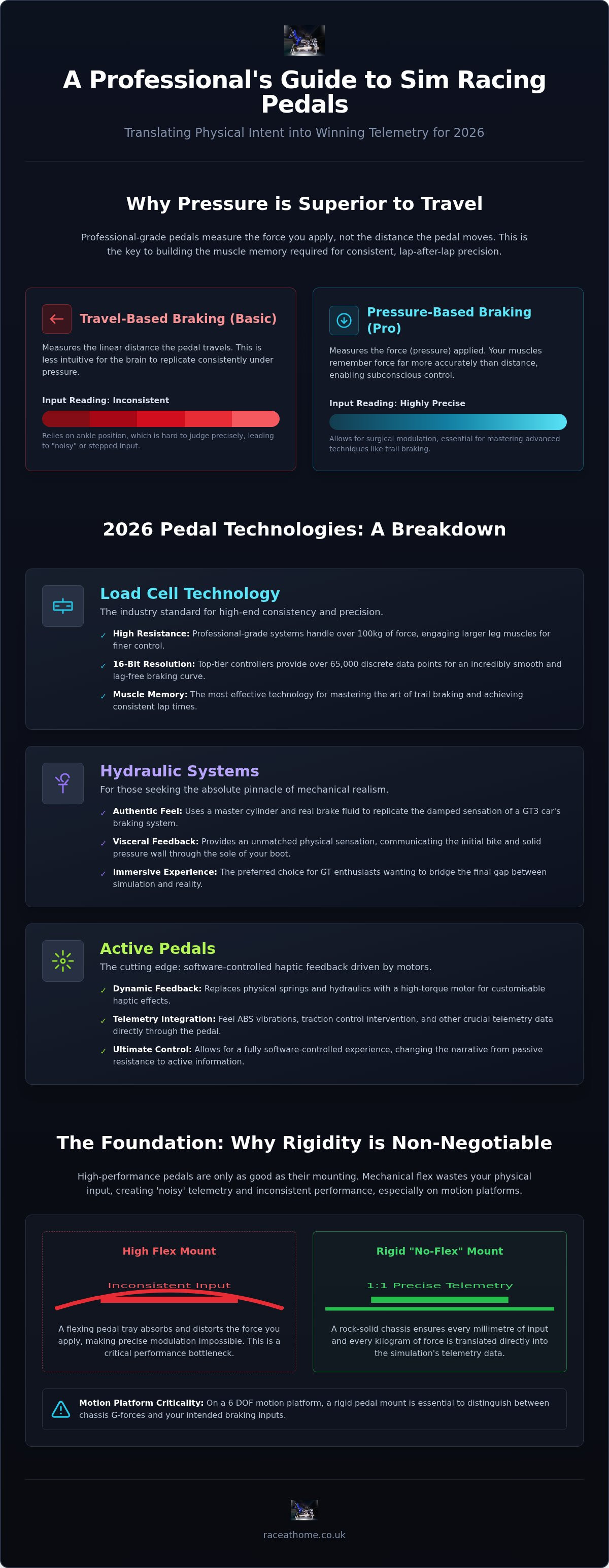
Load cell sensors measure the physical force applied to the pedal arm rather than the distance it travels, enabling you to modulate braking pressure with the same subconscious muscle memory used in a real car. This technology is the key to mastering trail braking. It allows you to bleed off pressure with surgical accuracy as you rotate the car into a corner. It's the difference between merely finding the apex and hitting it with millimetre precision every single lap. Whilst a standard pedal might feel like a computer peripheral, professional-grade hardware provides the "engine room" of your on-track performance. Elite racers prioritise pedal feel over steering torque because the human brain is neurologically wired to replicate pressure more accurately than linear movement.
The Role of Pedals in a High-End Sim Rig
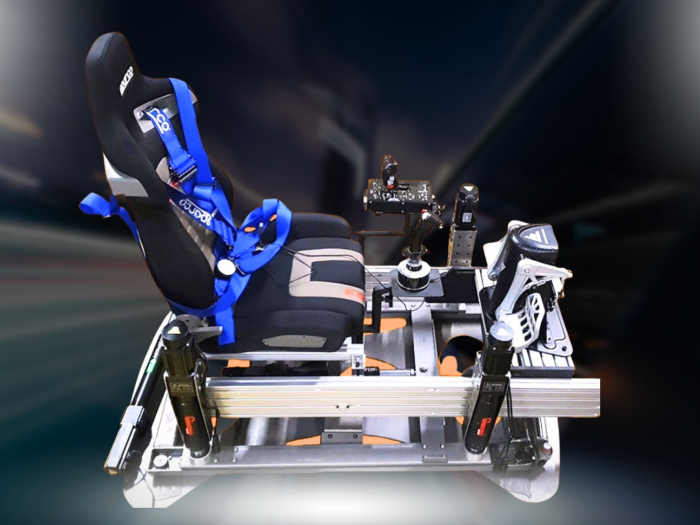
High-performance hardware requires a foundation that doesn't yield under heavy loads. When you integrate top-tier pedals into a professional setup like the LowSlider 6 DOF, the synergy is transformative. A motion platform subjects your body to physical forces that can shift your centre of gravity, making intuitive pedal control even more vital. If your pedal tray flexes even a few millimetres, the telemetry data being sent to the simulator becomes "noisy" and inconsistent. Investing in the best sim racing pedals eliminates this mechanical guesswork. It provides the psychological confidence to push deeper into the braking zone, knowing the hardware will respond exactly as it does in a professional GT3 cockpit. This rock-solid stability is what allows you to stop thinking about the equipment and start focusing entirely on the racing line.
Understanding the Technology: Load Cell vs Hydraulic vs Active Pedals
The landscape of pedal technology has matured significantly over the last few seasons. Choosing the best sim racing pedals in 2026 involves deciding between three distinct engineering philosophies, each offering a different path to on-track consistency. While entry-level gear relies on simple travel distance, professional-grade hardware focuses on the physics of force and fluid dynamics to bridge the gap between digital data and physical sensation.
Load Cell Technology: Precision through Pressure
Load cells remain the industry standard for high-end consistency. Unlike basic sensors that track how far a pedal moves, a load cell measures the actual pressure applied to the pedal arm. This mimics the behaviour of a real braking system where the pads have already met the disc and further deceleration is achieved by pushing harder, not further. For professional-grade formula car simulation, a load cell capable of handling 100kg or more is essential. This high resistance allows you to use your larger leg muscles rather than just your ankle, providing a much broader range for modulating pressure. To ensure these inputs are translated without "stepping" or lag, the highest-quality controllers now utilise 16-bit resolution, providing over 65,000 discrete points of data for incredibly smooth braking curves.
Hydraulic and Active Systems: The Cutting Edge
If you're seeking the absolute pinnacle of realism, hydraulic systems and active motors represent the current frontier. Hydraulic pedals, such as those from Sim Racing Professional, use a master cylinder and real brake fluid to create a fluid-damped sensation that is almost impossible to replicate with rubber elastomers alone. This is often the preferred choice for GT3 enthusiasts who want that authentic, slightly damped initial bite followed by a solid pressure wall. It's a visceral experience that provides immediate feedback through the sole of your boot.
The Simucube ActivePedal has changed the narrative by replacing physical springs and hydraulics with a high-torque motor. This allows for software-controlled haptic feedback where you can feel ABS vibrations, traction control intervention, or even the "thump" of a gear change directly through the pedal. It's a game-changer for those who want a fully customisable feel without getting their hands dirty with physical adjustments. If you're building a no-compromise rig, our specialists at Race@Home can provide the expert consultancy needed to match these advanced systems to your specific driving style.
Maintenance requirements vary significantly across these technologies. Hydraulic systems may eventually require fluid flushes or seal inspections, much like a real race car. Load cell systems are generally more "set and forget," though they require occasional lubrication and the replacement of polyurethane elastomers as they lose their spring rate over time. Active pedals represent a higher initial investment but offer the benefit of being largely maintenance-free, as all "physical" changes are handled via software profiles.
Selecting Pedals for High-Performance Motion Rigs
High-force braking requires a foundation that doesn't budge. If you've invested in the best sim racing pedals, mounting them to a standard desk or a lightweight frame is a waste of engineering. Even a millimetre of flex in the pedal plate acts as a mechanical filter, distorting the pressure data reaching the PC. This is why the LowSlider motion rig is designed with an over-engineered steel foundation. It ensures every Newton of force goes directly into the sensor, not into bending the rig's chassis. Flex kills telemetry, and in a professional environment, telemetry is everything.
Mounting Geometry and Rig Rigidity
Achieving the perfect heel-to-toe alignment is critical for smooth downshifts and precise trail braking. Whether you prefer a high-offset Formula seating position or the upright stance of a GT3 car, your rig must offer granular adjustability to accommodate your favourite driving style. A compact footprint doesn't mean sacrificing structural integrity. High-end rigs use reinforced mounting points to handle the 100kg+ forces generated by elite load cells without shifting. Without this rigidity, your telemetry becomes inconsistent, making it impossible to build the muscle memory required for professional-level competition. You need a setup that feels as solid as a real-world bulkhead.
Pedal Feedback in a Motion Environment
When your cockpit is pitching under braking and rolling through corners, your relationship with the pedals changes. Motion telemetry provides physical cues that your eyes can't always catch. For example, a 6 DOF platform allows you to feel traction loss through your hips, which tells you exactly when to bleed off the brake pressure. This physical "G-loading" requires pedals that stay exactly where they're supposed to be. Using sim racing accessories specifically engineered for motion compatibility ensures that your sensors aren't triggered by the movement of the rig itself. It's about maintaining a clean signal between your foot and the software.
Synchronising your pedal inputs with the physical pitch of the rig creates a closed-loop feedback system. As the nose of the simulator dives during heavy braking, your leg naturally applies more pressure. If the pedals are mounted to a platform that isn't rock-solid, this sensation is lost. To find the best sim racing pedals for your setup, you must consider the entire ecosystem, ensuring that the hardware can withstand the visceral forces of a high-performance motion simulator. Precision is only possible when your equipment is as committed to the corner as you are.
The Best Sim Racing Pedals of 2026: Expert Recommendations
The market for the best sim racing pedals has matured into a landscape of engineering excellence. In 2026, hardware is no longer judged solely on build quality; it's evaluated on the sophistication of the sensor-to-software handshake. For the professional racer, the following systems represent the absolute pinnacle of performance, durability, and sensory feedback.
- Heusinkveld Ultimate+: Still the definitive gold standard for professional sim racers. These pedals utilise a high-force load cell system that provides a rock-solid brake feel, designed specifically for those who demand 100kg+ of resistance.
- Simucube ActivePedal: A revolutionary motor-driven system that replaces physical elastomers with software-controlled haptics. It's the ultimate choice for drivers who want to customise their pedal feel instantly without opening a toolbox.
- Sim Racing Professional (SRP): These pedals offer an exceptional hydraulic feel that mimics the fluid dynamics of a real GT3 master cylinder. They provide a visceral, damped sensation that load cells struggle to replicate.
- VRS DirectForce Pro: Widely regarded as the best performance-to-value ratio for serious competitors. It offers high-fidelity pressure sensing and industrial-grade construction at a competitive price point.
- Asetek Invicta: This system combines a unique hydraulic cylinder with a rock-solid load cell foundation, offering the "hard wall" feel favoured by formula car specialists.
Top Picks for Formula and GT Specialists
Formula specialists often prefer the Heusinkveld Ultimate+ or Asetek Invicta for their ability to simulate a extremely short, high-pressure brake throw. This allows for the micro-modulations required when braking from 200mph. Conversely, GT3 enthusiasts often gravitate toward SRP hydraulic systems. The fluid-damped return stroke mimics modern GT3 brake behaviour, helping you feel the car's weight transfer more naturally. Pedal face design is equally vital; choosing a curved or flat face can significantly impact your comfort during long endurance stints. If you're looking to integrate these into a bespoke cockpit, consult the specialists at Race@Home to ensure your hardware is matched perfectly to your rig's geometry.
The Future of Pedals: Software-Driven Realism
Software is now as important as the metal itself. The Simucube ecosystem allows you to change your pedal profile on-the-fly, switching from a soft road car feel to a stiff Formula 1 brake with a single click. This digital control also enables advanced haptic feedback. You can feel ABS pulses, engine vibrations, and even traction control intervention directly through the pedal face. This level of fidelity is particularly transformative when using a Pimax VR headset. The visual immersion of a high-resolution headset needs to be matched by physical feedback that feels just as real. When your eyes see the wheels locking and your feet feel the ABS vibration simultaneously, the digital world disappears.
Completing the Immersion: Pairing Pedals with a LowSlider Platform
High-end pedals are only half the equation for professional-level consistency. To truly unlock their potential, they require a platform that communicates the car's behaviour to your entire body. When you pair the best sim racing pedals with a 6 DOF motion system, you create a complete sensory loop. The physical pitch of the cockpit under heavy braking confirms exactly what your foot is feeling through the load cell or hydraulic cylinder. This synergy eliminates the "guessing game" of digital racing, replacing it with the visceral confidence found in a real-world track session.
At Race@Home, we focus on hand-built, bespoke engineering to ensure your hardware remains a precision instrument. Most mass-produced cockpits suffer from micro-vibrations and structural flex that introduce "noise" into your telemetry. Our UK-manufactured platforms are designed to be the ultimate foundation, providing a rock-solid mounting point for 100kg+ braking forces. This professional-grade approach moves your setup away from the feeling of a gaming peripheral and into the realm of a genuine training tool. It's about achieving a minimal footprint without sacrificing the structural integrity required for elite competition.
The Race@Home Advantage
Our bespoke UK manufacturing process ensures every component is perfectly aligned for your specific ergonomic needs. We don't just sell hardware; we provide a gateway to total immersion. By integrating Pimax VR Headsets with our motion platforms, we align your visual horizon with physical G-forces, ensuring your brain and body receive synchronised data. If you're considering a professional upgrade, our guide on buying a motion simulator in the UK offers the essential technical insights needed for a no-compromise home setup. We help you organise a rig that balances high-performance output with practical home logistics.
Next Steps for Your Sim Racing Career
Moving from a static rig to a full-motion environment is the most significant step a driver can take toward professional realism. A sim racing motion rig is an invaluable asset for driver training, allowing you to practice weight transfer and limit-handling in a safe, repeatable environment. Before you finalise your 2026 upgrade, ensure your final checklist includes a rigid, motion-compatible pedal plate and high-fidelity sensors that won't be overwhelmed by the movement of the rig. When your equipment is this capable, your only focus is the next apex.
Mastering the Art of Precision Braking
Choosing the best sim racing pedals is the most significant step you can take toward professional-level consistency. Whether you opt for the visceral fluid feel of a hydraulic system or the cutting-edge customisation of motor-driven active technology, your hardware must translate digital telemetry into physical confidence. Remember that even the finest sensors will fail to perform if they aren't mounted to a rock-solid, motion-ready foundation that eliminates performance-robbing flex.
At Race@Home, we are specialists in high-end sim racing integration. We understand that every millimetre of movement matters. Our bespoke motion platforms are hand-built in the UK and engineered to withstand the immense forces of professional competition, with global shipping available for drivers worldwide. It's time to move beyond the limitations of static gear and feel the true intensity of the track.
Upgrade your sim racing experience with a bespoke Race@Home motion platform and start hitting every apex with surgical precision. Your journey to the podium begins at your feet.
Frequently Asked Questions
Are load cell pedals really better than standard potentiometer pedals?
Load cells are significantly superior because they measure the physical force applied rather than the distance the pedal moves. This allows you to build muscle memory based on pressure, which is far more accurate than gauging linear travel. Potentiometer pedals rely on a simple sweep across a sensor, making it difficult to replicate precise braking points. With a load cell, you can modulate your trail braking with the same subconscious effort used in a real-world vehicle.
Can I use high-end pedals on a desk or do I need a full sim rig?
High-end pedals require the stability of a dedicated rig to be effective. Professional sets often demand 80kg to 100kg of pressure, which would cause a standard office chair to roll backwards or a desk to shift. To get the most from the best sim racing pedals, you need a rigid mounting plate that eliminates flex. This ensures that every bit of force you apply is translated into telemetry rather than being lost to mechanical movement.
What is the difference between a 2-pedal and 3-pedal set for sim racing?
The choice depends on the specific discipline you intend to master. A 2-pedal set is the standard for modern Formula and GT3 racing, where paddle shifters and auto-clutch software are used. A 3-pedal set is essential if you enjoy historic racing, drifting, or using a manual H-pattern shifter. If your rig has a narrow footwell, a 2-pedal configuration often allows for more ergonomic spacing, helping you avoid leg strain during intense endurance sessions.
How much force should I set my brake pedal to for the best realism?
For maximum realism, most professional drivers set their brake force between 65kg and 90kg. This range allows you to use your larger leg muscles for better modulation without causing physical fatigue during long races. A Formula car typically requires a much stiffer, shorter throw than a GT3 or road car. The key is to find a setting that feels solid underfoot, ensuring you can reach maximum braking pressure without the pedal hitting a physical stop.
Do hydraulic sim racing pedals require a lot of maintenance or fluid changes?
Hydraulic systems are remarkably durable but do require periodic inspections. You don't need to change the fluid as often as a real car, but checking the seals for leaks and ensuring the master cylinder is lubricated is good practice. Most professional sets, like those from Sim Racing Professional, are designed to be "set and forget" for long periods. However, if the pedal feel becomes spongy, a simple bleed of the system will restore its razor-sharp response.
Is it worth upgrading to active pedals like the Simucube ActivePedal in 2026?
Active pedals are a transformative upgrade for the 2026 season. Unlike mechanical systems, they use a high-torque motor to provide software-controlled haptic feedback. This allows you to feel ABS vibrations and traction control intervention directly through your foot. It removes the need for physical elastomer swaps, as you can change the entire pedal feel with a single click. For those building a professional-grade simulator, the Simucube ActivePedal offers a level of customisation that is currently unmatched.
How do I ensure my sim racing pedals are compatible with my motion platform?
Compatibility depends on structural rigidity and electrical isolation. Your pedals must be mounted to a reinforced plate that can withstand the G-forces of a 6 DOF platform without shifting. It's also vital to ensure the pedal electronics are shielded from the electromagnetic interference generated by motion actuators. At Race@Home, we specialise in bespoke integration, ensuring your sensors provide a clean signal whilst the rig is pitching and rolling through high-speed corners.
Will better pedals actually make my lap times faster or just more consistent?
Better pedals primarily improve your consistency, though this inevitably leads to faster lap times. By providing superior feedback during trail braking, the best sim racing pedals allow you to find the limit of grip without locking your wheels. You'll find yourself hitting your apexes more reliably and reducing the frequency of costly mistakes. Speed in sim racing comes from repeatability, and high-fidelity pedals are the most effective tool for achieving that level of professional performance.


