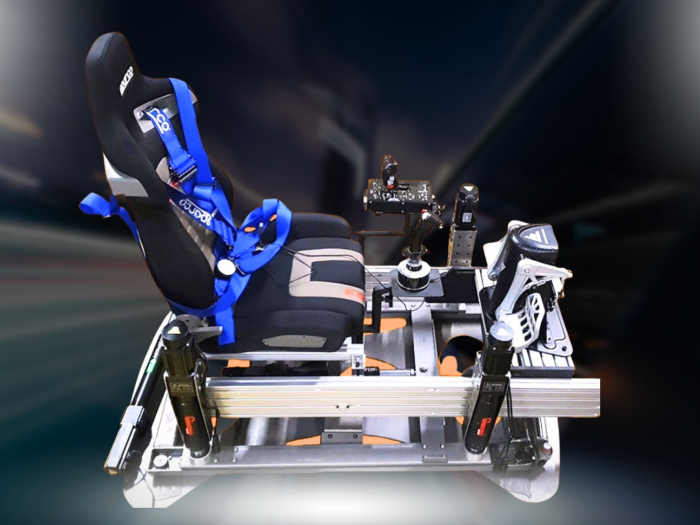

What if the most significant breakthrough in your lap times happened before you even arrived at the circuit? You've likely felt the frustration of a static simulator where the lack of physical feedback leads to "sim-only" driving habits that simply don't work on a real track. Integrating a professional motion simulator for driver training changes the equation, turning digital telemetry into the visceral, high-fidelity sensations your brain needs to react instinctively.
With 6 DOF technology, you aren't just playing a game; you're building genuine muscle memory for oversteer and traction loss whilst learning the nuances of track elevation and camber. This 2026 guide explores how proprietary systems like the LowSlider 6 DOF platform offer a compact, cost-effective alternative to expensive real-world testing. We'll examine the technical requirements for a professional setup and how to ensure your sim-learnt skills translate perfectly to your next track day. Whether you're a veteran racer or an aspiring enthusiast, it's time to bridge the gap between the digital and the physical with precision engineering.
Key Takeaways
- Learn why static rigs often create "sim-only" habits and how a professional motion simulator for driver training provides the essential inner-ear feedback needed for real-world track performance.
- Discover why 6 DOF technology is the gold standard for replicating vehicle dynamics, specifically how yaw and traction loss cues help you catch oversteer before it's too late.
- Compare seat movers against full cockpit systems to see why maintaining the ergonomic relationship between your seat, wheel, and pedals is vital for professional consistency.
- Explore how the LowSlider's ultra-low profile design allows you to fit a professional 6 DOF rig into a compact space whilst maintaining a hand-built, UK-engineered standard.
- Understand how to integrate high-end peripherals, such as Pimax VR headsets, to create a fully immersive environment that mirrors the sensory demands of a competitive race weekend.
Why Static Simulators Limit Professional Driver Development
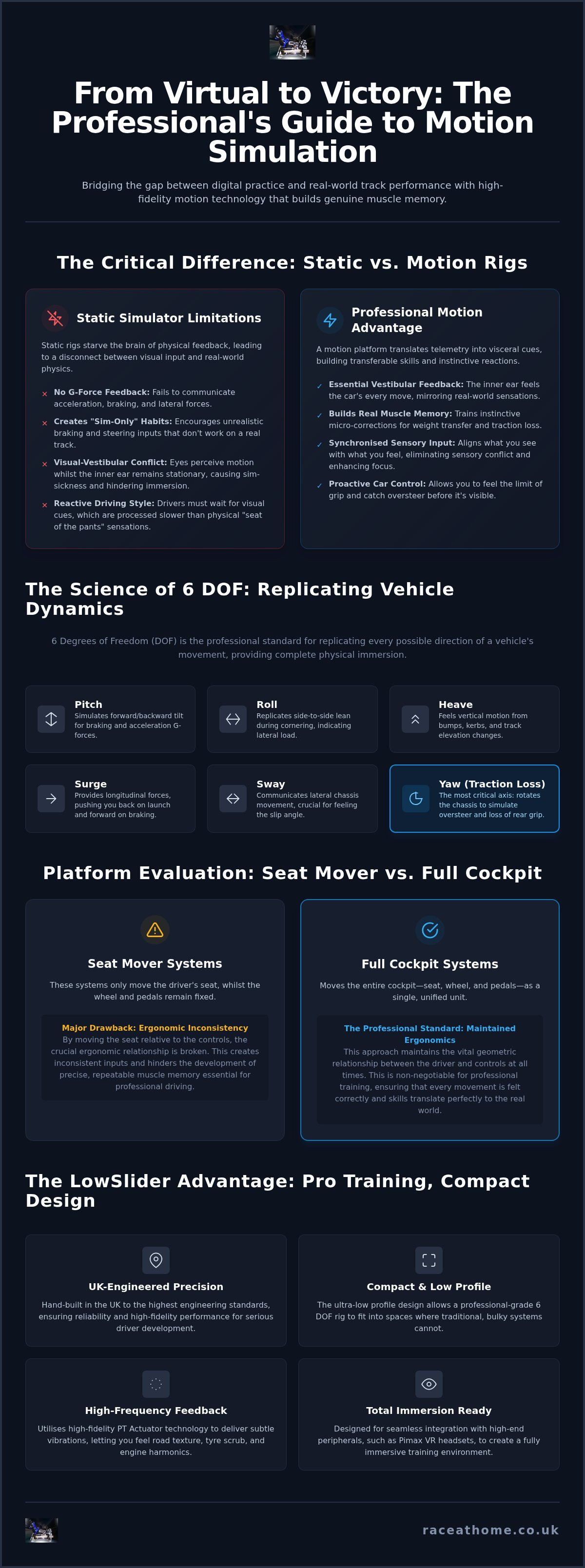
A motion simulator for driver training is far more than a high-end gaming peripheral; it's a sophisticated engineering tool designed to translate digital telemetry into physical vestibular cues. In a static environment, your brain is starved of the most critical data points required for high-performance driving: acceleration, braking, and lateral G-forces. This "missing link" creates a fundamental disconnect between the virtual cockpit and the real-world circuit. When your eyes perceive high-speed cornering whilst your inner ear remains stationary, the result is often visual-vestibular conflict. This sensory mismatch is the primary cause of sim-sickness and prevents the brain from fully committing to the experience.
Professional drivers don't just use their eyes to navigate a corner. They rely on the "seat of the pants" feel to identify the limit of the car's grip long before the visual horizon begins to shift. To understand how these forces are replicated, it's helpful to examine The Science of 6 DOF and how it mirrors the complex movements of a physical chassis. Without this physical feedback, a driver is essentially guessing the slip angle, leading to a reactive rather than proactive driving style.
The Role of Vestibular Feedback in Car Control
The human body is remarkably sensitive to slip angles, detecting minute changes in direction through the inner ear with incredible speed. Physical sensation triggers a neural response significantly faster than visual processing. In a real car, you feel the rear end rotate through your hips and vestibular system. By integrating a motion simulator for driver training, you harness this biological advantage. It allows you to develop the instinctive micro-corrections needed to catch oversteer the moment it begins. This immediate feedback loop is what separates a world-class driver from a talented amateur.
Static Rigs vs. Real-World Muscle Memory
Static rigs often inadvertently encourage "bad habits" that can be dangerous on a real track. Without the physical sensation of weight transfer, you might develop unrealistic braking techniques or aggressive steering inputs that would instantly unsettle a physical race car. You're effectively training your muscles to ignore the laws of physics. These sim-only behaviours don't translate to the circuit; they hinder your actual development. High-fidelity motion technology acts as the essential bridge that ensures your digital practice sessions result in tangible, transferable skills for your next real-world race weekend.
The Science of 6 DOF: Replicating Full Vehicle Dynamics
To truly master a circuit, you must understand the physics acting upon the chassis. A professional motion simulator for driver training achieves this through 6 Degrees of Freedom (DOF), a technical standard that replicates every possible direction of movement. These axes include Pitch, Roll, Yaw, Heave, Sway, and Surge. Whilst entry-level rigs might focus on simple tilting, a professional-grade system uses these movements to provide the same sensory data used in professional driver development at the highest levels of motorsport. By utilising high-fidelity PT Actuator technology, these platforms deliver high-frequency vibrations that allow you to feel road texture, tyre scrub, and even engine harmonics through the cockpit.
Pitch, Roll, and Heave: Feeling the Track Surface
Pitch and Roll are the foundations of weight transfer. When you bury the brake pedal, the nose-down Pitch tells you exactly how much pressure you're applying to the front tyres. Similarly, Roll replicates the lateral lean as you load up the outer suspension through a high-speed sweeper. Heave is perhaps the most underrated axis. It simulates vertical displacement, such as the massive compression at the base of Eau Rouge or the sharp jolt of a kerb strike. Feeling these Heave cues allows you to adjust your racing line based on the physical feedback of the track's surface, ensuring you don't unsettle the car on a hidden bump.
Traction Loss and Surge: Perfecting the Launch and Corner Exit
Surge provides the longitudinal G-forces that push you into your seat during a launch or pull you forward under heavy deceleration. It is vital for timing gear changes and managing brake bias. However, for those training in rear-wheel-drive machinery, the "Twin Traction Loss" (Yaw) found in a high-end motion simulator for driver training is the most critical axis. This independent movement simulates the rear end stepping out, giving you the physical warning needed to catch a slide before your eyes even register the rotation. Software like iRacing or Assetto Corsa sends raw telemetry data to the actuators, which process the information in milliseconds to ensure the physical sensation matches the visual output. When you combine this precision with Pimax VR sim racing, your depth perception and spatial awareness reach a level that static screens simply cannot match. If you're ready to experience this level of realism, exploring a LowSlider 6 DOF motion platform is the logical next step in your driver development journey.
Evaluating Motion Platforms: Seat Movers vs. Full Cockpit Systems
Selecting the right motion simulator for driver training involves a fundamental architectural choice: do you move just the seat or the entire cockpit? Entry-level "seat movers" function by tilting the driver's seat independently of the wheel and pedals. Proponents of this method argue that it creates intense "pressure points" against the driver's body, which can mimic the feeling of sustained G-forces. Whilst this provides a visceral sensation, it introduces a significant flaw in professional development. If the seat moves whilst the controls remain static, your ergonomic relationship with the car is constantly shifting. This disconnect can lead to "ghost inputs" where your body's involuntary movement relative to the steering wheel causes unintended steering or braking adjustments.
Professional-grade full cockpit systems move the seat, wheel, and pedals in perfect synchronisation. This ensures that your arms and legs remain at the exact distance from the controls regardless of the chassis angle. Maintaining this "control triangle" is vital for building consistent muscle memory that translates to a real race car. When you're threshold braking or trail-braking into a tight hairpin, you need to know that your pedal pressure is a result of your input, not the seat tilting away from the floor. For those building a bespoke setup, understanding sim rig motion platform compatibility is the first step toward ensuring your hardware supports a full-motion architecture.
The Ergonomic Argument for Full Cockpit Motion
Consistency is the hallmark of a professional driver. In a seat-mover rig, if the seat pitches forward under heavy braking, the distance between your hips and the brake pedal decreases. This change, however minute, alters your ability to modulate brake pressure accurately. Full cockpit motion eliminates this variable. By moving the entire environment, the rig preserves the ergonomic integrity of the cockpit. You don't have to fight the rig to maintain your driving position; instead, you can focus entirely on the car's behaviour and your line through the corner.
Which System Best Translates to Driver Training?
When evaluating hardware for a commercial motion simulator or a high-end home setup, full cockpit motion is the industry standard for 2026. It provides the most accurate data for your vestibular system without compromising your physical inputs. Whilst seat movers are often more affordable and compact, they lack the technical precision required for high-level driver development. The following table highlights the key differences between these architectures and the proprietary LowSlider 6 DOF approach.
| Feature | Seat Mover | Full Cockpit (Standard) | LowSlider 6 DOF |
|---|---|---|---|
| Ergonomic Consistency | Low (Controls are static) | High (Controls move with driver) | Maximum (Ultra-low profile) |
| Muscle Memory Accuracy | Moderate | High | High-Fidelity |
| Space Requirement | Minimal | Substantial | Compact / Professional |
| G-Force Simulation | Pressure-based | Vestibular-based | Vestibular + High Frequency |
Optimising Your Training Setup: Hardware and Space Logistics
Integrating a motion simulator for driver training into a home or commercial environment requires careful planning of physical logistics. You need to consider the total footprint, which includes the "swing area" or the maximum range of motion during extreme manoeuvres. Unlike massive industrial rigs that demand a dedicated studio, the LowSlider 6 DOF platform is engineered with an ultra-low profile design, making it compatible with standard ceiling heights. Ensure your power supply is stable and that you've accounted for noise isolation; using high-density rubber mats in residential settings can significantly reduce the transmission of high-frequency vibrations to the floor.
Space Management for Home Training
Measuring your space is the first step toward a professional setup. A typical 6 DOF rig requires a clear area of approximately 2m x 2m to allow for full yaw and surge movement without obstruction. The LowSlider's proprietary design minimises the vertical lift, so you won't feel cramped even in a smaller room. This compact engineering doesn't compromise on performance, but it does eliminate the need for costly structural modifications to your property. If you're concerned about the intimidation factor of high-end equipment, remember that modern engineering has simplified the process. The LowSlider arrives in four pieces and features a one-hour customer assembly, ensuring you spend less time with a spanner and more time on the track.
The Software Side: Data and Telemetry Analysis
The physical hardware is only half of the equation. To truly benefit from a motion simulator for driver training, you must leverage telemetry-driven data to identify where you are losing time. Modern platforms process real-time data from titles like iRacing and Assetto Corsa, creating a "digital twin" of track conditions that translates perfectly into physical cues. This allows you to analyse tyre scrub and brake lock-ups through feel rather than just looking at a graph after the session. Telemetry-driven motion provides a physical manifestation of digital data, turning abstract numbers into tangible sensations that refine your driving technique.
To complete the immersion, integrating high-end sim racing accessories like load-cell pedals is essential for accurate brake modulation. Pairing these with a Pimax VR headset provides the 360-degree spatial awareness required for professional-level racing, allowing you to look through the apex just as you would in a real car. If you're ready to build your ultimate development tool, you can customise your LowSlider 6 DOF motion platform here to suit your specific training goals.
The LowSlider Advantage: Professional Training, Compact Footprint
Bridging the gap between a digital environment and real-world performance requires hardware that doesn't just move, but communicates. The LowSlider 6 DOF and 3DoF platforms represent the pinnacle of compact engineering, specifically designed to meet the rigorous demands of a motion simulator for driver training. Whilst many industrial-grade rigs are too cumbersome for home use, our proprietary design delivers professional-grade fidelity within a footprint that respects your space. Every platform is hand-built in the UK, ensuring a level of craftsmanship and technical authority that mass-produced alternatives simply cannot match. Race@Home acts as a dedicated consultant for drivers who demand professional sim racing simulator quality without the logistical burden of an industrial-sized installation.
Engineering Excellence: The LowSlider Proprietary Design
The core of the LowSlider advantage lies in its ultra-low profile architecture. By keeping the cockpit as close to the floor as possible, we lower the centre of gravity, which significantly enhances motion fidelity and reduces mechanical latency. This design ensures that every surge, sway, and yaw movement is crisp and immediate, providing the high-frequency feedback your vestibular system needs to react. We utilise premium materials and precision engineering to create a rig that outlasts mass-market equipment, even under the stress of high-torque direct drive wheels and load-cell pedals. Despite this sophisticated construction, the modular "Four Piece" assembly means you aren't faced with a complex build process. Most customers are track-ready in under an hour, as the system is designed for straightforward integration into your existing setup.
Next Steps: Investing in Your Racing Career
Choosing the right motion simulator for driver training depends on your specific development goals. If your focus is on perfecting weight transfer and braking feel, the LowSlider 3DoF platform provides an exceptional entry point into professional feedback. However, for those competing in high-performance rear-wheel-drive categories, the 6 DOF model is the ultimate tool, offering the twin-traction loss cues essential for mastering the limit of grip. Beyond the immediate performance gains, the long-term ROI is substantial. When you consider the escalating costs of track-day fees, fuel, and tyre wear, a high-fidelity motion rig pays for itself whilst allowing you to log hundreds of practice laps in a controlled, repeatable environment. It is the most efficient way to ensure that when you do arrive at the circuit, your muscle memory is already tuned for success. To start your development journey, you can explore the LowSlider 6 DOF Motion Platform and discover the difference that precision UK engineering makes to your lap times.
Mastering the Track Through High-Fidelity Motion
The evolution of simulation technology has transformed the virtual cockpit into a high-fidelity development tool. By choosing a professional motion simulator for driver training, you aren't just adding immersion; you're investing in a system that translates digital data into the physical cues required for elite car control. We've explored how 6 DOF technology replicates full vehicle dynamics and why maintaining ergonomic consistency is vital for building transferable muscle memory.
Race@Home provides the definitive solution with the LowSlider platform. These rigs are hand-built in the UK with a proprietary low-profile design that fits standard rooms without sacrificing performance. With worldwide shipping and a straightforward one-hour assembly, the transition from static racing to professional-grade motion is now within reach for every dedicated driver. Upgrade Your Training with the LowSlider 6 DOF and ensure your digital practice translates into real-world trophies. The track is waiting; it's time to feel every millimetre of it.
Frequently Asked Questions
Does a motion simulator help reduce motion sickness in sim racing?
Yes, it helps by resolving the visual-vestibular conflict that causes nausea. When you're in a static rig, your eyes see movement whilst your inner ear feels nothing, which confuses the brain. A motion simulator for driver training provides the physical feedback that matches your visual input. This alignment effectively reduces sim-sickness, allowing you to focus on your racing technique and endure longer training sessions without discomfort.
How much space do I need for a 6 DOF motion simulator?
You should aim for a clear floor space of approximately 2m x 2m. Although the LowSlider 6 DOF platform is famously compact and low-profile, you need to account for the physical displacement during high-intensity manoeuvres. This space ensures the rig can surge and yaw freely without any obstruction. Because it's designed to be residential-friendly, you won't need extra-high ceilings or a dedicated industrial studio to house it.
Is a 6 DOF motion platform compatible with Pimax VR headsets?
Yes, the integration with Pimax VR headsets is a core feature for professional users. High-fidelity motion platforms work in tandem with VR software to ensure the physical movements and visual horizon are perfectly synchronised. This creates a deeply immersive environment where you can judge distances and apexes with total precision. It's the ultimate setup for drivers who want to replicate the sensory demands of a real-world cockpit.
Can I assemble a Race@Home LowSlider rig by myself?
Yes, the LowSlider is designed for a simple one-hour customer assembly. It arrives in four modular sections; this makes it easy to move into your home and set up without professional help. You don't need a background in mechanical engineering to get started. This user-friendly approach ensures that you can move from unboxing to your first practice session on the track in a very short time.
What is the difference between 3DoF and 6 DOF for driver training?
A 3DoF platform focuses on pitch, roll, and heave, which are great for weight transfer and road surface feedback. However, a motion simulator for driver training with 6 DOF adds sway, surge, and yaw. Yaw is the most vital addition for competitive racers as it simulates traction loss. Feeling the rear of the car step out allows you to catch slides instinctively; this is essential for mastering rear-wheel-drive cars.
Will a motion simulator improve my real-world lap times?
Yes, it's a highly effective tool for improving real-world performance. By providing physical cues for traction loss and weight transfer, the rig helps you build the muscle memory needed to react faster on a real circuit. You'll stop relying solely on visual cues and start driving with the "seat of the pants" feel. This transition from reactive to proactive driving is what leads to more consistent lap times.
Do I need special electrical wiring for a motion rig at home?
No, you won't need any bespoke electrical work or industrial power upgrades. The system is designed to plug directly into a standard UK domestic socket. It's efficient enough to run alongside your high-end gaming PC without tripping breakers. Just ensure you use a high-quality surge protector to keep your investment safe from power fluctuations whilst you're pushing the actuators to their technical limit.
Which racing games support motion telemetry in 2026?
The vast majority of professional-grade racing titles fully support motion telemetry. This includes industry standards like iRacing, Assetto Corsa, and rFactor 2. These games provide the high-frequency data that the PT Actuators need to replicate kerb strikes, engine vibrations, and tyre scrub accurately. Whether you're training for GT3 racing or rally stages, the software ensures the physical sensations in your cockpit are a perfect "digital twin" of track conditions.


