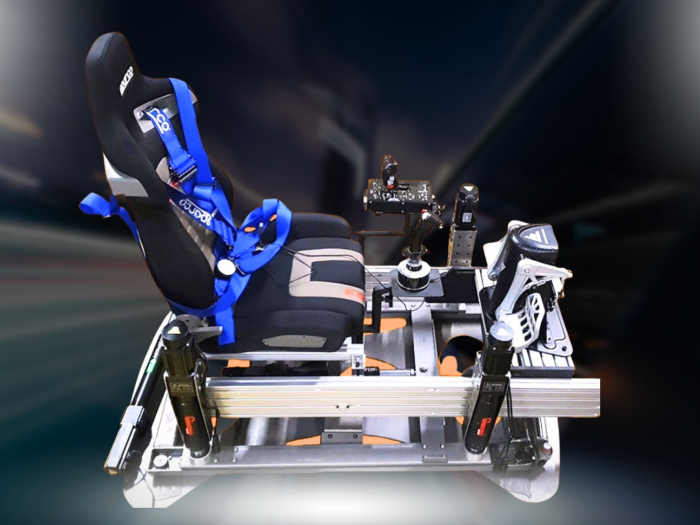

Can you really claim to be in the cockpit if your eyes are fighting a blurry screen-door effect whilst your body feels a different set of G-forces? It's a frustration every serious driver knows. The disconnect between visual data and physical feedback doesn't just ruin the realism; it leads to motion sickness and missed braking points that kill your competitive edge. You want to feel the car's weight shift through a hair-pin, not feel fatigued by a heavy headset during a gruelling endurance stint.
Finding the best VR headset sim racing in 2026 requires looking beyond basic resolutions to find a device that achieves a seamless bridge between software telemetry and physical sensation. This guide reveals the ultimate VR headsets that deliver professional-grade immersion and flawless compatibility with high-end motion platforms like the LowSlider 6 DOF. We will examine the dominance of Micro-OLED panels, the shift towards ultra-lightweight ergonomics, and the specific technical requirements needed to ensure your visual-physical mismatch becomes a thing of the past. Whether you are chasing tenths on a hot lap or settling in for a 24-hour race, the right hardware is your gateway to a professional-level experience.
Key Takeaways
- Master the transition from 2D monitors to 3D spatial environments to significantly improve your apex judgement and braking precision.
- Identify the critical technical specifications, such as PPD and FOV, that distinguish enthusiast-grade hardware when choosing the best VR headset sim racing professionals rely on.
- Compare the 2026 industry benchmarks, including the Pimax Crystal Super and Crystal Light, to find the perfect balance between high-fidelity resolution and performance.
- Learn how a 6 DOF motion platform like the LowSlider aligns your physical senses with your visual input to create total immersion whilst reducing fatigue.
- Understand why a bespoke, hand-built cockpit provides a superior, no-compromise foundation for professional simulation compared to mass-market alternatives.
Why VR is the Ultimate Evolution for Sim Racing in 2026
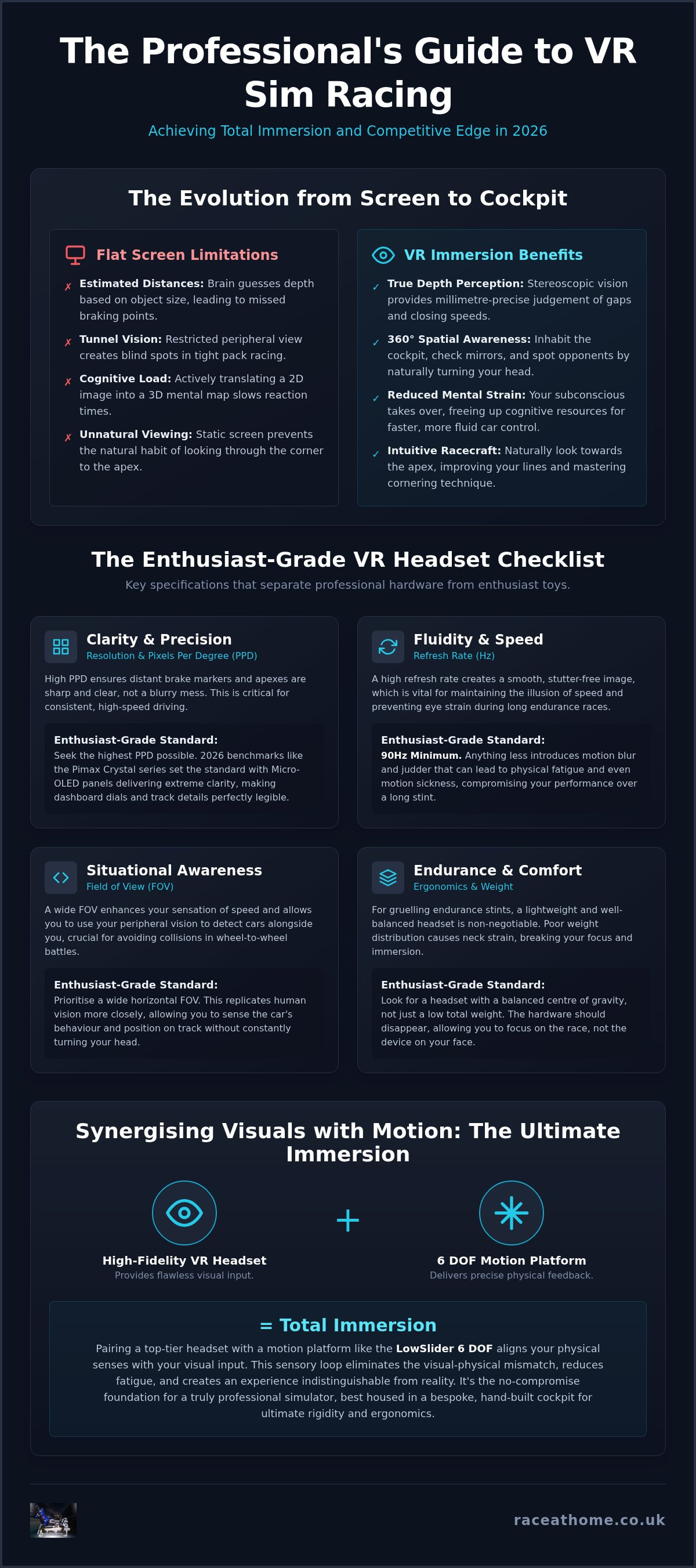
Sim racing has transcended the limitations of the flat screen. By 2026, the distinction between a hobbyist setup and a professional simulator is defined by spatial awareness. Using the best VR headset sim racing technology allows you to move from observing a race to inhabiting one. You aren't just looking at a representation of a GT3 car; you're strapped into the seat, surrounded by the roll cage, with the dashboard exactly where it would be in the real world.
Professional racing teams have pivoted toward VR for driver coaching for this exact reason. Understanding what is virtual reality in a competitive context means recognising that it bridges the gap between digital data and physical intuition. It allows drivers to practice muscle memory that translates directly to the track. The psychological benefit of "sitting" in the cockpit rather than staring at a monitor cannot be overstated; it aligns your brain's spatial mapping with the car's physical dimensions.
Mastering Depth Perception and Racecraft
Stereoscopic vision is the secret weapon of the elite sim racer. On a 2D monitor, your brain must estimate distances based on the relative size of objects. In VR, your eyes receive two distinct images, allowing you to calculate the gap to the car ahead with millimetre precision. This depth perception is vital when diving down the inside at a tight hairpin or defending your line through a high-speed chicane. You can judge the closing speed of an opponent with far greater accuracy, leading to cleaner, more confident racecraft.
It also enables the natural habit of "looking through the corner". You can turn your head to focus on the apex whilst your hands follow your gaze. This spatial awareness is impossible to replicate on a static screen without distorting the field of view. In tight pack racing, this 360-degree awareness prevents the "blind spot" collisions that frequently ruin races on traditional setups. You aren't just driving; you're navigating a three-dimensional space.
The Emotional Impact of Total Immersion
Immersion isn't just a marketing buzzword; it's a tool for performance. When you are fully immersed, the cognitive load on your brain decreases. You no longer have to manually translate 2D pixels into a 3D mental map. Your subconscious takes over, allowing for faster reaction times and more fluid car control. The best VR headset sim racing enthusiasts use is one that disappears, leaving only the track and the machine.
This setup creates a no-compromise environment for enthusiast-grade simulators. It evokes the visceral thrill of high-performance driving, where every vibration and visual cue feels authentic. By pairing a high-fidelity headset with a motion platform, you align your inner ear with your eyes. This creates a sensory loop that feels indistinguishable from the real thing. It's the ultimate evolution for anyone serious about their craft, providing the emotional intensity that keeps you coming back to the rig.
The Technical Checklist: What Makes a Racing Headset Enthusiast-Grade
Choosing the best VR headset sim racing professionals use isn't about chasing the highest marketing numbers. It's about how those numbers translate into track performance. High resolution and Pixels Per Degree (PPD) are the first hurdles. When you're approaching a corner at 200mph, you need to identify distant brake markers and track surface changes instantly. A low PPD makes these vital cues appear as a shimmering mess, forcing you to rely on guesswork rather than visual precision. By 2026, enthusiast-grade hardware prioritises a high PPD to ensure every apex is sharp and every dashboard dial is legible.
Refresh rates are equally critical for maintaining the illusion of speed. Whilst casual users might settle for lower figures, a dedicated racer requires at least 90Hz to ensure smooth visuals. Anything less creates a stuttering effect that leads to eye strain and physical fatigue during long endurance sessions. Weight distribution plays a similar role in comfort. A headset might be lightweight, but if the centre of gravity is too far forward, it will strain your neck through every high-G turn. Balanced ergonomics allow you to focus on the race, not the hardware strapped to your face.
Field of View and the Sensation of Speed
Field of View (FOV) is often misunderstood as just "seeing more". In reality, it's about the sensation of speed and sensing the car's behaviour. Your peripheral vision is much more sensitive to motion than your central vision. A wide horizontal FOV allows you to perceive the world rushing past, which is how your brain calculates velocity. More importantly, it lets you sense the car's slip angle. When the rear of the car begins to rotate, you'll see it in your peripherals before you feel it in the wheel. Premium optics eliminate the "scuba mask" effect of entry-level units, providing the spatial awareness needed for aggressive wheel-to-wheel racing.
Optics and Clarity: Pancake Lenses vs. Fresnel
The shift from Fresnel to pancake lenses has revolutionised visual clarity. Older Fresnel lenses suffered from "god rays" and a tiny "sweet spot", meaning if your eyes moved even slightly, the image became blurry. Pancake lenses offer edge-to-edge clarity, allowing you to glance at your wing mirrors without moving your entire head. To drive these high-fidelity displays, 2026 hardware requires high-bandwidth DisplayPort connections and foveated rendering. This technology tracks your eyes and only renders the area you're looking at in full detail, maintaining high frame rates without sacrificing quality. If you're looking to upgrade your current simulator rig, ensuring your hardware supports these standards is essential for a professional-grade experience.
The Top VR Headset Contenders for Sim Racing Rigs
By mid-2026, the market for the best VR headset sim racing enthusiasts can buy has split into distinct tiers based on resolution and weight. At the pinnacle sits the Pimax Crystal Super. This device has become the benchmark for professional-grade rigs because it offers an optical engine that eliminates the last vestiges of pixelation. For those who prioritise pure PCVR performance without the standalone bloat, the Pimax Crystal Light provides a streamlined alternative that retains the high-fidelity optics necessary for competitive racing.
Accessibility remains important, and the Meta Quest 3 continues to serve as a versatile entry point. Whilst it lacks the raw bit-rate of a dedicated DisplayPort connection, its pancake lenses and ease of use make it a popular choice for those just starting their journey. Conversely, the Bigscreen Beyond 2 has carved out a niche for endurance specialists. Its ultra-lightweight form factor is custom-fitted to the user's face, making it the preferred option for multi-hour stints where neck fatigue becomes a factor.
The Pimax Range: Engineered for Simulators
Race@Home specialises in Pimax hardware because these headsets are built with the high-FOV requirements of simulation in mind. The use of QLED panels combined with local dimming technology is a game-changer for night racing. If you've ever struggled to see the track markers at Le Mans or Spa during a midnight stint, you'll appreciate the deep blacks and high contrast these panels provide. We ensure every Pimax unit integrates seamlessly with SteamVR, providing a stable software environment that won't crash when you're leading the final lap.
Comparing Standalone vs. Dedicated PCVR
The choice between a standalone headset and a dedicated PCVR unit often comes down to the "compression vs. clarity" debate. Standalone devices often rely on compressed data streams over USB or Wi-Fi, which can introduce subtle input lag. In a high-stakes race, that millisecond of delay is the difference between a perfect save and a trip to the barrier. A dedicated cable ensures a zero-latency connection. You must also match your headset choice to your GPU capabilities; driving a Crystal Super requires significant computing power to maintain the 90Hz+ refresh rates discussed earlier. It's a no-compromise approach that ensures your visuals stay as fast as your reflexes.
Synergising Visuals with Motion: VR and the LowSlider Platform
Even the best VR headset sim racing setup can feel incomplete if your body remains static whilst your eyes perceive 150mph movement. This disconnect is the primary driver of motion sickness. When you pair a high-fidelity headset with a LowSlider 6 DOF motion platform, you resolve this by aligning your vestibular system with your visual input. Instead of your brain fighting a sensory conflict, it receives a unified message: you are accelerating, braking, or cornering. This synergy transforms the experience from a mere visual game into a physical reality.
The LowSlider advantage lies in its ultra-low profile. Standard motion rigs can be tall and unstable, which often interferes with sensitive VR tracking sensors. Our proprietary design keeps the centre of gravity low, ensuring that your Pimax or Meta headset maintains a rock-solid lock on your position. This stability is crucial when you're experiencing the violent shifts of a high-downforce car through a chicane.
Eliminating the Disconnect: Visual vs. Physical
Vestibular-visual synchronisation is the science of matching physical movement to what you see. The LowSlider 6 DOF platform simulates G-forces by pitching, rolling, and heaving the rig to match the car's telemetry. When you slam on the anchors at the end of a long straight, the platform pitches forward, providing the somatic data your brain expects. Physical motion realism eliminates sensory conflict by providing the tangible feedback your brain requires to validate visual movement. This makes the experience more comfortable and allows for much longer racing sessions without the threat of nausea.
Traction loss feedback is the "missing link" in this immersion. It allows you to feel the rear of the car sliding through the seat of your pants before your eyes even register the rotation. In VR, this physical "tell" is what allows you to catch a slide with instinctive counter-steering.
Setting Up Motion Compensation for VR
A moving rig presents a unique technical hurdle: your VR "world" must stay stable even as your cockpit tilts. Without motion compensation, the dashboard would appear to bounce around your head as the actuators move. Professional setups use specific software tools to synchronise Pimax headsets with PT Actuators, ensuring the virtual horizon remains level whilst you feel every kerb and bump. For a detailed technical walkthrough, consult The Ultimate Pimax VR Motion Simulator Set-up Guide 2026.
If you want to bridge the gap between digital data and physical sensation, enquire about our LowSlider motion platforms to complete your professional simulator build.
Building the Ultimate Professional Simulator
Transitioning from a static desk setup to a hand-built motion cockpit is the final step in the evolution of a driver. By 2026, the gap between consumer-grade peripherals and professional-grade engineering has widened significantly. Whilst mass-market rigs often prioritise cost-cutting and shipping logistics, a bespoke simulator focuses on the "No-Compromise" pursuit of realism. Our LowSlider platforms are engineered in the UK to provide the rigid foundation required for high-torque wheelbases and high-fidelity VR tracking. If the rig flexes, the immersion breaks; therefore, we utilise high-grade materials that ensure every Newton-metre of torque is felt by the driver, not absorbed by the frame.
Precision engineering doesn't have to mean complex logistics. We understand that your focus should be on the track, not on a pile of confusing components. Every LowSlider platform is designed for a one-hour assembly, allowing you to get your rig track-ready with minimal downtime. We ship our hardware globally, ensuring that whether you are in the UK or across the world, you have access to the same British-built quality that professional racing teams rely on. When you invest in the best VR headset sim racing hardware, you owe it to your performance to mount it on a chassis that can match its speed and accuracy.
Curating Your High-End Hardware
A VR-first setup requires a specific approach to peripherals. Because your eyes are covered by the headset, you must rely on tactile intuition and muscle memory. Selecting pedals with high-end load cells and buttons with distinct mechanical feedback is essential for navigating your controls whilst blindfolded. The compact footprint of the LowSlider 6 DOF is particularly beneficial here; it fits into dedicated simulator rooms without dominating the space, yet provides a full range of motion. For a deeper look at selecting the right tactile gear, see our guide on Sim Racing Accessories: The Ultimate Guide to Enhancing Your Competitive Edge.
Future-Proofing Your Investment
The world of 6 DOF telemetry is constantly evolving. As software developers release more granular physics data, your platform must be capable of translating that information into physical sensation. Race@Home platforms are modular by design, allowing for future upgrades as VR technology and motion software continue to advance. This ensures your rig remains at the cutting edge for years to come. If you are ready to transform your experience and bridge the final gap between simulation and reality, explore our motion platforms and VR bundles today.
Step Into the Cockpit of the Future
The pursuit of the perfect lap is no longer confined to a flat screen. By 2026, the standard for the best VR headset sim racing professionals choose is defined by the synergy between ultra-high resolution and physical feedback. You've seen how Pimax optics provide the clarity needed for distance markers, whilst 6 DOF platforms like the LowSlider bridge the gap between digital telemetry and real-world sensation. It's the difference between playing a game and mastering a craft.
Achieving this level of immersion requires a no-compromise approach to engineering. As an official Pimax partner, we specialise in hand-built UK simulators designed to deliver professional-grade performance right to your home. With worldwide shipping in four easy pieces, your ultimate rig is closer than you think. Our bespoke approach ensures that your hardware doesn't just look the part; it performs with the precision required for elite competition.
Build your bespoke professional motion rig with Race@Home and experience the visceral intensity of true-to-life racing. The track is waiting; it's time to feel every turn.
Frequently Asked Questions
Which VR headset has the highest resolution for sim racing in 2026?
The Pimax Crystal Super 8K Micro-OLED is the current resolution leader, priced at $2,199. Its advanced optical engine provides a level of clarity that effectively eliminates the screen-door effect. This resolution is vital for identifying distant track markers and reading fine dashboard telemetry with precision. Whilst other headsets offer high fidelity, the Crystal Super's combination of PPD and panel technology makes it the definitive choice for resolution-hungry drivers seeking the ultimate visual experience.
Does a motion platform help reduce VR motion sickness?
Yes, a high-fidelity motion platform is one of the most effective ways to combat VR-induced nausea. Motion sickness typically occurs when your eyes perceive movement that your inner ear does not feel. By using a LowSlider 6 DOF platform, your body receives physical feedback that matches the visual cues from the game. This synchronisation resolves the sensory conflict, allowing for longer, more comfortable racing sessions without the fatigue often associated with static VR setups.
Can I use a Pimax headset with a LowSlider 6 DOF motion rig?
Absolutely, the LowSlider 6 DOF was engineered specifically to work in harmony with high-end headsets. As an official supplier, we ensure that Pimax hardware integrates seamlessly with our motion platforms. The ultra-low profile of the LowSlider rig provides the stability required for accurate VR tracking. This combination ensures that the virtual horizon remains stable even during aggressive manoeuvres, providing the most immersive experience currently available for professional sim racing enthusiasts who demand total realism.
How much space do I need for a full motion sim rig with VR?
You don't need a dedicated warehouse to house a professional setup. A LowSlider 6 DOF platform has a surprisingly compact footprint, typically requiring a clear floor area of approximately 1.5 metres by 2 metres. This allows it to fit comfortably into most spare rooms or dedicated gaming dens. Because VR eliminates the need for bulky triple-monitor stands, the overall spatial requirement is often lower than that of a traditional high-end static simulator rig.
What PC specs are required for high-end VR sim racing?
To run the best VR headset sim racing setups at 90Hz+, you will need a top-tier gaming PC. We recommend at least an NVIDIA RTX 4090 or the 2026 equivalent, paired with a high-performance processor like an Intel i9 or AMD Ryzen 9. High-bandwidth RAM and a fast NVMe SSD are also essential for maintaining smooth frame rates. Without sufficient computing power, you risk stuttering visuals, which can ruin immersion and cause physical discomfort.
Is VR better than triple monitors for competitive sim racing?
VR offers a significant advantage in depth perception and spatial awareness, allowing you to judge braking distances and apexes more accurately than on flat screens. Whilst triple monitors provide a wider field of view without wearing a headset, they lack the stereoscopic 3D effect that makes you feel "inside" the car. For many professional drivers, the trade-off is worth it for the improved lap times and visceral immersion that only a high-fidelity VR environment provides.
How difficult is it to assemble a Race@Home motion platform?
We have designed the LowSlider platform for simplicity and speed. It arrives in four main sections, allowing for a straightforward one-hour assembly process. You don't need a degree in mechanical engineering to get track-ready; the modular design and clear instructions mean you can transition from unboxing to racing in a single afternoon. Our goal is to provide professional-grade hardware that remains accessible to enthusiasts who want to focus on driving rather than complex logistics.
What is the best VR headset for sim racing if I wear glasses?
The Pimax Crystal range is excellent for glasses wearers due to its generous internal housing and adjustable IPD settings. However, for the ultimate comfort, we recommend using custom prescription lens inserts. These allow you to experience the best VR headset sim racing visuals without the physical pressure of frames against your face. If you prefer an ultra-lightweight setup, the Bigscreen Beyond 2 is custom-fitted to your face and requires prescription inserts as standard, offering a bespoke fit.


