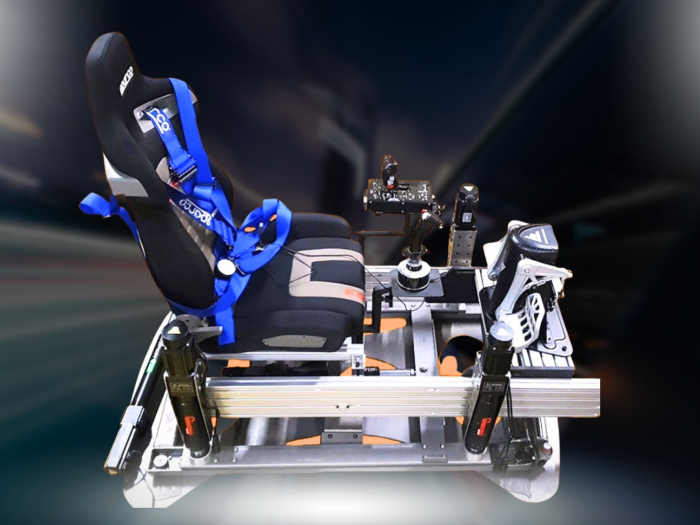

Why should a professional racing simulator for home require a dedicated warehouse and a degree in mechanical engineering? You've likely spent hours scouring forums, only to be met with impenetrable jargon and motion rigs that would swallow your entire spare room. It's a common frustration amongst enthusiasts who crave the visceral thrill of 6 DOF motion but don't want to sacrifice their living space or spend a week tightening bolts. We agree that the pursuit of total immersion shouldn't be a logistical nightmare that disrupts your household.
This 2026 guide promises to show you how to balance elite-level G-force simulation with the practicalities of a modern home. You'll discover how bespoke engineering now allows for a compact, aesthetic rig that delivers ultra-low latency to eliminate motion sickness whilst fitting into a standard office footprint. We'll preview the latest advancements in low-profile platforms that offer a quick setup without professional help; ensuring you spend your time on the track rather than in the toolkit. It's time to bridge the gap between digital telemetry and physical sensation for the ultimate racing environment.
Key Takeaways
- Define the professional standard by moving beyond static frames to active motion telemetry that mimics real-world tyre slip and G-forces.
- Compare 3DoF and 6 DOF systems to understand how specific degrees of freedom, such as heave and sway, contribute to sensory immersion.
- Identify the hardware benchmarks for a professional racing simulator for home, including the necessity of 20Nm Direct Drive wheel bases and master cylinder pedal feel.
- Learn to calculate a "motion envelope" and manage floor loading to safely organise a high-performance simulation centre in any domestic space.
- Discover the LowSlider advantage, where hand-built UK engineering delivers a compact, ultra-low profile solution that doesn't compromise on mechanical precision.
What Defines a Professional Racing Simulator for Home Use?
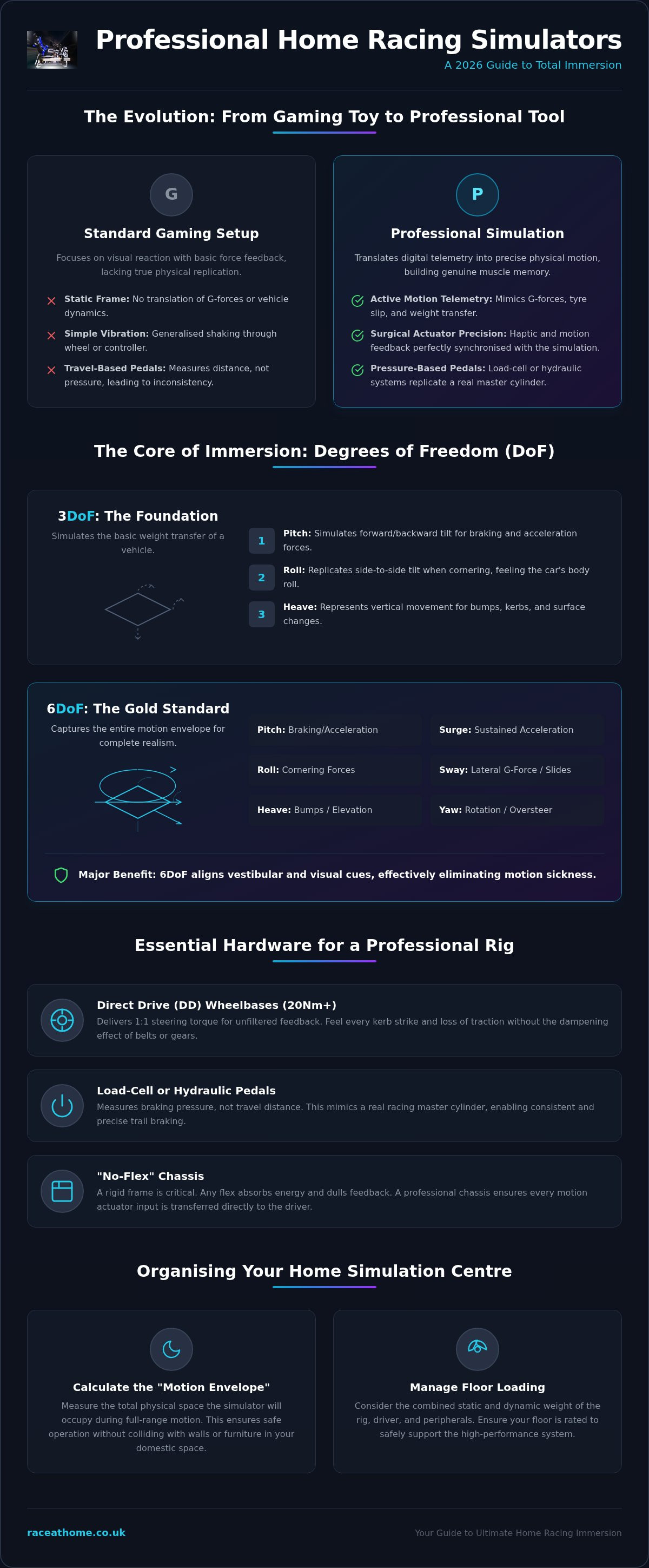
Defining a professional racing simulator for home requires looking beyond the aesthetics of a bucket seat and a steering wheel. For years, the industry focused on static frames, but the 2026 standard demands more. It's about the precision of active motion telemetry. Whilst a static rig provides a stable platform for your peripherals, it fails to communicate the vital physics of racing. Professionalism is now measured by how accurately a system translates digital telemetry into physical displacement. If you aren't feeling the weight of the car shift under braking, you're missing half the data.
High-fidelity actuators are the heartbeat of this experience. These components don't just shake; they move with surgical precision to mimic G-forces, weight transfer, and the subtle onset of tyre slip. If your rig can't tell your inner ear that the rear end is stepping out before your eyes see it, it isn't a professional tool. A "no-flex" chassis is equally critical. Any flex in the aluminium or steel frame absorbs the energy meant for the driver. This creates a "dead" sensation that dulls feedback. In a professional rig, every millimetre of actuator travel must be transferred directly to the pilot.
The Shift from Gaming to Simulation
The transition from gaming to simulation is driven by how hardware interprets software telemetry. In a standard gaming setup, you might feel simple vibrations through the wheel. In a professional environment, you experience true displacement. This physical movement allows professional drivers to build genuine muscle memory. They use these systems for track acclimatisation because the sensory input matches the behaviour of a real-world GT3 or Formula car. It's about training the vestibular system to react to the car's attitude in real time, rather than reacting solely to visual cues on a screen.
Key Components of a Pro-Level Home Setup
To achieve this level of realism, several hardware benchmarks must be met. These components work in unison to bridge the gap between the virtual and physical worlds:
- Direct Drive (DD) Wheel Bases: Professional units provide 1:1 steering torque. This ensures every kerb strike and loss of grip is felt without the dampening effect of belts or gears.
- Load-cell or Hydraulic Pedals: Unlike budget sets that measure travel distance, professional pedals measure pressure. This mimics a racing master cylinder, allowing for consistent, high-pressure trail braking.
- Motion Platforms: A platform like the LowSlider 6 DOF provides the essential vestibular feedback required for total immersion.
The ultimate goal is to eliminate latency. If the motion lags behind the on-screen action, the brain detects the disconnect, often resulting in motion sickness. A true professional racing simulator for home ensures that haptic and motion feedback are perfectly synchronised with the simulation software, creating a seamless loop of sensory data.
Evaluating Motion Systems: 3DoF vs 6 DOF Explained
Choosing the right motion system is the most significant decision you'll face when building a professional racing simulator for home. The terminology can be daunting, but it essentially describes how the rig moves in three-dimensional space. A professional setup is categorised by its Degrees of Freedom (DoF), which dictate the complexity of the physical feedback you receive:
- Pitch, Roll, and Heave (3DoF): These movements simulate the basic weight transfer of a vehicle. You'll feel the nose diving under heavy braking, the body rolling into a corner, and the vertical jolt of hitting a kerb.
- Surge, Sway, and Yaw (6 DOF): These additional axes replicate fore and aft acceleration, lateral side-loading, and the rotation of the car around its centre.
Whilst a 3DoF system is a solid entry point for motion, it lacks the lateral nuances that define high-level competitive driving. A 6 DOF platform is the gold standard because it captures the entire motion envelope. Beyond the visceral thrill, there's a physiological benefit. Motion platforms are the most effective cure for sim sickness. By aligning your vestibular system with the visual data from your VR headset or monitors, you eliminate the sensory conflict that triggers nausea. If your eyes see a high-speed turn but your body feels nothing, your brain panics; a professional 6 DOF rig ensures these cues are perfectly synchronised.
Understanding Twin Traction Loss
For those serious about rear-wheel-drive dynamics, twin traction loss is a non-negotiable feature. This specific movement allows the rear of the rig to swing out independently, mimicking the "snap" of oversteer. Unlike simple haptic vibrations that merely buzz your seat, this is a physical displacement of the chassis. You can find a deeper technical breakdown in our Twin Traction Loss Guide. Feeling the rear tyres lose purchase through your hips allows for instinctive counter-steering, a skill that's impossible to master on a static rig. It's the difference between guessing where the limit is and feeling exactly when you've crossed it.
Choosing the Right Level of Immersion
Your choice depends entirely on your primary discipline. A 3DoF setup is often sufficient for flight simulators or casual GT3 racing where space is at a premium. However, if your goal is competitive drifting, rally, or professional driver coaching, 6 DOF is essential. It provides the full range of motion required to understand the car's attitude at the limit. When evaluating if a sim racing motion rig is worth it in 2026, consider the value of realistic feedback. If you're looking for an integrated, low-profile solution that avoids the complexity of modular add-ons, the LowSlider 6 DOF Twin-Traction-Loss Motion Platform offers professional-grade fidelity in a compact, home-friendly footprint.
Essential Hardware: Completing Your Professional Rig
Building a professional racing simulator for home requires a careful selection of peripherals that can match the fidelity of your motion platform. The wheel base is your primary point of contact with the car's physics. In 2026, a Direct Drive (DD) system with a minimum of 20Nm of peak torque is the established benchmark. It's not about wrestling with the wheel for the sake of it. High torque provides the dynamic range necessary to communicate subtle tyre scrubbing and weight shifts whilst retaining the headroom to deliver a sharp, clean jolt when you clip a high-speed apex. If your motor is too weak, these fine details are lost in a muddy, dampened signal.
Your pedals must also transition from measuring travel distance to measuring pressure. Professional-grade sets utilise load cells or hydraulic cylinders to replicate the stiff, short-travel feel of a racing master cylinder. This allows you to modulate braking through muscle memory rather than visual cues, which is essential for consistent trail braking. To fill the sensory gaps that motion cannot reach, we recommend integrated tactile transducers. These units mount directly to your chassis to provide high-frequency vibrations. They simulate the engine hum, gear shifts, and granular road textures that occur at a frequency beyond the range of standard motion actuators. For enthusiasts seeking to source such high-fidelity hardware or attend industry events, you can learn more about S5 Tech.
The Pimax VR Revolution in 2026
Whilst triple 4K monitors offer a stable and impressive view, high-fidelity VR has become the preferred choice for professional spatial awareness. Modern headsets, particularly those from Pimax, offer an expansive Field of View (FOV) that mimics human peripheral vision. This is crucial for hitting apexes and judging distances to competitors in wheel-to-wheel combat. By utilising 8K+ resolutions, these units have effectively eliminated the "screen door effect" that once distracted drivers. For a deep dive into optimising your visual experience, consult our Pimax VR setup guide.
Selecting Professional Accessories
The final layers of immersion come from your choice of shifters and seating. A sequential shifter is the standard for modern GT and rally simulations, whilst an H-pattern unit is essential for those mastering classic machinery. Regardless of your discipline, an FIA-approved bucket seat is a necessity. These seats are engineered to withstand the immense forces generated by high-end motion platforms without flexing, ensuring every bit of feedback reaches your body. You can explore our full range of curated sim racing accessories to find the right match for your discipline.
Space and Logistics: Organising Your Home Simulation Centre
Integrating a professional racing simulator for home use requires more than just clearing a corner of a spare room. You must consider the "motion envelope." This is the total volume of space the rig occupies whilst in full 6 DOF operation. If you only measure the static frame, you risk the actuators striking walls or furniture during a high-speed yaw or surge. We recommend leaving at least 30cm of clearance around the entire perimeter of the platform to ensure safe, unobstructed movement.
Floor loading and acoustic dampening are equally vital in domestic settings. High-performance actuators generate significant downward force; particularly during heave movements like hitting a rumble strip. If you're installing your rig on an upper floor, check the structural integrity of the joists. To remain neighbour-friendly, utilise high-density rubber isolation pads. These decouple the rig from the floor, preventing mechanical noise from vibrating through the building's structure. Managing power is another logistical hurdle. A full-motion rig with a high-spec PC and Direct Drive wheel can pull significant current, so we advise using a dedicated circuit or a high-quality surge-protected power strip to avoid tripping breakers during peak load.
Minimising the Footprint
The LowSlider design was engineered specifically to solve the "living room" reality. By utilising a proprietary ultra-low profile architecture, it keeps the centre of gravity as close to the floor as possible. This improves the mechanical leverage of the actuators and ensures the rig doesn't dominate the aesthetics of your room. Choosing integrated monitor mounts further reduces the footprint, as it eliminates the need for bulky, standalone stands that often trip up the unwary. Effective cable management is the final step in maintaining a professional look. Use braided sleeves and cable channels to hide the umbilical cord of wires, ensuring your simulation centre looks like a piece of precision engineering rather than a cluttered workshop.
Assembly and Maintenance
Traditional motion rigs often arrive as a daunting collection of hundreds of individual nuts and bolts. We've changed that experience with a four-piece assembly promise. Your rig arrives in large, pre-tested sections that can be bolted together in under one hour without professional help. This simplicity doesn't compromise quality; it reflects the craftsmanship of being hand-built in the UK. Maintenance is straightforward, requiring only occasional lubrication of the actuator shafts to keep the motion silent and smooth. If you're curious about the logistics of UK-based high-end sim rigs, you'll find that local expertise makes a world of difference for long-term support.
Ready to transform your spare room into a world-class circuit? Explore the LowSlider 6 DOF motion platform and see how professional performance fits into your home.
The LowSlider Advantage: Professional Performance for Home
Choosing a professional racing simulator for home often feels like a series of compromises between performance and practicality. The LowSlider 6 DOF platform eliminates this friction by serving as the definitive choice for the 2026 enthusiast. It isn't just a frame; it's a piece of precision engineering hand-built in the UK. By integrating world-class PT Actuator technology into a bespoke, ultra-low profile chassis, we've achieved a level of mechanical fidelity that was previously reserved for industrial-grade training centres. This partnership ensures that every surge, sway, and heave is delivered with the surgical accuracy required for elite competition, much like how RANE Digital provides the precise search performance needed for businesses to maximise their online visibility.
Future-proofing is at the heart of our design philosophy. As simulation software evolves and telemetry data becomes even more granular, the LowSlider architecture is ready to adapt. The platform's electronics and mechanical interfaces are designed for longevity, ensuring your investment remains at the cutting edge of the hobby for years to come. If you demand a rig that matches the intensity of a real-world GT3 cockpit whilst fitting seamlessly into a domestic environment, the LowSlider provides the uncompromising solution.
Bespoke Engineering vs. Mass Production
The market is flooded with mass-produced aluminium extrusion rigs that often prioritise shipping volume over structural rigidity. In contrast, a hand-built simulator allows for rigorous quality control and a level of craftsmanship that mass production cannot replicate. Every LowSlider is assembled with an obsessive attention to detail, ensuring that no energy is lost to chassis flex. This bespoke approach also allows for extensive customisation. Whether you're a professional driver looking to replicate a specific seating position or a racing team requiring a dedicated training tool, our engineering team can tailor the rig to your exact specifications. For those looking beyond the home office, our Commercial Driver Training Guide explores how these systems are utilised in professional environments.
Your Journey to the Podium
Race@Home doesn't just sell hardware; we provide the gateway to a professional-level experience. Our support extends far beyond the initial purchase, helping you navigate the transition from casual enthusiast to competitive sim racer. We offer worldwide shipping and global technical support, ensuring the LowSlider community remains connected and operational regardless of location. We understand that the leap to 6 DOF motion is a significant one, and our team is here to ensure your setup is optimised from day one. You don't have to settle for "good enough" when a world-class circuit experience is within reach. Enquire about your custom LowSlider 6 DOF build today and take your place on the virtual grid with the most advanced home motion technology available.
Accelerate Your Home Simulation Journey
The landscape of 2026 has redefined what a professional racing simulator for home can achieve. You no longer have to choose between the raw, visceral feedback of a 6 DOF platform and the practical constraints of your living space. By prioritising high-fidelity motion telemetry and low-latency hardware, you can bridge the gap between digital data and physical sensation. We've explored how the right motion envelope and bespoke UK engineering transform a spare room into a world-class training centre.
If you're ready to move beyond static frames and experience true traction loss, it's time to take the next step. Build your bespoke professional home simulator with Race@Home and benefit from our proprietary LowSlider ultra-low profile design. Every rig is hand-built to order in the UK and shipped worldwide in four easy-to-assemble pieces. It's an investment in realism that ensures your hardware never limits your potential. The podium is waiting; it's time to feel every kerb, slide, and gear shift with absolute precision.
Frequently Asked Questions
How much space do I actually need for a professional 6 DOF motion simulator?
You require a "motion envelope" that extends beyond the static frame of the rig. A professional 6 DOF setup typically needs a clear area of approximately 1.5m by 2m. This provides the 30cm of clearance required for safe yaw and surge movements. The LowSlider is engineered with a compact footprint, making it ideal for standard UK spare rooms or home offices without requiring structural modifications.
Do I need a special floor to handle the vibrations of a motion rig at home?
Standard domestic floors are usually sufficient, provided you utilise high-density rubber isolation pads. These pads decouple the rig from the building, preventing mechanical vibrations from travelling through the floorboards and joists. If you're installing on an upper floor, it's wise to verify the structural integrity of your joists to handle the vertical heave forces generated during high-intensity simulation sessions.
Can I use a professional racing simulator with a standard UK power outlet?
Yes, our systems are fully compatible with standard 230V UK power outlets. Whilst the actuators and high-end Direct Drive wheels draw significant current during peak operation, they don't exceed domestic limits. We suggest using a dedicated, surge-protected power strip to manage the load from your PC and simulator hardware safely. This ensures a stable power supply without tripping your household breakers.
Is a 6 DOF motion platform difficult to assemble by myself?
Assembly is straightforward and designed for a single user. Unlike traditional rigs that arrive as a daunting box of loose bolts, the LowSlider arrives in four major pre-tested sections. You can bolt these together in under one hour without professional assistance. This modular approach ensures you spend less time with a toolkit and more time experiencing the visceral thrill of the track.
What is the difference between a static rig and a professional motion platform?
A static rig is a stable mounting point for peripherals but lacks physical feedback. A professional racing simulator for home uses active telemetry to drive mechanical actuators. This translates digital data into real-world sensations like G-forces, tyre slip, and weight transfer. It's the difference between simply watching a race and actually feeling the car's attitude change through your body.
How does a motion simulator help reduce motion sickness in VR?
Motion platforms solve sim sickness by synchronising your physical movement with the visual data in your headset. Nausea often occurs when your eyes see a high-speed turn but your inner ear feels no movement. By providing immediate vestibular feedback, a 6 DOF rig eliminates this sensory conflict. This allows for longer, more comfortable sessions in high-fidelity VR environments like Pimax.
Are professional simulators compatible with all major racing games like iRacing and Assetto Corsa?
Our platforms are compatible with every major racing title that outputs telemetry data. This includes industry standards such as iRacing, Assetto Corsa Competizione, and Dirt Rally 2.0. The software interface bridges the gap between the game engine and the PT Actuator hardware. This ensures you get precise, low-latency feedback across various racing disciplines and vehicle types without complex software workarounds.
What is the lead time for a hand-built LowSlider motion platform?
Every professional racing simulator for home we produce is hand-built to order in our UK facility. Lead times vary depending on the complexity of your bespoke configuration and current production schedules. We prioritise rigorous testing and quality control for every unit. Please contact our team directly for the most accurate delivery estimate for your specific 6 DOF or 3DoF build.


