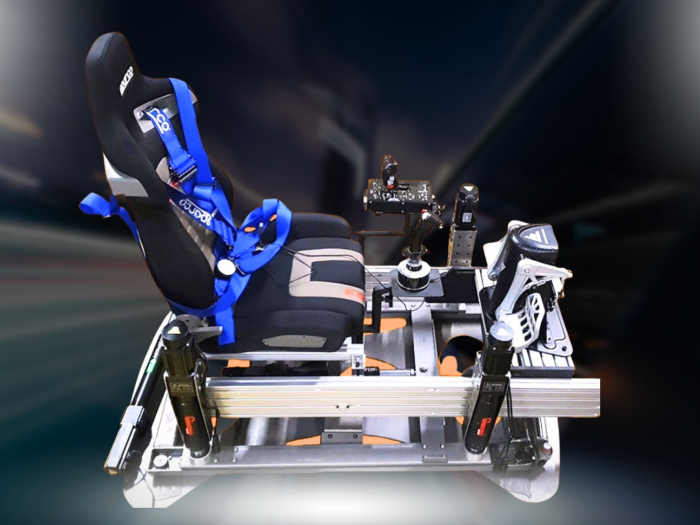

What if the only thing standing between your home office and the apex at Silverstone is a few inches of travel? You've spent hours meticulously tightening T-nuts and cable-managing your dream cockpit, yet even the most rigid aluminium profile rig can feel strangely lifeless when it's bolted firmly to the floor. You're feeling the force feedback through the rim, but your inner ear is missing the weight transfer of a heavy braking zone or the lateral snap of a lost rear end. It's a common frustration for enthusiasts who crave the visceral reality of a real-world track day but fear the complexity of traditional hydraulics.
Choosing the right motion platform for aluminum profile rig setups in 2026 doesn't have to mean sacrificing your spare room or your sanity. This guide will help you navigate the shift from static to sensory, ensuring you achieve professional-level immersion without the headache of poorly calibrated telemetry or oversized hardware. We'll explore how modern actuator technology and compact, UK-engineered foundations allow you to seamlessly integrate full motion into your existing chassis. From managing the physical footprint to mastering software compatibility, you're about to discover how to turn digital data into tangible, high-performance sensations.
Key Takeaways
- Understand why static cockpits eventually hit a "realism ceiling" and how the right hardware translates digital telemetry into visceral, real-world feedback.
- Navigate the technical differences between 3DoF and 6 Degrees of Freedom to find the optimal motion depth for your specific racing style and immersive goals.
- Learn how to select a motion platform for aluminum profile rig integration that maintains structural rigidity whilst offering a seamless fit for standard 40-series extrusion.
- Master the practical logistics of a home motion setup, from assessing floor loading requirements to ensuring your space can accommodate the physical footprint of an active rig.
- Discover the "no-compromise" advantage of hand-built UK systems that prioritise ease of assembly, taking you from delivery to the first corner in less than an hour.
Why Your Aluminium Profile Rig Needs a Motion Platform Upgrade
You've likely reached the point where your lap times are plateauing. Your direct drive wheel provides exquisite detail and your pedals are perfectly calibrated, yet you're still missing that elusive "seat of the pants" feel. This is the realism ceiling. A static rig, no matter how rigid or expensive, simply cannot replicate the physical load of a high-speed corner or the violent snap of a kerb strike. To truly evolve as a driver, you need to transition from a stationary cockpit into the world of active feedback.
Beyond Static Sim Racing: The Sensory Shift
Motion platforms do far more than just tilt your seat; they translate complex telemetry data into tangible weight transfer. If you dive into a heavy braking zone, the actuators pitch the chassis forward, mimicking the natural dive of a real GT3 car. This sensory shift allows you to rely on your inner ear rather than just your monitor. By engaging your vestibular system, a full motion racing simulator helps you catch slides earlier and find a more consistent rhythm. It's the difference between watching a race and being in one. You'll find your focus sharpens when the car's behaviour is a physical reality rather than a visual suggestion.
Why Aluminium Profile is the Perfect Motion Foundation
The beauty of the modern sim racing ecosystem is the ubiquity of 40-series extrusion. Choosing a motion platform for aluminum profile rig integration is the logical next step because your current chassis is already built to handle immense stress. Aluminium profile rigs offer the structural integrity required to withstand the high-frequency vibrations and sudden torque of performance actuators. Unlike lightweight tube rigs that might flex or creak under load, profile doesn't waste energy. It ensures every millimetre of actuator travel is felt by the driver, not lost in the frame.
This modularity also ensures your setup remains future-proof. Adding motion doesn't mean starting from scratch. Because your rig is built from T-slot extrusion, you can easily reposition your seat, pedals, and wheel deck to find the perfect centre of gravity for your new motion foundation. It's a professional-grade solution that respects the investment you've already made in your hardware. Beyond the mechanical components, many drivers also prioritise the visual appeal of their setup, using automotive-themed digital designs from RPM Digital Garage to create a truly bespoke racing environment. If you're serious about immersion, bolting your rig to a motion platform is the only way to bridge the gap between digital data and visceral reality.
3DoF vs 6 DOF: Finding the Right Motion Depth for Your Cockpit
"Degrees of Freedom" (DoF) is often treated as a marketing buzzword, but it represents the fundamental physics of your simulator. Choosing a motion platform for aluminum profile rig setups requires an understanding of how these axes translate into lap times. While a 3DoF system provides the essential sensations of a car's attitude, a 6 DOF system replicates the entire envelope of physical movement. The decision ultimately rests on the balance between your budget and your desire for total immersion.
Understanding 3DoF: Pitch, Roll, and Heave
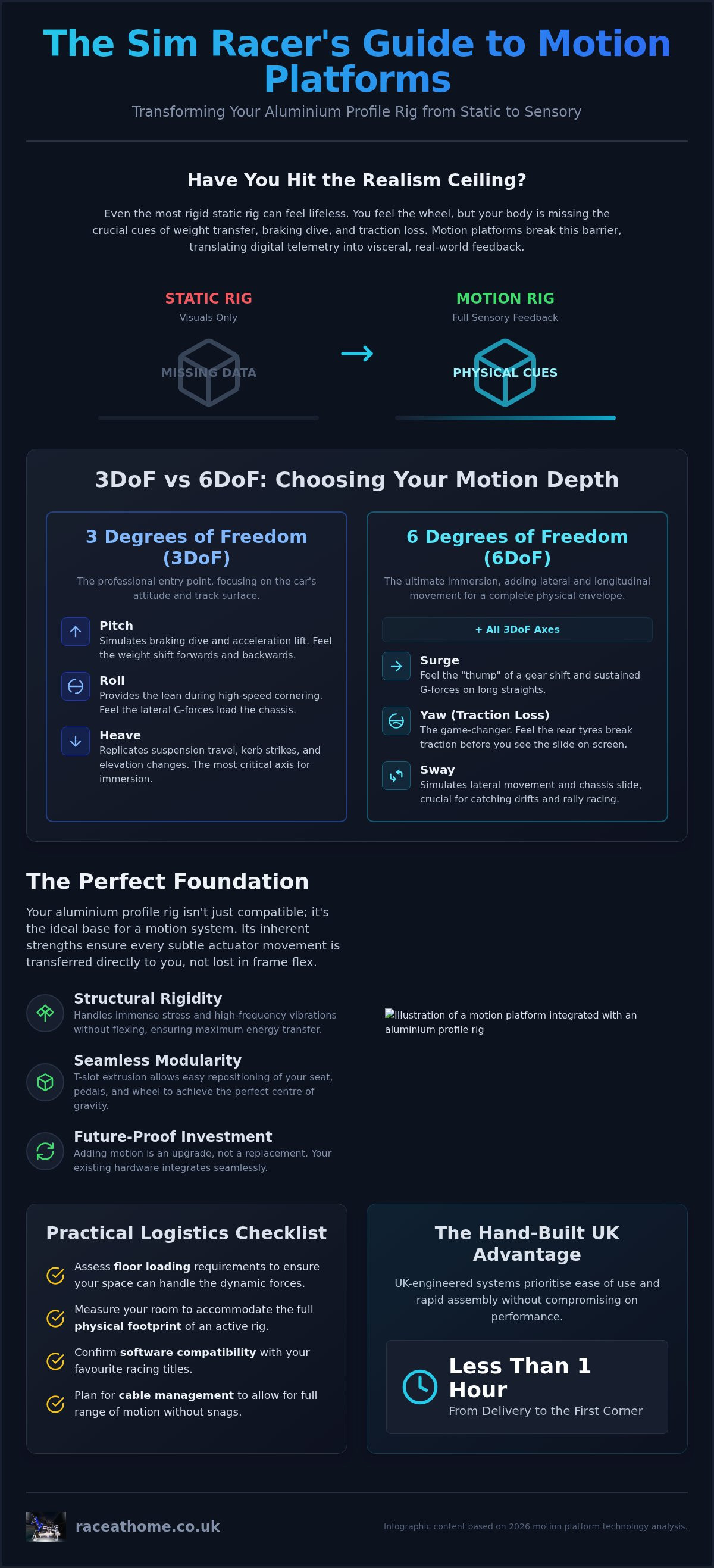
A 3DoF platform focuses on the vertical and rotational movements that define the track surface. Pitch simulates the nose-down effect of heavy braking and the lift of acceleration. Roll provides the lean during high-speed cornering. Heave is perhaps the most critical for immersion, as it replicates suspension travel, kerb strikes, and elevation changes. This configuration is widely considered the professional entry point, offering enough feedback to improve consistency without the complexity of lateral slide simulation.
The 6 DOF Difference: Traction Loss and Surge
Stepping up to 6 DOF introduces the axes that separate enthusiasts from elite sim racers: Sway, Surge, and Yaw. Surge is vital for feeling the "thump" of a gear shift and the sustained longitudinal G-forces of a long straight. Yaw, or Traction Loss, is the game-changer for anyone racing GT3s, rally cars, or drift builds. It allows you to feel the rear tyres breaking traction long before your eyes register the slide on screen. This level of sophistication mirrors the trends seen in Immersive Technologies in Civilian Agencies, where high-fidelity simulation is used to bridge the gap between training and reality.
6 DOF is the replication of all possible rigid body movements in 3D space.
The choice often comes down to your primary racing discipline. If you're exclusively driving high-downforce Formula cars, the vertical feedback of a 3DoF system might suffice. However, if you find yourself wrestling a GT3 car around a damp Spa-Francorchamps, traction loss becomes a necessity for survival. Investing in a 6 DOF system is a significant jump in performance, but modern engineering has made it more accessible for home use. If you're looking for a bespoke, space-efficient solution, the LowSlider 6 DOF Twin-Traction-Loss Motion Platform offers a compact way to achieve this ultimate evolution of the hobby.
Compatibility and Mounting: Integrating Actuators with Aluminium Extrusion
Integrating a motion platform for aluminum profile rig setups is often perceived as a daunting technical hurdle, yet the modular nature of 40-series extrusion makes it the ideal candidate for a performance upgrade. When evaluating sim rig motion platform compatibility, you must decide between mounting individual actuators at the four corners of your chassis or utilising a dedicated motion foundation. While corner mounting is a common DIY route, it often introduces unwanted "rig flex," where the aluminium frame itself absorbs the energy of the movement instead of transferring that vital feedback directly to the driver.
A platform-based approach acts as a structural sub-frame, ensuring that every movement is crisp and immediate. This isolation is a hallmark of sophisticated driving simulation technology; by placing the motion systems beneath a dedicated base, you preserve the rigidity of your cockpit whilst enjoying the full range of telemetry-driven sensations. Aesthetics also matter in a home environment. Effective cable management and strategic control box placement are essential to prevent snagging during high-velocity movements, keeping your setup looking as professional as it feels.
The LowSlider Approach: A Foundation for Any Profile Rig
The LowSlider system is engineered as a bespoke "bolt-on" solution that respects the investment you've already made. It doesn't require complex rig modifications or drilling into your 8020 chassis. Instead, your existing rig mounts directly to the platform, creating a unified structure. This configuration naturally optimises the centre of gravity, which is critical for actuator longevity. When the weight is distributed across a stable foundation, the motors don't have to fight against an unbalanced load, resulting in smoother transitions and more accurate G-force simulation.
Actuator Technology: PT Actuator and Precision Engineering
In 2026, the distinction between consumer-grade hardware and professional-grade engineering has never been clearer. We partner with PT Actuator because their systems deliver the industrial-strength reliability required for high-end sim racing. When assessing actuators, you should prioritise stroke length, typically 100mm to 150mm, alongside rapid response times. Professional actuators must operate with near-silent efficiency whilst providing the high-frequency vibrations needed to simulate road textures and kerb strikes. It's this level of precision that ensures your simulator remains a high-performance tool rather than a noisy distraction, allowing you to focus entirely on the apex.
Key Considerations Before Buying Your Full Motion Simulator
Transitioning to a motion platform for aluminum profile rig setups is the ultimate upgrade for any serious enthusiast. You aren't just adding a peripheral; you're installing a piece of precision machinery into your home. Before you commit to a purchase, you must follow a methodical checklist to ensure your environment is ready for the forces involved. This isn't about discouraging your ambition, but about ensuring your "no-compromise" setup performs exactly as intended from day one.
- Step 1: Measure your floor space and ceiling height, accounting for the maximum travel of the actuators at full heave.
- Step 2: Assess your floor loading capacity; a full 6 DOF system with a rig and driver can easily exceed 200kg.
- Step 3: Evaluate your power requirements, as high-performance actuators often benefit from a dedicated circuit to prevent interference with other electronics.
- Step 4: Check software compatibility for your favourite racing titles and prepare for telemetry tuning via platforms like Sim Racing Studio.
- Step 5: Decide between VR or monitor mounting; on a motion rig, monitors should ideally be mounted to the platform itself to maintain a consistent focal point.
Space Management and Floor Loading in UK Homes
Standard UK rooms are famously compact. Traditional motion systems often sit high off the ground, which can leave your head uncomfortably close to the ceiling when the platform reaches full extension. The LowSlider design addresses this directly by keeping the centre of gravity as low as possible, making it suitable for standard domestic environments. You should also utilise heavy-duty isolation feet. These components are essential for dampening high-frequency vibrations, preventing the mechanical noise from transferring through the floorboards to other rooms in your house.
The VR Integration: Pimax and Motion Realism
For those seeking the pinnacle of immersion, a Pimax VR motion simulator setup provides a sense of speed that monitors simply cannot match. However, physical movement introduces a unique challenge: your headset tracks your movement relative to the room, not the rig. This is why motion cancellation software is essential. It subtracts the rig's movement from the VR tracking data, ensuring your virtual eyes stay perfectly aligned with the cockpit. Achieving this "no-latency" synchronisation is the secret to a comfortable, long-distance racing experience that avoids motion sickness.
If you're ready to transform your static cockpit into a professional-grade simulator, calculate your bespoke motion platform quote today and take the first step toward total immersion.
The LowSlider Advantage: Why Race@Home is the Ultimate UK Solution
Selecting the right motion platform for aluminum profile rig integration is the final step in a long journey toward simulator perfection. Whilst many manufacturers offer generic, one-size-fits-all solutions, Race@Home specialises in bespoke, hand-built systems designed to meet the rigorous demands of high-end sim racing. Being based in the UK, we understand the specific needs of local enthusiasts, particularly the requirement for compact, ultra-low profile hardware that doesn't dominate a standard room. Our focus is on the transformative quality of the hardware, ensuring your digital telemetry translates into visceral reality.
The LowSlider 6 DOF Twin-Traction-Loss Motion Platform isn't just about performance; it's about accessibility. Most high-end motion systems require days of calibration and complex mechanical assembly. Our proprietary design allows for a four-piece assembly that takes less than an hour to complete. This means you can move from delivery to the track in record time, spending your hours on the apex rather than under the rig with a spanner. It is the definitive choice for profile rig owners who demand professional-grade immersion without the traditional setup headaches.
Bespoke Engineering vs. Mass Production
Hand-built UK manufacturing ensures a level of attention to detail that mass production simply cannot replicate. Every LowSlider is built to order, allowing for customisation options that cater to various aluminium profile widths and cockpit configurations. You aren't just buying a product; you're gaining direct access to expert engineering advice from the very people who designed and built your platform. This bespoke approach eliminates the guesswork, ensuring your rig is perfectly balanced for maximum actuator longevity and precise sensory feedback.
Your Path to Full Motion
The transition to a professional-grade setup is a significant investment in your craft. When you choose to buy motion simulator UK systems directly from us, you benefit from global shipping and a dedicated technical support network. We've refined the ordering process to be as transparent as possible, maintaining lead times of approximately four weeks from deposit to shipping. This ensures you receive a curated piece of engineering that is ready for immediate deployment.
Ultimately, you must decide if a sim racing motion rig worth it for your personal hobby. For those who demand a no-compromise attitude toward quality and realism, the LowSlider provides the definitive evolution of the sim racing experience. It's the gateway to a professional-level sensation that bridges the final gap between digital data and physical reality.
Elevate Your Racing Experience to Professional Standards
Selecting a motion platform for aluminum profile rig setups requires a specialist touch to ensure your equipment fits your lifestyle as well as it fits your chassis. At Race@Home, we pride ourselves on delivering hand-built UK quality that respects your space and your time. Our systems feature an ultra-low profile design and a four-piece assembly that takes less than an hour to complete; this ensures you're back on the track in record time without the headache of complex mechanical modifications.
Are you ready to feel the difference for yourself? Explore the LowSlider 6 DOF Motion Platform at Race@Home and start your journey toward total racing immersion today. Your dream setup is closer than you think.
Frequently Asked Questions
Can I add a motion platform to any aluminium profile rig?
Yes, most motion platforms are designed to integrate seamlessly with standard 40-series aluminium extrusion. If your rig uses T-slot profiles, you can typically bolt the actuators or the entire foundation directly to the frame. You must ensure your cockpit is structurally rigid to prevent the frame from flexing under the high torque generated during intense racing sessions.
What is the difference between a seat-mover and a full motion platform?
A seat-mover only actuates the driver's seat, whilst a full motion platform moves the entire cockpit, including the wheel and pedals. Full motion is generally preferred by professionals because it maintains the physical relationship between your hands, feet, and the controls. This consistency is vital for developing accurate muscle memory and preventing the disorientation that occurs when pedals remain static during a slide.
Does a full motion racing simulator require special electrical wiring?
Most modern systems are designed to run on standard UK 230V domestic wall sockets. Whilst you don't typically need industrial wiring, high-performance actuators can draw significant current during peak heave or surge movements. It is often wise to use a dedicated circuit or a high-quality surge protector to ensure your PC and motion hardware don't interfere with other household electronics.
How much space do I need for a 6 DOF motion platform in my home?
You should ideally allocate a clear footprint of approximately 2 metres by 1.5 metres for the rig and its range of travel. When choosing a motion platform for aluminum profile rig integration, you must also account for the vertical clearance. High-intensity heave movements can raise the cockpit significantly, so ensure your ceiling height can accommodate the maximum travel of your chosen actuators.
Will a motion platform work with all sim racing games?
Motion platforms rely on telemetry data exported by the game engine to function. Most major titles, such as iRacing, Assetto Corsa Competizione, and F1 24, provide robust data support. If a title doesn't output telemetry, the platform will remain static. Most enthusiasts use third-party software like Sim Racing Studio to bridge the gap between the game data and the physical hardware.
Is it difficult to set up the software for a motion rig?
Modern software interfaces have become remarkably user-friendly and often feature "plug and play" functionality. You can download pre-configured profiles for specific cars and tracks, which saves hours of manual calibration. Whilst deep customisation is available for those who want to tweak every G-force value, most drivers can get onto the track within minutes of finishing the mechanical assembly.
How do I prevent motion sickness when using a full motion simulator?
The key is to start with short sessions at a lower intensity to allow your brain to adapt to the new sensory inputs. If you are using VR, motion cancellation software is essential to keep your virtual horizon aligned with the physical movement of the rig. Ensuring there is no latency between the visual data and the physical feedback will significantly reduce the risk of nausea.
What maintenance does a sim racing motion platform require?
Electric actuators are generally sealed units that require very little internal maintenance. You should perform a monthly check to ensure all bolts securing the motion platform for aluminum profile rig to the chassis haven't vibrated loose. Wiping the actuator shafts with a clean, dry cloth to remove dust will prevent premature wear on the seals and ensure smooth, silent operation for years.


