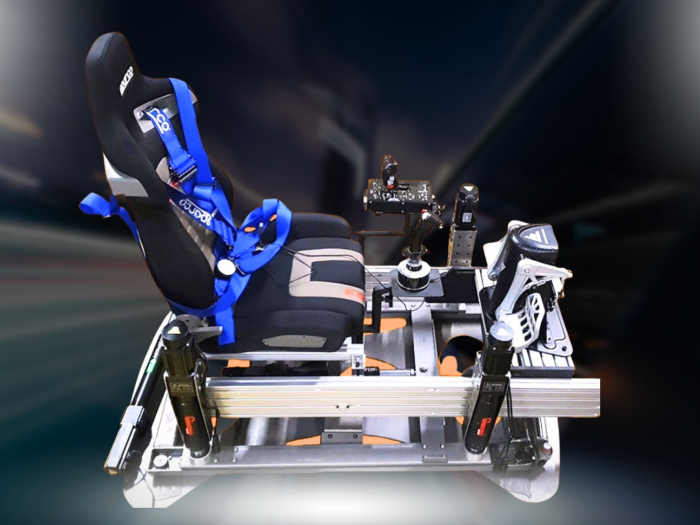

Why does your high-end sim rig still feel like a static office chair when you’re hitting 150mph at Copse? You’ve likely invested in the best direct-drive wheel and load-cell pedals, yet that missing link between the screen and your seat remains. Finding the right motion platform for sim racing often feels like a compromise between a bulky, industrial-sized cage or a sluggish system that lags behind the on-screen action. You’re right to believe that a professional experience shouldn’t require a dedicated warehouse or an engineering degree to configure.
This 2026 buyer’s guide promises to simplify your search for the ultimate immersion. You’ll discover how to select a rig that balances realistic traction loss and G-force simulation with a compact footprint designed for a standard home setup. We will break down the nuances of actuator technology, compare degrees of freedom, and highlight why low-profile, UK-engineered designs are redefining the enthusiast market. From rapid assembly to seamless software integration, here is everything you need to transform your setup into a world-class racing cockpit.
Key Takeaways
- Learn how advanced actuators translate digital telemetry into tangible physical sensations, allowing you to feel every kerb and gear shift with absolute precision.
- Decipher the complexities of Degrees of Freedom (DOF) to identify which mechanical movements, from pitch to yaw, are vital for your personal level of immersion.
- Discover why traction loss is the most sought-after feature in a motion platform for sim racing and how it provides the vital feedback needed to master car control.
- Evaluate the logistical requirements of a home setup, including how to achieve full-scale motion within standard room dimensions using clever low-profile engineering.
- Understand the advantages of choosing hand-built, UK-engineered systems that offer a bespoke, professional experience with assembly times of under an hour.
What is a Motion Platform for Sim Racing and Why Do You Need One?
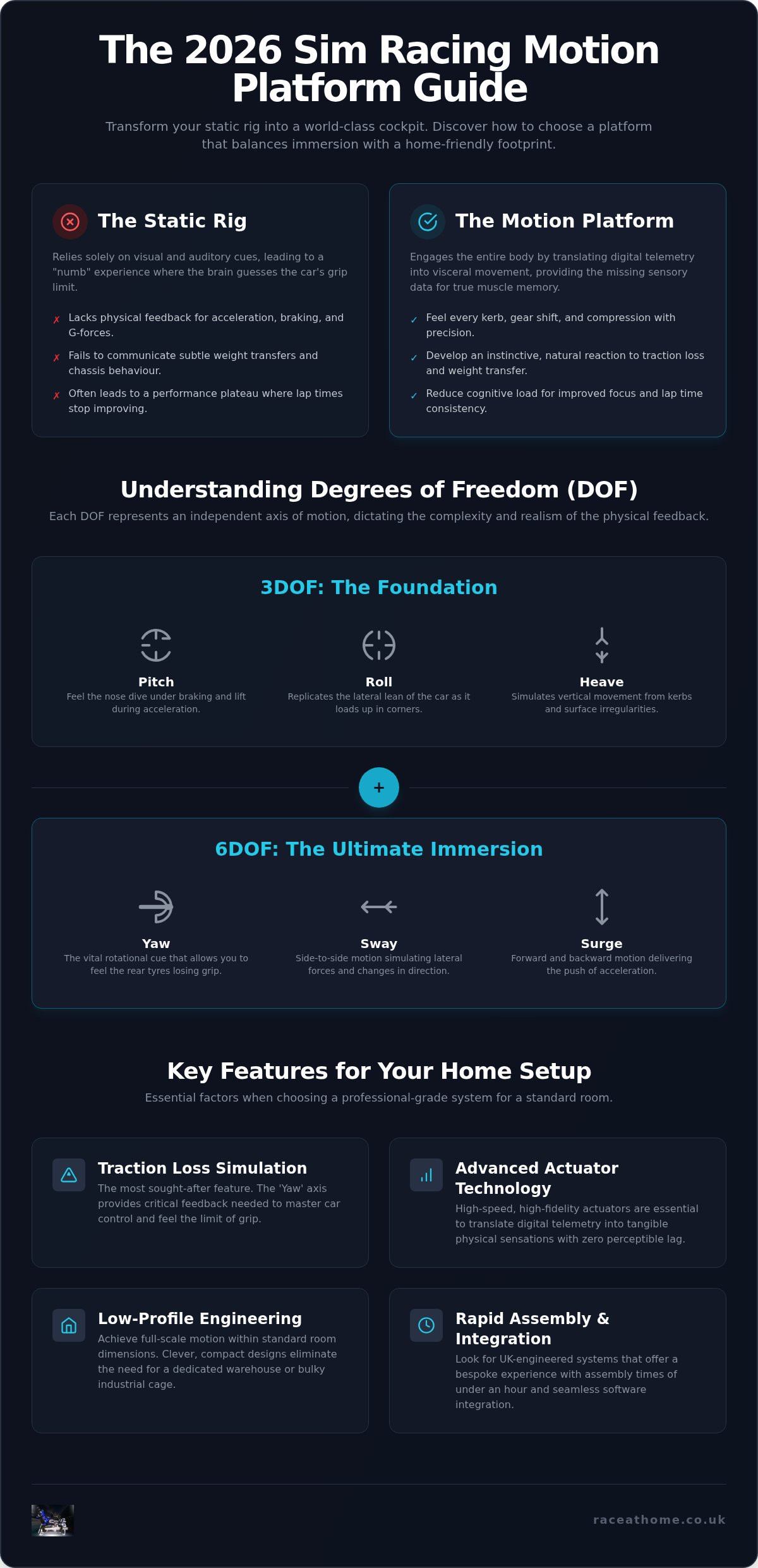
A motion simulator is much more than a collection of motors; it's the essential bridge between digital telemetry and physical sensation. Whilst a static rig forces you to rely solely on visual and auditory cues, a motion platform for sim racing engages your entire body by translating raw data into visceral movement. High-speed actuators receive telemetry from sims like iRacing or Assetto Corsa, converting digital numbers into precise physical forces. You don't just see a corner; you feel the chassis lean as the suspension compresses under load.
Static setups often feel "numb" because they lack the physical feedback of acceleration, braking, and lateral G-forces. Without these sensations, your brain is forced to guess where the limit of grip lies. A motion setup provides that missing sensory data, which is vital for developing true muscle memory. By feeling the car's behaviour in real-time, you develop a natural instinct for traction loss and weight transfer. This physical connection leads to incredible lap time consistency, as you're reacting to the car's movement rather than just watching it happen on a screen.
The Psychology of Immersion: Beyond the Screen
Static vs. Motion: When is it Time to Upgrade?
Many sim racers eventually reach a performance plateau where their lap times stop improving. This often happens because a static rig cannot communicate the subtle weight transfers that occur during heavy braking or complex cornering sequences. If you find yourself struggling to judge the car's pitch or roll, it's likely time to move beyond a static frame. Upgrading to a motion platform for sim racing is the natural progression for any enthusiast looking to build a "forever rig." It represents the final step in creating a professional-grade cockpit that mirrors the physical demands and sensory richness of a real-world race car.
Understanding Degrees of Freedom (DOF): 3DOF vs 6 DOF
In mechanical engineering, a Degree of Freedom (DOF) represents a single, independent axis of motion. When selecting a motion platform for sim racing, these degrees dictate the complexity and accuracy of the feedback you receive. Whilst a basic 2DOF system might provide simple tilting, a professional setup aims to replicate the full range of movement experienced by a real chassis on a circuit. Entry-level systems often feel like a rocking chair because they lack the vertical "Heave" axis, which makes the experience feel detached and floaty. Moving to 6 DOF eliminates these compromises entirely, providing a complete physical map of the car's behaviour.
High-fidelity Actuator Technology allows for the simultaneous execution of multiple movements across all six axes. If your platform lacks certain degrees of freedom, your brain is forced to fill in the gaps, which inevitably breaks immersion. This is why understanding the specific roles of Pitch, Roll, Heave, Yaw, Sway, and Surge is essential for any serious enthusiast looking to invest in a long-term solution.
The 3DOF Experience: Pitch, Roll, and Heave
A 3DOF setup is often the entry point for those looking for more than just a vibrating seat. It focuses on the three primary rotational and vertical movements that define the basic feel of a car on track.
- Pitch: This maps directly to longitudinal forces. You feel the nose dive under heavy braking and lift during hard acceleration.
- Roll: This replicates the lateral lean of the car. As you turn into a corner, the seat tilts to simulate the suspension loading up on one side.
- Heave: This is the vertical axis. It's crucial for simulating track surface irregularities, kerb strikes, and the sensation of the car "bottoming out" on a straight.
The 6 DOF Advantage: Adding Yaw, Sway, and Surge
Whilst 3DOF provides a solid foundation, it leaves out the lateral and rotational forces that define car control at the limit. A 6 DOF motion platform for sim racing adds the final layers of realism required for professional-level training.
- Yaw: This is the rotational movement around the vertical axis. It's the only way to feel the rear of the car stepping out (oversteer) before you see it on screen.
- Sway: Instead of just tilting, Sway moves the entire platform left or right. It’s the most effective way to simulate sustained lateral G-forces in high-speed sweepers.
- Surge: This replicates the visceral snap of a gear shift and the immediate shove into your seat during a launch or sudden deceleration.
If you're ready to move beyond basic tilting and experience true chassis dynamics, exploring a bespoke motion rig is the next logical step for your home cockpit.
Actuator Technology and the Importance of Traction Loss
The heart of any high-end motion platform for sim racing lies in its actuator technology. Whilst many entry-level systems rely on haptic actuators that primarily provide vibration and high-frequency effects, professional rigs utilise long-travel linear actuators. These mechanical components don't just buzz; they physically move the entire chassis to simulate the heavy G-forces of a real circuit. In premium UK-built systems, the choice often falls on PT Actuators. These are renowned for their industrial-grade reliability and their ability to handle the extreme loads of a full-scale cockpit without sacrificing precision.
Amongst all the sensations a driver seeks, traction loss remains the most critical for performance. It is the physical sensation of the tyres losing their grip on the tarmac. Without it, you are essentially driving blind, waiting for the visual cue of the horizon spinning to tell you that you've pushed too hard. High-quality actuator systems provide this feedback through a dedicated pivot or slide mechanism, allowing you to catch a slide before it becomes a race-ending spin.
Twin Traction Loss: Feeling the Limit of Grip
Standard traction loss systems usually focus on the rear of the car, simulating oversteer. However, a Twin Traction Loss setup takes this further by adding a second layer of feedback for the front axle. This dual-actuator geometry allows you to feel both oversteer and understeer independently. It’s a game-changer for GT3 racers and professional drifters who need to know exactly which end of the car is sliding. Instead of a simple "simulated" slide, you experience a physical pivot that matches the car's real-world geometry. This level of detail is why elite drivers prioritise this specific configuration over generic haptic seats.
Actuator Speed and Latency: The "Realism Killer"
In the world of motion, speed is far more important than total travel distance. If an actuator takes too long to respond to a telemetry signal, the resulting movement feels disconnected from the action on screen. This latency is a primary cause of motion sickness, as your inner ear detects movement that doesn't align with what your eyes see. When evaluating a motion platform for sim racing, you should look for high acceleration rates and speeds measured in mm/s. A system that can snap into position instantly creates a convincing sense of realism; a sluggish system will always feel like a toy. High-end actuators ensure that the "shove" of a gear shift or the "thump" of a kerb strike happens at the exact millisecond the data leaves the simulation.
Practical Considerations: Space, Assembly, and VR
The most common hesitation when considering a motion platform for sim racing is the "elephant in the room": physical size. Many enthusiasts assume that a professional-grade 6 DOF setup requires a dedicated warehouse or a reinforced garage floor. This misconception often prevents drivers from upgrading, yet modern engineering has shifted the focus toward compact, home-friendly designs. High-performance motion no longer demands a massive industrial footprint, provided the rig is designed with spatial efficiency in mind.
When planning your setup, you must account for the dynamic clearance rather than just the static dimensions. A 6 DOF system moves across every axis; therefore, maintaining a safety margin of at least 50cm around the perimeter is essential. Low-profile designs, such as the LowSlider series, are specifically engineered to minimise vertical height. This ensures that even at full actuator extension, the rig remains well within the limits of standard UK ceiling heights. Power requirements are equally manageable, with most professional home rigs designed to run from standard domestic sockets without requiring specialised electrical work.
Compact Motion: Fitting a 6 DOF Rig in a Standard Room
The synergy between motion platforms and VR headsets, particularly high-fidelity units like Pimax VR Headsets, is transformative. VR provides the visual depth, but without physical feedback, the brain often struggles with a sensory mismatch that leads to motion sickness. By adding a motion platform for sim racing, you synchronise your vestibular system with the visual data. This alignment eliminates nausea and creates a level of immersion that a flat screen simply cannot replicate. It turns the digital environment into a tangible, high-speed reality.
The One-Hour Assembly Myth vs. Reality
Building a self-assembly motion simulator used to be a daunting, multi-day engineering project. However, the move toward modular shipping has changed the landscape for international buyers. By delivering the platform in four pre-built sections, the mechanical assembly becomes a straightforward task that most users can complete in under an hour. You don't need a workshop full of specialised tools; a standard set of hex keys and a bit of floor space are usually sufficient.
The final step is software integration. Modern systems utilise streamlined interfaces like SimTools or proprietary drivers to bridge the gap between the game telemetry and the actuators. This "plug-and-play" philosophy means you spend less time debugging code and more time hitting apexes. If you're ready to see how a professional setup fits into your home, you can view our range of compact motion platforms to find the perfect match for your space.
Why the LowSlider 6 DOF is the Ultimate Choice for 2026
Selecting a motion platform for sim racing in 2026 requires a shift from "bigger is better" to "smarter is faster." The LowSlider 6 DOF represents this evolution by combining a proprietary ultra-low profile chassis with the unmatched sensory feedback of a Twin-Traction-Loss system. Whilst mass-market alternatives often compromise on material quality to hit high production volumes, this UK-engineered platform is built to order with a focus on mechanical purity. It bridges the gap between digital data and physical reality without requiring you to sacrifice your entire living space to a massive industrial frame.
The synergy between its compact footprint and high-performance actuators makes it the definitive choice for the modern enthusiast. If your goal is to feel every subtle weight transfer whilst maintaining a clean, professional-looking home setup, the LowSlider's design philosophy delivers. It integrates seamlessly with the wider ecosystem of sim racing accessories, ensuring that your wheel, pedals, and VR headset work in perfect harmony with the physical movement of the cockpit.
Hand-Built Excellence: The Race@Home Philosophy
Every unit that leaves our workshop is a testament to the "no-compromise" build process. Choosing a specialist UK manufacturer over a generic reseller ensures you receive direct engineering support and a level of reliability that mass-produced rigs cannot match. If you require a setup tailored for professional teams or commercial driver training, our hand-built approach allows for bespoke customisation that standard rigs simply can't accommodate. For teams or manufacturers who need to showcase their bespoke hardware with high-end visualisations, professional 3D services like productrenders.co.nz can bring these concepts to life with photorealistic clarity. We don't just sell hardware; we provide a precision tool designed to withstand the rigours of high-intensity training. This dedication to craftsmanship means your rig is built to perform at the limit, day after day.
Making the Investment: Long-Term Value and Support
Investing in a motion platform for sim racing is a commitment to your long-term progression as a driver. The LowSlider is designed as a "forever rig," engineered with the durability to grow alongside your hobby. Its modular design allows for worldwide shipping in four manageable pieces, ensuring that international customers can enjoy professional-grade motion with an assembly process that takes less than an hour. You aren't just buying a seat; you're securing a gateway to the highest level of immersion available. If you're ready to elevate your home setup with world-class engineering, now is the time to Buy your motion simulator in the UK and experience the ultimate evolution of the racing cockpit.
Mastering the Physics of Performance
The transition from a static rig to a full-motion setup represents the ultimate leap in driver development. By prioritising 6 DOF and rapid telemetry translation, you move beyond mere immersion into the realm of professional-grade training. You now understand that realistic traction loss and low-latency actuators are the vital components needed to unlock consistent lap times and instinctive car control. A high-fidelity motion platform for sim racing is no longer a bulky luxury; it's a precision tool refined for the modern home cockpit.
At Race@Home, we combine hand-built UK craftsmanship with engineering that fits your lifestyle. Our platforms feature an ultra-low profile and a streamlined one-hour assembly process from four pre-built sections. With worldwide shipping available, the highest level of realism is within your reach. It's time to stop watching the race and start feeling every kerb strike and slide as if you were on the circuit.
Explore the LowSlider 6 DOF Twin-Traction-Loss Platform and redefine your racing experience today. The track is waiting.
Frequently Asked Questions
How much space do I really need for a motion platform for sim racing?
You need a footprint slightly larger than a standard static rig, plus a safety clearance of approximately 50cm around all sides. Whilst the LowSlider 6 DOF is engineered with an ultra-low profile to fit under standard ceilings, the dynamic movement requires this buffer to prevent collisions with furniture. Always measure the maximum extension of the actuators during your planning phase to ensure a safe, unobstructed racing environment.
Does a 6 DOF motion platform cause motion sickness?
Motion sickness usually occurs when there's a disconnect between what your eyes see and what your inner ear feels. A high-fidelity 6 DOF platform actually reduces this risk by synchronising physical sensations with on-screen telemetry. High-speed actuators with low latency ensure that every bump and turn happens instantly. If the movement is perfectly aligned with the visual data, most drivers find they can race for extended sessions without any feelings of nausea.
Is it difficult to set up the software for a motion rig?
Modern software integration is designed to be a "plug-and-play" experience for enthusiasts. Most systems utilise industry-standard interfaces or bespoke proprietary drivers that automatically detect your racing titles. Once the initial calibration is complete, the software runs in the background, translating telemetry into motion without manual intervention. It's a straightforward process that allows you to focus on your lap times rather than spending hours troubleshooting complex code or software settings.
Can I use a motion platform with a VR headset like the Pimax?
Using a motion platform for sim racing alongside a high-resolution headset like a Pimax VR unit is the pinnacle of immersion. The physical feedback grounds you in the virtual environment, significantly enhancing the sense of presence. To ensure the best experience, professional setups utilise motion cancellation software. This technology subtracts the rig's movement from the VR tracking data, keeping your virtual eyes perfectly aligned with the cockpit even during the most intense high-G manoeuvres.
What is the difference between a seat mover and a full motion platform?
A seat mover only articulates the chair, whilst a full motion platform moves the entire cockpit, including the wheel and pedals. Seat movers are often more affordable but can create a disconnected sensation where your feet and hands stay static while your body moves. A full platform, such as the LowSlider 6 DOF, ensures your entire body remains in the same relative position to the controls, replicating the true dynamics of a real chassis.
Will a motion rig work with all sim racing games?
Most motion platforms are compatible with any title that outputs telemetry data. This includes all major simulators like iRacing, Assetto Corsa Competizione, and Dirt Rally 2.0. If a game supports external data output, the motion software can translate those signals into physical movement. Whilst some arcade-style titles might lack this specific feature, the vast majority of enthusiast-grade racing software is fully supported and ready to use out of the box.
How much power does a professional 6 DOF motion platform consume?
A professional 6 DOF system is surprisingly efficient and typically runs from a standard domestic UK power outlet. Whilst peak consumption can spike during intense sequences with heavy G-forces, the average draw is often comparable to a high-end gaming PC. You won't need specialised industrial wiring or a dedicated circuit; most home setups are perfectly capable of handling the electrical load of the actuators alongside your computer, monitors, and other peripherals.
Is a sim racing motion rig actually worth the investment in 2026?
Investing in a motion rig is the final step for any driver seeking the ultimate level of realism and performance. In 2026, the technology has matured to offer incredible reliability and compact designs that fit into standard rooms. It provides the sensory data required to master car control and improve consistency at the limit. If you're serious about your development, the physical feedback is an invaluable tool that static rigs simply cannot replicate.


