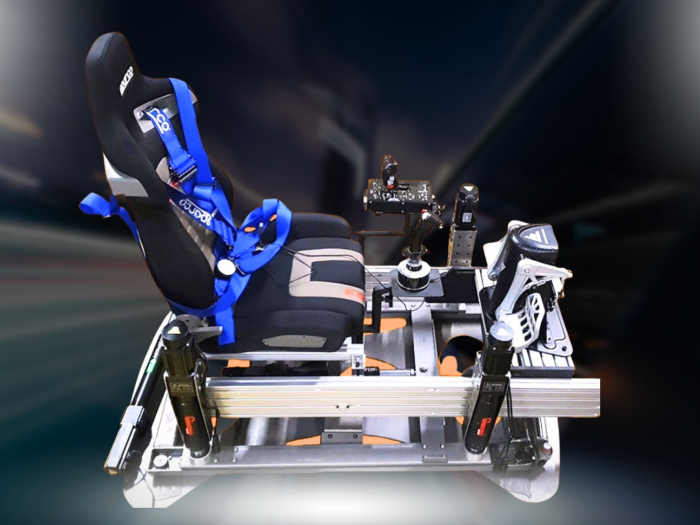

You're diving into the apex at Silverstone, but as the front tyres begin to scrub, your rig stays eerily silent, leaving you to guess the grip levels through your steering wheel alone. You know this feeling of disconnect. It's the frustrating barrier between a standard hobbyist setup and a professional-grade training tool. If you aren't using a twin traction loss motion platform, you're only receiving half the story. Most systems focus solely on the rear, but true mastery requires sensing every nuance of understeer and oversteer simultaneously.
Discovering how this technology transforms your experience is the key to unlocking consistent, elite performance. We'll show you how precise telemetry feedback allows you to perfect your car control and lower your lap times. We're going to explore the engineering behind ultra-low profile designs like the LowSlider 6 DOF, which solve the stability issues of taller rigs whilst offering a straightforward one-hour assembly. From technical specifications to the sensory impact of independent front and rear slip, this 2026 guide covers everything you need to build a world-class racing environment.
Key Takeaways
- Master the distinction between basic rear-only movement and a comprehensive system that simulates independent front and rear tyre slip.
- Learn how a twin traction loss motion platform translates digital telemetry into physical sensations to help you catch slides before they happen.
- Resolve the "tall rig" dilemma by opting for low-profile engineering that ensures maximum stability without sacrificing high-performance feedback.
- Optimise your setup for total immersion by integrating precision motion with advanced VR headsets for a true-to-life racing experience.
- Gain insights into the long-term value of investing in hand-built UK hardware designed for rapid assembly and professional-grade durability.
What is a Twin Traction Loss Motion Platform?
In the pursuit of perfect lap times, your brain needs more than just visual cues. A twin traction loss motion platform serves as the bridge between digital physics and physical reality. It specifically targets "yaw", which is the horizontal rotation of the car around its vertical axis. Whilst a standard motion simulator might focus on the heave of a kerb or the pitch of heavy braking, traction loss tells you exactly when your tyres have reached their limit. Professional drivers prioritise this feedback because it allows them to feel the slip angle of the vehicle, providing a tactile warning before a slide becomes unrecoverable.
High-fidelity telemetry is the engine behind this experience. Your PC processes thousands of data points every second, which the platform's actuators then translate into precise physical movements. This isn't random shaking; it's a direct, lag-free representation of the car's behaviour on track. If the rear tyres lose traction on a damp exit, the platform swings the rear of the rig to match. It's a sophisticated translation of software data into "seat of the pants" feel.
Single vs Twin Traction Loss: The Critical Difference
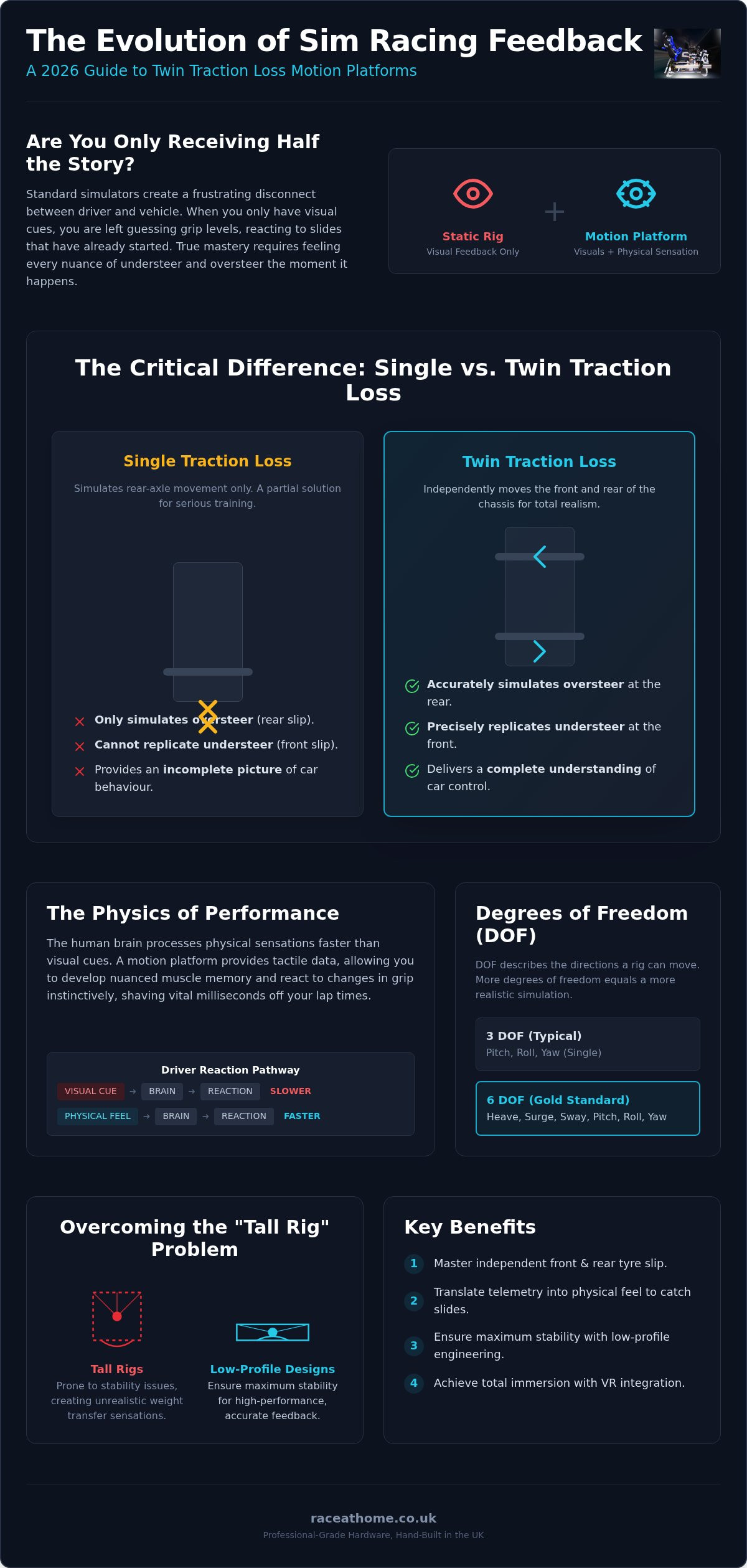
Most entry-level systems utilise a single actuator at the rear to simulate tail-happy oversteer. Whilst this adds excitement, it's only a partial solution for serious training. A twin traction loss motion platform uses two independent actuators to decouple the front and rear of the chassis. This is vital for identifying understeer. When the front end pushes wide in a slow corner, you'll feel that specific loss of grip through the front actuator, allowing you to adjust your steering input or throttle immediately. It's the difference between guessing where the grip is and knowing exactly which axle is failing.
The Importance of Degrees of Freedom (DOF)
Degrees of Freedom (DOF) describe the directions in which a rig can move. A 3DOF system typically covers pitch, roll, and a single yaw movement. However, for those seeking the ultimate training tool, 6 DOF is the gold standard. This level of complexity allows for heave, surge, sway, pitch, roll, and yaw to operate simultaneously. The LowSlider 6 DOF motion simulator integrates these movements into a cohesive, high-performance environment. By combining twin traction loss with full 6-axis motion, you create a simulation where every weight transfer and tyre scrub is felt with surgical precision.
The Physics of Performance: Why Twin Traction Loss Matters
The human brain is remarkably adept at interpreting lateral acceleration. In a real race car, you don't just see the slide; you feel it through your hips and spine before your eyes even register the change in trajectory. This "seat of the pants" sensation is exactly what a twin traction loss motion platform replicates. By providing physical feedback the moment the tyres lose their grip, the system allows you to shave vital milliseconds off your reaction times. You aren't reacting to a visual cue on a screen; you're reacting to a physical force, which is a much faster cognitive process.
This tactile data is essential for developing nuanced muscle memory across various drivetrain layouts. If you're piloting a high-torque RWD GT3 car, the platform communicates the precise moment the rear axle breaks traction. Conversely, in a FWD touring car, you'll feel the front end wash out during understeer. Without this, steering often feels floaty and disconnected, forcing you to rely on visual guesswork. By adding a physical reference point for grip, you can lean on the car with far more confidence than a static rig could ever provide.
Decoupling Yaw and Sway for Realism
True realism requires the ability to decouple front and rear movements. Whilst basic rigs might swing the entire chassis as one unit, a twin-actuator setup allows the front and rear to move independently. You'll experience the distinct sensation of scrubbing the front tyres in a tight hairpin, a feedback loop that is invaluable for tyre management. In long-distance endurance races, this level of detail helps you maintain consistency, as you can physically monitor tyre degradation through the changing behaviour of the platform over a stint.
Training for the Real Track
It's no coincidence that professional racing teams increasingly rely on motion simulators for driver training. The ability to translate virtual data into real-world car control skills is the ultimate goal of any high-end rig. There is a profound psychological benefit to feeling the limit of adhesion; it builds the confidence necessary to push the car to its absolute edge without fear. If you're looking to bridge the gap between simulation and the circuit, exploring the precision of a hand-built motion system is the logical next step for any serious competitor.
Overcoming the "Tall Rig" Problem: Stability and Footprint
Many enthusiasts browsing DIY forums will recognise the "tall rig" dilemma. Traditional motion designs often stack actuators and frames on top of one another, resulting in simulators that are nearly six feet tall. These towering structures aren't just difficult to fit into a standard home office; they're inherently less stable. High-performance racing requires a twin traction loss motion platform that stays grounded. A lower centre of gravity reduces the leverage forces acting on the floor, ensuring that the rig’s energy is directed into your seat rather than shaking your entire room.
Stability isn't just about safety; it's about physical comfort. When a rig is too tall, the pivot point for motion is often far from the driver's inner ear. This mismatch creates vestibular-ocular conflict, the primary cause of motion sickness in sim racing. By keeping the platform low, the physical movement aligns more closely with what your eyes see on screen or in VR, allowing for longer, more intense sessions without fatigue. It's a professional solution that respects the constraints of a home environment whilst delivering uncompromising feedback.
The LowSlider Design Philosophy
The LowSlider approach prioritises an ultra-low profile whilst maintaining the full travel distance required for 6 DOF realism. Unlike traditional stacked systems that add layer upon layer of heavy steel, this design integrates the twin traction loss motion platform into a compact, manageable footprint. It’s a professional-grade solution that doesn't demand a dedicated warehouse. This compactness makes it ideal for home-based setups where space is at a premium, providing the same high-fidelity feedback as commercial training centres without the structural bulk.
Actuator Quality: The PT Actuator Advantage
Precision engineering is nothing without high-quality components. Professional-grade PT Actuators are used because linear actuators offer significant advantages over consumer-grade gear motors. They provide surgical precision and far greater longevity, handling the rapid, repetitive stresses of traction loss without developing mechanical play. Crucially for home users, these actuators offer remarkably silent operation. Their high-speed response also eliminates the perceptible lag found in cheaper systems, ensuring that the physical feedback is perfectly synchronised with the in-game telemetry.
Maximising Immersion: VR and Accessory Integration
Physical feedback is only one half of the immersion equation. To truly feel "in" the car, your eyes must perceive the same lateral forces that your body feels. A twin traction loss motion platform provides the yaw and sway, but without a wide Field of View (FOV), your brain struggles to gauge the scale of the movement. This is where virtual reality becomes a non-negotiable component for the elite racer. It bridges the gap between seeing a slide and living it by placing your perspective directly inside the cockpit.
Software synchronisation is the invisible thread holding this together. If the physical rig rotates but the visuals lag by even a few milliseconds, the immersion breaks and motion sickness sets in. Modern telemetry-based software ensures that the physical movement of your rig perfectly matches the on-screen data. When you feel the rear end step out, your visuals follow instantly; it's a seamless feedback loop that allows you to drive by instinct rather than just reaction. This alignment is what transforms a simulator from a game into a professional training environment.
Pimax VR: The Professional Choice
Pimax headsets have become the industry standard for motion rigs due to their expansive FOV and high resolution. A narrow FOV on a standard headset can feel like looking through binoculars, which masks the subtle lateral movements of a twin traction loss motion platform. Setting up a Pimax VR motion simulator ensures zero-latency tracking, which is vital for maintaining the horizon line whilst the rig is in motion. By removing the need for bulky triple-monitor setups, you also save significant space in your home office without sacrificing any visual awareness.
Essential Sim Racing Accessories
The feedback loop doesn't stop at the seat. Choosing the best sim racing accessories is critical to complement your platform's capabilities. Load-cell pedals are particularly important. They allow you to modulate braking pressure with extreme precision, which is vital when you're trying to settle the car during a slide you've just felt through the chassis. Similarly, Direct Drive wheels provide the high-torque fidelity needed to match the intensity of the motion platform. Together, these components create a professional-grade ecosystem where every input and output is perfectly aligned.
If you're ready to transform your setup into a professional-grade training tool, explore our range of hand-built motion platforms and accessories today.
Is a Twin Traction Loss Rig Worth the Investment?
Deciding to upgrade to a high-end motion setup is a significant milestone for any enthusiast. It represents a shift from casual gaming to a dedicated pursuit of car control mastery. When analysing the cost vs benefit of a sim racing motion rig, the value is found in the fidelity of the data you receive. A twin traction loss motion platform provides the specific sensory input needed to find the limit of a car without the risks of a real-world track day. It's a long-term investment in your skills as a driver.
Longevity is a crucial factor often overlooked in the mass market. Whilst consumer-grade gear-driven systems might offer a lower entry point, they often lack the durability required for daily high-torque use. Hand-built UK hardware is engineered to a different standard. By using professional-grade components and a "no-compromise" approach to materials, these rigs are designed to be future-proof. A 6 DOF system doesn't just provide immediate thrills; it ensures your setup remains at the cutting edge of simulation technology for years to come.
Bespoke Craftsmanship vs Mass Production
The difference between a mass-produced rig and a bespoke, hand-built solution is felt in every corner. We understand that the biggest barrier to entry for many is the perceived complexity of the build. To solve this, we ship our platforms in four manageable pieces. This modular approach allows for a one-hour customer assembly, sparing you the days of frustration often associated with complex DIY projects. You get the benefit of specialist engineering without the headache of a professional installation crew. Having access to UK-based specialist support means you're never left troubleshooting alone.
Final Verdict: Taking the Leap to Full Motion
The transformative nature of twin traction loss cannot be overstated. It is the final piece of the puzzle for total immersion, providing the horizontal slip data that your brain craves. If you're ready to move beyond static racing and experience the visceral reality of a professional-grade setup, the path is clear. You can buy a motion simulator in the UK with the confidence that it will be delivered worldwide and ready for action in sixty minutes. Your ultimate home sim racing journey starts with the decision to stop guessing where the grip is and start feeling it.
Master the Circuit with Professional-Grade Motion
The transition from a static rig to a twin traction loss motion platform represents the ultimate evolution in sim racing realism. You've seen how decoupling front and rear slip angles provides the surgical precision needed to identify understeer and oversteer instantly. By prioritising a low-profile design, you eliminate the instability of traditional tall rigs whilst gaining a compact, high-performance environment that fits perfectly within a home office. This isn't just about immersion. It's about building the physical reference points required for elite car control.
Taking the leap to full motion is now more accessible than ever. Our hardware is hand-built in the UK and designed for a straightforward one-hour customer assembly. We ship worldwide in four manageable pieces, ensuring your journey from unboxing to the first corner is as seamless as the telemetry itself. If you're ready to stop guessing and start feeling every nuance of the track, it's time to build your professional-grade rig with the LowSlider 6 DOF. Your fastest lap times are waiting for you on the other side of the apex.
Frequently Asked Questions
What is the difference between traction loss and sway in sim racing?
Traction loss simulates the horizontal rotation or yaw of the vehicle, whilst sway represents the lateral G-forces felt as the car moves side-to-side. Traction loss is vital for feeling the rear end step out or the front tyres scrubbing. Sway focuses on the weight transfer during cornering. A twin traction loss system provides a more nuanced experience by allowing the front and rear axles to communicate grip levels independently.
Do I need a special floor or reinforced room for a motion platform?
You don't need a reinforced room for our platforms. The LowSlider design is engineered for domestic environments, utilising an ultra-low profile to distribute weight evenly across its footprint. Standard solid floors or well-supported wooden joists are typically more than adequate. We recommend using a high-density floor mat to protect your surfaces and dampen any minor acoustic vibrations during intense racing sessions whilst maintaining rig stability.
Will a twin traction loss system help me catch slides in iRacing or Assetto Corsa?
A twin traction loss motion platform significantly improves your ability to catch slides in iRacing or Assetto Corsa. By translating telemetry data into physical yaw movement, the rig tells you the car is rotating before your eyes process the visual change. This tactile warning allows for instinctive corrections, helping you maintain the limit of adhesion and avoid race-ending spins during competitive online sessions.
How difficult is it to assemble the LowSlider 6 DOF platform?
Assembly is designed to be straightforward and consistently takes under one hour for our customers. The platform ships worldwide in four manageable pieces to simplify the logistics of home delivery. We've prioritised a user-friendly setup process that avoids the days of frustration often found with complex DIY motion kits. You don't need specialist engineering skills; just basic tools and the provided instructions to get racing.
Does motion sickness occur more frequently on 6 DOF platforms?
Actually, 6 DOF systems can reduce motion sickness because they provide more accurate physical cues that match what your eyes see. Sickness often stems from a sensory mismatch between your eyes and your inner ear. The high-speed PT Actuators in our rigs eliminate perceptible lag, ensuring that every pitch, roll, and yaw movement is perfectly synchronised with the in-game physics, keeping your vestibular system in balance.
Can I use my existing sim racing cockpit with a Race@Home motion base?
Our motion platforms are designed to be compatible with most standard aluminium profile cockpits. The LowSlider base acts as the foundation for your existing seat, pedals, and wheel setup, allowing you to upgrade without replacing your entire rig. If you're unsure about specific mounting points, our UK-based team can provide technical guidance to ensure your current equipment integrates seamlessly with the new motion hardware for a professional-grade finish.
How much space is required for a full motion simulator setup?
You only need a slightly larger footprint than a standard static cockpit. The compact design of the LowSlider 6 DOF prioritises home office compatibility without sacrificing performance. Generally, providing a clear area that allows for the platform's range of travel is sufficient. Because the rig stays low to the ground, it doesn't dominate the room visually, making it a much more practical choice for home-based professional training environments.
Is twin traction loss compatible with VR headsets like Pimax?
A twin traction loss motion platform is the perfect partner for high-end VR headsets like Pimax. The expansive field of view in VR allows you to perceive lateral movements and yaw rotations more naturally than on a flat screen. We specialise in synchronising these systems to ensure zero-latency tracking, which is essential for a truly immersive and comfortable experience. This combination effectively eliminates the need for bulky triple-monitor setups.


