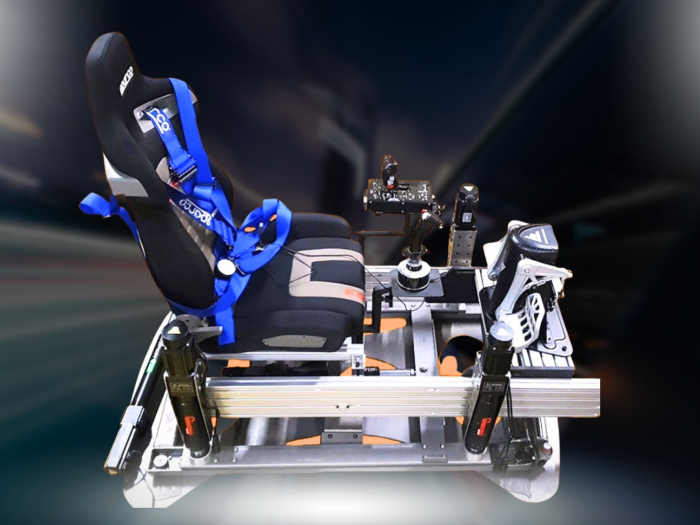

What if the true cost of your sim rig isn't the hardware you buy, but the immersion you lose by staying static? It's a question that haunts every serious driver looking to bridge the gap between a screen and the tarmac. You've likely found yourself staring at complex price lists, wondering how much does a motion simulator cost whilst fearing you'll end up overpaying for a glorified vibrating chair. It's natural to be wary of gimmick hardware that promises the world but delivers little more than a headache.
We understand that the jump to motion is a significant commitment of both finance and floor space. You want to ensure that every pound spent translates directly into sharper haptic feedback and more precise car control. This guide provides the clarity you need to navigate the 2026 market. We'll explore the technical tiers of movement, the reality of actuator performance, and why a bespoke 6 DOF platform is the definitive choice for those who refuse to compromise on realism.
Key Takeaways
- Learn to distinguish between entry-level seat movers and professional-grade platforms to ensure your investment matches your performance expectations.
- Understand the technical variables, such as actuators and degrees of freedom, that dictate how much does a motion simulator cost in the current market.
- Evaluate the hidden costs of ownership, including assembly time, power requirements, and the long-term value of bespoke UK engineering.
- Discover how proprietary technologies like Twin-Traction-Loss provide professional-level realism without the excessive footprint of commercial rigs.
Navigating the Motion Simulator Price Spectrum in 2026
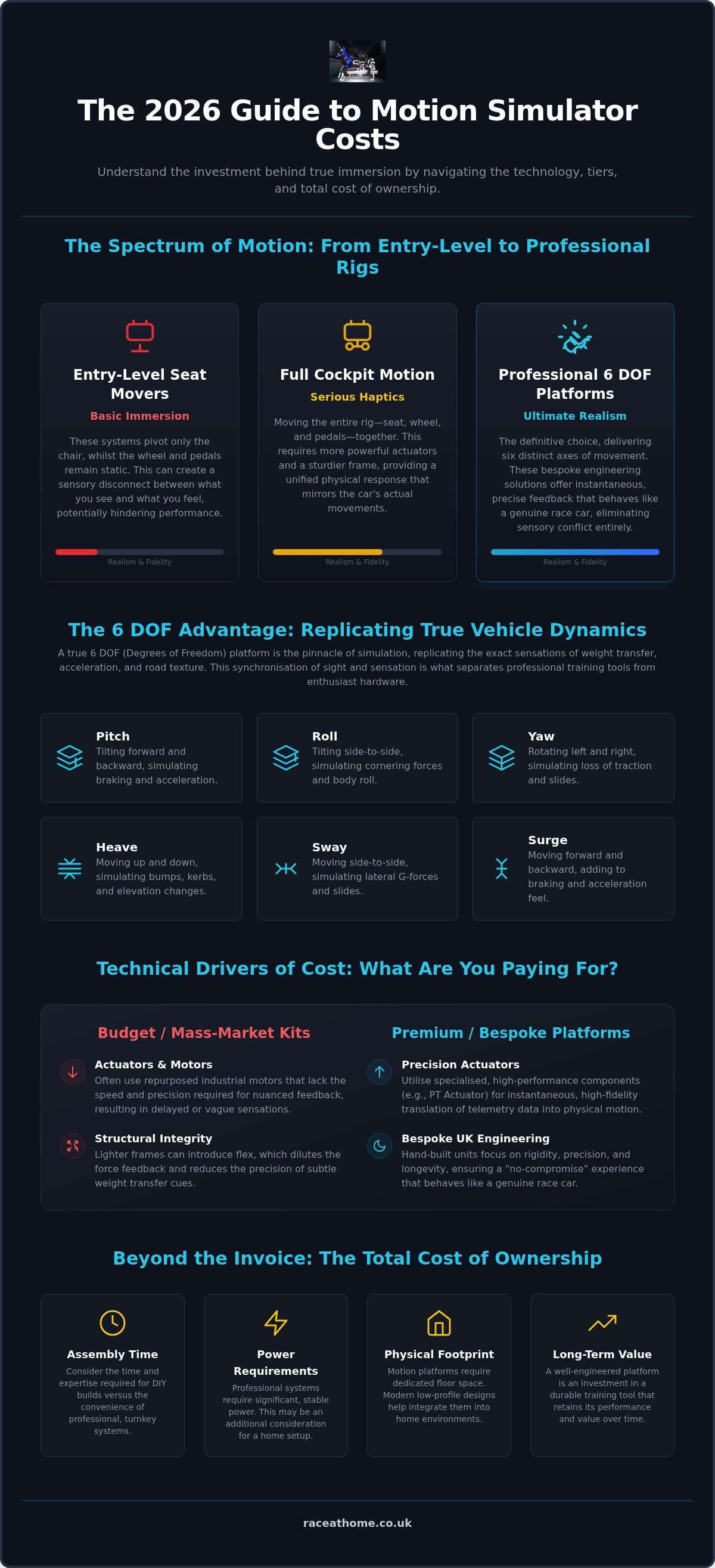
The market for high-performance haptics has expanded rapidly, leaving many enthusiasts asking exactly how much does a motion simulator cost before they commit to a purchase. In 2026, the answer depends entirely on the level of fidelity you demand from your telemetry data. We categorise systems into three distinct tiers: seat movers, cockpit movers, and full-motion platforms. Whilst the lower tiers offer an accessible entry point, they often sacrifice the structural rigour required for professional-level training. Choosing the wrong tier can lead to a "gimmick" experience that fails to improve your lap times or provide genuine immersion.
Entry-Level Seat Movers vs. Full Cockpit Motion
Seat movers represent the most basic form of movement. These systems pivot only the chair whilst your steering wheel and pedals remain stationary. This creates a sensory disconnect. Your eyes see the car turning, but your hands don't feel the rig move in sync with the chassis. It can actually hinder your performance by providing conflicting signals to your brain. For drivers serious about developing real-world muscle memory, full cockpit motion is essential. It ensures that every input is met with a physical response that mirrors the car's actual Degrees of Freedom.
Moving the entire rig requires more powerful actuators and a significantly sturdier frame. This structural integrity is where much of the investment goes. A rig that flexes under the weight of motion loses the precision needed to feel subtle weight transfers. If your goal is to replicate the visceral feel of a GT3 car or a formula chassis, the transition from moving a seat to moving a full cockpit is the most critical step in your journey.
The Premium Tier: Professional 6 DOF Systems
When you move into the premium tier, you're no longer just buying a peripheral. You're investing in a bespoke engineering solution. A professional 6 DOF (Degrees of Freedom) system provides the ultimate evolution of the hobby. It delivers heave, pitch, roll, yaw, surge, and sway. Modern 2026 technology has allowed us to refine these systems into ultra-low profile designs like the LowSlider, which integrate seamlessly into home environments without requiring a dedicated warehouse.
Bespoke UK manufacturing stands apart from mass-produced alternatives by focusing on precision and longevity. Hand-built units utilise high-grade components from partners like PT Actuator, ensuring that the translation from digital telemetry to physical sensation is instantaneous. Understanding how much does a motion simulator cost means looking past the initial invoice. You must consider the engineering expertise that goes into every actuator and pivot point. A well-engineered platform provides a "no-compromise" experience that behaves like a genuine race car, offering a level of realism that mass-market kits simply cannot match.
The Technical Drivers of Cost: Actuators and Degrees of Freedom
The engineering complexity of a rig is the primary factor in how much does a motion simulator cost. It isn't just about the number of motors; it's about the precision of the translation from digital telemetry to physical feedback. Every degree of movement added requires additional actuators, sophisticated control boards, and structural reinforcements to handle the increased kinetic energy. In 2026, the industry has moved beyond simple vibration, focusing instead on the high-fidelity recreation of vehicle dynamics that allow drivers to feel the limit of grip before they lose the car.
The 6 DOF Advantage: Pitch, Roll, Yaw, Heave, Sway, and Surge
A 6 DOF platform is the pinnacle of sim racing technology. Whilst a 3DoF system might cover basic tilt and lift, a true 6 DOF setup simulates six distinct axes of movement: pitch, roll, yaw, heave, sway, and surge. This mechanical depth is essential for professional driver coaching because it replicates the exact sensations of weight transfer under braking and cornering. This level of fidelity mirrors the standards set by professional-grade motion simulation used in safety research and aerospace training.
The "immersion tax" for 6 DOF is justified by the elimination of sensory conflict. In a 3DoF rig, your brain often has to fill in the gaps for missing movements, which can lead to fatigue or motion sickness. By providing every axis of movement, a 6 DOF system ensures your inner ear and your eyes receive identical signals. This synchronisation is why professional platforms are significantly more expensive than entry-level kits; you're paying for the elimination of latency and the perfection of the physical narrative.
Precision Actuators vs. Budget Motors
The choice of actuators is where the most significant price variance occurs. Budget systems often use repurposed industrial motors that lack the response time required for sim racing. Premium platforms, however, utilise specialised components like PT Actuators. These are designed for high-frequency response, allowing them to communicate "road feel" such as kerb strikes and tyre scrub alongside larger chassis movements. If an actuator has high latency, the motion will always feel "behind" the car, ruining your ability to catch a slide.
Stroke length also plays a vital role. Longer travel allows for more dramatic heave and pitch, essential for rally or flight simulation, but it requires more expensive, high-torque servos to maintain speed. When you're calculating how much does a motion simulator cost, you must look at the quality of these internal components. For those seeking the ultimate balance of compact design and professional performance, exploring the LowSlider range reveals how UK engineering can maximise actuator efficiency without requiring a commercial-sized footprint.
Finally, consider the proprietary technology that manages these components. Features like Twin-Traction-Loss add another layer of engineering cost but are vital for realistic oversteer sensations. This technology allows the rear of the rig to move independently, providing the tactile feedback necessary to sense the back end stepping out, a feature that distinguishes a professional tool from a high-end toy.
DIY Builds vs. Bespoke Turnkey Systems: Choosing Your Path
The decision to build your own rig or invest in a professional solution is the most significant fork in the road for any enthusiast. When calculating how much does a motion simulator cost, many drivers only look at the price of raw actuators and aluminium profiles. They often overlook the value of their own time. A DIY project can easily consume hundreds of hours in fabrication, wiring, and software troubleshooting. Whilst the initial component cost might seem lower, the "labour tax" of a home build is substantial. You aren't just paying for parts; you're paying for the engineering expertise required to make those parts work in harmony.
The Hidden Frustrations of DIY Motion
Building a motion platform from scratch involves more than just bolting motors to a frame. The real challenge lies in telemetry mapping and software synchronisation. If the motion cues aren't perfectly aligned with the digital car's behaviour, the result is a disorienting experience that can actually induce motion sickness. DIY builds also lack the rigorous stress-testing that professional platforms undergo. Without industrial-grade quality control, you risk mechanical failures or electrical interference that can ruin a race weekend. Choosing a bespoke motion simulator saves months of setup time, allowing you to focus on driving rather than debugging code or tightening loose bolts.
Turnkey Solutions and White Glove Delivery
Premium turnkey systems offer a level of refinement that is difficult to replicate in a garage. These platforms come pre-configured with proprietary telemetry profiles that have been tuned by professional drivers. This out-of-the-box performance ensures that your investment delivers immediate results. One of the most significant logistical benefits of a high-end UK build is modularity. Whilst many international competitors ship massive, heavy crates that require a forklift and a wide warehouse door, modern bespoke designs are more agile.
Our LowSlider platforms, for example, are shipped in four manageable pieces. This modular approach means your rig will actually fit through standard UK doorways and can be carried up a flight of stairs without professional movers. When evaluating how much does a motion simulator cost, consider the assembly time. A system that can be fully operational in under an hour provides a massive value proposition compared to a crate that sits in your hallway for weeks. You're investing in a refined, hand-built piece of engineering that respects your space and your schedule. This seamless transition from delivery to the first corner is what defines the premium enthusiast experience.
Total Cost of Ownership: Beyond the Initial Invoice
When evaluating how much does a motion simulator cost, the initial purchase price is only one part of the equation. A professional-grade rig is a long-term investment in your performance. To find the true value, you must consider the total cost of ownership over a five-year lifecycle. If you spend ten hours a week in the cockpit, you'll accumulate 2,600 hours of high-fidelity training. Amortising a premium platform over this period often reveals a per-hour cost that is significantly lower than a single track day. High-end hardware is designed to endure this level of intensity without the mechanical fatigue that plagues budget alternatives.
Operational costs are another factor. High-performance actuators are remarkably efficient, but they do require a stable power supply. Whilst the idle draw is minimal, peak movements during a heavy rally stage or a high-downforce corner will spike consumption. We recommend a dedicated power circuit for 6 DOF platforms to ensure the PC and motion system don't compete for current. Despite the physical output, the impact on your monthly electricity bill is usually less than the cost of running a high-end gaming PC alone.
Ancillary Hardware: VR and Peripherals
A motion platform is the heart of an ecosystem. To maximise your investment, you need visuals and controls that can keep pace with the physical feedback. Pairing a 6 DOF system with Pimax VR headsets is the definitive way to achieve total immersion. This combination ensures your eyes and inner ear receive perfectly synchronised data, but it does require a potent PC. Budgeting for a workstation with a top-tier GPU is essential to handle 6 DOF telemetry and high-resolution VR simultaneously. You'll also want to invest in high-end load-cell pedals and a direct-drive wheel to ensure your inputs are as precise as the motion you're receiving.
Maintenance and Longevity
Industrial-grade actuators, such as those used in our LowSlider range, are built for millions of cycles. They require very little maintenance beyond occasional inspections and keeping the workspace free of dust. This durability is why premium motion hardware holds its resale value amongst enthusiasts. If you decide to upgrade in the future, a well-maintained UK-built platform remains a highly sought-after asset. You should also account for software. Advanced telemetry suites often require annual subscriptions to maintain compatibility with the latest racing titles. Having access to UK-based technical support is vital here; it ensures your rig stays calibrated and operational for years to come. For a detailed breakdown of the long-term benefits, you can view our professional motion solutions and see how bespoke engineering protects your investment.
The LowSlider Advantage: Professional Realism for Home Rigs
Understanding how much does a motion simulator cost requires a look at the physical footprint as well as the financial one. Traditional 6 DOF platforms often resemble industrial machinery, requiring significant floor space and dedicated rooms. The LowSlider design challenges this paradigm. It delivers professional-grade telemetry without the commercial-sized bulk. Our UK engineering team has refined the geometry to keep the centre of gravity low, ensuring that the platform remains stable whilst providing intense, high-frequency feedback. This efficiency is the result of hand-built quality that mass-market alternatives simply cannot replicate. When you evaluate how much does a motion simulator cost, you're ultimately assessing the long-term value of the engineering.
Compact Footprint, Full-Scale Immersion
Integrating motion into a home environment often presents a logistical puzzle. Many enthusiasts have already invested in high-end sim racing rigs and are hesitant to replace their entire setup. The LowSlider is designed to be the ultimate foundation. Its ultra-low profile allows it to sit beneath your existing rig, adding 6 DOF movement without raising your seat to an impractical height. This clever design solves the "spare room" problem that often deters potential owners.
Beyond the mechanics, the aesthetic is tailored for the home. Each unit features a premium powder-coated finish that looks as sharp as it performs. It's a piece of engineering that you'll be proud to display in your home office or dedicated gaming space. You're not just buying a tool; you're investing in a bespoke piece of British craftsmanship that balances raw performance with domestic practicality.
The Future of Home Simulation
The year 2026 marks a turning point where the barrier between home simulation and commercial driver training has finally dissolved. Race@Home provides the gateway to this professional realm. We've focused on making high-end motion accessible through modular shipping and intuitive assembly. By shipping each platform in four manageable pieces, we ensure that bespoke UK engineering can reach drivers across the globe without the astronomical freight costs of oversized crates. This modularity ensures your platform arrives safely and can be moved through standard doorways with ease.
Investing in a LowSlider isn't just about adding movement; it's about evolving your hobby into a visceral, sensory reality. You'll feel every kerb, every weight shift, and every loss of traction with the same precision as a professional driver. It's time to stop wondering about the logistics and start feeling the tarmac. We invite you to step into the future of home simulation and experience the transformative power of a truly bespoke 6 DOF platform. The path from enthusiast to expert begins with the right foundation.
Step Into the Future of Professional Motion
Investing in a motion platform is the definitive step towards mastering vehicle dynamics. Whilst the initial question of how much does a motion simulator cost is a practical starting point, the true value is found in the precision of every weight shift and the durability of the actuators. You've seen how the right engineering bridges the gap between digital data and physical sensation, transforming a hobby into a professional-grade training tool. Choosing a system that balances a compact footprint with full 6 DOF immersion ensures your setup remains relevant for years to come.
At Race@Home, we specialise in hardware that refuses to compromise on realism. Our LowSlider platforms are hand-built in the UK and trusted by professional racing teams for elite driver coaching. We've simplified the logistics of high-end haptics by offering worldwide shipping in four manageable pieces that assemble in under an hour. It's time to stop watching the tarmac and start feeling it. Explore the LowSlider 6 DOF Motion Platform today and discover the ultimate evolution of your home rig. Your fastest lap is waiting.
Frequently Asked Questions
Is a 6 DOF motion simulator worth the investment for a casual racer?
Yes, if immersion and long-term satisfaction are your primary goals. Casual racers often find that static rigs lose their novelty over time, whereas 6 DOF provides consistent sensory engagement that mimics real-world driving. It transforms the experience from a game into a visceral activity. Whilst it represents a significant commitment, the reduction in motion sickness and the increase in seat time often justify the investment for those who value genuine realism over arcade-style play.
How much space do I actually need for a full-motion racing rig?
You typically need a footprint slightly larger than a standard sim rig, but modern designs have reduced this requirement significantly. Our LowSlider platforms are engineered with an ultra-low profile to fit within standard home environments. A clear area of approximately 2 metres by 1.5 metres is usually sufficient for the rig's range of movement. This compact footprint allows you to integrate professional-grade haptics into a spare room or office without needing a dedicated warehouse.
Do I need special electrical wiring to run a motion platform at home?
Most home motion platforms run on standard UK mains power, but high-performance systems benefit from a dedicated circuit. Whilst you don't necessarily need industrial wiring, using a high-quality surge protector is essential to protect the sensitive actuators and control boards. If you are running a 6 DOF system alongside a high-end PC and VR headset, ensure your room's ring main can handle the combined peak draw during intense movement sequences to avoid tripping breakers.
What are the most common hidden costs when buying a motion simulator?
Beyond the hardware, enthusiasts should budget for software subscriptions, PC upgrades, and shipping logistics. When calculating how much does a motion simulator cost, many forget to include the price of telemetry software like SimTools or SimHub. You may also need a more powerful GPU to maintain high frame rates whilst processing motion data. Additionally, consider the shipping method; modular systems delivered in manageable pieces avoid the excessive costs associated with heavy freight and specialised unloading equipment.
Does motion realism actually improve lap times or just immersion?
It improves both by providing tactile cues that static rigs cannot replicate. Motion allows you to feel the limit of grip, weight transfer, and the exact moment the rear tyres begin to slide. This physical feedback lets you react instinctively rather than waiting for visual confirmation on screen. By developing this muscle memory, you can push the car closer to its limits with greater confidence, which directly translates into more consistent and faster lap times.
Can I add motion to my existing static sim racing cockpit?
Yes, many professional platforms are designed to be bolt-on solutions for existing aluminium profile rigs. The LowSlider 6 DOF platform acts as a foundation that sits beneath your current cockpit. This modularity means you don't have to replace your favourite seat, wheel, or pedals to experience full-motion realism. It is a cost-effective way to evolve your setup without discarding the high-quality components you have already meticulously configured and adjusted to your driving style.
What is the difference between a seat mover and a full-motion platform?
A seat mover pivots only the chair, whilst a full-motion platform moves the entire cockpit, including the controls. Seat movers are often cheaper but create a sensory disconnect because your hands and feet stay static whilst your body moves. Full-motion systems ensure that your steering wheel and pedals move in perfect synchronisation with the chassis. This unified movement is essential for professional driver coaching as it accurately replicates the physical forces experienced in a real race car.
How difficult is it to assemble a professional motion rig by myself?
Modern engineering has made assembly remarkably straightforward for the end user. Our hand-built platforms are shipped in four pre-assembled sections, allowing for a complete setup in under an hour. You won't need specialised engineering skills or heavy machinery to get started. Each component is designed to fit through standard UK doorways, ensuring that the transition from delivery to your first session on track is as seamless and stress-free as possible for the home enthusiast.


