
Why invest in a 200-degree field of view if your body remains anchored to a static chair? The staggering visual fidelity of a Pimax headset is often squandered when your inner ear fails to register the G-forces of a hairpin turn or the sudden lift of a runway departure. This sensory disconnect doesn't just break immersion; it's the root cause of the visual-vestibular conflict that leaves many enthusiasts reaching for the "exit" button.
We understand that you want more than just a screen on your face; you want to feel the track beneath you. Finding the best motion platform for Pimax VR is about more than just raw power; it's about finding a system that matches the headset's precision without cluttering your room or complicating your software stack. This guide will help you pair your high-resolution optics with a professional-grade rig that translates digital telemetry into visceral, real-world sensations.
We'll examine the technical requirements for 2026, from low-latency 6 DOF configurations like the UK-built LowSlider to the latest motion compensation updates in Pimax Play. You'll discover how a compact, ultra-low profile setup can provide total sensory immersion whilst keeping your feet firmly on the ground.
Key Takeaways
- Understand why Pimax's industry-leading field of view requires ultra-low latency motion to prevent sensory mismatch and motion sickness.
- Discover why a 6 DOF system is the best motion platform for Pimax VR, providing the necessary sway and surge to match wide-angle visuals.
- Learn how to correctly configure motion compensation via OpenXR to ensure your virtual cockpit remains stable whilst the rig is in motion.
- Explore the benefits of an ultra-low profile design that maintains ergonomic integrity without requiring a dedicated room for your setup.
- Realise how bespoke, hand-built systems can be assembled in under an hour, offering a professional-grade experience with plug-and-play simplicity.
Why Pimax VR Demands a High-End Motion Platform
The Pimax ecosystem is defined by its pursuit of the "no-compromise" visual experience. When you're peering through the lenses of a Pimax Crystal or an 8K model, the sheer scale of the 200-degree field of view places immense pressure on your brain to accept the virtual world as reality. This creates a "presence gap." If your eyes see a high-speed drift through a chicane but your body remains perfectly still, the immersion shatters instantly. For enthusiasts, finding the best motion platform for Pimax VR isn't just a luxury; it's a technical requirement to bridge this sensory divide.
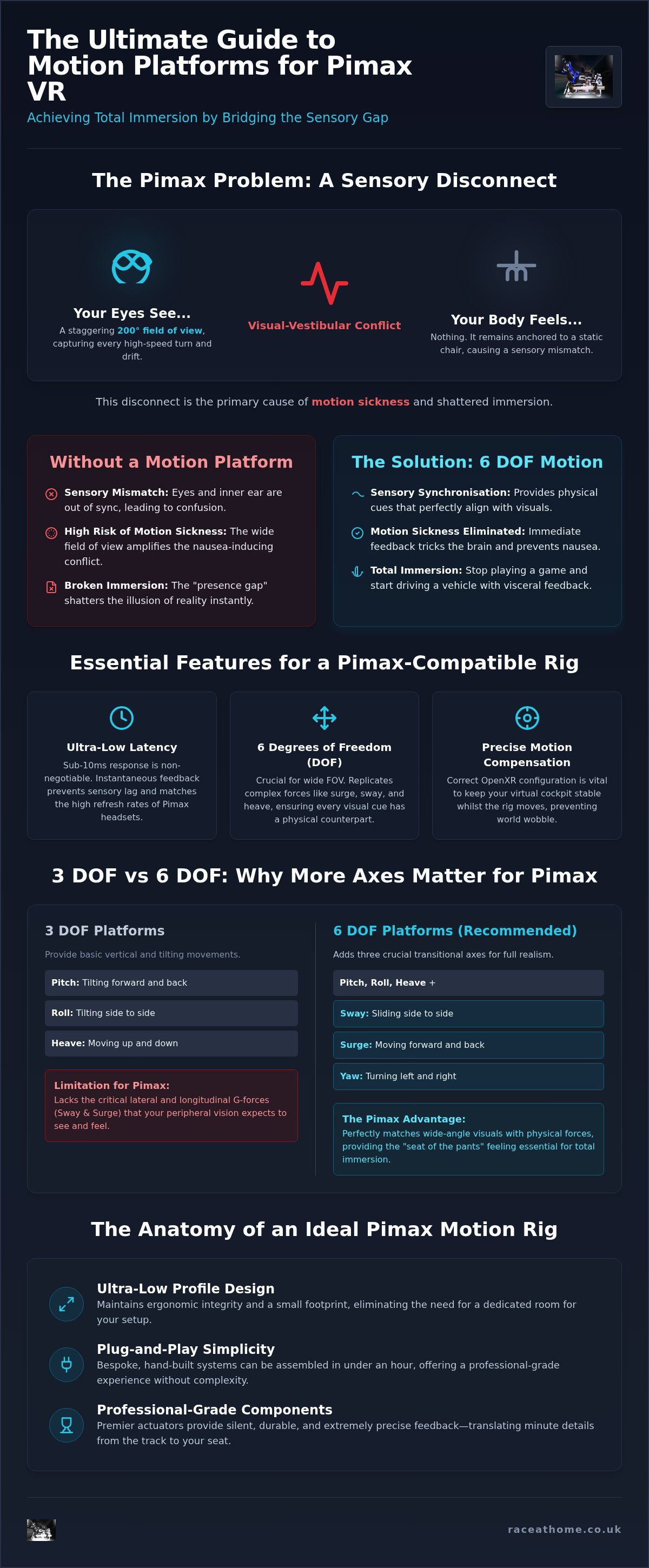
Peripheral vision is significantly more sensitive to motion than our central focus. Because Pimax headsets fill your entire visual field, any movement in the digital world that isn't mirrored by physical feedback becomes jarring. Choosing the best motion platform for Pimax VR involves prioritising response time over raw travel distance to maintain this delicate balance. A high-fidelity motion simulator solves this by providing the vestibular synchronisation necessary to trick your brain. By utilising 6 Degrees of Freedom (6 DOF), a rig can replicate the complex forces of surge, sway, and heave, ensuring every visual cue has a physical counterpart.
The Challenge of High-Resolution Immersion
High-resolution VR exposes flaws that monitors simply cannot. In a Pimax Crystal, the clarity is so high that micro-stutters in motion or slight delays in telemetry translation become distracting. You don't just want to see the track; you need to feel the subtle vibrations of the kerbs and the weight transfer during heavy braking. This level of detail requires professional-grade actuators that offer precise, granular feedback rather than generic, violent shaking. When your hardware can translate minute data points into tangible sensations, the psychological benefit is profound. You stop playing a game and start driving a vehicle.
Overcoming the Motion Sickness Barrier
Visual-vestibular conflict occurs when your eyes report movement that your inner ear doesn't feel. This is the primary cause of nausea in VR. Pimax users are particularly susceptible because the wide FOV amplifies the perceived movement. A low-latency platform reduces this nausea by providing immediate physical cues that align with the visuals. It's a common misconception that motion rigs need to be violent to be effective. In reality, the most comfortable and immersive experiences come from subtle, high-frequency movements that provide constant, low-latency data to your vestibular system. This immediate feedback loop is what allows for hours of racing whilst eliminating the looming threat of motion sickness.
Essential Features for a Pimax-Compatible Motion Rig
Identifying the best motion platform for Pimax VR requires looking beyond marketing brochures and into raw engineering specifications. For a headset that demands high-performance computing, the physical rig must be equally capable. Sub-10ms latency is non-negotiable for VR enthusiasts. If the actuator reacts even 20ms after your virtual car hits a bump, your brain registers the lag. This delay causes the visual-vestibular conflict that ruins immersion. High-speed telemetry processing ensures that physical feedback is instantaneous, matching the high refresh rates of your Pimax lenses.
Precision is the next pillar of a quality rig. There is a massive difference between generic "shaking" and true "moving." Precision actuators provide granular detail, such as the distinct texture of tarmac or the specific vibration of an engine at high RPMs. Rig rigidity is also frequently overlooked. VR tracking systems, particularly Pimax's inside-out tracking, are highly sensitive to structural vibration. A flimsy rig introduces "noise" into the tracking data. This causes the virtual world to wobble or drift. A rigid, ultra-low profile frame is essential to keep the coordinate system stable whilst the actuators are working at full capacity.
Mechanical Precision and Actuator Technology
PT Actuators are widely regarded as the premier choice for high-end bespoke rigs. These components offer a perfect balance of silent operation and extreme durability, which is vital for residential setups or home offices. In road racing, the speed of movement is far more critical than total travel distance. You don't need 150mm of vertical heave to feel a kerb; you instead need an actuator that can move 5mm in a fraction of a second. This rapid response is what creates the "seat of the pants" feeling that professional drivers rely on for car control.
Software Ecosystem and VR Compensation
Compatibility is the heartbeat of any motion setup. The software must bridge the gap between telemetry-heavy titles like iRacing, Assetto Corsa Competizione, or Microsoft Flight Simulator 2024 and your hardware. Systems that integrate natively with SimHub and Pimax Play allow for a seamless, plug-and-play experience. Without a dedicated software team refining these drivers, even the most expensive hardware becomes a liability. If you're looking for a system that balances this technical precision with a compact, home-friendly footprint, exploring the bespoke motion solutions at Race@Home provides a clear path to professional-grade immersion.
6 DOF vs 3DOF: Choosing the Right Feedback for Wide FOV
Deciding on the best motion platform for Pimax VR often comes down to a choice between 3DOF and 6 DOF configurations. Whilst both offer a massive leap over a static chair, the way they interact with Pimax's expansive field of view differs significantly. 3DOF systems typically cover pitch, roll, and heave. These provide the fundamental sensations of climbing, diving, and vertical bumps. For many, this is the entry-level for motion realism, but it leaves certain physical gaps that a high-resolution VR headset will quickly expose.
In contrast, a 6 DOF system completes the physical envelope by adding yaw, sway, and surge. This level of feedback is essential for "tricking" the brain into total immersion. When your eyes see a 200-degree vista of a racetrack, your vestibular system expects to feel the lateral push of a corner (sway) and the longitudinal force of a gear shift (surge). Without these, the experience can feel incomplete, particularly in competitive sim racing where every bit of data helps you find the limit of grip.
The 3DOF Experience: Solid but Limited
3DOF rigs are often the preferred choice for flight simulator enthusiasts. In a cockpit where G-loading and altitude changes are the primary sensations, pitch and roll do a fantastic job of replicating the feeling of flight. However, when paired with a Pimax headset, 3DOF can sometimes feel "floaty" during ground-based activities. Because your peripheral vision is so active, the lack of lateral sway or surge becomes more noticeable. It's a cost-effective solution, but for those chasing the ultimate immersion goal, it may feel like a compromise in road racing scenarios.
The 6 DOF Advantage: Professional-Grade Realism
If you want to feel the car slide, you need more axes. A 6 DOF motion simulator transforms your cornering behaviour by providing yaw and sway. Yaw allows you to sense the rotation of the vehicle, whilst sway provides the lateral G-forces that tell you how hard you're pushing into a turn. This is why 6 DOF is the standard for professional driver training; it provides the "seat of the pants" feeling required to catch a slide before it ends your race.
For the elite Pimax user, the "holy grail" is often Twin Traction Loss. This specific configuration allows you to feel the rear wheels losing grip independently of the front. In VR, this tactile cue is transformative. You don't just see the car oversteer; you feel the rig pivot beneath you. Whether you're navigating a rally stage or a tight street circuit, this level of feedback ensures that your body and eyes are finally speaking the same language.
Optimising Motion Compensation and Reducing Latency
Achieving total immersion requires more than just high-speed actuators; it demands a perfect handshake between your headset's tracking and the rig's telemetry. For those seeking the best motion platform for Pimax VR, motion compensation is the final technical hurdle. Without it, your virtual cockpit will bounce and sway along with the rig, creating a disorienting sensation where your eyes think the car is moving independently of your body. This software-driven subtraction ensures that the only movement you see is the movement of the car on the track, not the rig in your room.
OpenXR has emerged as the definitive API for 2026, offering superior performance and lower overhead than the ageing OpenVR standard. With Pimax Play 2.0 now in open beta, users can leverage native motion compensation features that were previously complex to configure. By mounting a reference tracker, often a dedicated controller, directly to the frame of your platform, the software can precisely calculate and negate the rig's physical travel from the VR view. This results in a rock-steady horizon that allows you to focus on your racing line rather than fighting a shifting camera.
The Technical Setup for Pimax Users
Integrating your hardware doesn't have to be a weekend-long ordeal. The logic involves telling the software exactly where the static world ends and the moving world begins. You can follow our Pimax VR motion simulator setup for a detailed walkthrough on calibrating the Zero Point. This alignment is critical. If your virtual head is even a few millimetres off-centre from your physical seat, the sense of scale in the Pimax wide FOV will feel distorted. Proper calibration ensures that when you look down at your virtual hands, they are exactly where your physical ones reside.
Latency Reduction Strategies
Even the most precise actuators can be undermined by electrical noise or slow data polling. To keep latency below the target 10ms threshold, consider using a dedicated USB expansion card rather than your motherboard's shared ports. Actuators generate significant electromagnetic interference, so shielded cables are essential to prevent phantom movements or tracking skips. On the software side, ensure your telemetry polling frequency is set to the highest supported rate, typically 100Hz or higher, to match the rapid refresh of the Pimax Crystal or 8K displays. If you're ready to upgrade to a system that handles these technicalities with ease, explore the LowSlider range at Race@Home and experience professional-grade stability today.
Why the LowSlider is the Best Motion Platform for Pimax Users
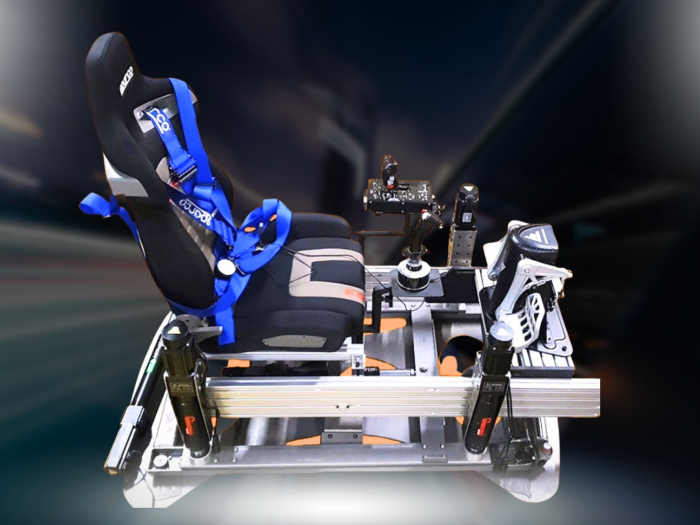
Most motion platforms are industrial towers that require a dedicated garage or a reinforced floor. The LowSlider is different. It is engineered for the enthusiast who demands professional-grade performance without sacrificing their living space. For those who refuse to settle for mass-market compromises, the LowSlider represents the best motion platform for Pimax VR currently available. Its proprietary ultra-low profile design ensures that your centre of gravity remains natural, providing a "seat of the pants" feel that taller, generic rigs simply cannot replicate.
Hand-built in the UK, every LowSlider rig is a testament to bespoke craftsmanship. We don't believe in mass-produced, "one size fits all" solutions that overlook the nuances of high-end VR. Instead, we provide a modular system that ships globally in four manageable pieces. You can go from unboxing to racing in under an hour. This ease of assembly, combined with our partnership with PT Actuator for premium hardware, ensures that you spend more time in the cockpit and less time with a spanner in your hand.
Ergonomics and the VR User
Pimax headsets, whilst visually stunning, require a stable and ergonomic seating position to maintain long-term comfort. A low centre of gravity isn't just about the "feel" of the car; it's about maintaining a natural eye-level. The LowSlider keeps you close to the floor. This ensures your virtual horizon remains consistent without the need for awkward rig heights that can distort your sense of scale. We've also prioritised easy ingress and egress. You shouldn't have to be a contortionist to enter your cockpit. Our design allows you to step in and out with ease, making it as practical for a quick qualifying lap as it is for a four-hour endurance stint.
The Race@Home Commitment to Quality
Our commitment extends beyond the frame itself. We curate a selection of premium sim racing accessories to ensure every touchpoint of your rig matches the quality of the motion feedback. If you're looking to buy motion simulator UK systems that offer local reliability and expert engineering, the LowSlider 6 DOF Twin-Traction-Loss is the 2026 benchmark. It translates digital telemetry into tangible sensations with a level of fidelity that mass-produced rigs cannot match. By focusing on the "real-world" translation of data, we provide the ultimate evolution of the hobby for the Pimax community.
Elevate Your Simulator to Professional Standards
Pairing a Pimax headset with the right hardware transforms a visual encounter into a visceral reality. You've seen how a high-resolution wide FOV demands more than just generic vibration; it requires the surgical precision of a 6 DOF system to eliminate motion sickness and achieve true presence. By prioritising low-latency actuators and robust OpenXR motion compensation, you ensure your virtual horizon remains rock-steady whilst you push for every tenth of a second on the track.
Selecting the best motion platform for Pimax VR is a definitive investment in realism that bridges the gap between software telemetry and tangible sensation. Our hand-built UK rigs are engineered for this exact purpose, offering worldwide shipping in four easy-to-assemble parts alongside expert-led integration support to get you into the cockpit faster. We don't just provide hardware; we provide the gateway to a professional-level experience that fits within your home.
The ultimate evolution of your hobby is finally within reach. Explore the LowSlider 6 DOF Motion Platform at Race@Home and redefine what it means to be fully immersed in the drive. Your seat is waiting.
Frequently Asked Questions
Does a motion platform really help with VR motion sickness?
Yes, choosing the best motion platform for Pimax VR is one of the most effective ways to combat motion sickness. Nausea usually stems from visual-vestibular conflict, where your eyes see movement that your inner ear doesn't feel. By providing immediate physical feedback that matches the digital telemetry, a platform re-aligns these senses. This synchronisation allows your brain to accept the virtual environment as reality, which significantly extends your comfortable racing time.
Can I use a Pimax Crystal with a 6 DOF motion platform?
Absolutely, the Pimax Crystal is an ideal candidate for a 6 DOF motion platform. Its high-resolution displays and glass aspheric lenses provide incredible clarity, but this fidelity makes any lack of physical movement more obvious. Pairing it with a full-motion rig ensures that the presence created by the visuals is backed up by tangible G-forces. It's a combination that represents the pinnacle of home simulation in 2026.
Is it hard to set up motion compensation for Pimax headsets?
Setup complexity has decreased significantly with the arrival of OpenXR and Pimax Play 2.0. Whilst early implementations required complex workarounds, modern software features native motion compensation. You simply mount a tracking reference to your rig's frame to subtract the platform's movement from the VR view. We provide expert-led support to help you calibrate this alignment, ensuring your virtual cockpit remains perfectly stable during high-intensity manoeuvres.
How much space do I need for a full motion sim rig at home?
Space requirements depend on the rig design, but the LowSlider is engineered specifically for standard residential rooms. Unlike industrial-style towers that need massive clearance, our ultra-low profile system maintains a compact footprint similar to a high-end static cockpit. You generally need a clear area of approximately 2 metres by 1.5 metres to allow for the platform's range of motion without hitting walls or furniture.
Are motion platforms too loud for a flat or shared house?
Modern actuator technology, particularly the PT Actuators used in our builds, is remarkably quiet and suitable for shared living spaces. The sound is often comparable to a high-end direct drive wheel base. Because the LowSlider sits so close to the floor, it also minimises the structural vibrations that often travel through floorboards in taller rigs. Using a dedicated isolation mat can further dampen any remaining noise for late-night sessions.
Do I need a separate PC to run the motion software and VR?
You don't need a separate computer; a single high-performance PC can manage both the VR rendering and the motion telemetry software. Pimax headsets already demand significant GPU power, so as long as your system meets those requirements, the additional overhead for motion software is negligible. Most enthusiasts find that a modern multi-core processor handles the background telemetry polling without impacting the frame rates necessary for a smooth VR experience.
What is the difference between a 3DOF and a 6 DOF platform for sim racing?
A 3DOF platform provides pitch, roll, and heave, which covers basic tilt and vertical bumps. However, a 6 DOF system is widely considered the best motion platform for Pimax VR because it adds yaw, sway, and surge. These extra axes allow you to feel the rear of the car sliding and the lateral push of cornering. This complete physical envelope is what creates the professional-grade realism required for competitive driving.
How long does it take to assemble a Race@Home LowSlider rig?
Assembly is a straightforward process that typically takes under an hour. We ship the LowSlider worldwide in four major, pre-assembled sections to minimise technical frustration. You won't need a workshop full of tools or advanced engineering knowledge to get started. By following our instructional guides, you can transition from unboxing the components to sitting in your fully functional motion cockpit with minimal downtime.


