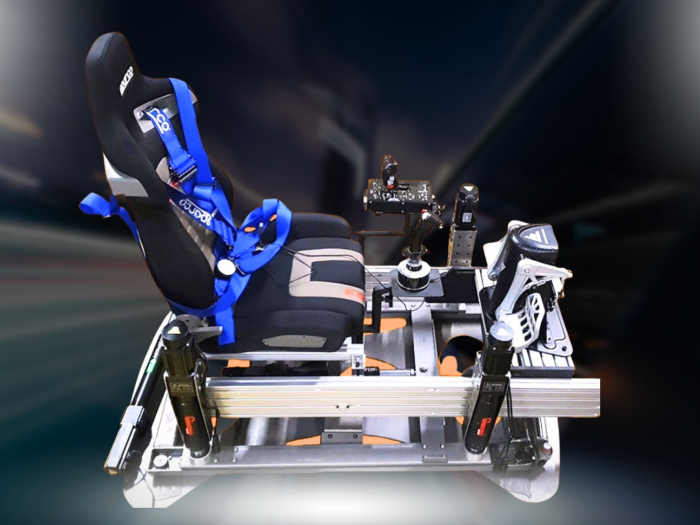

If your eyes tell you you’re hitting the apex at 140mph but your inner ear insists you’re sitting still in your spare room, your brain will eventually rebel. For many enthusiasts, sim racing VR and motion combined represents the absolute peak of immersion, yet it’s frequently avoided due to the dreaded spectre of motion sickness. You’ve likely felt that jarring disconnect when your eyes perceive a high-speed hair-pin whilst your body remains stubbornly static. It’s a physiological conflict that breaks the illusion of speed and often ends sessions prematurely. We understand that true realism requires a perfect translation of digital telemetry into physical sensation.
In this guide, you’ll discover how to synchronise high-end VR with precision 6 DOF motion platforms, such as the LowSlider, to eliminate sensory lag and create a seamless feedback loop. We promise to show you how matching physical movement to visual cues doesn’t just improve comfort; it transforms your rig into a professional-grade training tool. We’ll explore the technical requirements for Pimax headsets, the software logistics of SimHub, and how to achieve this ultimate level of realism within a compact, home-friendly footprint.
Key Takeaways
- Understand the physiological synergy between visual depth and physical G-force to achieve a complete sensory loop that mimics real-world driving.
- Learn why sim racing VR and motion combined is the ultimate solution for motion sickness, providing the essential vestibular confirmation your brain requires during high-speed manoeuvres.
- Identify the specific hardware and PC specifications needed to drive high-resolution Pimax headsets and 6 DOF platforms simultaneously without performance bottlenecks.
- Discover the essential software configuration steps for motion compensation, ensuring your virtual cockpit remains perfectly stable whilst your rig delivers high-frequency physical feedback.
- Explore the benefits of the hand-built LowSlider platform, which delivers professional-grade precision and low-latency response within a compact, home-friendly footprint.
The Synergy of Sim Racing VR and Motion Combined
A hybrid rig isn't just a collection of peripherals; it's a unified sensory ecosystem. When you experience sim racing VR and motion combined, you're bridging the gap between digital telemetry and physical reality. In the past, racers often chose one or the other. Some preferred the 3D spatial awareness of a headset, whilst others prioritised the tactile feedback of a moving chassis. By 2026, the technology has reached a tipping point. Higher refresh rates in headsets and the advent of ultra-low latency actuators mean these two worlds now operate in perfect harmony. This creates "Sensory Presence," a psychological state where your brain stops questioning the simulation and simply accepts you're sitting in a cockpit.
Visual Depth vs. Physical Feedback
VR provides the essential 3D spatial awareness required to judge distances and hit every apex with surgical precision. However, visual data alone can't tell you when the rear tyres are beginning to slide. This is where a motion platform becomes indispensable. It delivers the "seat of the pants" feel, translating subtle traction loss into tangible physical cues. If you're using VR without motion, you're missing half the conversation. Conversely, motion without VR lacks the scale of the environment. Combining them ensures that every visual input is backed by a corresponding physical force, creating a loop that feels entirely natural.
The 2026 Standard for Immersion
The current benchmark for enthusiasts is the full motion racing simulator utilising 6 Degrees of Freedom (6 DOF). In 2026, 6 DOF has transitioned from a professional luxury to the baseline for serious VR users. High-resolution headsets, such as those from Pimax, demand equally precise motion to maintain the illusion. Any mechanical "noise" or lag in the actuators will immediately break the immersion provided by a high-fidelity display. This is why hand-built engineering is so vital. Rigs like the LowSlider are designed to eliminate flex, ensuring that the telemetry data is translated directly to the driver with zero interference. When sim racing VR and motion combined are executed with this level of precision, the technical complexity fades away, leaving only the visceral thrill of the race.
Solving the Sensory Conflict: How Motion Enhances VR Comfort
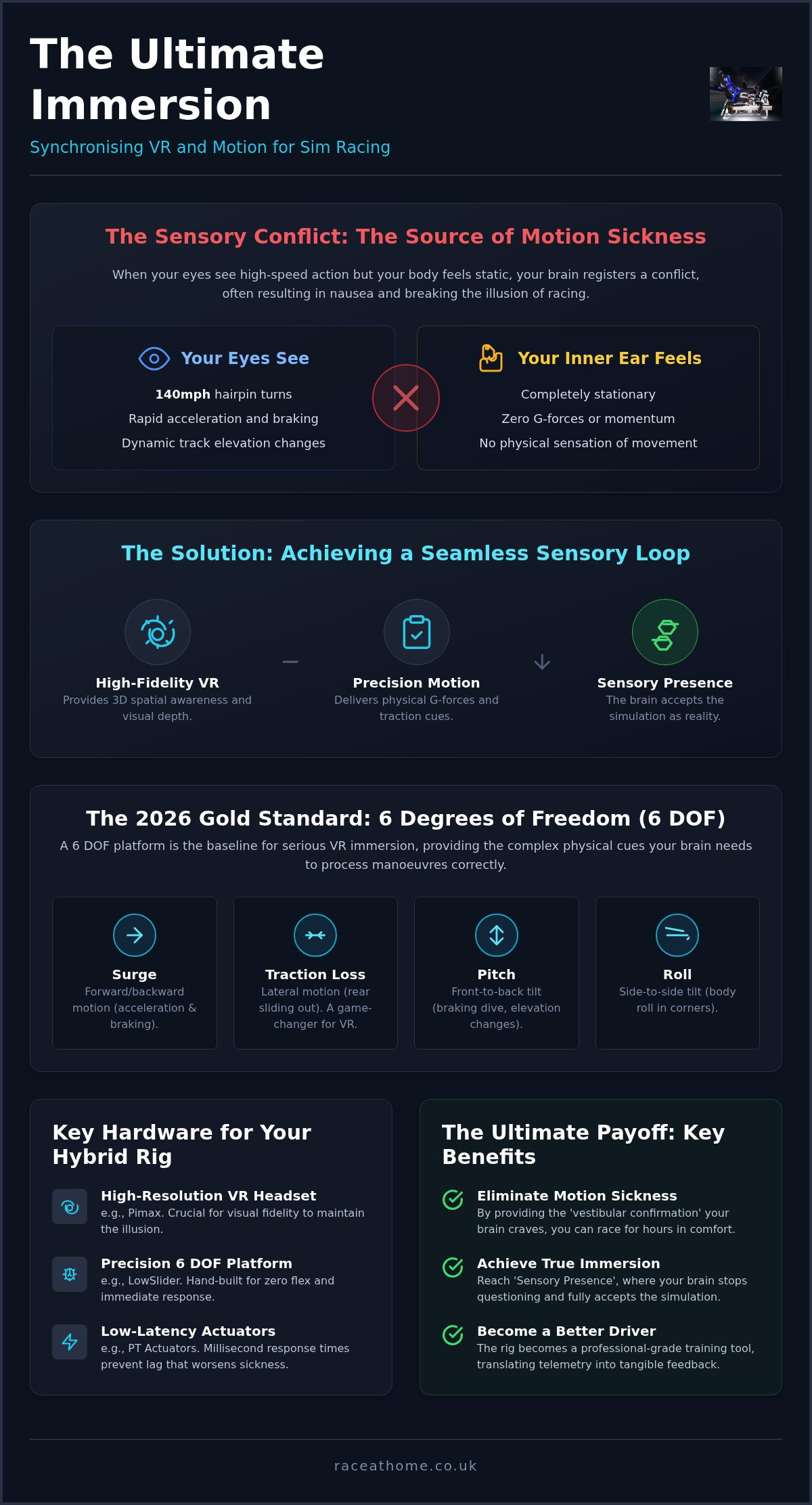
Many newcomers believe that nausea is simply the price of entry for high-fidelity racing. This is a misconception. When you use sim racing VR and motion combined, you aren't just adding "bumps" to your seat; you're providing the "vestibular confirmation" your brain craves. Your inner ear, or vestibular system, is incredibly sensitive to acceleration and orientation. If your eyes see a sharp turn at a high-speed circuit whilst your body remains static, your brain interprets this conflict as a sensory hallucination. This often triggers a defensive nausea response. By adding physical movement that matches the visual data, you resolve this conflict at its source.
The Science of Motion Sickness
The "Sensory Mismatch" occurs when visual data from your Pimax headset disagrees with the physical data from your inner ear. High-end VR vehicle simulations rely on low-latency actuators to bridge this gap. PT Actuators, for example, respond in milliseconds to game telemetry. This speed ensures that as soon as you turn the wheel, you feel the car's weight transfer. If the motion is laggy, the sickness actually gets worse. When it's perfectly timed, the physical sensation of G-forces validates the visual movement, allowing you to race for hours without the typical fatigue associated with VR.
Improving Comfort with 6 DOF
Whilst a 3DoF setup covers the basics of pitch and roll, it often leaves the brain feeling lost during complex manoeuvres. This is how 6 DOF platforms improve sim racing comfort by adding surge and traction loss. Surge provides the physical kick during braking and acceleration, whilst "Twin Traction Loss" is the game-changer for VR users. It mimics the rear of the car stepping out or the front washing wide. Without this lateral feedback, your brain can't process a slide in VR correctly.
If you're setting up a hybrid rig for the first time, follow this acclimatisation checklist to ensure a smooth transition:
- Start with short 10-minute sessions to build your "VR legs" gradually.
- Ensure your motion software is set to high-frequency telemetry output for maximum smoothness.
- Use a fan to keep a cool breeze on your face, which helps the brain stay grounded in the physical space.
- Focus on a fixed point in the distance, like the horizon, if you feel a moment of instability during a heavy crash.
By synchronising these cues, you'll find that sim racing VR and motion combined actually feels more natural and comfortable than a static screen. If you're ready to upgrade your feedback loop, you can view our hand-built motion platforms to find the perfect fit for your setup.
Building the Ultimate Hybrid Rig: Key Hardware Requirements
Achieving a professional-grade experience with sim racing VR and motion combined requires more than just high-end components. It demands a "Holy Trinity" of hardware where the PC, the headset, and the motion platform function as a single, low-latency unit. If one link in this chain fails, the immersion breaks. For instance, a powerful PC is non-negotiable. Running a high-resolution headset whilst simultaneously processing complex motion telemetry requires significant overhead. In 2026, enthusiasts typically look towards flagship GPUs to maintain stable frame rates, as any stutter in VR will immediately clash with the physical movement of the rig.
Beyond raw power, the physical build quality of your cockpit is paramount. Standard consumer rigs often lack the rigidity required for high-torque actuators. Any flex in the frame introduces mechanical "noise" that can confuse VR tracking sensors, leading to visual jitter or lost tracking. Our hand-built UK engineering focuses on an ultra-stiff, compact footprint that eliminates these unwanted vibrations. This ensures that the only movement you feel is the precise data coming from the track, translated through a frame that remains rock-solid under load.
The Headset: Why Pimax Leads the Field
In the world of VR, Field of View (FOV) is the primary driver of realism. Pimax headsets excel here, offering a wide perspective that allows you to use your peripheral vision to judge speed and cornering. High refresh rates of 120Hz or more are also essential to reduce the "screen door" effect and maintain visual fluidness. To get the most out of your hardware, consult our Pimax VR motion simulator setup guide for specific optimisation tips that ensure your visuals stay perfectly aligned with your physical movements.
The Platform: 6 DOF vs 3DoF
Choosing between a LowSlider 3DoF and a 6 DOF platform often comes down to your desired level of feedback and budget. Whilst the 3DoF provides excellent pitch and roll, the 6 DOF platform introduces twin-traction-loss, which is a game-changer for VR users. It allows you to feel the car rotate and slide, providing the physical context needed to catch a spin before it happens. Additionally, the LowSlider’s low-profile design is a practical necessity. It makes climbing into the cockpit whilst wearing a bulky headset much safer and easier, all whilst maintaining a professional, home-friendly footprint.
Configuration Secrets: Achieving Perfect Telemetry Synchronisation
Hardware provides the potential for realism, but software configuration provides the reality. When setting up sim racing VR and motion combined, the goal is to create a latency-free feedback loop where your brain cannot distinguish between digital data and physical force. This requires a methodical approach to calibration. If your settings are slightly off, the resulting "lag" doesn't just break immersion; it actively causes the sensory conflict we aim to avoid. By following a structured synchronisation process, you can transform a collection of high-end parts into a cohesive, professional-grade racing machine.
What is VR Motion Compensation?
The first priority for any hybrid rig is implementing motion compensation. Without it, your "virtual head" moves within the car whenever the rig tilts. If your LowSlider pitches forward under heavy braking, the VR headset perceives this as your head moving closer to the dashboard. This is incorrect; your head should remain static relative to the cockpit. To solve this, you must use software-based compensation, often via OpenXR or specialised plugins, which "cancels out" the rig's movement. Some enthusiasts prefer using an extra tracker mounted to the chassis to provide a fixed reference point, ensuring your view remains perfectly locked within the virtual cabin regardless of how much the platform moves.
Beyond the visual anchor, you must tune your telemetry output frequency. High-resolution headsets like the Pimax series operate at 120Hz or higher, meaning your motion data must be processed with equal speed. Using the latest version of SimHub (version 9.12.4) or proprietary PT Actuator controllers allows you to match these high refresh rates. This ensures that the physical "kick" of a kerb hits your seat at the exact millisecond your eyes see the tyre make contact. Low-latency USB 3.0 hubs and high-quality data cables are essential here to prevent any "bottlenecking" of the telemetry stream.
Fine-Tuning the Software
Once the basic synchronisation is established, you must adjust your "Washout" filters. These filters are the secret to sustained immersion. They allow the rig to return to its neutral centre position after a manoeuvre without you feeling the reset. If the washout is too fast, you'll feel a jarring "return" sensation; if it's too slow, you'll run out of physical actuator travel during long corners. A perfectly tuned washout filter is imperceptible, leaving the rig ready for the next input whilst your brain still "feels" the previous G-force.
Finally, balance your road vibrations against chassis movement. You want to feel the texture of the tarmac and the thud of the gear shifts, but these shouldn't overwhelm the macro movements of the car's weight transfer. Calibrating the "G-force" feel is about precision rather than maximum travel. It's often more effective to have 20mm of perfectly timed, high-fidelity movement than 100mm of slow, vague travel. If you're looking to achieve this level of precision in your own home, explore our 6 DOF LowSlider platforms to see how hand-built UK engineering handles the most demanding telemetry data.
The Race@Home LowSlider: Engineered for VR Immersion
The LowSlider isn't just another cockpit; it's the physical foundation required to make sim racing VR and motion combined a reality in a domestic setting. Whilst many 6 DOF systems require a dedicated garage or industrial space, our engineering philosophy prioritises a compact footprint without sacrificing performance. This rig is hand-built in the UK to ensure zero flex. As we discussed earlier, even the slightest mechanical wobble can ruin VR tracking accuracy. By using precision-milled components and ultra-stiff mounting points for the PT Actuators, we've created a platform that delivers high-fidelity feedback directly to the driver, not into the floor.
It's about more than just strength; it's about aesthetics. We believe a high-end simulator should look as professional as it feels. The LowSlider features a sleek, industrial design that fits naturally into a modern home office or gaming room. It doesn't scream "arcade machine"; it whispers "professional training tool." This rig is designed for those who refuse to compromise on quality or style.
Bespoke Engineering for the Home
The proprietary ultra-low profile design of the LowSlider serves a dual purpose. First, it lowers the centre of gravity, which significantly improves the rig's stability during high-frequency movements. Second, it makes the cockpit incredibly accessible. If you're wearing a Pimax headset, your situational awareness of the physical room is limited. A low-profile rig allows you to step in and out with confidence, reducing the risk of trips or falls. For many enthusiasts, buying a motion simulator in the UK from a local specialist ensures a level of craftsmanship and technical support that mass-produced imports simply can't match. We use premium materials designed to withstand the relentless torque of 6 DOF motion whilst maintaining a refined, premium finish.
Worldwide Accessibility
You don't need to be an engineer to experience this level of immersion. We've designed the LowSlider to be shipped worldwide in four easy-to-assemble pieces. This compact packaging reduces shipping costs and ensures the rig arrives in perfect condition. Once it's in your room, the assembly process is straightforward and typically takes under one hour. There's no need for a complex workshop; the "Four-Piece" design is intuitive and requires only minimal tools.
Whether you're in London or Los Angeles, we provide the entire ecosystem, from the headset to the actuators. It's a complete, plug-and-play solution for the modern racer. If you're ready to stop playing and start driving, it's time to elevate your setup to the professional level. The combination of VR and motion is the final frontier of sim racing, and the LowSlider is your gateway to total immersion.
Mastering the Ultimate Feedback Loop
Achieving total immersion isn't about simply buying the most expensive parts; it's about synchronising the visual and physical worlds into a single, cohesive experience. We've explored how sim racing VR and motion combined creates a "Sensory Presence" that static rigs simply can't match. By utilising 6 DOF to provide essential vestibular confirmation and fine-tuning your software for perfect telemetry alignment, you don't just see the race; you feel every subtle shift in the car's weight and every ripple in the tarmac.
You're now equipped with the knowledge to build a professional-grade hybrid rig in your own home. Our LowSlider platforms are hand-built in the UK and designed for a compact footprint, ensuring they fit your lifestyle as well as they fit your lap times. With worldwide shipping available and a one-hour assembly guarantee, the transition from box to track is faster than you might think. It's time to stop compromising on realism and start experiencing the visceral thrill of true simulation. Explore the LowSlider 6 DOF Motion Platform today and transform your racing forever. The next level of performance is waiting for you.
Frequently Asked Questions
Does a motion platform help with VR motion sickness?
A motion platform is the most effective way to combat VR-induced nausea. By providing physical movement that matches the visual cues from your headset, it eliminates the sensory conflict that causes sickness. This "vestibular confirmation" tells your brain that the turns and accelerations you see are real. When you experience sim racing VR and motion combined, the physical feedback validates the visual data, allowing for much longer sessions without fatigue.
What is VR motion compensation and do I need it?
VR motion compensation is a software layer that prevents your virtual head from moving inside the car when the rig tilts. If the platform pitches forward under braking, the compensation software "subtracts" that movement from your view so the dashboard stays in the correct place. It's essential for anyone using a 6 DOF system. You can implement this through OpenXR or specialised plugins to ensure your virtual perspective remains perfectly stable.
Can I use any VR headset with a Race@Home motion rig?
You can use almost any PC-powered VR headset with a Race@Home rig, including popular models like the Meta Quest 3 or Valve Index. Whilst we are official partners with Pimax and recommend their wide field-of-view headsets for ultimate realism, the LowSlider is designed to be hardware-agnostic. As long as your headset is compatible with your PC and sim software, it'll work seamlessly with our motion telemetry and actuator systems.
How much space do I need for a combined VR and 6 DOF motion setup?
One of the primary benefits of the LowSlider design is its incredibly compact footprint. Unlike industrial-sized simulators, our 6 DOF platform is engineered to fit within a standard home office or spare bedroom. The proprietary ultra-low profile design means the rig doesn't require extra vertical clearance. You typically only need enough floor space to accommodate a standard sim cockpit, as the motion happens within a very efficient physical area.
Is it difficult to set up a motion rig for sim racing at home?
Setting up a Race@Home rig is designed to be a straightforward process for any enthusiast. We ship the LowSlider in four pre-assembled pieces, which allows most customers to be ready for the track in under an hour. The technical side is handled by user-friendly software like SimHub or Sim Racing Studio. These programmes automatically detect your game telemetry and translate it into motion, making the "plug and play" experience a reality.
Which sim racing games support both VR and motion combined?
Most leading sim racing titles fully support sim racing VR and motion combined through standard telemetry output. Popular games include iRacing, Assetto Corsa Competizione, Dirt Rally 2.0, and the F1 series. These titles provide high-frequency data that our PT Actuators use to create precise physical feedback. As long as the game supports VR and outputs UDP or memory-mapped telemetry data, it'll be compatible with your hybrid motion setup and Pimax headset.
Do I need a special PC to run VR and motion together?
You don't need a "special" PC, but you do need a high-performance one. Running high-resolution VR headsets whilst simultaneously processing motion telemetry requires a powerful GPU and CPU. We recommend a modern, enthusiast-grade graphics card to maintain the stable frame rates necessary for comfort. A robust PC ensures that the motion and visuals remain perfectly synchronised, preventing the lag that can break immersion or cause sickness during high-speed manoeuvres.
What is the difference between 3DoF and 6 DOF for VR users?
The primary difference lies in the number of physical forces you feel. A 3DoF system provides pitch, roll, and heave, covering basic hills and cornering leans. A 6 DOF platform adds surge, sway, and yaw, which includes traction loss. For VR users, traction loss is a game-changer. It allows you to feel the rear of the car sliding laterally. This additional data provides the physical context needed for your brain to stay grounded.


