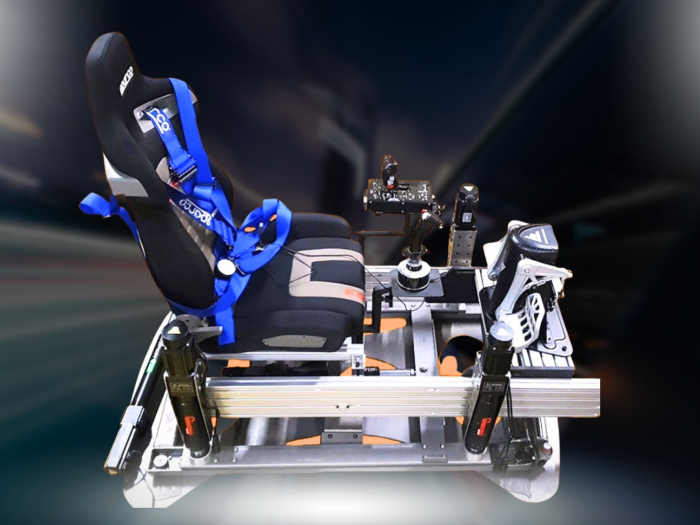

What if the missing tenth of a second on your qualifying lap isn't hidden in your pedal technique, but in your inner ear? You've likely felt that frustrating disconnect whilst pushing through a high-speed chicane, where your eyes see the slide but your body feels nothing but a stationary seat. It's the classic numb sensation that separates a hobbyist setup from a true professional training tool. If you're ready to stop guessing where the limit of grip lies, a sim racing motion upgrade is the definitive next step in your journey.
We understand the hesitation; you want the visceral feedback of a GT3 car without turning your home office into a cluttered industrial workshop. This guide explores how to transform your static rig into a high-fidelity motion simulator. We will break down the essential hardware, the nuances of software integration, and the engineering behind compact, British-built solutions like the LowSlider. You'll discover how to achieve realistic G-force simulation and improved car control through a bespoke, space-efficient approach that fits your current environment.
Key Takeaways
- Learn how a sim racing motion upgrade translates digital telemetry into physical instinct, allowing you to detect traction loss through vestibular feedback rather than just steering vibration.
- Decipher the complexities of Degrees of Freedom (DOF) to select a hardware configuration that matches your specific performance requirements and immersion goals.
- Overcome space and noise concerns with ultra-low profile, British-engineered platforms like the LowSlider, designed to fit seamlessly into a standard home office.
- Understand the vital role of rigid aluminium profile chassis and specialised Sim Manager software in maintaining the fidelity of high-torque motion actuators.
- Discover the advantage of hand-built, bespoke motion systems that prioritise ease of assembly and long-term mechanical reliability over mass-produced alternatives.
The Evolution of Immersion: Why a Sim Racing Motion Upgrade is Essential
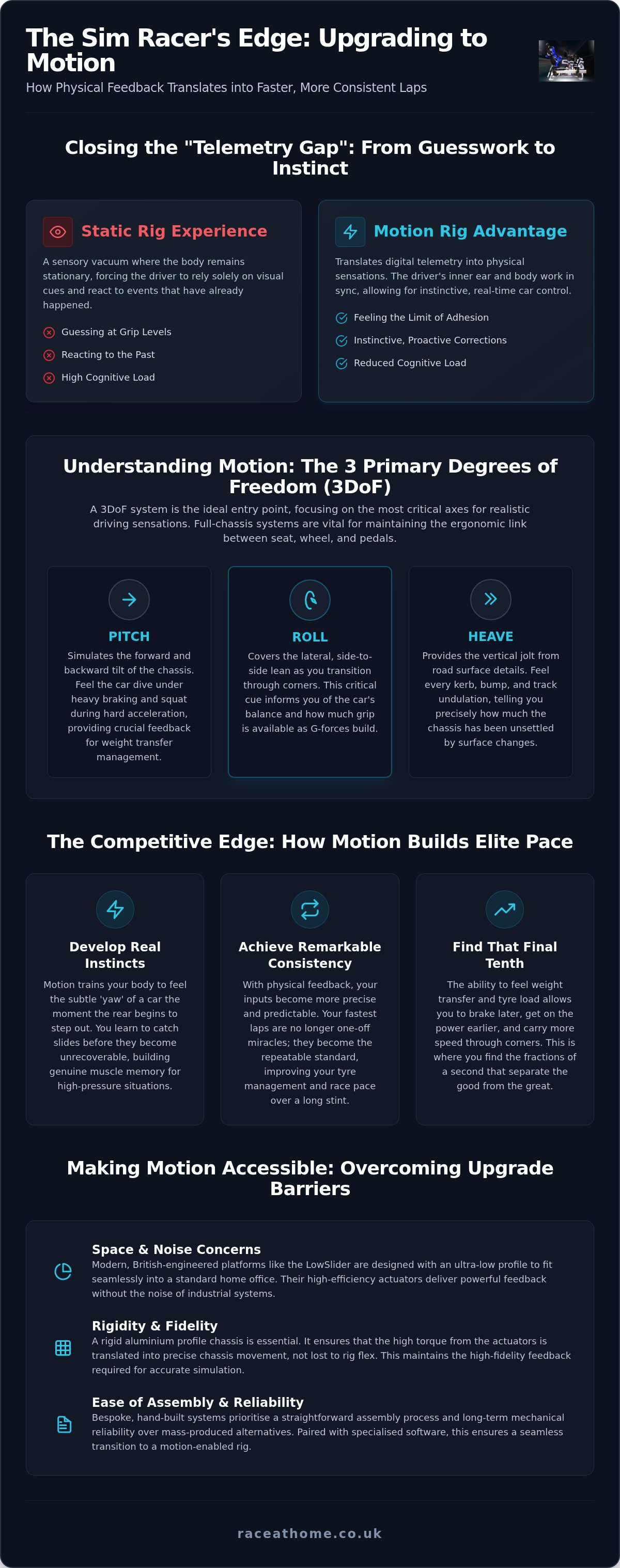
A sim racing motion upgrade represents more than just a mechanical addition to your cockpit; it's a fundamental shift in how your brain interprets digital speed. While a high-end direct drive wheel provides excellent feedback through your hands, it often leaves your body in a sensory vacuum. This creates a "telemetry gap" where you're forced to guess what the rear tyres are doing until the visual cues of a slide appear on your screen. By the time your eyes see the car rotate, the opportunity to make a precise correction has usually passed. You're reacting to the past rather than the present.
Integrating motion closes this gap by translating raw telemetry data into physical sensations. This allows your nervous system to process grip levels through your seat, significantly reducing your cognitive load. Instead of mentally calculating the car's attitude based on visual data alone, you react instinctively. You stop driving with your eyes and start driving with your whole body. It's the definitive final step for any enthusiast aiming to replicate a professional-grade driver training environment at home.
Beyond Force Feedback: The Physicality of Racing
The sensation of speed is built on weight transfer. When you stand on the brakes at the end of a long straight, a motion platform provides the pitch that signals weight shifting to the front axle, informing your trail-braking technique. When you clip a kerb, "heave" provides the vertical jolt that tells you exactly how much the chassis has been unsettled. These physical cues are essential for understanding the car's balance through a complex sequence of corners.
Vestibular feedback serves as the biological bridge that synchronises your inner ear with the digital physics of the simulation, effectively curing the sensory mismatch that plagues static rigs. Without this physical connection, your brain struggles to fully commit to the car's behaviour. With it, the transition from a digital game to a physical experience is complete.
The Competitive Edge: How Motion Improves Lap Times
Precision comes from predictability. A sim racing motion upgrade allows you to feel the subtle "yaw" of a car the moment the rear end begins to step out. Catching these slides early isn't just about spectacular saves; it's about maintaining momentum and preserving tyre life over a long stint. You'll find that your lap times don't just get faster; they become remarkably repeatable.
This consistency is why professional driver coaching relies so heavily on motion platforms. It builds the genuine muscle memory required for high-pressure racing where every millimetre of track matters. By training your body to feel the limit of adhesion, you develop a level of car control that is simply impossible to achieve on a static setup. You aren't just playing a simulation anymore; you're developing real-world racing instincts.
Deciphering Degrees of Freedom: Choosing Your Upgrade Path
In mechanical engineering, Degrees of Freedom (DOF) refers to the specific number of independent directions in which a platform can move. For a sim racing motion upgrade, this is the most critical technical decision you'll make. Whilst entry-level "seat-movers" are often marketed as a budget entry point, they can create a frustrating sensory disconnect. Because your feet and hands remain stationary whilst your body moves, the brain receives conflicting signals. A full-chassis system ensures your entire cockpit moves as one unit, maintaining the ergonomic relationship between your seat, wheel, and pedals. This consistency is vital for developing genuine muscle memory.
The choice between a 3DoF and 6 DOF setup usually comes down to a balance between your available space and your desire for a "full-world" simulation. If you're primarily racing open-wheelers on smooth circuits, the vertical and lateral cues of a 3DoF system might suffice. However, if you're a GT or drift racer who needs to catch slides at the absolute limit of adhesion, the additional axes of a 6 DOF platform become indispensable.
3DoF: The Perfect Entry Point for Motion
A 3DoF system focuses on the three primary axes of movement: Pitch, Roll, and Heave. Pitch simulates the dive under heavy braking and the squat during hard acceleration. Roll covers the lateral lean as you transition through corners. Heave provides the essential vertical impact of kerbs, road surface changes, and track undulations. The LowSlider 3DoF motion platform is an ideal first step for enthusiasts who need a compact, high-fidelity solution that doesn't require a dedicated warehouse to operate. It provides the core physical cues needed to "feel" the car's weight transfer without the complexity of a larger footprint.
6 DOF: The Professional Standard for Realism
Stepping up to a 6 DOF platform introduces Yaw, Sway, and Surge. Yaw is the most transformative addition for competitive racers because it handles traction loss. The LowSlider 6 DOF Twin-Traction-Loss Motion Platform takes this a step further by isolating both the front and rear axles. This "Twin Traction Loss" sensation is the secret to realistic oversteer correction; it tells you exactly when the rear tyres have surrendered grip long before the visual data reaches your eyes. Sway adds lateral G-force cues, while Surge provides longitudinal forces that push you into the seat. It's a no-compromise experience that replicates the intense physicality of a real cockpit. If you're looking to eliminate guesswork and drive with total confidence, exploring our bespoke motion solutions will help you find the right axis count for your specific racing discipline.
Overcoming Upgrade Barriers: Space, Rigidity, and Compatibility
One of the most persistent myths surrounding a sim racing motion upgrade is that it requires a dedicated industrial unit and a degree in structural engineering. Many enthusiasts fear that adding movement means welcoming a noisy, bulky machine into their home. This simply isn't true. Modern engineering has evolved to provide silent, high-fidelity feedback that integrates seamlessly into a domestic environment. The key lies in selecting high-quality actuators, such as those from our partners at PT Actuator, which deliver immense torque without the mechanical racket associated with older systems.
However, the quality of your motion is only as good as the frame it sits on. A sim racing motion upgrade demands a rigid foundation, typically an '80/20' aluminium profile chassis. If your current rig has any hint of flex, the actuators will spend their energy bending the metal instead of moving your body. This results in mushy feedback and a loss of the fine-grained detail that helps you catch a slide. Transitioning to motion is often the point where hobbyists must trade their entry-level tubular frames for a professional-grade, rigid cockpit.
The Static Rig Audit: Is Your Cockpit Ready?
Before you bolt on a motion platform, you must perform a thorough rigidity audit. Flex is the ultimate enemy of motion fidelity. Check your wheel deck and pedal plate; under high-G loads, any movement here will dilute the sensory data coming from the simulation. Ensure your aluminium profile rig is torqued to specification and all peripherals are hard-mounted with zero play. For a deeper dive into preparing your hardware, consult The Ultimate Sim Racing Setup Guide for expert advice on building a professional-grade foundation.
Space-Saving Engineering: The Low-Profile Advantage
The LowSlider philosophy centres on achieving maximum feedback within a minimal physical footprint. By utilising an ultra-low profile design, we keep the centre of gravity as close to the floor as possible. This isn't just about stability; it's about practicality. A compact motion rig can live in a home office or a spare bedroom without dominating the entire room. Whilst mass-market alternatives often look like industrial scaffolding, a hand-built, bespoke British rig provides a refined aesthetic that complements your home environment while outperforming the competition in every metric.
The Technical Transition: Actuators, Software, and Assembly
Executing a successful sim racing motion upgrade requires a seamless digital-to-physical handshake. Your simulator generates high-frequency telemetry data every millisecond, detailing everything from tyre slip angles to suspension travel. To translate this into physical movement, we utilise sophisticated "Sim Manager" software. This interface acts as the central nervous system of your rig, capturing raw data from titles like iRacing, Assetto Corsa Competizione, or DiRT Rally 2.0 and converting it into precise commands for the actuators.
The hardware doing the heavy lifting in this process is the PT Actuator system. These industrial-grade components are chosen for their extreme reliability and near-silent operation. Unlike cheaper, belt-driven alternatives, these direct-drive actuators provide the instantaneous response times needed to catch a snap-oversteer moment. When the software and hardware are perfectly synchronised, the result is a transparent experience where the machinery disappears, leaving only the sensation of the track beneath you.
Telemetry Translation: Tuning Your Motion Feedback
Precision tuning is the difference between a professional training tool and a ride that causes fatigue. Within the software, you can organise specific "motion profiles" for different car classes. A high-downforce formula car requires sharp, short-travel movements to simulate a stiff chassis, whilst a rally car needs longer, more fluid strokes to replicate weight transfer on loose gravel. Balancing these cues is vital; if the motion is too disconnected from the visuals, it can lead to discomfort. For those concerned about the transition, our guide on How to Solve Motion Sickness in Sim Racing provides expert strategies for calibrating your feedback for maximum comfort.
Assembly Logistics: From Box to Podium in 60 Minutes
A common barrier to a sim racing motion upgrade is the perceived complexity of the build. Whilst some manufacturers ship a mountain of loose bolts and unlabelled brackets, we've engineered a more refined approach. Our LowSlider platforms are hand-built in the UK and utilise a proprietary 4-piece assembly model. This design allows us to ship globally whilst ensuring the system remains incredibly simple to put together.
Most of our customers go from unboxing their shipment to their first competitive lap in under an hour. We provide comprehensive support during this initial setup phase, ensuring your software is configured and your actuators are calibrated correctly from day one. You don't need an engineering degree to achieve professional-grade realism. If you're ready to bypass the frustration of complex builds, explore our range of LowSlider platforms today and see how quickly you can transform your racing experience.
The Race@Home Solution: Bespoke Motion Without the Complexity
Choosing a sim racing motion upgrade is a significant investment in your competitive future. Whilst mass-market alternatives focus on high-volume production, Race@Home prioritises the individual driver's experience. Every platform we produce is hand-built in the UK, ensuring a level of mechanical fidelity and structural integrity that off-the-shelf units simply cannot match. This bespoke approach means your rig isn't just a collection of parts; it's a finely tuned engineering solution designed for longevity and pin-sharp sensory feedback.
British engineering is at the heart of our no-compromise attitude toward quality. We believe that the ultimate evolution of your hobby shouldn't require you to sacrifice your living space or your technical sanity. By choosing our hardware, you're partnering with a specialist that understands the delicate nuances of car behaviour and the rigorous requirements of professional-grade training. Whether you're a home enthusiast or a professional racing team, our platforms provide the essential gateway to a truly immersive, elite-level experience.
The LowSlider Philosophy: Performance Meets Practicality
Our design language is defined by the marriage of high-performance output and domestic practicality. The ultra-low profile of the LowSlider range ensures that even a sophisticated 6 DOF system maintains a compact footprint, making it the most space-efficient high-end solution currently available. This efficiency extends to your peripheral choices too. For those seeking total visual immersion, our platforms integrate perfectly with Pimax VR Headsets, where the low-latency motion response helps eliminate the sensory disconnect often found in VR simulations. The standout differentiator remains our Twin-Traction-Loss feature, providing a level of rear-axle communication that mass-produced rigs often overlook.
Investing in Realism: Your Next Steps
The journey from a static setup to full motion is a transformative milestone for any driver. We make this transition as straightforward as possible through our curated build and consultation process. You can easily request a custom quote to customise your bespoke LowSlider build to your specific cockpit dimensions and racing preferences. With reliable worldwide shipping and dedicated, UK-based technical support, you're never left to navigate the setup phase alone.
If you're ready to stop driving in a physical vacuum and start feeling every ripple of the tarmac, it's time to commit to the ultimate hardware evolution. You can find more detail on how to Buy your motion simulator UK to begin your transformation into a professional-grade sim racer today.
Master the Limit with Professional Motion
Transitioning from a static setup to a full-motion simulator is the most significant leap you can make in your digital driving career. By closing the telemetry gap, you replace guesswork with physical instinct, allowing you to catch slides and manage weight transfer with the same precision as a professional driver. Whether you choose a compact 3DoF system or the uncompromising realism of a 6 DOF platform, a sim racing motion upgrade is the definitive way to unlock consistent lap times and total sensory immersion.
At Race@Home, we specialise in bridging the gap between digital data and real-world sensation. Our LowSlider platforms are hand-built in the UK, featuring an ultra-low profile design that fits seamlessly into your home environment. With our unique 1-hour easy assembly process, you can move from unboxing to the podium in record time. It's the reason our bespoke engineering is trusted by professional drivers and elite enthusiasts alike.
Ready to feel every ripple of the track? Upgrade your sim rig with a bespoke LowSlider motion platform and experience the ultimate evolution of the hobby. Your fastest lap is waiting just beyond the next corner.
Frequently Asked Questions
Can I add motion to my existing sim racing rig?
Yes, you can add motion to your current setup provided your chassis is sufficiently rigid. A sim racing motion upgrade requires a foundation that won't flex under the torque of high-performance actuators. Most '80/20' aluminium profile rigs are ideal candidates for our LowSlider platforms. If your rig is made of thinner tubular steel, you might experience lost fidelity as the frame absorbs the movement rather than transferring it to your body.
Does a sim racing motion platform cause motion sickness?
Motion platforms often reduce the symptoms of motion sickness by synchronising your physical sensations with the visual data on screen. Sickness typically occurs when your eyes see movement that your inner ear doesn't feel. By providing vestibular feedback, a 6 DOF rig eliminates this sensory mismatch. Proper calibration of your motion profiles ensures the movements are sharp and realistic, which helps your brain accept the digital environment as a physical reality.
How much space do I need for a 6 DOF motion simulator?
Our LowSlider 6 DOF platform is engineered for high-end performance within a remarkably compact footprint. Whilst traditional simulators require a dedicated room, our ultra-low profile design allows it to fit into most standard home offices or spare bedrooms. You should allow for a small safety perimeter around the rig to account for maximum pitch and roll excursions. This ensures the moving components don't interfere with walls or furniture during intense racing sessions.
Is a motion rig loud enough to disturb my neighbours?
Modern systems utilising PT Actuators are surprisingly quiet and don't disturb others in your home. The actuators themselves operate with a faint hum rather than the mechanical clatter found in older designs. The primary concern is often vibration transferring through the floor. We recommend using high-density rubber isolation mats beneath the platform to dampen these frequencies, making the rig perfectly suitable for use in flats or upstairs rooms without causing a nuisance.
What sim racing software is compatible with motion platforms?
Most major simulation titles are fully compatible with motion platforms through specialised telemetry software. This includes industry standards like iRacing, Assetto Corsa Competizione, and the F1 series. The software extracts raw data from the game engine and translates it into physical movement. Because these titles provide high-frequency telemetry updates, the motion response is instantaneous. You can easily switch between different car profiles to ensure the motion feels authentic to each specific vehicle.
How difficult is it to assemble a Race@Home motion rig?
Every Race@Home rig is designed for a straightforward, 1-hour assembly process that requires no specialised engineering knowledge. We ship our platforms in four pre-assembled pieces, significantly reducing the complexity of the build. You simply need to bolt the main sections together and connect the electronics. We provide comprehensive UK-based support and detailed instructions to guide you through the software configuration, ensuring you spend less time building and more time on the track.
Do I need a special PC to run a motion simulator?
You don't need a dedicated secondary computer, as any modern high-end gaming PC can handle the telemetry processing alongside the simulation. The software used for a sim racing motion upgrade has a very low CPU overhead, meaning it won't impact your frame rates or system stability. As long as your PC meets the requirements for titles like iRacing or VR use, it will comfortably manage the additional data required to drive the actuators.
Is a 3DoF or 6 DOF motion platform better for beginners?
A 3DoF platform is an excellent entry point, but a 6 DOF system provides the most complete training environment for beginners and professionals alike. Whilst 3DoF covers the essential weight transfer, 6 DOF adds critical traction loss cues that help you catch slides earlier. If your budget allows, starting with a 6 DOF platform is a "buy once" solution that prevents the need for further hardware upgrades as your driving skills evolve.


