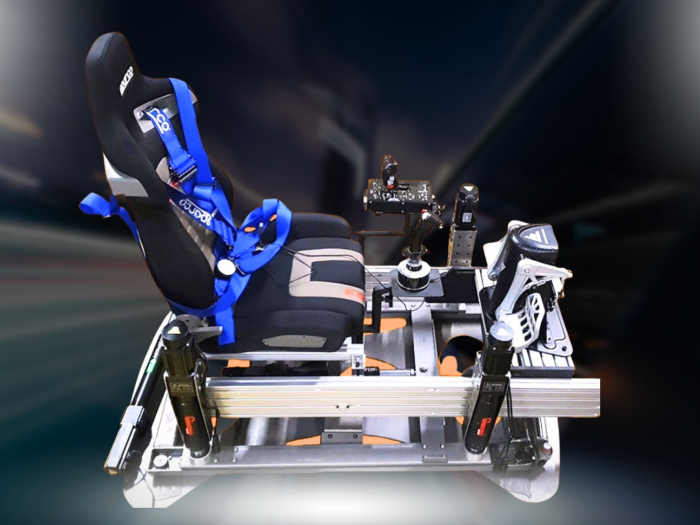

Sim sickness isn't a sign of a weak stomach; it's a fundamental data mismatch that your brain cannot resolve without the right hardware. You've likely spent thousands on a high-end rig and a Pimax headset, only to find yourself sidelined by cold sweats and nausea after just three laps. It's incredibly frustrating to own a world-class setup that you simply cannot use because of persistent sim racing VR sickness. You're not alone in this struggle, and the common advice to just "push through it" often does more harm than good.
This guide will show you how to synchronise your inner ear with the digital world, effectively eliminating discomfort by using advanced 6 DOF motion technology to bridge the sensory gap. By aligning your physical sensations with the telemetry of the car, you can finally achieve the level of immersion you've been chasing. We will explore why traditional methods often fail and provide a clear hardware roadmap, featuring the LowSlider 6 DOF platform, to ensure your next session is defined by the thrill of the chase rather than the flip of your stomach.
Key Takeaways
- Understand the "Sensory Mismatch Theory" and why your brain triggers nausea when your eyes perceive high-speed motion that your inner ear cannot feel.
- Discover why high-fidelity 6 DOF motion platforms are the most effective way to resolve sim racing VR sickness by providing the precise vestibular cues your brain expects.
- Learn why software optimisations like field-of-view adjustments and high refresh rates are essential foundations but often insufficient without physical feedback.
- Identify how ergonomic rig organisation and tactile feedback work in tandem with motion to reduce cognitive load and significantly prolong your racing sessions.
- Explore the engineering behind the LowSlider 6 DOF platform and how its precise PT Actuator technology ensures smooth, non-jerky transitions for total immersion.
Understanding the Science of Sim Sickness and Sensory Conflict
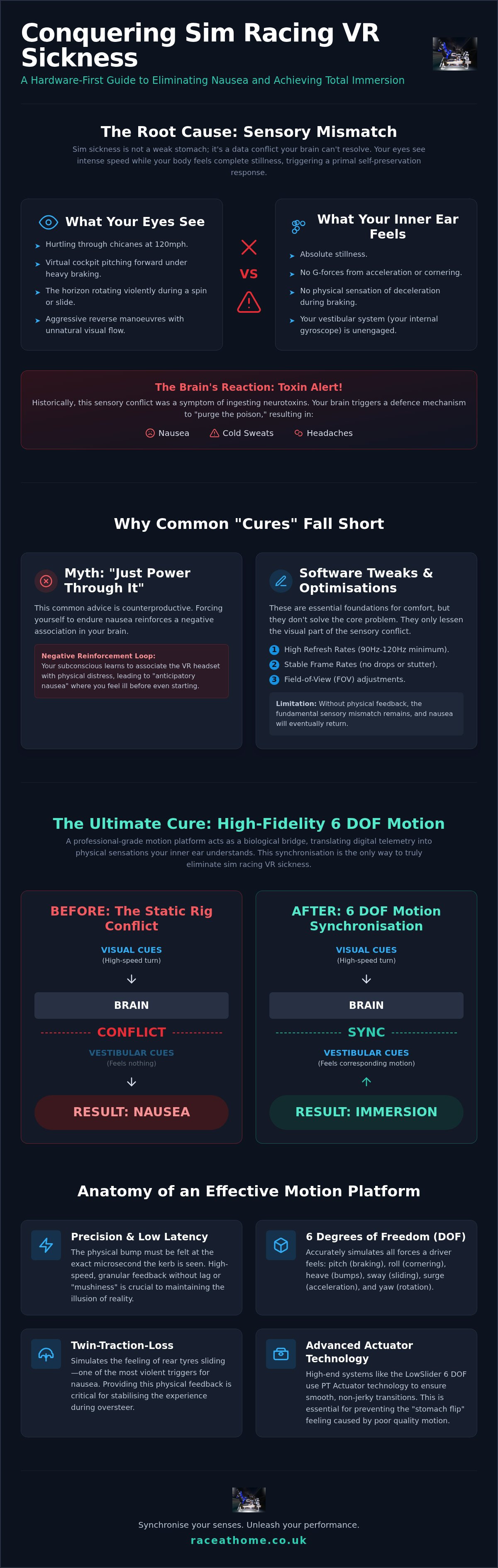
Sensory Mismatch Theory is the primary driver of Virtual reality sickness. It occurs when your eyes tell your brain you're hurtling through a chicane at 120mph, but your body remains static in a chair. This discord creates a profound physiological disruption. In the context of sim racing VR sickness, your brain receives two high-speed data streams that it simply cannot reconcile. The visual system registers intense movement, whilst the rest of your senses report total stillness. This conflict isn't just a minor annoyance; it's a fundamental breakdown in how your brain processes reality.
Certain manoeuvres amplify this effect significantly. Heavy braking causes the virtual cockpit to pitch forward, but without physical deceleration, your internal sensors remain unengaged. Sharp cornering and reversing in VR are particularly aggressive triggers. Reversing often causes an immediate "stomach flip" because the visual flow is completely untethered from any physical sensation of inertia. If you've ever felt a wave of heat or a sudden headache after a spin, you've experienced the brain's frantic attempt to make sense of these impossible physics.
Many racers attempt to "power through" the nausea to build their "VR legs." This is a counterproductive strategy. Forcing yourself to stay in the rig whilst feeling ill reinforces negative brain-avoidance behaviour. Your subconscious begins to associate the headset with physical distress, which can lead to "anticipatory nausea" where you feel sick before you've even turned a lap. Stopping at the first sign of discomfort is the only way to train your brain effectively.
The Vestibular System: Your Internal Gyroscope
The inner ear contains the vestibular system, a biological gyroscope that detects linear acceleration and rotational movement. It's incredibly sensitive to the forces experienced in a cockpit. When you see a high-G turn but feel nothing, your brain interprets the sensory mismatch as a sign of physiological distress. Historically, this type of internal confusion was a symptom of ingesting neurotoxins. Consequently, the brain triggers an emetic response, essentially trying to purge "poison" that doesn't actually exist. This is why sim sickness feels so visceral and hard to ignore.
VR vs. Screen-Based Motion Sickness
On triple-monitor setups, your peripheral vision often catches static objects in your room, which act as "real-world anchors." VR removes these anchors entirely, creating an intense perception of self-motion known as vection. In 2026, maintaining a stable refresh rate of 90Hz or 120Hz is the minimum standard for a comfortable experience. Any drop in performance creates latency between your head movement and the display update, which instantly shatters the illusion of reality and spikes the risk of nausea. High-fidelity VR requires consistent, low-latency delivery to keep the sensory conflict manageable.
Why High-Fidelity Motion Platforms are the Ultimate Cure
Whilst software optimisations provide a necessary foundation, they don't address the core vestibular conflict. A professional-grade motion platform acts as a biological bridge. It translates digital telemetry into physical sensations that your inner ear can understand. This synchronisation is the only way to truly eliminate sim racing VR sickness for good. By providing the missing physical data, a motion rig convinces your brain that the visual movement is real, effectively silencing the internal alarm bells that trigger nausea.
Precision is paramount. Gimmicky, low-frequency systems can actually exacerbate discomfort by introducing lag or "mushy" feedback. You need the sharp, low-latency response of a 6 DOF system to ensure your brain registers the physical bump at the exact microsecond your eyes see the kerb. If the physical movement is even slightly out of sync with the visual frame, the sensory mismatch returns with a vengeance. High-fidelity platforms, such as those utilising PT Actuator technology, provide the high-speed, granular feedback required to maintain the illusion of reality without the "stomach flip" feeling.
Twin-Traction-Loss: Stabilising the Rear End
One of the most violent triggers for nausea is a sudden, unannounced slide of the rear tyres. In a static rig, your eyes see the horizon rotate, but your body feels nothing. This disconnect is a primary cause of sim racing VR sickness. A 6 DOF platform with Twin Traction Loss: The Secret to Realistic Sim Racing allows you to feel the back of the car step out. This lateral feedback grounds your vestibular system, giving your brain the corrective data it needs to process a spin without the accompanying sickness.
Heave, Pitch, and Roll: Completing the Sensory Map
To achieve total immersion, your rig must replicate the full spectrum of a car's behaviour. Vertical movement, or heave, is essential for grounding you over bumps and undulations. Without it, your brain struggles to understand why the world is shaking whilst you remain still. Pitch is equally critical during heavy braking. It provides the forward-leaning sensation that matches the visual dive of the car, preventing that disorienting "face-forward" nausea. Whilst a 3DoF platform is a brilliant starting point, only a 6 DOF system provides the complete biological solution required for long-duration racing. If you are ready to move beyond software tweaks, exploring the capabilities of a LowSlider 6 DOF motion platform is the definitive step toward a nausea-free experience.
Comparing Software Tweaks with Physical Motion Hardware
Software adjustments are often the first port of call for those battling sim racing VR sickness. Field of View (FOV) tweaks and frame rate optimisations are vital components of a stable experience. If your frame rate drops below 90Hz, or ideally 120Hz, the resulting latency makes nausea almost inevitable. However, these are prerequisites rather than total solutions. Even with a perfect 120Hz signal, your body still lacks the physical confirmation of the visual movement. You can spend weeks endlessly troubleshooting software settings, yet the fundamental sensory gap remains unresolved. Hardware is the only definitive answer to this biological puzzle.
Optimising VR for Motion Sickness
High-end hardware like Pimax VR headsets offers a significant advantage through a wide FOV. This reduces the "scuba mask" effect that often triggers claustrophobic discomfort and peripheral vision flashes. To ensure stability, you must align your virtual cockpit precisely with your physical seat. If the virtual steering wheel is even a few centimetres off-centre from your physical hands, the cognitive load increases, making you more susceptible to illness. For a deep dive into these technical configurations, consult The Ultimate Pimax VR Motion Simulator Set-up Guide 2026.
When Software Fails: The Case for Hardware
Many software "fixes" actually compromise the very realism you're seeking. Enabling a 100% horizon lock might stabilise the view, but it creates a disconnected, floating sensation that feels entirely unnatural. Similarly, locking the cockpit to the car's movement can be jarring for the vestibular system. These are compromises that help you survive a race but don't address the core mechanics of sim racing VR sickness. The "fan method", which involves blowing air on your face, is a helpful distraction, but it's a temporary plaster on a deep-seated problem. It fails to address the root cause: the total lack of vestibular feedback.
Investing in a permanent hardware solution like a 6 DOF motion platform shifts the experience from survival to performance. Instead of bracing for the next wave of nausea, you can focus on hitting your apexes and managing your tyres. When the rig physically pitches as you brake, the sensory conflict vanishes. You no longer need to rely on software crutches that ruin immersion. The transition from "surviving" a session to "attacking" the track with total confidence is only possible when your physical and digital realities are perfectly synchronised. This hardware-first approach ensures that your setup is ready for the high-intensity racing of 2026 and beyond.
Practical Steps to Organise Your Rig for Maximum Comfort
Ergonomics are often overlooked in the fight against sim racing VR sickness, yet they are fundamental to your brain's comfort. If your steering wheel is even slightly off-centre or your pedals require a strained reach, you increase your cognitive load. Your brain is already working overtime to process the VR environment; adding physical discomfort creates a "stress stack" that accelerates the onset of nausea. A perfectly aligned rig allows you to relax into the experience, letting the hardware do the heavy lifting of immersion.
Tactile feedback, such as bass shakers, provides high-frequency data that complements a 6 DOF system. Whilst the motion actuators handle the G-forces and weight transfer, shakers deliver the granular "feel" of the engine and road surface. This multi-layered approach ensures every sense is occupied by consistent data. Additionally, maintaining a cool environment is non-negotiable. VR headsets act like small heaters strapped to your face. High temperatures can cause the vestibular system to become hypersensitive, so use high-velocity fans to maintain a steady airflow across your body and face.
Rig Stability and Floor Integrity
A wobbly rig is a primary source of micro-stutters. These tiny, unintended movements conflict with the telemetry-driven motion of your platform, instantly confusing your inner ear. The proprietary, ultra-low profile design of the LowSlider ensures maximum structural integrity, eliminating the flex that plagues taller, less stable systems. For a detailed breakdown of how to construct a rock-solid foundation, see The Ultimate Sim Racing Setup Guide: Building a Professional Motion Rig in 2026. Structural stability is the silent partner of a nausea-free setup.
Developing Your 'Motion Legs' Safely
Acclimatisation is a marathon, not a sprint. Start your journey with slower, heavier cars like GT4s or road vehicles. These provide more predictable, slower-paced motion cues compared to the violent, high-downforce snaps of a formula rig. Limit your initial sessions to 15 minutes, even if you feel fine. Stopping at the first sign of discomfort is the golden rule; it prevents your brain from forming a permanent association between racing and sickness. Stay hydrated and ensure you are well-rested amongst your longer sessions to keep your sensory processing at peak performance.
If you want a rig that remains stable under the most intense racing conditions, consider the LowSlider 6 DOF motion platform as your next major performance upgrade.
The LowSlider 6 DOF: Engineered for Immersion and Stability
The LowSlider 6 DOF represents the pinnacle of engineering for those determined to conquer sim racing VR sickness. Mass-market rigs often suffer from mechanical "noise", such as unwanted vibrations and rattles that confuse your sensory processing. These micro-distractions break the illusion of reality and can lead to immediate nausea. The LowSlider is hand-built in the UK to eliminate these flaws. Every movement is deliberate; every actuator response is driven by pure telemetry data. This level of precision ensures your brain receives only the intended motion cues, allowing you to stay in the cockpit for hours without discomfort.
At the heart of the system is PT Actuator technology. Unlike cheaper alternatives that use jerky, stepped movements, these actuators provide exceptionally smooth transitions. In a high-speed corner, you need a fluid weight transfer that mimics the behaviour of a real chassis. If the motion is notched or delayed, your vestibular system will immediately flag the discrepancy. By providing high-fidelity, low-latency feedback, the LowSlider maintains the delicate synchronisation between your visual and physical senses. It turns the digital world into a tangible, physical reality.
Many enthusiasts believe a full motion rig requires a dedicated warehouse space. The LowSlider challenges this assumption with a compact footprint designed specifically for home environments. You don't need a massive industrial setup to solve your motion sickness. This rig delivers professional-grade 6 DOF performance within a footprint comparable to many static rigs. It's a high-performance tool that fits into your life without compromise.
Bespoke Engineering for the Home Enthusiast
The LowSlider arrives in four easy-to-assemble pieces, allowing you to transition from unboxing to racing in approximately one hour. This design isn't just about convenience; it's about structural integrity. The ultra-low profile centres the mass of the entire rig, providing more accurate vestibular feedback. When the centre of gravity is low, the physical sensations are sharper and more realistic. For those looking to invest in a premier setup, our Buy Motion Simulator UK: The 2026 Professional Guide provides a comprehensive roadmap for selecting high-end hardware.
Future-Proofing Your Racing Career
A 6 DOF platform is the final hardware upgrade you'll ever need. It moves you beyond "coping" with your setup and into the realm of professional-level driver training. When you can feel every kerb, every slide, and every braking zone, your lap times naturally improve alongside your comfort. You are no longer fighting the equipment; you are using it to sharpen your instincts. Precision engineering removes the biological barriers to speed. If you are ready to eliminate the "stomach flip" and unlock your true potential, explore the LowSlider 6 DOF Motion Platform today.
Master the Track with Total Sensory Synchronisation
Eliminating sim racing VR sickness is not about lowering your expectations; it's about elevating your hardware to match your brain's biological demands. By bridging the gap between visual movement and physical sensation, you transform a disorienting experience into a professional-grade training tool. The key lies in precise, low-latency feedback that resolves the sensory conflict at its source. You no longer need to rely on temporary software patches or restrictive field-of-view settings that compromise your immersion.
A bespoke motion rig provides the vestibular cues necessary for long-duration sessions and peak performance. Our LowSlider 6 DOF platform is hand-built to order in the UK, featuring an ultra-low profile proprietary design that ensures maximum stability amongst even the most intense racing conditions. It's fully compatible with Pimax VR headsets and all major sim titles, offering the ultimate evolution for your home setup. When your physical and digital realities align, you're free to focus on the apex and the chequered flag.
Solve your sim sickness with a bespoke LowSlider 6 DOF platform and reclaim your place on the grid with total confidence. The track is waiting for you.
Frequently Asked Questions
Can a motion platform actually stop me from feeling sick in VR?
Yes, a high-fidelity motion platform addresses the root cause of sim racing VR sickness by resolving the sensory mismatch between your eyes and your inner ear. When your rig physically pitches during braking or rolls through a corner, your vestibular system receives the data it expects based on the visual input. This synchronisation convinces your brain that the perceived movement is real, effectively silencing the nausea response.
Is 3DoF enough to cure motion sickness, or do I need 6 DOF?
Whilst a 3DoF platform provides essential cues for pitch, roll, and heave, a 6 DOF system is the definitive solution for total comfort. The addition of lateral movements and traction loss is vital for resolving the conflict during slides and complex cornering. By replicating the full range of a vehicle’s physics, 6 DOF ensures your body feels every dimension of movement that your eyes perceive in the headset.
How long does it take to get used to a motion simulator?
Most drivers acclimatise to a motion simulator within a few days to two weeks of regular use. It is best to start with 15-minute sessions to build your "motion legs" without overtaxing your sensory processing. Statistics suggest that about 30% of first-time VR users experience initial discomfort, but this almost always resolves when you combine consistent, short-duration exposure with the corrective physical feedback of a motion rig.
Does traction loss really help with nausea during cornering?
Traction loss is a critical component because it provides physical confirmation of a rear-end slide. Without this feedback, your eyes see the horizon rotate whilst your body feels static, which is a primary trigger for nausea. Feeling the back of the car step out via a 6 DOF platform allows your brain to process the rotation naturally. This physical data prevents the disorienting "spinning" sensation that often leads to sickness.
Will a motion rig make my sickness worse if it is not set up correctly?
Yes, high latency or "mushy" feedback can exacerbate discomfort. If the physical movement lags even slightly behind the visual frame, the sensory mismatch actually increases. Using high-fidelity PT Actuator technology ensures that transitions are crisp and perfectly timed with the software telemetry. This precision is essential to prevent the rig itself from becoming a source of internal confusion rather than a cure for it.
What are the best VR settings to use with a motion platform in 2026?
Prioritise a stable frame rate of 90Hz or 120Hz over maximum graphical fidelity to minimise sim racing VR sickness. In 2026, native OpenXR support in major titles provides the lowest possible latency for motion users. You should also ensure your virtual cockpit is perfectly aligned with your physical seat. This reduces the cognitive load on your brain and prevents the jarring "floating" sensation that often triggers a nausea response.
Do I need a specific type of seat for a motion rig to prevent sickness?
A rigid, side-bolstered bucket seat is highly recommended to ensure your body moves in perfect unison with the actuators. If you use a seat with too much flex, your body will lag behind the rig's movements, creating secondary vibrations. This lack of structural integrity can lead to micro-stutters in your vestibular feedback. A solid connection to the platform ensures the motion cues are delivered with the intended precision.
Is it better to use a fan whilst racing on a motion platform?
Using a high-velocity fan is highly effective for maintaining a cool core temperature and providing a constant directional reference for your senses. Airflow helps prevent the overheating often associated with high-resolution VR headsets. It also serves as a subtle "real-world" anchor that can help ground your vestibular system. This simple addition works in tandem with your 6 DOF platform to maintain comfort during intense, long-duration racing sessions.


